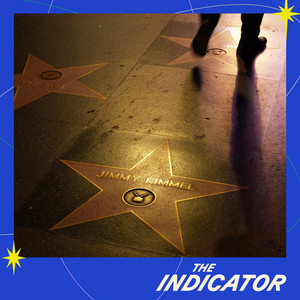
With the suspension and then return of late-night TV host Jimmy Kimmel.
Free speech has been a big national conversation over the last couple of weeks.
This all began with the tragic shooting of conservative influencer Charlie Kirk and comments Kimmel made in the wake of that on his late-night show.
We had some new lows over the weekend with the MAGA gang desperately trying to characterize this kid who murdered Charlie Kirk as anything other than one of them.
But when it comes to free speech, there's another conversation which deserves more airtime.
That may explain how we got here.
It's the Telecommunications Act of 1996.
This is The Indicator from Planet Money.
I'm Darian Woods.
And I'm Adrian Marr.
Today on the show the economics of television censorship, how the Telecommunications Act set the stage for government meddling and corporate capitulation.
This message comes from NPR sponsor, Capella University.
With Capella's FlexPath learning format, you can set your own deadlines and learn on your schedule.
A different future is closer than you think with Capella University.
Learn more at capella.edu.
This message comes from Whole Foods Market.
Fall sports are back.
Feed your team made-in-house marinated chicken wings and Teton Waters ranch hot dogs and sausages, or grab an oven-ready 16-inch pizza.
Host game day with help from Whole Foods Market.
See CapitalOne.com slash bank for details.
Capital One N.A., member FDIC.
We should start with a little explainer on how TV works in America.
So you have the networks, which create shows like Jimmy Kimmel Live.
And most of these networks are not actually TV stations.
They just produce shows that TV stations around the country buy.
And there are two huge companies that own a lot of TV stations and buy that content.
One of them is called Sinclair Broadcast Group, and the other is Nexstar.
Together, they cover most of America.
And the Trump administration has been piling on the pressure to these companies.
It's no secret that Trump hates these late-night comedians.
And that they are not fans of his either.
You can't turn him off.
He won't power down.
He's like Ultron.
He just keeps going.
Every day, it's something crazier than the next.
I don't care for him.
Doesn't seem to have, like, the skill set.
Doesn't have the skill set to be president.
You know, just not a good fit.
That's all.
It's also no secret that these companies involved in Jimmy Kimmel each have deals pending that need government approval.
Nextar is in the middle of a huge deal trying to absorb another media company, Tegna.
That would bring it to covering a massive 80% of American households.
That's something that would require approval from the FCC and other regulators.
So yes, because the government has leverage over these deals.
That definitely encourages these entertainment companies to want to play ball with the White House.
But let's look at the roots of the issue here.
Let's figure out how these corporations got so big that they could sway the fate of a big TV show like Jimmy Kimmel Live, and why the Trump administration has so much power over their broadcast decisions.
For that, we spoke to Rohit Chopra.
I'm a former commissioner on the Federal Trade Commission and I was also head of the Consumer Financial Protection Bureau.
Up to fairly recently, right?
Until I was fired, that's right.
Rohit was fired by President Trump, along with a lot of other Democratic appointees.
Rohit was skeptical of monopolies when he was in office.
And he doesn't mince words when he talks about the Jimmy Kimmel saga being a symptom of how corporations like Nexstar and Sinclair have grown larger and larger.
Decades ago, most people were getting information from newspapers about and then local TV.
And we've seen since that time, where we had diversity in information sources, now just a handful of conglomerates, many times run by rich oligarchs in our society.
They now control so much of the flow of information online and through the airwaves.
To Rohit.
When a big conglomerate stops broadcasting a show for political reasons, that's not just a difference of opinion within a vibrant marketplace of ideas.
To him, that's censorship.
It becomes easier to censor people when a few corporations hold the reins for how the media is going to report news.
Rohit, at least partially, blames the Telecommunications Act of 1996.
The Telecommunications Act of 1996 was one of many policy changes since the Reagan era to loosen up ownership restrictions when it came to the flow of information in our society.
The Telecom Act is a sprawling piece of legislation signed under President Clinton and House Speaker Newt Gingrich.
It covers everything from phone lines to the internet to cable TV.
But key to this story.
Prior to the Telecom Act, companies couldn't have TV audiences that covered more than 25 of the population.
And the rationale was to ensure that TV showed a range of views, that it was responsive to local needs and was competitive.
This new law eased the corporate straitjacket.
It allowed TV companies to grow bigger and paved the way for the current limit, which is 39 of America.
And so at that time, we saw huge amounts of consolidation.
So it was, I guess, an attempt to reflect a different information environment, but many people look at it in retrospect as really just a big corporate giveaway.
Rohit wants to do away with the Telecommunications Act entirely and build a new law in its place, one that is not so friendly to broadcast companies growing larger and larger.
It is not just the Telecom Act.
That's Olivier Sylvain.
He's a law professor at Fordham University.
And Olivier emphasizes a point that Rohit also shares, which is that not all the blame can be pinned on the law.
It just happens that the FCC for the past few decades has been in a specially deregulatory mood and has been reading the Telecom Act as entitling companies to buy up properties across the country.
That said, Olivier has some sympathy for the idea that concentration of broadcast companies has been a problem.
Given that broadcasters do have an outsized impact on certain kinds of content, say sports programming or late night television or news, I think there's absolutely something to it.
On the other hand, you know, Joe Rogan is a kingmaker and runs a podcast and he doesn't have a broadcast license, right.
In other words, maybe media concentration isn't as concentrated as it looks.
And we raised this with Rohit.
Is the media landscape really as consolidated as you say it is if you take a broader definition of how information flows?
Not just TV, but podcasts and streamers and newsletters.
Well, I really reflect back to some of the origins of our internet.
No one really owned the World Wide Web.
Everyone was able to publish using a common set of protocols.
But increasingly, our information ecosystem is now dominated by all of these gatekeepers, whether it be YouTube or Facebook or Spotify, or like Disney and Paramount, who are succumbing to some of these government controls.
The bigger the company, the more money at stake.
And so that means the information we all receive could be more vulnerable to the whims of whoever's in government.
The government has the rubber stamp.
What the Jimmy Kimmel story seems to teach us is that concentrated markets have the potential to choke freedom of speech.
This episode was produced by Cooper Katz McKim with engineering by Sina Lafredo.
It was fact-checked by Sierra Juarez.
Cake and Cannon edits the show and the indicators are production of NPR.
This message comes from BetterHelp.
It's only human to ask others for advice, like turning to your barista, hairdresser or a taxi driver for life advice.
But when you're looking for help about relationships anxiety, depression or other clinical issues, they may not have all the right answers.
Instead, get guidance from a licensed therapist online with BetterHelp.
Visit BetterHelp.com for 10% off your first month.