Ted Audio Collective You're listening to Ted Talks Daily, where we bring you new ideas to spark your curiosity every day.
I'm your host, Elise Hulme.
The world is made of data, as I'm sure you're reminded every time you're on a smartphone.
But information designer Georgia Looby makes a case for choosing more intentionally what kind of data to pay attention to.
And as she shares in her 2024 talk, her attention to data actually helped solve a medical mystery in her own life.
After short break. And now our Ted Talk of the Day.
I know this sounds weird, but the thing that I'm the most passionate about in the entire world is data.
Really fun, right? Well, I believe so.
In my practice as a designer, I use data to tell stories.
Stories that are anchored in numbers, but actually that are mostly defined by small and qualitative data, which are the ones that can add all of the context in human nuances.
But what does that mean?
Well, for example, when Google wanted to help people understand the threat of plastic pollution, we designed a microsite where you can drop objects that you use every day, such as a photo that pollutes the sky and the ocean, making this invisible layer tangible and visceral.
Or when the clothing company and other stories wanted to communicate about inspiring women, I designed a fashion collection where I showed the achievement of three amazing women scientists into data patterns that are woven and embroidered into the textiles.
From a personal level, data is the lens that I use to make sense of the world.
I leave and breathe data.
And I loved data so much that one time, I used it as a writing language to get to know a new friend across the Atlantic.
For one entire year, we've been writing to each other every week, but we didn't use a word of English.
We spoke data, sharing the most intimate details of our days and our personalities, such as all of the time that we complained and what it was about and was it even necessary?
Or the thank yous that we said and what they were for, and even the time that we argued with our partners.
And right now, the full set of 52 and 52 postcards happily lives in the permanent collection of the Museum of Modern Art, which is quite nice.
Thank you. But this mission took on a new meaning when I became sick with a chronic illness.
I have been living with long COVID for the past four years.
Long COVID, if you're not familiar, is an umbrella term that I use to describe the various health consequences that some of us have after an acute COVID infection or a COVID reinfection.
And an infection -associated illness like long COVID can be mild and pass just in a few months, but it can actually be extremely disabling and leave you unable to attend to the basic tasks of your life for years, or possibly indefinitely.
Since my first COVID infection in 2020, and especially so after my reinfection in 2022, I started to develop constant debilitating symptoms.
At my worst, I was completely housebound and at times fully bedbound, and for a while, I even had to stop working, which has been the hardest for me.
As I started to develop these constant, undiagnosed symptoms, I, of course, turned to data, tracking these symptoms every day, such as extreme fatigue, dizziness, heart palpitation, tinnitus, head pressure, nerve pain and more.
Tracking them together with the treatments that I was trying.
And then biometrics for my smartwatch, what I was eating and what I was doing for the day, such as walking or commuting, and even my level of stress.
And I did that to hopefully understand possible correlations and help me and my doctors crack this mystery, but also to keep me sane in moments of deep suffering and uncertainty.
At a certain point in my journey, I decided that I needed to share the data that I collected with people.
In fact, when you read about long COVID, you usually read a list of symptoms that might make a healthy person think, well, I'm tired too after work, or well, I have headaches as well, or yeah, after my last COVID infection, I coughed for a couple of weeks.
But I had never seen a thorough account of what it means to live with a debilitating condition like this one on a daily basis.
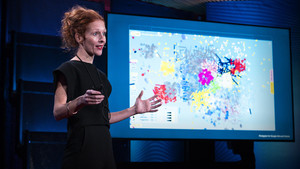
I had the opportunity to share my story with the New York Times in form of a visual op -ed when I used the language of painted data visualization to share my journey day after day.
The piece starts with warm color brush strokes that surround the title, 1374 days, my life with long COVID.
As you start reading my essay in words, you see that the brush strokes interact with the text, understanding without a legend that every different color's brush stroke represent a different symptoms, and seeing that the symptoms aggregate by days.
And as you keep reading a stack of different blood work and health tests, just a sample of the many I've had pile up on screen, and then a body figure appears and gets overwhelmed with all the different types of symptoms that I've experienced over the past four years.
Here is where my spreadsheet, my data diary of sorts shows up.
And as you keep reading, you encounter additional symbols for the hundreds of doctors' appointments, the dozens of medications I've tried, my hospitalizations, and ultimately, the tens of thousands of dollars that I spent for my care.
And finally, you piece it all together when you encounter a visual calendar of my year.
The calendar gets filled with all the brush strokes and the additional symptoms.
And then you'll see an additional handwritten annotation that can help you understand what was happening, my vaccinations and my reinfections, ultimately seeing that the calendar of our lives changed drastically and dramatically after we got COVID.
And now back to the episode.
Now, this is a detailed story of my journey, but I always wanted to include other people's experiences.
And so I asked members of the long COVID community that I connected with online to respond to one prompt.
I hope that I will be able to blank again.
And at the end of the piece, you read hundreds of heart -wrenching hopes from people that hopefully will be able to walk their dogs again, to play with their children, to get back to work, and simply to live a life that is free and independent, ultimately concluding with a collective hope that we can all
start living with a blank canvas full of possibility once again.
The response to the piece has been incredible.
I received thousands of messages from people sick with different chronic illnesses and caregivers that in different ways told me that they finally feel seen, that they now have a visible, striking and emotional evidence to send to their loved ones to make them understand what they're really going through.
Data, if we look at them and represent them for what they are, which are human and nuanced representations of our lives, data can move us profoundly.
Data can shape human narratives that can open conversations, convey empathy, and even connect people.
As for me, you might be asking, 10 months after the publication of the essay, I am doing much better.
I am not cured. I still have limitations, a few setbacks, and I still take a fair amount of daily medication and prescribed supplements, but I am starting to paint a different picture for myself.
Now, this is my own story.
I am no medical expert and I don't aim to speak for the long COVID community at large, but here's what I have done.
Earlier this year, I decided to shift focus completely.
I started a new data collection, one that is only about progress, where the categories in my spreadsheets are only what I have been able to do, such as walking to the subway or trying a few minutes of physical activity without any consequence of what I've been grateful for for the day, such as a dinner
out with my partner, and the few moments that I felt really good in my body.
I have retired my smart torch, which truthfully was giving me more bad than good news every day, and I have stopped logging and therefore paying constant attention and giving meaning to my symptoms.
In the beginning, it felt scary.
I felt almost naked, a drop in this build habit of monitoring my body so closely, something that gave me a semblance of control, and also something that made me who I have been for the past four years.
But I realized something, that changing how I look at things also changes how things look, dropping the need to observe my symptoms and shifted my focus has reshaped the way that I see my journey.
Now, I want to make clear that the last thing that I want is for people to think that these illnesses are all in our heads, or that positive thinking alone can fix them.
That is simply not true.
This new approach is part of a program based on solid neuroscience called brain retraining.
Every day, like thousands of other people, I've been putting in hours to retrain my brain to react differently to symptoms and trigger.
And this approach followed the principle of neuroplasticity, which is our brain's amazing ability to rewire itself, something that can help reduce symptoms and improve the life of people with chronic illnesses.
This new approach, and this new data collection, have been giving me hope, something that I have missed for a long, long time.
Almost a year ago, at the end of my essay, I also shared my hope at the time.
It reads, I hope that I will be able to take walks again, to snowboard, to sit at a restaurant and eat with my friends, to travel to my home country, to be pain free, and simply enjoy a day in the sun without symptoms or fear.
I hope that one day I will get back to the person that I used to be.
And I am happy to report that I am on track for most of that.
The snowboarding part is still a bit out there, but I will be taking a plane to go to Italy, my home country, for the first time in years, in two days after this talk, which I'm really excited about.
Thank you. Thanks. I believe there is a bigger message here.
The world is made of data, but not the data that we produce with our smartphones or credit cards.
It's made of the data that we decide to give our attention to at any given time, because what you choose to see shapes who you will become, and ultimately your entire world.
I believe in my recovery now.
It might be far away in time, it might have bumps in the road, but firmly believing that it can happen and choosing to look at it over and over despite the obstacles is the first step in that direction.
I know that for sure now.
Thank you. That was Georgia Lupe speaking at TED at BCG in 2024.
If you're curious about TED's curation, find out more at TED .com slash curation guidelines.
And that's it for today.
TED Talks Daily is part of the TED Audio Collective.
This episode was produced and edited by our team, Martha Estefanos, Oliver Friedman, Brian Green, Autumn Thompson and Alejandra Salazar.
It was mixed by Christopher Faizi -Bogan.
Additional support from Emma Tobner and Daniella Valareso.
I'm Elise Hugh. I'll be back tomorrow with a fresh idea for your feed.
Thanks for listening.
Thank you.