NPR. This is the indicator from Planet Money.
I'm Weilin Wang. As some of you might know, I'm based in Chicago.
It is a city where the weather can be all over the place.
It briefly snowed this week, even though it's April.
Weather outside is less than delightful, but not horrible.
There's no bad weather, there's only bad clothing.
Am I right? Not that right.
That's our motto. Chicago Fed.
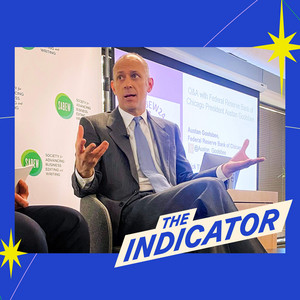
Austin Goolsbee is the president of the Federal Reserve Bank of Chicago.
And as you just heard, the bank's motto is, there's no bad weather, only bad clothing.
That means the Fed does its job, no matter what's happening in the economy.
Well, the economic weather conditions are pretty unpredictable right now.
We've been escalating trade war in huge swings in global stock markets.
So today on the show, Austan Goolsbee of the Chicago Fed tells us about some potential storm clouds on the economic horizon.
You'll meet the stagflationary impulse and something called the freakout channel.
And Austan also tells us why he's not freaking out.
Support for NPR and the following message come from Betterment, the automated investing and savings app, CEO Sara Levy shares how Betterment utilizes tech tools powered by human advice.
Betterment is here to help customers build wealth their way and we provide powerful technology and complete human support where technology can deliver ease of use and affordability and the people behind that technology can provide advice and guidance.
Learn more at Betterment .com.
Investing involves risk, performance not guaranteed.
NPR informs and connects communities around the country, providing reliable information in times of crisis.
Federal funding helps us fulfill our mission to create a more informed public and ensures that public radio remains available to everyone.
Learn more about safeguarding the future of public media.
Visit protectmypublicmedia .org.
The last time I saw Austan Goolsbee was in December.
Tariffs were already very much in the conversation, and Austan said then that tariffs don't necessarily have a long lasting impact on inflation, unless there's a retaliatory trade war or some kind of drawn out supply chain disruption.
Those seem like pretty big open questions right now as we watch the news, like how are you assessing kind of each of those risks?
Yeah, I have some qualms, you're remembering everything I said, but I don't think that was wrong.
I took good notes. I don't think that was wrong.
You know, months ago, to highlight, in pure theory, a one -time tariff is a one -time increase in cost. And the only problem with that analysis is that's for the perfect theoretical tariff, that there's no retaliation and there are no supply chain disruptions that spill over from one industry to the next.
And the problem is we went through a period in 2020 with massive supply disruptions.
Everybody lived through that.
Transitory became trans -a -tor -y part because if you can't get a computer chip you can't make a car.
If they can't make a car then the used car price goes up.
If the used car price goes up and there are no new cars, then the rental car company's prices go up.
And that kind of chain lasts a lot longer than the theoretical pure tariff.
The Chicago Fed oversees an especially manufacturing intensive region.
This means Austin talks a lot with people who work in the auto industry and other businesses affected by tariffs.
He says they're worried about this spillover tariff scenario.
And they're struggling with an uncertainty induced paralysis.
As one auto executive expressed it, you'd be crazy to do anything, to invest in any way for the next six months until you figure out what are the rules going to be.
This uncertainty is making his job even harder.
This is not that easy of a time to be a central banker because at the end of the day, the law gives the Fed two jobs when setting monetary policy.
Stabilize the prices, maximize employment.
When you get a stagflationary shock, which is to say something that both reduces employment and increases the prices simultaneously, that's a kind of uncertainty that's not that pleasant.
I just want to say for the record you said stagflation before I did, so is this something that is a topic du jour these days?
Look, I call it a stagflationary impulse because if you back to the future style brought somebody from the 1970s when we had stagflation, the inflation rate was almost double digits and the unemployment rate was 7, 8, 9%.
So if they came in a time machine forward and you said we're worried about stagflation, unemployment is a little over 4 % and inflation is in the twos, they would be like, we would love to live in that kind of stagflationary environment.
So let's be careful not to talk ourselves into a worse situation than need be, but it's directionally a stagflationary direction, which is to say, big tariffs drive up prices and drive down economic growth.
We talked about the transitory versus transitory debate over inflation with COVID, what are your takeaways from that period as you think about the stagflationary impulse and kind of the new pressures you're seeing now?
My fear has been and what I hear when I'm out talking to people, is this anxiety that if the tariffs do come in place and are this big, that it's gonna take us back to these two periods that were really unpleasant so period one was 2020 when we learned that massive supply disruptions can last well longer than than the textbook seems to suggest they should and that they spill over from industry to industry to industry and then the second lesson is the 2021 -2022 when inflation gets going, people are angry, dissatisfied with the economy.
Even if you tell them, ah, but the unemployment rate is low, growth is high, they're like, look out the window at what the prices are.
I'm not coming up with some theoretical.
This is just what is on the minds of people when I'm out talking to them.
They don't want to go back to these Twin Towers of Awful that we just went through.
Do you also worry about inflation expectations if we're, everyone's still recovering from the trauma of this period you just described, plus now you see on the news about tariffs?
And I will say for myself, we're about to embark on a kitchen remodel, which feels completely cursed.
And I was going to ask you, like, should I buy my appliances now?
And second of all, does this make you worry about inflation expectations?
People ask me, well, what keeps you up at night?
One of them is, if the anxiety over the terror starts changing people's behavior, then it can go through a channel.
I call that the freakout channel.
Oh no, the freakout channel!
We've now covered the stackflationary impulse.
We've talked about the twin towers of terror, now we're at the freakout level?
Here's the thing about the freakout channel.
It can be rooted in completely rational behavior.
That front -running, and we're gonna build up a stockpile of parts and components, as soon as you see a lot of behavior like that, it will start showing up in the aggregate data.
Now you should be a little nervous because uncertainty tends to suppress businesses investing, tends to make people not want to spend money.
If you start seeing people change their behavior based on these uncertainties, that makes the economy more complicated and it should make you a little...
put you on edge. I am on edge.
Okay just remember we start from a position of strength.
The unemployment rate is very low historically.
We worked very hard to get inflation from totally unacceptable to high -level down to something close to the target of 2 % and the hard data remains pretty decent.
If you started to see the market -based measures of inflation expectations in the long run going up, that would be a very disturbing sign.
I think the Fed would have to act.
So far we haven't seen that.
We have seen short -run expectations go up quite a lot.
I think because of tariffs, but long run, they aren't.
Oh, and as for my kitchen remodel, Austin wouldn't tell me whether I should buy my appliances now or wait, but he did say, if you do buy a fridge, make sure it fits in the new space, which honestly, great advice, trade war or no trade war.
This episode was produced by Cooper Katz -McKim.
It was engineered by Harrison Paul and fact checked by Sierra Juarez.
Kate Kincannen is our show's editor, and the indicator is production of NPR.
99 percent of the U .S. population lives within listening range of at least one public media station.
And everyone can listen to NPR podcasts free of charge.
That means you get completely unpay walled access to stories, prize winning reporting and shows that represent the voices in every corner of the country.
Here the bigger picture every day on NPR.
Wait, wait, don't tell me.
Fresh air. Up first. NPR News Now, Planet Money, Ted Radio Hour, ThruLine, the NPR Politics podcast, Code Switch, Embedded, Books We Love, and Wild Card are just some of the podcasts you can enjoy sponsor -free with NPR+.
Get all sorts of perks across more than 20 podcasts with the bundle option.
Learn more at plus .npr .org.
When Malcolm Gladwell presented NPR's ThruLine podcast with a Peabody Award, he praised it for its historical and moral clarity.
On ThruLine, we take you back in time to the origins of what's in the news...
...like presidential power, aging, and evangelicalism.
Time travel with us every week on the ThruLine podcast from NPR.