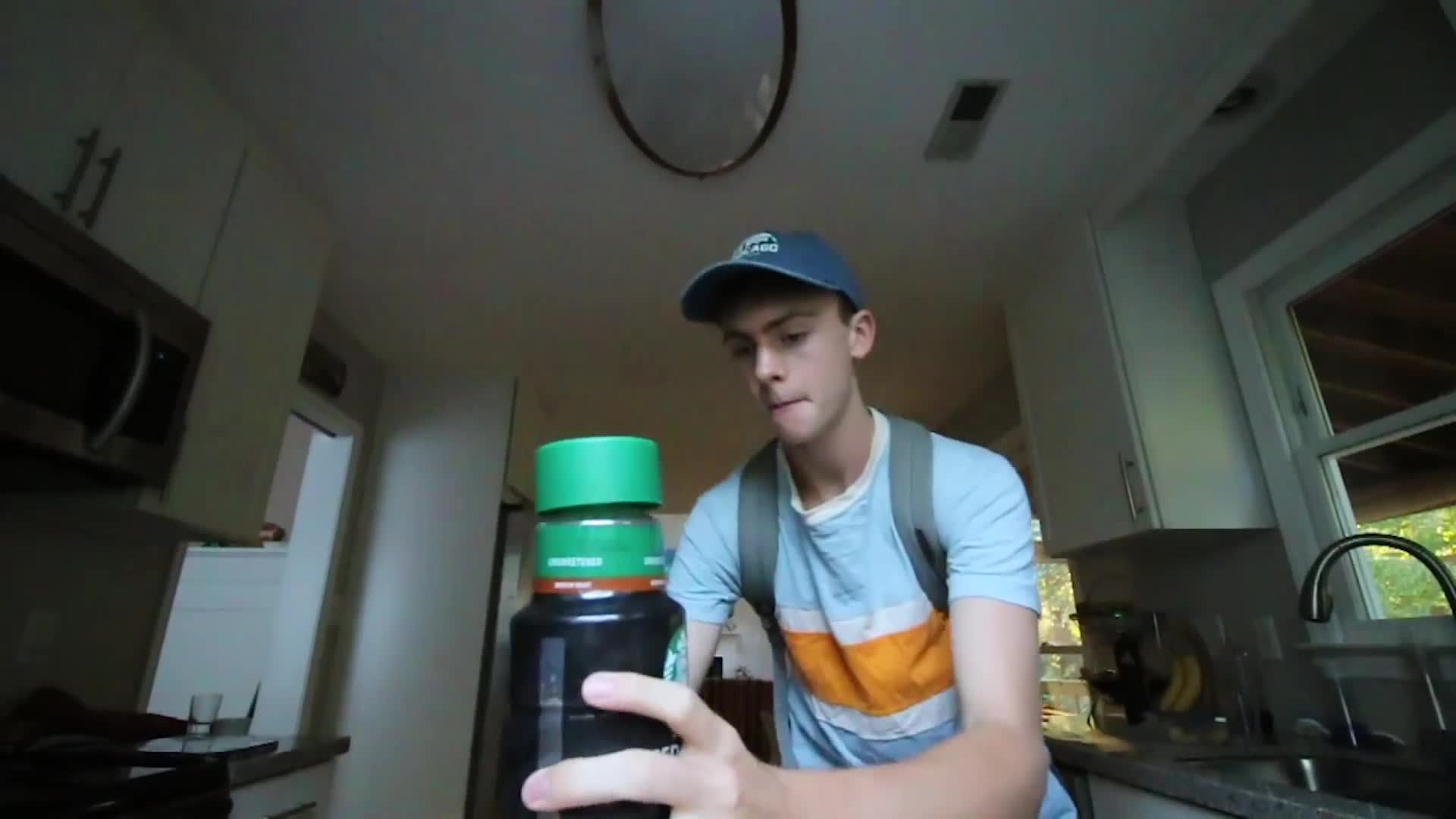
All right.
So welcome to like another couple thousand of you guys.
Um, it just continues to get crazier and crazier and more insane.
Um, just so fortunate for all this so cool.
As you probably saw by the title of this video, you're probably curious curious, curious.
So what if I like to move back to America after living in France for seven months?
Some of you have probably lived in other countries before and you know the whole subject of reverse culture shock.
And to start all this off, I guess one of the largest misconceptions about moving to another country is that it's all fun, it's all travel, it's all experiences, new food and just this magical kind of paradise which sometimes it feels like.
But that doesn't mean that there aren't other parts.
For those of you who haven't seen my other videos, I was living in France for seven months because my mom's job.
She's a French professor, she was on sabbatical, so our whole family moved to the south of France.
I lived there, I went to public school there and basically had to start a new life in another country.
Anyway, about a month ago, we came back home to the United States.
And when I came back home, it was kind of a shock, to be honest.
It was weird hearing English all the time.
Just, like, going out in public, and I'm hearing English.
It's not French.
It sounds super weird, but it was really surprising to my brain, I guess.
My brain was kind of freaking out.
It was like, what is this English that I'm hearing all the time?
It took time to... Oh my god, there are so many ants.
Do you see that?
My hand is on, like, an ant nest.
One time when I was a kid, I ate an ant.
Anyway um, When it came closer and closer to coming back home to America, a lot of people would ask me are you excited to come back home?
Are you nervous?
Are you scared?
And I guess... I wasn't really any of those.
I was just full of adrenaline.
Like, everything was gonna be... Everything... I just had a ton of... And so I guess what I was...
So I guess what I'm trying to say is everything.
The whole reentry of coming back home was just fun.
I had so many things to look forward to.
Friends, running, and then I was going to go back to school and see all of my other friends.
I was just excited to see people again because I feel like I'd become such a better, more mature and well-rounded person.
I was excited to just present that new self.
Look at this plane.
That's so cool.
And one of the weirdest sensations, I guess, is that I've fallen back into my routines that I did before I left for France.
It almost feels like I never even went to France at all.
Which is which is odd, because I spent so much time there, I experienced so much there and I don't want to ever forget it happened.
It's not that I do forget, but sometimes I just don't think that I was living there.
It feels like I almost never did.
That's just how normal life is here for me.
Another thing about moving back here is that it's just easy here.
I can go to a restaurant, I can order food, and it's all in English.
There's no awkward, oh, I don't really understand you, There's none of that.
It's just, oh, hey, can I have some water?
Can I have this?
Oh, yeah, I'd like my steak medium rare.
I have immense vocabulary.
I can say whatever I want.
I'm not nervous about speaking.
It's just easy.
And that's just one of the biggest things that stood out to me, I guess, is just how easy everything is living here.
Because it's my country.
It's my home.
It should be this easy.
But when you live in another country where everything is hard and you feel kind of disabled with everything, it's a really weird sensation to have everything be at ease.
And I guess there's pros and cons that come with that.
I guess one of my biggest philosophies that I took away from living in France is how important it is to be uncomfortable in a good way.
A lot of you may know the channel Yes Theory.
If you don't, definitely check them out.
They make some awesome videos.
But their whole slogan, or Montreal, is seek discomfort.
And when living in another country, you're always in some sort of discomfort, and that's just really how you grow as a person.
And that's why I felt like I've grown as a person so much when I was living in France is because I was uncomfortable all the time, and that forces you to mature.
It forces you to grow up, and something about living in America now is I don't feel uncomfortable all the time and I don't feel like I'm outside of my comfort zone as much as I was in France, which is easy, but easy isn't necessarily good.
So that's something I'm going to try to change is I want things to be more uncomfortable here?
I want to put myself outside of my comfort zone more and more.
So maybe I'll film more in school because that's not easy.
That's uncomfortable.
It's kind of awkward.
There's a plane above me.
It's like one of those inflatable things that, whatever, like car lots.
7.36 right now.
Something that's not widely talked about is reverse culture shock.
Basically, you become accustomed to the culture that you were living in and then coming back to your own kind of freaks you out because your habits are different, the way of life is so different.
It feels weird to be back in American culture.
Like, my lunch, for example, is like 45 minutes instead of two to three hours.
I'm rushing to eat, trying to maybe do homework at the same time to manage my time efficiently.
I'm not necessarily talking with friends or having a conversation, because my mentality has just shifted, because I feel like we're always in a rush.
And maybe that's because of how our society is structured in America.
Like, for example, our classes are back to back to back to back with no breaks and even our lunch is relatively short compared to France.
But for other countries I know it might not be, but it feels rushed.
And so, right now, my days feel like I'm waking up, I'm packing to go to school, then rushing to school, I'm going to my class, going to another class, cramming in all this knowledge.
I'm going to lunch, then going to more classes, and I'm going to practice, I'm running, I'm going back home, I'm showering, I'm doing homework, I'm trying to go to sleep as fast as I can, maybe try to edit a video.
I'm just in this constant rush.
I'm not slowing down and time is starting to fly.
I'm not really letting things set into myself.
And if I'm really being honest, I feel like it's starting to take a toll on my mental health.
I just It's not that I'm not happy, because I'm really happy because I have so many amazing things happening in my life, but I definitely feel more stress living in America.
Yeah, I feel like it's harder to maintain better mental health here in America than it is in France for me personally.
I was also able to have a lot more freedom in France, less responsibilities, which was great, and that was awesome for me.
So, coming back home, it's been kind of hard to adjust to having a very serious year, junior year, a lot of stress of school running and all of that.
So I feel like there's a lot more expectation.
Also, I'm not trying to like make the mood all bad but, like you know, we go through struggles in life.
It's not always happy smiles, greatness, you know.
It's important to have emotions and to go through things, not to shy away from that.
Just got a text from my friend.
They're down the street and I'm gonna go meet up with them so they can be in the video.
And that's my favorite part of being back home is seeing all my friends, because they really make me happy.
So I'm gonna go meet them.
Biking and vlogging.
Okay, I think the restaurant is up here.
Green.
I'm gonna go on the sidewalk.
I think it's up here.
So I'm gonna lock up my bike and go on foot.
Another thing that's weird about being in America again is the architecture looks so different from France.
It's still beautiful, but it's just not the same.
In France, everything is just so stunning, so you're constantly in awe.
But here, it's a little more chill.
It's still pretty, but it's just a different type of beauty.
Yeah, time to go find Emily.
Hi, guys.
Hey, guys, you want to be in the video?
Yeah.
Bye!
See you guys.