NPR.
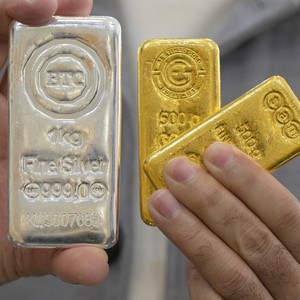
The prices of gold and silver are on rollercoaster rides.
Gold has been rising over the last few years.
Silver shot up like a skyrocket in January.
But then both plunged in price and sputtered around the end of the month.
Is somebody hoarding gold bars?
Is there a rampant demand for candelabras?
What is going on?
This is The Indicator from Planet Money.
I'm Darian Woods.
And I'm Adrian Ma.
Today on the show, the long and short history of precious metals.
We talk with some traders about what this volatility in gold and silver is saying about the state of the world.
This message comes from ServiceNow.
People should do the creative work they actually want to do, not boring busy work.
Now, with AI agents built into the ServiceNow platform, you can automate millions of repetitive tasks in every corner of your business IT, HR and more.
So your people can focus on the work that they want to do.
That's putting AI agents to work for people.
It's your turn.
Get started at servicenow.com slash AI dash agents.
To explain what's happened with gold and silver over the last month, we spoke with David Kotak.
David co-founded Cumberland Advisors, a money management firm.
And David starts the story in 600 BC in Lydia, a kingdom that was where modern-day Turkey is now.
Lydia was the first trading country. that actually put together a coin that contained gold.
So gold has a history of almost 3,000 years in monetary and finance and trading and payments.
David says gold is both malleable and strong.
It can be spread extremely thinly, even down to the width of a single atom.
So it has this solidity, this robustness against getting destroyed, which is helpful for preserving wealth.
And with a bit of heat, it can be subdivided for payments.
Also, there isn't much of it.
If you took all the gold that's ever been mined in the entire world and made one large cube out of it, it would be about 70 feet by 70 feet by 70 feet.
Another way you might have heard this explained is that you could fit all the gold ever mined into about three Olympic-sized swimming pools, which is not that much when you think about it.
Gold hits this kind of sweet spot for storing wealth.
If it were too rare, Too few people would actually be able to afford any and not many people would trade it.
But if it were too common, it would be really cheap and pretty hard to store.
And here's something kind of counterintuitive.
Gold is prized as a financial metal because it's not used in industry much.
Sure, it's used in some electronics, but about 90 of gold is used for jewelry or as a financial asset.
And that means if the economy tanks, the value of gold is not just going to automatically dive as industry uses it less.
Now, silver is similar to gold, but on the podium of financial metals, it gets a silver medal.
Everything about it is just not quite as good for wealth storage.
It's malleable enough to use as coins, but it's more reactive and not as strong.
The nickname for it is the poor man's gold.
And there's a lot more silver in the world, about seven times as much as gold.
And that's a big reason why silver is priced a lot lower.
That could actually be a good thing for everyday commerce.
Silver coins were how people collected wages and bought bread in ancient Greece.
And silver has a lot of important practical uses today, like a silver paste that goes into solar panels to collect electrons from the sun.
But as we said, that means if the economy tanks, then silver will likely tank too.
Even so, silver is pretty good as a financial metal, and it has the history.
The US monetary system was based around silver and gold right from the start.
The country's first coinage act had every coin above a penny made out of them.
Broadly.
The US dollar was essentially a claim on gold or silver until Richard Nixon abandoned the gold standard in 1971.
The Civil War was the only major exception to that.
And now the free market just determines how much the metals cost.
All right, so that is a quick fact sheet on gold and silver.
And these facts have literally been known for millennia.
So what has changed recently to send the gold and silver market into a jumbled joyride?
Yeah, for the recent history, we spoke to Philip Diehl.
Philip is president of U.S.
Money Reserve, which is a company that sells gold and silver.
In the 1990s, Philip was the director of the United States Mint.
He was in charge of American coin production.
That's right.
I was making money, making money.
I'm sure he's used that line before.
I'm sure it never gets old.
Philip says gold started rising in value about two and a half years ago.
I marked the beginning of this rally back on October 7th, in the immediate wake of the Hamas attack on Israel.
And that's emblematic really of one of the forces that tends to drive gold is geopolitical tension and warfare.
Phillips says that there were real concerns that this conflict would spread in the Middle East, which it has.
And then on top of that, we've got the Russian war in Ukraine and China asserting that it owns territory in the South China Sea and Taiwan.
And that was before the US captured Venezuela's president and ramped up its rhetoric on acquiring Greenland.
The geopolitical uncertainty in the outright conflict has grown around the world.
That uncertainty has led to the first big cause of gold prices going up.
Central banks around the world buying up gold.
Turkey has been a big buyer and so has Poland.
And China might be the number one buyer, but it keeps its numbers secretive.
But here's what we haven't mentioned.
Gold and really any precious metal has a big downside.
It doesn't accumulate interest.
It might change in value but it's not out there doing productive work like say, a loan to a company.
Precious metals just sit there.
And that's why, for the last 30 years, central banks have held onto more of something special.
It's something widely accepted.
It's traditionally held most of its value and paid interest.
We're talking about U.S.
Treasury bonds.
But recently a switch happened.
Central banks around the world started to hold more gold than US treasuries.
Huge demand from the central banks has become a baseline.
U.S. treasuries can be sanctioned, and a country's access to U.S. dollars can be limited.
A dollar might lose value to inflation.
And there's a small but not zero chance the U.S. government could even default.
Gold can get around those problems.
That leads to reason number two for gold's rise.
Everyday investors buying up gold.
They're nervous about the stability of the world, too.
Philip points to people in China buying more gold, for example.
The Chinese in particular.
As the real estate market has crashed because the Chinese do not have a lot of options, those of us in the West have to invest overseas.
They've tended to move to gold.
Central bank purchases and private investors, particularly in China.
These are the forces that have pushed up gold over the last few years.
And over that time, silver wasn't quite as hot.
That brings us to January.
Why was there this huge upswing in silver, followed by a crash in silver and gold?
Phillips says this massive rise in silver in January was largely speculation.
People making bets that the price will rise in the future.
Maybe as a second best substitute for pricey gold.
Maybe as an input into lots of computer chips for AI data centers in the future.
I think all of us who are watching it were saying, yeah, this is setting up for correction.
That correction came on January 30th.
That's the same day that Donald Trump announced he'd nominate Kevin Walsh for chair of the US central bank, the Federal Reserve.
Kevin Walsh is generally seen as a more traditional Fed chair pick than some of the other potential candidates.
And that was reassuring to markets that the U.S. dollar would likely be preserved.
But good news for the U.S. dollar is often bad news for gold and silver.
As of this recording, even after the corrections, gold and silver are still well up for the year, which is happy news for those holding onto the metals, maybe less happy for the United States.
This episode was produced by Angel Carreras with the engineering by Sina Lefredo.
It was fact-checked by Sierra Juarez.
Kate Concanon edits the show and The Indicator is a production of NPR.