Hello and a very warm welcome to the Easy English Podcast.
And, as always, we are going to be listening to some slow English and learn some new phrases and vocabulary along the way.
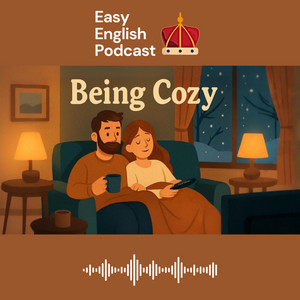
I'm your host Oliver, and today we are going to talk about something that is very relevant at this time of year, and that is cosiness, coziness.
This is a shared feeling that many of us have across cultures.
No matter where you're from, where you came from, what you do, most of us experience coziness.
What is it?
Let's find out in today's episode.
As always, we're going to learn five key words and phrases for today's episode that I want you to listen for.
First, if you're watching the video, you can probably see that I have this on my face.
It is a plaster.
So I slightly, in the past week, I injured my head.
So I hit my head.
I had a little bit of an accident.
And unfortunately, I got a mild concussion, what we call a concussion.
It's when, you know, your brain is a little bit affected.
You don't feel so good for a while.
So that's why I've been a little bit quieter with maybe Patreon posts and a few things.
So I do apologize.
I am starting to feel a bit better.
I'm not 100% and unfortunately I cut above my eye.
So a little bit better.
Hopefully it's not a big scar or anything, but we will see.
So, today's episode, let's look at our key vocab.
And remember, if you're one of the many new people that have started listening recently, make sure that you're following or subscribed to the Easy English Podcast.
It really helps for Spotify and Apple Podcasts to recommend the show.
And the same with rating it five stars and reviewing it.
It helps show the podcast to more English learners.
And it's the best way that you can support me as well.
Okay, so our five essential words for today's podcast is cosy at number one.
Of course, with the topic being cosiness, which is the noun, cosy is an adjective.
And to be cozy, it means giving a feeling of warmth, comfort and relaxation.
So, for example, this cute little cafe was very cozy.
The next word is actually a Danish and Norwegian word.
And I may not pronounce this right, but I wanted to explain it before we listen, so you can understand what I'm saying.
So it is hygge.
If you're Norwegian or Danish, tell me if I am saying that word correctly.
I'm trying.
Hygge.
And this is a Danish and Norwegian word for a mood of coziness.
So that same feeling and comfortable contentment.
So, for example, lighting candles might create a sense of hygge.
The third phrase today that I would like to teach you is a phrase, and that is to hunker down, to hunker down.
And this is a phrasal verb and it means to settle in a place for a period of time, often to be safe or comfortable during bad weather.
So we might hunker down for the weekend during a storm, for example.
If you want to learn more phrasal verbs, remember I do have an e-book, which is Phrasal Verbs Are Easy, where I teach you some of the most useful phrasal verbs, in my opinion, through short stories.
The link is in the description below.
Our fourth word today is snuggle, snuggle.
And this is a verb, I love this word, to snuggle.
And to snuggle means to move into a warm, comfortable position, usually close to another person or an object.
So we might snuggle up with another person.
So we're getting cozy, we're getting nice and warm and comfortable.
We're snuggling, snuggling up, we're snuggling under something.
And the fifth word today is ambience.
Ambience and this is a noun and it means the character and atmosphere of a place, so the ambience is the character or the atmosphere of that place.
So we might say that the nice, warm lighting created a cozy Christmas ambience.
So, to start with, what is coziness and why do we love it?
Coziness is not just a physical state that we are in.
It is a psychological state, a mental state that promotes well-being, or a feeling of well-being at least.
We like being cosy because it triggers like a psychological feeling of safety and security.
Feeling good, feeling safe, feeling cosy.
When it's cold or windy or rainy outside, being inside and being warm and dry is a positive contrast.
It shows you that you are safe and secure in your house or your apartment or wherever you are inside.
And this feeling can help reduce stress and anxiety and make you feel really good.
And when we're talking about this, you might talk about feeling protected or safe from what is outside.
So you know, let's say there was a big winter storm, lots of snow, and i might hunker down at home and, as a result, i feel protected from that storm, i feel cozy inside.
The next reason is that coziness provides a comfort with sensory details, So it appeals to all of our senses.
And we use specific language to describe the details in our life, where we are, that create this feeling, the ambience, that environment and atmosphere that make it.
So things that we can see first.
You might have, for example, soft lighting.
Perhaps firelight or the glow of a candle.
These can make us feel cozy.
So I might say, you know, yesterday I put on some soft lights and lit some candles and it made the ambience of the room so cozy.
We might also associate the feeling of cosiness with touch, so touching things.
For example, soft fabrics, so something very soft.
We might think of it with warm drinks, so a hot drink on a cold day.
Or a thick blanket that keeps us warm.
These are all cosy feelings with touch.
I might say I love this soft, warm blanket.
It is perfect to snuggle up under.
But we don't just have sight and touch.
We also have sound that can make us feel cozy too.
For example, if we have some quiet music or maybe the crackling sound of a fire as well.
A lot of people think that that is cozy or it makes them feel cozy.
And this is one that's very common, the sound of rain outside.
So if you're lying in bed and you're trying to sleep and you can hear the rain outside hitting the house, that can make many people feel cosy too.
So that brings us to also how other cultures describe cosiness.
So I mentioned this word, 風景.
So this Danish term, which is often actually now used in English.
So I've seen it more and more.
But I've heard people pronounce it incorrectly, like haig.
But I hope the correct pronunciation is hygge or something similar, hygge.
So I have seen this in more books and articles about this concept.
And I guess it's because it describes a more profound and intentional kind of cosiness, a deeper kind of cosiness.
And we really don't have that word in English.
And, if I understand correctly, hygge is a conscious act of creating ambience and focusing on the present moment.
So it's about finding the joy in simple things, not only being cozy.
So a focus on intentionality.
Hygge isn't passive.
It requires some effort.
So it's not just about being warm.
It's about making a choice to light the candles, to turn off the very bright lights and to pour a hot drink.
And this feeling of hygge is also often shared with others.
While you can feel cozy alone.
I guess hygge often includes friends or family gathered for simple activities like baking, playing a board game or having a long, simple meal together.
If you think you know I'm mistaken on this explanation, because of course it's only from reading online about this feeling and you're from Denmark or Norway and you use this term, please explain it to me.
I'm very curious.
I find this a very fascinating word and a beautiful word.
So I think a big part of feeling cozy or wanting to feel cozy is definitely seasonal.
So, for example, when I think of myself and I think of summertime, I don't really want to feel cozy in summertime.
I don't have that desire or that wish to feel cozy.
Instead, I want to be outdoor more.
I want to wear T-shirts.
I want to perhaps be more active.
I don't have that desire to hunker down, to snuggle up and to stay indoors.
What do you think?
Very quickly before I talk about some of the other changes, if you do want with transcripts with every episode, so the written transcripts.
It comes with PDF files and bonus episodes every week, mostly every week.
I have been quite bad this week with my head.
Then you can subscribe and support the Easy English Patreon as well.
So, for a fee every month, a subscription fee, you can support the show and you get access to all of that additional bonus content as well, as I believe it's over 60 bonus episodes now which, when you subscribe, you get access to these immediately.
And often, a lot of these episodes are more personal.
Okay, so enough of me promoting ahead of Christmas.
Let's have a little look at, again, this feeling of cosiness.
So...
Like I mentioned, you know, into spring and summertime.
I don't really get that feeling of wanting to be cozy.
But I noticed definitely for me personally, when it gets to autumn I start to feel that you know that want to be cozy.
When it gets colder outside, maybe the weather gets worse.
I start to think oh, I want to be cozier.
I would like to get a little bit cozier.
And I wonder if you have the same experience.
So that's why we're going to go to today's listener spotlight.
So this is one of my favorite parts of the show, where every week, I ask you a question and I ask you to answer it, whether you're listening on YouTube or you're listening on Spotify, wherever you are to write me your answer, and I pick a few of them and read them out in the next episode.
Okay, so I asked last week about to tell me, you know, what you like or dislike about winter.
So really to talk about winter.
So I had quite a few answers and I have a few here that I'm going to read out.
The first says, hi.
So I think it's from Christina.
Hi.
And she said, hi from Hungary.
I like winter.
I like going to sled, ski, making a snowman and drinking hot chocolate.
In my childhood, there was more snow than nowadays.
I went sledding with my grandparents a lot, and every time the first snow fell we always made a really big snowman.
I think I like winter because of these things.
Wow.
Thank you, Christina.
What a lovely comment and some lovely memories as well.
I agree with you.
I think when I was a child that it snowed a lot more.
It never really snows very much here, but I have a lot of memories, perhaps because it was so important to me when I was a child when it did snow, that my memories show me that there was more snow than there was.
But that's interesting to hear because I think that we had more snow too when I was a child.
Okay, another comment we had from Mana Oliveira.
And they said, I hate the cold.
I love summer, the sun, the beach.
In winter, we have to wear lots of clothes and sometimes leave the house in the rain.
That's true.
I can relate.
We definitely have to leave the house a lot in the rain in this country.
Thank you very much for that brilliant comment.
And I had a couple more comments.
One said, I love winter because I like the cold weather and hate the high temperature.
And another said, I don't like winter.
It's cold and I hate snow.
But winter also has its beauty.
Great points.
So, like you said, you know some people don't like the cold, but winter does have its beautiful moments too.
So that brings me to today's question.
So the question I would like you to answer for next week, wherever you're listening, is what does coziness mean to you?
What is cozy for you?
Essentially, what do you find cozy?
Give me some examples, some moments.
You can even share a memory if you would like to.
And I will pick a few of the answers and read them out in the next episode.
Although I don't get to read out every comment, I do personally read all of your comments every week.
I always try to make an effort to spend the time to read your answers, because I really really enjoy doing so.
Okay.
So for me, I guess to summarize, right, I think that coziness means something different to everyone.
I've given you some examples.
So about different senses.
So, you know, sight, we've got sound, we have touch and even smell.
So I didn't mention smell, I guess.
I've never really thought about what a cosy smell is, but perhaps you can have some home cooking, maybe the smell of your mother or grandmother baking something in the wintertime, making a cake or a nice fresh bread.
Perhaps that's a cosy smell that you have.
And I think that This is nothing that I've read, but maybe my opinion.
I think that coziness can sometimes also be linked to our memories.
Some really good memories can make us feel cozy when something happens in life that reminds us of those times.
So, for example, if you remember when you were a child sitting by a nice warm fire, you can get that connection and that feeling as well.
Maybe things that remind us of home, that remind us of childhood, they maybe also make us feel cosy as well.
Of course, it depends on your childhood, depends on the memories, but maybe this is something as well related to that topic.
What do you think?
But as we head into winter now, perhaps we should all try to make an extra effort to feel cosy.
Because I suppose it is quite good for our mental health, for our well-being and how we feel when it's dark outside, it's cold and the weather is not so nice.
It's more important than ever to take a little bit of an extra care for ourselves.
So, on this beginning of December, I wish you and your family a very nice, cozy rest of your day, or a very cozy week.
And I hope that you have a few cozy moments in your day today.
As always, thank you very much for your support.
The podcast has grown so much this year.
I was looking at the statistics and in one year, Spotify was telling me that it has grown by 999, which is crazy.
It was a very, very small podcast one year ago.
It's still a So thank you so much for the support.
Thank you for sharing with your friends, with family, with other people learning English.
And thank you for supporting the show in any way that you do.
I really appreciate each and every listener.
And I appreciate the effort that you're making to learn English too.
It's not easy to consistently learn, to keep trying to learn another language and learn about another culture.
And I think that it's very admirable, yeah?
It's something that I am proud of for you too.
So thank you for listening and I will see you in the next episode of the Easy English Podcast.
Goodbye.