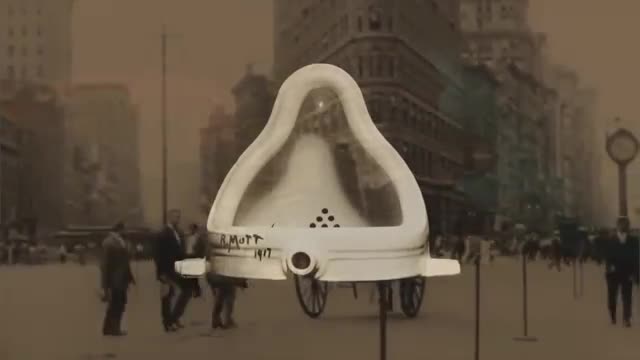
In 1917, Marcel Duchamp bought a mass produced porcelain urinal from a plumbing suppliers, laid it on its side, signed it and then put it in an exhibition and called it art.
The fountain, as it was named, has cast a long shadow not only over the 20th century, but also the 21st century.
Over 100 years after it was created, it is still considered one of the most revolutionary works in art history.
It is also one of the most contentious.
For some, Duchamp is the father of conceptualism, the so-called art of ideas.
For other, he is a charlatan responsible for the demise of traditional artistry.
But maybe we should look on this work differently.
We are not talking about brushstrokes or colours or textures.
We are talking about ideas.
Works like this are important.
They stimulate discussion and pose difficult questions.
This is not a film about taste or style, and it is not a film about what is right or wrong.
It is a film that, like Duchamp's Urinal, asks the question, what is art?
Born in Normandy in 1887, Duchamp had a perfectly normal middle-class upbringing.
His grandfather was a painter and they had a fairly cultural life.
His father was a notary, an important legal figure in France.
And Marcel was one of six children, of whom four became artists, rather to their father's disappointment.
The young Duchamp was intelligent, but not very academic.
He knew from an early age he wanted to be an artist.
One of his earliest works was painted when he was only 15 years old and shows his debt to the post-impressionists.
In 1902, at the age of 16, he moved to Paris to live, with his artist brother arriving in the city just when the great revolutions in modern painting were emerging.
Fauvism around 1905, and then a couple of years later, Cubism.
His two older brothers and his sister were very much involved with the Cubist movement, and around this time Duchamp's own work began to reflect a shift towards that style.
In 1911 he produced this painting using Cubist principles.
But his breakthrough was this painting, which is more ambivalent in its relationship with cubism.
He still used the limited palette and the fragmentation of that movement, but his figure is in a state of perpetual motion, something the Italian futurists were exploring.
Just before the painting's first presentation at the 1912 Salon des Indépendants in Paris, it was rejected by the cubist as being too futurist and he was told the title of the work was too literal.
This was a real turning point for Duchamp.
And after this, he had very little interest in groups or being told what to do.
No, I never enjoyed being part of a group.
I've always wanted to make something of personal contribution to it, which can only be done if you think by yourself and not follow the general rules of the group.
You see,
In 1912, Duchamp, Constantin Brancusi and Fernand Léger attended the Paris Aviation Salon.
All three were astounded at the sheer beauty of the huge airplane propellers on display.
Painting is washed up, Duchamp said to his companions after a moment of silence.
Who will ever do anything better than that propeller?
Can you?
In that moment, Duchamp was presented with the possibility of changing the rules of art and inventing from scratch an entirely new way of being an artist.
In 1913, he abandoned art altogether and got a job as a librarian.
Ironically, he was never much of a reader and it was during this period he carried out the only serious, sustained reading he did in his life.
He studied mathematics and physics, read a lot of books written by the French mathematician and theoretical physicist Henri Poincaré, and started experimenting with combining art and scientific concepts a more cerebral approach.
This was an exhilarating time when new discoveries had shaken the foundations of science.
Periodicals books, performances and lectures revealed groundbreaking scientific and mathematical theories in physics psychology, biology and many other disciplines.
Ideas and concepts which were being discussed in artistic and intellectual circles.
Poincaré is best known today for laying the mathematical foundations of chaos theory, but his writings on the fourth dimension and his philosophical discussions of the breakdown of principles would be a major influence on Duchamp's new art.
The notions of probability and chance played an important role in Poincaré's ideas, as it would with Duchamp and eventually, the Dada movement.
The element of chance in art is not a new idea.
Leonardo da Vinci advocated chance as an inspiration and encouraged the viewers to search for meaning in chaos.
And later in the 18th century, artists like Alexander Cossens, an English landscape painter, expanded on the idea.
It became Duchamp's method to move away from conscious thought.
And his great contribution to artistic debate.
The ready-made would be a direct development of his engagement with chance.
Duchamp's great work of chance was his first ready-made, Bicycle Wheel.
In 1913, at his Paris studio, Duchamp mounted a bicycle wheel upside down onto a stool, spinning it occasionally, just to watch it in motion as the spokes blurred.
He had no intention of showing it to anyone and didn't even think of it as a work of art.
For example, in that bicycle wheel, see here, it was 1913, it was in Paris.
The word didn't exist, the thought did not exist in my mind.
Duchamp used the term ready-made later to describe works of art he made from manufactured found objects.
But in 1913 bicycle wheel wasn't created as a work of art and wasn't formally shown in a gallery space until 1951.
And even then, it was a replica.
Like all his ready-mades and there weren't that many the wheel was chosen because it was a functional everyday item, with a total absence of good or bad taste.
The ready-made defied the notion that art must be beautiful.
But then, after that, in 14, I had a thing called the bottle rack.
It was a dryer for bottles, made of iron, manufactured.
He could have had no idea just how important these artefacts would be in art history, and we wouldn't know for quite a while.
We need to remember how many people would have seen these ready-mades.
Probably less than a handful.
So it wasn't the seismic event some see it as, and it didn't cause people to rethink art.
In fact, Duchamp didn't really think about it as art himself until around 1916.
And by then it was too late.
The ready-mades had all been destroyed.
It is important to note that, contrary to modern conspiracy theories that conceptual art was a money-making, cynical invention, Duchamp didn't sell any of these or make any money from the ready-mades, most of which he gave away.
In fact, he made next to nothing from art until his Pasadena show in 1963.
The art market was not the behemoth it is today.
I know, they don't know, they believe.
I believe that art is the only form of activity in which man, as man, shows himself to be a true individual.
One of the biggest effects of the ready-made was on the discussion about the definition of art.
In the 12th century, according to the Oxford English Dictionary, art was defined as skill at doing anything as a result of knowledge and practice.
So, for example, the monks, who created something as glorious as the Book of Kells, would have seen themselves as craftsmen, not artists.
By the time of the Renaissance, artists evolved from anonymous craftsmen to individuals practicing an intellectual pursuit, paving the way for the modern idea of an artist.
In 1740 we get our first real definition of what art is from a writer on aesthetics, Charles Bateau, who wrote a book called The Fine Arts Reduced to a Single Principle, which was an attempt to find unity among the different theories of beauty and taste and create a single principle, a clear-cut idea of what constitutes fine art.
Bateau's views were widely accepted not only in France but throughout Europe.
He stated that fine arts are fine or beautiful things which please of themselves, always in imitation of nature and requiring genius.
The main idea of bateaus was that the arts were a cause of pleasure.
A simple idea that really took hold.
Immanuel Kant in 1790 gave a more complicated and nuanced description that fine art is not how it is judged by a viewer, but how it is created.
The idea revolves around two new concepts, the genius and aesthetic ideas.
By the 19th century, photography was capable of producing nature perfectly and there is a move in the arts towards abstraction and away from the idea that art equals beauty.
Art Nouveau, Impressionism and Fauvism, once seen as revolutionary ideas, were now acceptable to the mainstream, and there was a crisis of sorts in what art meant.
Modernism brought with it a revolution in thoughts and ideas, as well as new challenges to the definition of art, with works like Duchamp's Bicycle Wheel being included in the concept of what art was and the definition was moving away from the narrow idea of beauty.
The idea of what is art had to be expanded to accommodate these new works and ideas.
By 1974, the American philosopher George Dickey was advocating the idea that art institutions such as museums and galleries, or anyone who says they are an artist, have the power to dictate what is art and what is not.
There are three key points to consider when discussing Duchamp's ready-mades.
First, selecting an object is a creative act.
Second, when an object's practical function is removed, it becomes something else.
Third, the act of presenting the object and giving it a title introduces a new thought, thereby giving it a new meaning.
So it took 300 years.
But the conventional question of what is art has shifted beyond seeing it as a skill or as a concept of beauty, beyond something that lies in shapes, colour and line, to ideas and concepts created with intent and purpose.
While Duchamp was unintentionally inventing the ready-made his painting, which the Cubists rejected in Paris knew descending, a staircase was selected for the 1913 Armory Show in New York City, where Americans accustomed to more naturalistic art were scandalized.
It was compared to an explosion in a shingle factory or a pile of golf clubs, and cartoonists satirise the piece.
This footage is from that time.
Let's take a moment to look at the clothes, the cars, the people.
Duchamp is considered scandalous now.
Imagine what they thought in 1913.
By this time, Duchamp was already feeling increasingly isolated in France and saw the United States as a way to escape what he saw as the stifling art scene.
Then the First World War broke out and Duchamp, who was exempt from military service due to a heart murmur, decided it was time to move to New York City.
He arrived in June 1914, surprised to find out that the scandal had made him the most famous modern artist in America and all his paintings at the Armory Show had sold out.
A New York gallery offered him 10000 a year an absolute fortune then, for his entire output of paintings, but he refused, saying he was finished with the painting.
This was two years before the fountain.
In early 1916, Duchamp started to rethink ideas around the ready-mades he had left in Paris.
He wrote to his sister to ask if she could send them to New York, but it was too late.
She had thrown them all out as junk when cleaning out his studio in Paris in 1915.
Humour is very much part of Duchamp's modus operandi, and I think that although he wanted his ideas to be taken seriously, he also wanted not being serious to be taken seriously.
Until then, for me, art was such a serious and pontifical thing that I was very happy when I discovered that I could introduce humour into it.
Then and now, the art world lacks any sense of humor or irony.
But Duchamp had a mischievous streak and was willing to ask big and very serious questions, but with a healthy dose of humor and skepticism.
So far his ready-mades had been a sort of private recreation, but the fountain would be a very public attack on the contradictions of the art world.
Some people see Fountain as a joke, and that's not a bad description.
It started out, in a way, as one of the most subversive jokes of the 20th century.
The American Society of Independent Artists was founded in 1917, and Duchamp was one of the directors.
The independents saw themselves as championing everything new and progressive in art.
And to that effect, their first exhibition didn't have any committee or jury.
It was designed to break down the barriers artists faced.
And as long as you paid six dollars, you could submit two works, no questions asked.
Duchamp disliked the group, as he disliked all groups, and decided to provoke them to test them even.
It was in that frame of mind that in April 1917, Duchamp made his way to the J.L.
Mott Iron Works, a plumbing supplier's situated at 118 Fifth Avenue.
The only way for Duchamp's provocation to work was by submitting Fountain under a false name Richard Mutt.
The name was derived from the manufacturer's name, but also inspired by the comic strip Mutt & Jeff, which Duchamp loved.
And Richard is French slang for a rich show-off or a moneybags.
The committee decided after much debate that Richard Mutt's Fountain was not a work of art, but they were tied by their own rules into accepting it.
Fountain however, was never seen by the public at the exhibition and was not mentioned in the catalogue.
Instead, it remained for the whole show hidden behind a curtain.
An act of cowardice by the committee.
A photo was taken by Alfred Stieglitz, and that was the last anyone saw of the actual urinal.
The object had been thrown away.
The thoughts and the ideas behind the object however, could not so easily be disposed of, and in both the literature that followed and the ideas that sprang forth from it, Duchamp's fountain had ignited the spark, and art would never be the same again.
Many of Duchamp's original ready-mades, like Fountain, were lost, dismantled or destroyed.
And by the 1960s only seven of Duchamp's 14 original ready-mades remained or survived only as photographs.
Starting in 1964, Arturo Schwartz collaborated with Duchamp on producing replicas of 14 of his most important ready-mades in numbered and signed editions.
Ironically, Schwartz had to return to traditional sculptural techniques to recreate them, challenging the very idea of the original ready-made.
What would happen if, in fact, these manufactured ready-mades were mass-produced and we could all buy one for two shillings?
No, no, no.
You have to sign them.
They are signed.
They are signed and numbered.
Yes.
An edition of eight is like any sculpture, so it's still in the realm of art in the form of technique.
You just make eight and you signed them and numbered them.
The replicas sent shockwaves through the art world by challenging traditional ideas of authorship, identity and the artist's role, while paradoxically preserving certain qualities of the original works, ultimately becoming stand-ins for the ready-mades.
Ever.
The provocateur Duchamp saw it as an opportunity to create controversy and challenge the artistic establishment.
He embraced replication as a way of rethinking terms such as creativity, originality and value and to blur conventional categories.
Everyone loves a conspiracy, especially if it debunks modern art.
And by challenging Duchamp's authorship of The Fountain, you are also challenging the very concepts.
In 1982, a letter was found, dated 11th of April 1917.
In it, Duchamp wrote to his sister.
One of my female friends under a masculine pseudonym, Richard Mutt, sent in a porcelain urinal as a sculpture.
This letter has led to claims that Fountain was actually created by an unnamed woman, not Duchamp.
He didn't identify his female friend, but many candidates have been put forward as creators, most notably the Dadaist Elsa von Freytag-Lorenhoven, one of the most extraordinary characters in art history, a poet, performance artist and object maker.
A truly extraordinary woman.
However Freytag-Lorienhoven, despite her talent for self-promotion, never claimed this work as her own, either at the time or in the years that followed, whether in private conversations or in published writings.
Furthermore, none of the many individuals involved ever mentioned her name in connection with the work, either at the time or in their later interviews or memoirs.
Duchamp himself adopted a female persona in the early 1920s Rose Célavie and three weeks before the Fountain scandal he wore women's clothing to an inaugural party for the magazine The Blind Man.
So, there is speculation that the female friend he mentions to his sister was his female alter ego.
There were however, women in the New York avant-garde scene who were involved in the 1917 fountain incident and are more likely candidates for the mystery female friend.
Women who, like Freytag Lorenhoven, have also been forgotten about in history.
Louise Norton and Beatrice Wood, both crucial contributors to the story of the fountain.
As noted, it was critical that the work should not be submitted by Duchamp.
I think the important thing to point out here is that in his letter he wrote sent and not created.
Beatrice Wood, a friend of Duchamp, was an artist and writer who made an important contribution to the myth surrounding this new, infamous but unseen object.
Wood wrote the first defense of Fountain in her 1917 article, The Richard Mutt Case where crucially, she wrote whether Mr Mutt, with his own hands, made the fountain or not has no importance.
He chose it."
He took an ordinary article of life, placed it so that its useful significance disappeared.
Under the new title and point of view, created a new thought for that object.
In her later memoirs, Wood reiterated that the fountain was in fact created by Duchamp.
Louise Norton was a Dada poet, a writer and a close friend of Duchamp, and she too is important in the story.
She is almost certainly the female friend who sent in the fountain on his behalf.
We can't be 100 certain, but it is her address, partially detectable on the paper entry ticket in the Stieglitz photograph.
The likeliest candidate for the female friend.
Duchamp claimed responsibility for Fountain until the end of his life in 1968.
And knowing what we know about the artist, if he was not the creator, he would have taken great joy in revealing that.
In 1923, at the age of 36, Duchamp suddenly announced that he had given up art for chess.
From his early painting Portrait of Chess Players in 1911 to Opposition and Sister Squares Are Reconciled of 1932 to Reunion, the performance chess game he staged with John Cage in 1968.
The game of chess was important to Duchamp, who saw many connections between chess and art.
Everybody can play chess, but I took it very seriously and enjoyed it because I found some common points between chess and painting.
Actually, when you play a game of chess, it's like designing something or constructing a mechanism of some kind.
He had played chess since he was a child, and as an adult he played for France in championships.
Wrote a chess book, translated another covered chess for Le Soir newspaper and became an official of the French Chess Federation.
The chess pieces are the block alphabet which shapes thoughts, he once said.
And these thoughts, although making a visual design on the chessboard, express their beauty abstractly, like a poem.
Chess and Duchamp make sense.
He was disciplined and self-absorbed, happy to work alone for long hours and days, which made studying the games of the great masters possible.
They are in motion all the time and that's what attracts me, because a part of failure, a position of failure that does not play, does not have a plastic or aesthetic side.
It is through the possibilities of the movements that can come after this position.
He said that while all artists were not chess players, all chess players were artists, and he loved the conceptual nature of the game, its pointlessness and the nearly infinite possible combinations of moves and tactics.
He was described by a chess master as someone who would always take risks in order to play a beautiful game, rather than be cautious and brutal to win.
The kind of risks he had taken as an artist, a great conceptual artist.
Quitting the art world to play chess would be a lovely way to end this film.
But sadly, it is yet another strategic game that Duchamp was playing.
He wanted to be known as the artist whose final artwork was to quit art to play chess.
But in fact, he quietly created artistic experiments for the rest of his life.
He worked on films in which he also made appearances, and he began a huge project creating miniature versions of all of his own works that he put into a suitcase as a kind of traveling museum.
At the age of 76, Duchamp agreed to hold his first ever career retrospective at the Pasadena Art Museum in 1963, then an obscure museum in a provincial outpost.
Impact of that show had a huge effect on a generation of artists who would go on to revolutionize the contemporary art world.
When he died, five years later, It was discovered that he had been working for 20 years in total secrecy, on his last major work, Étant donné, an installation visible only through a peephole in a wooden door.
It was a total surprise to the art world.
But, as with all his works, it was a collaboration not between himself and another artist or curator or writer, but between him and us.
The creative act is not performed by the artist alone.
The spectator brings the work in contact with the external world by deciphering and interpreting its inner qualification, and thus adds its contribution to the creative act.
Both the artist and the viewer are necessary to complete a work of art.
We bring our own external thoughts and ideas into Duchamp's world, and by doing so we are challenged to ask the question what is art?
Maybe the answer is in the question.
Why did you make it so difficult?
Well, because I didn't want to make it easy.