I'm Ayesha Roscoe, and this is The Sunday Story, where we go beyond the news of the day to bring you one big story.
This month, NPR's Daniel Estrin entered Gaza for the first time in more than two years.
He departed from Tel Aviv.
With outdoor cafes, high-rises, life, and in just one hour, driving along Israeli highways…
I arrived at the Israeli fence with Gaza.
He joined a military embed into Gaza with the Israeli military.
This is the only way for journalists to enter Gaza, as Israel continues to bar journalists from independent access.
I entered in an Israeli military vehicle with 11 other journalists.
So we've driven right through the Israeli fence.
There are a couple of Israeli military jeeps behind us.
And within minutes, we were at this Israeli military outpost.
And we were taken to an outlook.
Finally, he was able to see for himself what parts of Gaza look like today.
I'll give a quick explanation.
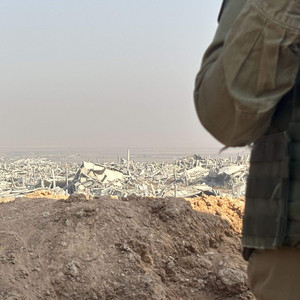
As you're seeing in front of you is the battlefield of Sajaiya.
To the left is Gaza City.
I climbed up to the top of a dirt berm and the first thing you see is just This endless expanse of rubble.
It's colorless, gray cement mangled what used to be homes and schools.
I mean, I'm struggling to describe it.
We've seen pictures of destruction in Gaza, but to stand there and to take it all in feels like something entirely different.
Last month, on October 8th, the Trump administration announced that Israel and Hamas had agreed to a ceasefire in Gaza.
President Trump said the deal would not only end the two-year war, but also launch a new era of peace.
At long last, we have peace. in the Middle East.
And it's a very simple expression, peace in the Middle East.
And we've heard it for many years, but nobody thought it could ever get there.
And now we're there.
But since the ceasefire went into effect, there have been waves of Israeli airstrikes within Gaza.
These airstrikes have not ended the ceasefire, but have made it even more fragile.
Meanwhile, progress on implementing Trump's 20-point Gaza peace plan has stalled.
Today on The Sunday Story, we're joined by NPR's Aya Batraoui and Daniel Estrin.
They're going to help us unpack the ceasefire agreement and why it's not going according to plan.
They'll also weigh in on what it would take to get things back on track.
Stay with us.
This message comes from BetterHelp.
Most FSA dollars expire at the end of the year, so it's time to use them or lose them.
With BetterHelp, you can invest those funds in taking care of your mind with online therapy.
Join today and you can be matched with a licensed therapist in as little as 24 hours.
Visit BetterHelp.com to get 10% off your first month.
This message comes from Mattress Firm.
Restless partner keeping you up?
Or maybe it's your pet or kids climbing into bed.
Those constant movements can make it hard to get the rest you need.
Mattress Firm's sleep experts will match you with a bed for deeper rest, like a Tempur-Pedic.
Its unique temper material absorbs motion for undisturbed rest.
Shop Mattress Firm's Black Friday sale and save up to 500 on select Tempur-Pedic adjustable mattress sets with next-day delivery.
Restrictions apply.
See mattressfirm.com or a store for details.
This message comes from Mint Mobile.
Starting at $15 a month, make the switch at mintmobile.com slash switch.
$45 upfront payment for three months.
Five gigabyte plan equivalent to $15 a month.
Taxes and fees extra.
First three months only.
See terms.
We're back with The Sunday Story.
I'm here with Aya Batraoui, NPR's correspondent in Dubai, and Daniel Estrin, NPR's correspondent in Tel Aviv.
Daniel and Aya, thank you so much for joining us.
It's good to be here.
Thanks.
Thank you, Ayesha.
So I'm glad to have you both on because there have been a lot of developments in the ceasefire.
And it's It's hard to follow what exactly is going on on the ground from day to day.
To be clear, the ceasefire went into effect last month.
But since then, there have been multiple waves of airstrikes and exchanges of fire.
So how is this still a ceasefire?
Aya, let's start with you.
Help me understand the contradiction here.
I mean, you're right.
There have been shots fired and bombs dropped.
And Aisha, there was a night during the ceasefire that was far deadlier than many nights of the war.
But despite that violence, both sides Israel and Hamas are saying that they're abiding by this ceasefire.
The ceasefire is actually still holding.
And this matters because...
Just days before the ceasefire was announced, all of Gaza City was facing a full occupation by the Israeli military.
And there were plans in place to occupy all of the Gaza Strip.
People were literally being forcibly displaced from Gaza City.
And there were real concerns that Palestinians would be displaced out of the territory entirely.
There were members of the far-right government who were actively still calling for that.
But what the ceasefire does is it takes those plans off the table.
But there are still a lot of unanswered questions about the future of Gaza.
Because this plan leaves so much open and so much still not addressed.
And that still has to be figured out as the ceasefire plan continues to unfold and move ahead.
So now we're more than a month into the ceasefire.
How are things going?
And could you start with like an overview of the major goals of this plan?
So here's how the ceasefire plan was laid out.
To begin with, Israel and Hamas would exchange hostages and prisoners.
A surge of humanitarian aid would enter Gaza.
Hamas would disarm Gaza.
A multinational peacekeeping force would enter Gaza alongside a newly trained Palestinian police force.
Israel would withdraw its troops from Gaza.
The territory would be rebuilt and redeveloped.
And eventually, down the line, there would be a pathway toward creating an independent Palestinian state.
Right now, where we are is just phase one of this deal.
And that was supposed to be the easy part.
And so far, some of the parts have gone according to plan.
Israel has received all of its living hostages who were still held in Gaza.
Israel in exchange released a certain number of Palestinian detainees and prisoners according to the ceasefire plan.
But then this is where things have gotten a lot more complicated.
Hamas was supposed to return the bodies of all the dead hostages in Gaza.
It has returned most of those bodies, but there are some bodies that are located under rubble, others in difficult, inaccessible areas of Gaza.
And so some bodies have still not been returned.
And Israel has accused Hamas of knowing where some of those bodies are and not returning them on purpose.
And so the slow return of these Israeli hostages' bodies.
Is this why the first phase has taken so long?
Yeah.
Israel had expected the return of those bodies to happen a lot more quickly.
So Israel is accusing Hamas of violating the ceasefire deal for that reason.
And until all of the bodies of the hostages are returned, from Israel's point of view, the next phase doesn't move forward.
Okay.
And what about humanitarian aid?
This is where Hamas accuses Israel of violating the ceasefire.
You know, let's remember, it was just a few months ago that a famine was declared in Gaza City and northern Gaza, and we saw those images pouring out of Gaza of famished babies, skin and bones, being held in the arms of their mothers.
We were seeing a spike in the number of deaths from malnutrition and hunger every day.
So part of the ceasefire deal was to reverse all of that, to make Israel open up the channels of getting in aid into Gaza.
But what we're seeing are all of these impediments to aid coming in at scale.
But help me understand this, because humanitarian aid was a part of phase one.
Wasn't there supposed to be an immediate flow of urgent aid into Gaza?
There was supposed to be an immediate surge of aid.
And Israel says hundreds of trucks of aid are coming in a day.
But, you know, a lot of that is commercial goods coming from Israel.
We have seen some markets in Gaza have more variety of food.
But the bottom line is that there's still not enough food entering Gaza.
And that is according to UN agencies, who say people are still struggling to put food on the table.
They say a fifth of Gaza's population still reports only eating one meal a day.
The World Food Program, for example, says meat...
Eggs, fruits and vegetables still remain rare.
And the United Nations points to specific impediments to getting that aid in.
They say Israel hasn't opened more border crossings into Gaza.
They say Israel is not allowing enough routes within Gaza for those aid trucks to move.
So these are some of the examples that they give on why aid is still not coming in at scale, even though they're ready to distribute that aid.
So it sounds like there's still a long way to go just to accomplish the goals of this first phase of the ceasefire.
But let's jump forward to the next phase.
What's supposed to happen in phase two?
And is there progress being made?
The ceasefire plan is still not in phase two.
It's been difficult to transition from the first phase to the next, because the second phase really redraws the security architecture of Gaza.
This is the phase in which Hamas is supposed to disarm.
That's a key part of the ceasefire deal.
And a key part of that is bringing in an international stabilization force.
That would be international troops, mainly Arab and Muslim forces, to come in and provide the security of that Gaza would need and to disarm Hamas, but not by force.
That is when you would start to see the other puzzle pieces coming together, which is Israel withdrawing from more than half of the territory that it currently controls.
They would then go all the way back to a buffer zone. on the peripheries of Gaza and remain there.
But here's where it gets tricky because the language around all of this is still so vague.
You know, some of the countries that are considering sending troops Would be Egypt, for example.
We've heard Indonesia is ready.
Pakistan is ready.
Turkey says it's ready to mobilize troops.
But those forces that are going to go in there, particularly the Egyptian forces, they want to make sure that they're not being sent in there to reoccupy Gaza on behalf of Israel and the United States or to finish Israel's job for them in Gaza.
And so we're seeing the United States move ahead with a draft resolution before the UN Security Council right now to give that international stabilization force a clear international mandate with clear timelines and clearly defined role.
But there's still a lot that needs to be worked out.
And the longer that the status quo remains, the weaker that this ceasefire becomes.
It's almost like pressure building.
This ceasefire is supposed to keep moving like water from one phase to the next.
That's how it was designed.
It's not supposed to stagnate.
So if things are getting bogged down right now in the details and how it's actually going to play out, what does this mean for Palestinians in Gaza right now?
The implications if this gets stuck and doesn't move forward.
For the two million people stuck in Gaza, in this endless limbo, it means continued malnutrition and instability.
Winter is coming.
It means flooding, cold.
It means no reconstruction, no rebuilding, no return to proper schooling, no even recovery of thousands of Palestinian bodies buried under the rubble that people want to bury.
You know, and let's remember here, the powerful far-right members of Netanyahu's government did not want this war to end.
They wanted the full occupation of Gaza, the complete annihilation of Hamas and the rebuilding of Jewish settlements in Gaza.
So the longer that this situation doesn't move forward and stays where it is, the more that this could actually play into the far-right in Israel.
When we come back, we'll take you to the part of Gaza where Israeli troops are fortifying their positions.
With Grammarly Mail and Coda coming together, you get proactive help across your workflow so you can outsmart the chaos.
Experience AI that proactively helps you go from to-do to done faster.
Unleash your superhuman potential today.
Learn more at superhuman.com slash podcast.
That's superhuman.com slash podcast.
Support for this podcast and the following message come from Fisher Investments.
One of the ways that I work to establish trust is to listen.
We're going to be asking you questions to make sure we truly can understand what's going on with you.
Then we can make decisions not only for the present moment, but also for whatever direction you're going into.
We're back with the Sunday story.
I'm here with Aya Batraoui, NPR's correspondent in Dubai, and Daniel Estrin, NPR's correspondent in Tel Aviv.
Daniel, before the break, Aya was talking about the risk for a frozen ceasefire where the next phase stalls or collapses before you even get there, and about how that could lead to conditions of a permanent and entrenched Israeli occupation.
So let's get back to your recent trip into Gaza.
Where exactly did the Israeli military take you?
So we were put in an Israeli military vehicle and driven just a few minutes into Gaza.
We stopped at a small Israeli military outpost.
And this is an outpost very close to what's known as the Yellow Line.
Aisha, this is the line where Israeli forces withdrew to at the very start of the ceasefire.
That was what the deal imposed.
And so right now, Gaza is essentially divided into two.
About 50 is held by Israel and Israeli troops and the other half of Gaza is is under Hamas control.
And that's where Palestinian civilians live.
And so there's not actually a yellow line painted on the ground though, right?
No, this yellow line, Aisha, is mostly invisible.
It appears on President Trump's map that he published with this proposal that Israel withdraw to that line.
On the ground, the Israeli military has started putting up yellow colored concrete blocks to denote where that line is.
But in most places, Palestinians simply don't know which side of the line they might be on.
And families trying to return to their former homes on the Israeli side of this yellow line, or even approaching that area, have been shot and killed.
They didn't know that they were crossing that front line.
So during our embed with the Israeli military, I was with a group of journalists and we were taken to an outlook to see this large swath of northern Gaza and what it looks like today.
To the left is Gaza City.
The yellow line is.
You can see it.
It is a bit before the first line of buildings or after the first line of buildings.
We were overlooking the Shizhaiya neighborhood of Gaza City.
That entire neighborhood Used to be densely packed.
I used to visit there as a journalist regularly reporting for NPR.
I remember driving through the narrow streets.
I pulled up my phone and I looked on Google Maps at where I was.
I mean, when you pull up your phone, the little dot puts you on a street with a name.
And yet the reality of that map of what Gaza used to be bears no resemblance to where you're actually standing.
This whole swath of devastation that I saw from that outlook.
All of that is a part of the Israeli-controlled part of Gaza.
The military spokesman we were with held up a map and showed what he said were roots of Hamas tunnels that they're still finding bits and pieces of.
They're connecting these roots, like connect the dots.
They're finding tunnel shafts.
They're trying to destroy them.
And so even though there is a ceasefire now, the military is very active.
They're destroying tunnels and other infrastructure.
From Israel's point of view, there's a lot of work left to accomplish.
Well, is that why they say that they are still occupying parts of Gaza?
They're saying that they still need to destroy the tunnels and all of that.
That's why they're still there?
That's exactly right.
From Israel's perspective, they're trying to prevent another October 7th, 2023 attack.
They want Gaza demilitarized.
The plan that the US has put forward is that the International Stabilization Force is going to be responsible for that.
But fundamentally, Israel does not want to entrust its security in anyone else's hands.
And so these are some of the huge questions that lay before us with this ceasefire.
The Israeli military spokesman I spoke with said...
Once Israel sees that this multinational force is on the ground and Hamas gives up its weapons, only then will Israel pull back its troops.
That's a huge if and a huge question mark over when.
And so we could see Israel there for the foreseeable future.
We built the infrastructure here to be suitable for troops to have normal conditions of staying here for a prolonged time.
Our time here depends on how fast the stages of the agreement move forward.
That military outpost I was at was outfitted with cement walls, a large cell phone tower, electricity wires, and the military is building the infrastructure for soldiers to be inside 50 of Gaza for the foreseeable future.
And Aisha, I'll just jump in here too and say how you define what is demilitarized can be very different from one party to the next.
So maybe the Arab states say it's demilitarized because we've taken over their heavy weaponry.
And maybe Israel says we need every single tunnel dismantled before we withdraw, or we need every single gun handed over.
Well, I mean, do you think Hamas is actually going to give up its weapons?
And what is the outlook for Hamas?
Well, I guess here I can talk about how Hamas sees itself.
It sees itself as an Islamic resistance group, first and foremost.
And it has consistently said that it has the right under international law to armed resistance so long as there is an occupation.
So they have never wavered on that publicly.
But it is facing immense pressure from countries it needs, like Qatar, Turkey, and Egypt.
They all want the war to end.
They all want the ceasefire to hold.
There's also pressure from Saudi Arabia and the United Arab Emirates.
These are two countries with very deep pockets that will be needed to rebuild security.
Gaza, they view Hamas as a threat to their stability, to the region because of their ideology.
And they want to see actually Hamas replaced by Palestinian officials and groups that are closer to them.
We did hear a senior Hamas official recently say publicly that Hamas is willing to discuss its heavy weapons.
That refers to its rockets, its rocket launchers, the kinds of weapons that can reach Israeli territory.
However, he also said that giving up light weapons with a short range is...
Fully disarming Hamas would not be in the best interest of Gaza.
And he says that's because it could lead to a security vacuum and the rise of other armed groups.
Yeah.
Aya mentions these other armed groups.
You know, we saw in the first days of the ceasefire Hamas engaging gun battles in the streets of Gaza against its armed rivals.
It is seeking to establish itself as the dominant military power in Gaza.
We've already seen it deploying some Hamas civilian police forces in the streets.
So what you see now is Hamas trying to fill this vague kind of vacuum, while there's no progress on the next steps, like on sending a multinational force into Gaza.
What we have heard from analysts is that Hamas, throughout the war, had one major goal, and that was to end the war and to survive it.
And they reached that goal.
So from what I'm hearing, both Israel and Hamas don't seem to be budging.
And meanwhile, this yellow line is starting to firm up and get more fortified.
So if and I know that is a really big if.
If the ceasefire were able to move forward, what would be phase three?
I haven't heard anyone use the term phase three.
But there are some other elements of the plan that we should run through.
There is a plan for a local Palestinian police force to be trained and deployed in Gaza to replace Hamas's police force.
They would be working alongside a multinational force.
Then there's a plan for a Palestinian technocratic committee to run Gaza temporarily, to run its public services, also replacing Hamas.
And then there would be a board of peace overseeing them.
Um, According to the Trump plan, President Trump would be the chairman of that board.
Former British Prime Minister Tony Blair would be on the board.
We don't know who else will be members of that board.
And then there's also a plan for economic investment in Gaza.
President Trump's plan talks about quote a Trump economic development plan to rebuild and energize Gaza.
It talks about convening a panel of experts who have expertise in what this US plan calls birthing some of the thriving, modern miracle cities in the Middle East.
I think if we're gonna talk about a phase three, we have to talk about what President Trump wants.
Ultimately, we've heard him say that Gaza is only a small part of his broader vision and his broader plan for the Middle East.
He wants a regional reordering of the Middle East.
He wants a normalization deal between Saudi Arabia and Israel while he is president.
And he has said publicly that he knew that couldn't happen as long as there was the war in Gaza.
His legacy is at stake with the ceasefire deal.
And he's talked about how proud he is of it.
That's all I've done all my life is deals.
The greatest deals just sort of happen.
And that's what happened right here.
And maybe this is going to be the greatest deal of them all.
President Trump has given his word publicly and privately that this deal is going to stick.
This took 3,000 years to get to this point.
Can you believe it?
And it's going to hold up too.
It's going to hold up.
And he's promising big here, lasting peace in the region.
From this moment forward, we can build a region that's strong and stable and prosperous, and united in rejecting the path of terror once and for all.
Now Israel and Hamas have accused each other of violations, but it is really President Trump who's holding it together.
And he has really stayed focused on this.
He has sent his son-in-law, Jared Kushner, his special envoy, Steve Witkoff, Vice President J.D.
Vance Secretary of State, Marco Rubio, and the president himself has gone to Israel since the ceasefire deal was announced to maintain it, to ensure that it is holding, to say that this is a policy priority of the president and the White House.
But also, you know, President Trump has business relationships with Gulf Arab states.
He has personal ties with Qatar and Saudi Arabia and the UAE, the leaders of these Gulf countries.
And he's really leaning on them to also try to keep this plan on track and looking to them to provide a lot of the funding that's going to be required for rebuilding Gaza.
Rebuilding is maybe going to be the easiest part.
I think we've done a lot of the hardest part because the rest comes together.
We all know how to rebuild and we know how to build better than anybody in the world.
So realistically, what could redevelopment or rebuilding look like?
No one's really given a clear vision of what Gaza will look like when it's rebuilt.
But what we do know is that right now, Gaza is split physically between east and west.
On the western part of Gaza along the Mediterranean coast.
That's where Hamas has some semblance of governance and where Gaza's two million people are squeezed.
The eastern part of Gaza is the part Daniel saw.
That's the part of Gaza that the Israeli military still occupies.
So basically what you're hearing now is just all of these plans being laid out.
You see them in the media.
You hear U.S. officials talking about them, including Jared Kushner.
The idea of... redeveloping Gaza, but only on the side that Israel occupies now, the east side.
These are plans to offer some kind of model city of what Gaza could look like without the influence of Hamas.
But nothing has been started on the ground as far as we know yet.
Because there's also many questions about, well, where would the reconstruction funding come from?
Really hard to imagine broad Arab support for this.
And whether Palestinians would voluntarily want to go live in a part of Gaza that's still occupied by Israel's military.
From everything that we've talked about, even as the ceasefire holds, there's so much uncertainty ahead.
Daniel, Aya, you've both covered the Israeli-Palestinian conflict for years.
What feels most relevant to you in this moment?
Well Aisha, this current ceasefire.
Trump put out with 20 points.
In the end it's just a short document.
It fits one or two pages.
It's very general, and I think its vagueness was its success.
It got everyone on board to stop the war.
The US idea here was let's get everyone to stop fighting and to agree, and then we're going to work out the details later.
Well, Aisha, later is now.
The details have not been worked out yet.
And then the plan says that if all of those steps that we have spoken about until now, if all those steps are taken, there could be the conditions for a pathway to an eventual Palestinian state.
Palestinian leaders and most of the international community and successive American presidents have sought that for decades a Palestinian independent state alongside Israel.
Israeli leaders today say it's not going to happen.
And a recent poll actually shows that...
There has been a major drop in public support for a Palestinian state since the October 7th attack.
Around three quarters of Jewish Israelis do not believe Palestinians have a right to their own state.
This really shows you just how far away we are from any kind of real Israeli-Palestinian peace process.
You know, Aisha, at this moment in time, Israelis do feel a sense of temporary relief for them.
It feels like the war is over.
I was in Hostage Square in downtown Tel Aviv that morning when the first living hostages were freed.
It was like a sense of euphoria.
You saw people smiling and crying at the same time.
But that feeling in Israel is quickly fading.
For one.
Israelis feel more isolated in the world today than perhaps ever before, because much of the world is furious with Israel over its conduct in Gaza.
And for Israelis, they want reckoning.
They want reckoning from their own leadership.
They don't trust the government of Benjamin Netanyahu.
They find him responsible for the biggest security failure in their history, the October 7th attack.
So that is something that is dogging Israelis every single day.
And also, this is a country that faces charges of genocide and war crimes.
There's been a finding by a UN commission that Israel did commit genocide in Gaza.
Israel denies that.
But these are accusations and charges that Israel will be fighting in international courts for a very long time to come.
So all of that will make it very difficult for Israelis to feel a sense that this chapter is over.
As someone who was covering this war from the very first day and really focused on what was happening in Gaza.
It's important to just step back and remember what did occur over those last two years.
More than 69,000 Palestinians have been recorded as killed by Israeli fire in this war.
And there are more bodies being retrieved daily from under the rubble.
So that death toll continues to climb.
And a third of those deaths, more than 20,000 of them were children.
And so the rehabilitation of Gaza, the reconstruction of Gaza, is going to take more than just financing and money.
It's going to take for people there to feel like they can live in peace and security without another war coming back.
So what this plan doesn't do?
It doesn't talk about transitional justice for people in Gaza and doesn't address the larger Israeli-Palestinian conflict.
It doesn't address the occupied West Bank at all, the continued Israeli raids into towns and villages there. the expansion of Jewish settlements, the arming and empowering of extremist settlers in the West Bank.
So Trump's plan may have ended the war in Gaza, but it's not clear how it ends the Israeli-Palestinian conflict.
Daniel and Aya, thank you so much for all of your reporting.
We really appreciate you breaking all of this down for us.
You're very welcome.
Thank you, Aisha.
This episode of The Sunday Story was produced by Justine Yan.
It was edited by Jenny Schmidt.
Kwesi Lee mastered the episode.
Special thanks to James Heider and Dee Dee Skanky.
The Sunday Story team includes Andrew Mambo and Liana Simstrom.
Our intern is Thomas Coltrane.
Irene Noguchi is our executive producer.
I'm Ayesha Roscoe.
Up First is back tomorrow with all the news you need to start your week.
Until then, have a great rest of your weekend.
If you're tired of family members constantly texting you for the passwords to streaming services, 1Password lets you securely share or remove access to logins.
Access from any device, anytime.
1Password lets you securely switch between iPhone Android, Mac and PC, with convenient features like autofill for quick sign-ins.
Right now, get a free two-week trial for you and your family at 1password.com slash NPR.
This message comes from Mint Mobile.
At Mint Mobile, their favorite word is no.
No contracts, no monthly bills, no hidden fees.
Plans start at $15 a month.
Make the switch at mintmobile.com.
That's mintmobile.com.
Upfront payment of $45 for 3-month 5GB plan required.
Equivalent to $15 a month.
New customer offer for first 3 months only.
Then full price plan options available.
Taxes and fees extra.
See Mint Mobile for details.