Public media counts on your support to ensure that the reporting and programs you depend on thrive.
Make a recurring donation today to get special access to more than 20 NPR podcasts.
Perks like sponsor free listening, bonus episodes, early access and more.
So start supporting what you love today at plus.npr.org.
You're listening to shortwave.
Hey, everyone.
Emily Kwong here with producer Hannah Chin.
Hey.
Hey, Emily.
Okay, so I've been looking into a question from one of our listeners in Lawrenceville Georgia, which is a suburb about 30 miles outside downtown Atlanta.
It's very pretty here in Atlanta.
Lots of hills and very green when you're landing at the airport.
You can see it's just a green canopy all over the city.
So this is Shabnam Khan.
She's lived in and around the area since 1986.
And clearly, she really loves the place she lives, partly because it's so lush.
Yeah, Atlanta is beautiful.
It's also subtropical, so I imagine there's lots of plants that thrive there.
Exactly, which is great for Shabnam because she loves to garden.
But there's one problem with her garden, Emily.
A problem that's been visiting pretty regularly, that started small.
A lizard here and there.
And it's just not going away.
I do gardening quite a bit, and now...
Last two or three or four years.
Every time I'm gardening, every time I'm working in the yard, I get scared by lizards and frogs.
Oh, no.
And there are many of them and lots of different varieties, like stripes and like beautiful colors, but I'm still scared of them.
Shabnam told me she doesn't even want to be in her garden anymore.
She's so stressed out by this spike in garden visitors.
And she says it's not uncommon for her to hear an army of frogs croaking in her neighborhood at night or to find multiple brightly colored lizards sunning on the grass.
And now she's like, where did all of these come from?
It's just the quantity boggles my mind.
Just the population seems to have exploded.
Today on the show, we are going on a lizard hunt.
We're talking to local experts about why so many lizards and frogs are showing themselves now.
And whether there's a way to manage Shabnam's clammy, scaly little problem.
You are listening to Shorewave, the science podcast from NPR.
This message comes from Charles Schwab.
This message comes from Whole Foods Market.
Follow your wellness goals and save big with sales on supplements and vitamins.
Explore an abundance of high-quality multivitamins, probiotics, and protein powders.
Keep good habits going strong.
Cook homemade meals featuring sustainable wild-caught sockeye salmon and many more delicious and lean protein options.
For wellness when you need it.
Shop smart meal shortcuts to stay motivated, like ready-to-eat salad kits.
Shop all things wellness at Whole Foods Market.
Forty years ago, the space shuttle Challenger exploded shortly after liftoff.
The nation was shocked, but the night before, engineers had pleaded for a launch delay.
He said the Challenger's going to blow up, everyone's going to die.
An NPR investigation into why last-minute warnings about the launch were dismissed.
Listen now on the NPR app to the Sunday story from the Up First podcast.
Okay, short wavers, once again, we are on a nature quest.
This is our monthly segment, bringing you a question from a fellow short waver who's paying attention to their local environment and how it's changing.
And this month Emily, you and I are investigating the world of herpetology frogs snakes lizards, salamanders to help out our listener, Shabnam in Georgia.
I love it.
Okay.
So, first things first, to start this nature quest, I needed to know what specific frogs and lizards Shabnam was seeing in her yard.
Naturally.
There are around 180 reptiles and amphibians native to Georgia, so I kind of needed to narrow it down.
So I asked her to send me some pictures.
Emily, I'm sending them to you right now.
Okay.
Do you want to describe these little creatures for our listeners?
So this one, it's like a peacock lizard.
It has this pink throat sack hanging from his little lizard head.
Yeah, the top animal is the green anole.
That's one of our most common lizards, found pretty much statewide, really common in gardens and home areas.
Then I'm looking at, woo, I really like this.
It's a salamander with like an electric blue tail.
It is one of our skinks, probably a five-line skink, but there's a couple other species that look similar.
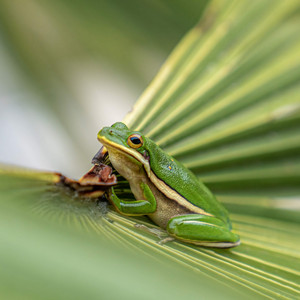
Green tree frog.
So this is Daniel Sullenberger, and he's a herpetologist and senior wildlife biologist with the Georgia Department of Natural Resources.
He identified these animals very quickly.
I guess this is what he does for a living.
But could he tell you anything else about them or why they might be populating Shabnam's yard?
Yeah, he did.
The things that are using her yard in Lawrenceville are very adaptable common things, things that can tolerate a wide range of conditions.
They're fine living in neighborhoods and homes.
They can live under You know, the deck on your porch or clump of cattails next to a retention pond.
Basically everywhere.
Okay, so these are not invasive lizards and frogs.
It appears not.
No, they're just super common.
But Shabnam also said she's seen increasingly more of these critters.
So did Daniel tell you why that might be?
Yeah, I asked him that too.
You know, I guess I would ask her, has anything changed?
In your neighborhood or your yard in that period of time.
You know there are things that you can do in your yard, intentionally or unintentionally, that tend to make better wildlife habitat.
Things like not mowing your grasses often or planting more native plants, maybe putting in a water feature like a fountain or a pond.
You know like if you put in a goldfish pond in metro Atlanta, you're going to get tree frogs and stuff using it.
Oh, duh.
Right, because amphibians love water.
Right.
And other local experts told me this too, like Mara Dudley.
She's a biology professor at Oglethorpe University and she's also the urban ecologist for the Amphibian Foundation in Atlanta.
What species might actually be found in your listener's area is going to depend a lot on the habitats that are present.
And primarily, is your listener.
Within about 100 yards of a body of water is going to make a big difference in terms of what species they might find.
So even a pool a block away could be contributing to what Shabnam is seeing in her yard.
Yeah, totally.
It's like the length of a football field.
So what can she do then to avoid seeing more lizards and frogs in her garden?
Daniel and Myra told me there's two different ways to kind of go about it.
There's the full eradication approach, basically making your yard as inhospitable as possible to any animal.
So things like cutting your grass very frequently, keeping it very short and neat.
If you have flower beds around your home, either don't have those or keep the shrubs and things trimmed so there's not layers of vegetation all the way to the ground.
Make sure you don't have any Rock piles, piles of limbs, piles of leaves, things like that.
Just places for animals to hide.
These are all terrible ideas, in my opinion.
But if you want to see less wildlife around your home, have nothing but concrete and sod and you'll see a lot less stuff.
Yeah.
Which, Daniel does say, comes with trade-offs.
Now, keep in mind...
When you're creating or destroying wildlife habitat around your home, it's hard to control what you're going to see.
So, for instance, if she really likes the birds well, this is going to maybe decrease the amount or diversity of birds.
You see too.
So that's the eradication approach.
So that's the eradication approach.
And then there's the sharing is caring approach.
I'll say this to your listener.
They probably don't want to see her as much as she does not want to see them, right?
Because any large organism is going to appear to be a predator to any kind of amphibian or reptile in the area.
Because, Emily, these reptiles and the amphibians, they want to hide.
So Mara suggested build a spot for them to do that.
Rather than tearing rocks and native plants out completely, just put them in a separate part of a garden, the part that maybe Shabdam doesn't garden in.
So create like a little amphibian sanctuary in a dedicated spot of the garden.
Yeah, exactly.
And Mara says this gentler approach, it has benefits for people too.
If your listener loves to garden, then she is probably benefiting significantly from having snakes or frogs in her garden, because they are some of the biggest consumers of insects and other pests like mice and rats and chipmunks that might be consuming things in her garden.
I feel like this is a whole perspective shift on amphibians in Atlanta from these herpetologists.
They're like, that may not be so bad.
Yeah, exactly.
Of course, I imagine this is happening in other places, not just Atlanta, where someone is noticing their garden being frequented by more and different animals.
Are there larger trends in urban wildlife?
Can we link what's happening in Shabnam's yard to a bigger ecological rise and fall in urban lizards and frogs?
Mara told me to some extent yes, the shift in wildlife that we're seeing goes beyond the greater Atlanta area.
It's happening in all these places that are urbanizing.
Because what we gain in real estate, animals lose in habitat, like in South Florida, where developers continue to push the Everglades boundary or subdivisions and ranches in the greater Yellowstone area.
If you move into a given area and there's a low amount of development around you and over time the demand for housing increases, what that means is all of these pockets that are natural areas tend to be then taken up and developed.
And what that means is that what was potentially suitable habitat for a lot of amphibians and reptiles now Right.
Because if they lose their habitat, then they got to go somewhere.
And that somewhere could be places that people are.
Yeah.
And Mara said this is just one of a few ways that human development can affect local amphibians.
Another way is fragmentation.
Particularly when it comes to amphibians, these species that live in terrestrial ecosystems most of the year and breed in freshwater ecosystems.
If there's now a road that is going through that connection in between, that puts a lot of species at greater risk for mortality.
Mara also mentioned human use of chemicals like pesticides that are really bad for amphibians and reptiles.
Yeah.
And then there's the issue of the predators that humans bring with us, like outdoor cats.
Mara likes to cite a 2020 study about this.
It was estimated that up to 92 million frogs were killed per year by cats in Australia.
And there have been some similar studies and kind of numbers that are coming out for the United States as well.
It's in the millions.
And that's just frogs.
Oh, dear.
That number doesn't count snakes, salamanders, lizards, other animals that are also killed by cats.
Honestly, this doesn't surprise me.
Cats are, they're adorable.
I have one.
And they're meant to kill.
They are.
But the good thing is, Emily, these things can work in reverse as well, right?
So just as human development can hurt reptiles and amphibians, it's also pretty easy for humans to help them.
Like planting native plants and removing invasives, or avoiding pesticide use, keeping our cats inside and then supporting temporary wetlands like ponds and marshes wherever they crop up near us.
So what I'm hearing from you Hannah, is there is so much we can do to help amphibians in our neighborhoods.
Yes, totally.
And there's actually one more aspect of Shabnam's question that I want to get into, Emily.
This idea that she's noticing more lizards and frogs.
Because Mara and Daniel told me, just because she's seeing them more often doesn't necessarily mean there's a population increase, that there's more of them.
Okay, but how come we don't know?
Because there's still a big gap in local scientists' data.
And that's because long-term studies monitoring the populations of these species in metro Atlanta really just don't exist.
So Mara is trying to change that through community science.
So the community science program is called the Metro Atlanta Amphibian Monitoring Program, which we like to refer to as MAMP, because that's quite a mouthful.
And Emily.
Anyone in the Metro Atlanta area can apply to be a community scientist in this MAMP program.
Mara and her colleagues will train them to identify each species in the field and document their findings.
And then volunteers have to take a series of quizzes to basically show that they retained all that information.
This is like school.
I mean, Emily, you love school.
I do.
It's true.
Anyway, there is an online sign-up form for trainings and program news.
We'll link to it in the show notes.
And if you like, Hannah and I are not in the metro Atlanta area but still want to learn how to identify and document local frogs, consider seeing if you have an active local Frog Watch chapter.
Search your city or state and Frog Watch USA.
Thank you so much for guiding us through this month's hoppy, hippity nature quest, Hannah.
Anytime, Emily.
Shortwavers, if you want to get in on this nature quest series, it's so easy.
Look around your environment.
Is anything changing?
Or do you have an environmental question you want us to investigate?
Well, record a memo and email it to us at shortwave at npr.org.
And we may look into it for a future episode.
This episode was produced by Burleigh McCoy with help from Rachel Carlson.
It was edited by Rebecca Ramirez.
Tyler Jones checked the facts.
The audio engineer was Jimmy Keeley.
Sam Polson composed and produced our NatureQuest theme music.
If you like this episode, follow us on the NPR app or wherever else you get your podcasts.
I'm Emily Kwong.
And I'm Hannah Chen.
Thank you for listening to Shortwave from NPR.
This week on Up First, more violence in Minneapolis.
Democrats say they will block a spending bill in the Senate after another deadly ice shooting.
How will Republicans respond?
And could the Trump administration rethink its strategy on immigration?
We'll keep you posted every morning with three stories you need to know to start your day up first.
Listen on the NPR app or wherever you get podcasts.
For 47 years, Iranians have lived under a dictatorship many no longer want.
Now the country may have reached a breaking point.
Iranians have recognized that they need to take matters into their own hands, pushing back against authority.
We ask three central questions about how Iran got here and what comes next.
Listen to ThruLine on the NPR app or wherever you get your podcasts.