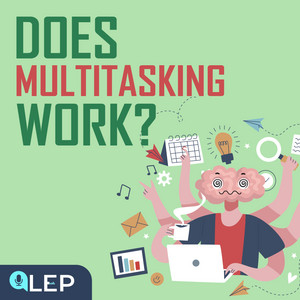
hey everyone welcome back to podcast and chill I'm Gwen here with my super thoughtful and endlessly curious co host Leo Leo oh hi I'm here what were you up to just texted my mom Um.
Is everything okay?
Yeah, she just wanted my Netflix login.
Leo, we're literally on air right now.
Can you focus? Relax.
I'm great at multitasking.
Are you, though? Totally.
Well, isn't that funny?
Because guess what today's topic is?
Uh, what? Multitasking.
Oh, my specialty. Are you sure about that?
Some people say it's a time saver.
Others think it's a total trap.
What are you waiting for?
Tell me more, Gwen.
Only if you promise to give me and our listeners 100 % focus.
You got it. All right, let's dive in.
And don't forget, we have a free PDF to help you work on these tips.
Make sure to create a copy so you can edit it for your own goals.
So, Gwen, let's start simple.
What is multitasking?
Multitasking is when you try to do more than one thing at the same time.
So, for example, typing an email while answering a text or listening to music while working.
Or texting your mom while having a conversation.
Hey, in my defense, my mom really wanted to watch her favorite series.
She said it was urgent.
All right, all right.
Let's get back to the topic.
So, multitasking. It sounds so smart, doesn't it?
Like, hey, I'm doing two things at once, I'm saving time.
That's why so many people try it, they think it's a shortcut.
Isn't it? Well, let's say it is not the best kind.
Why not? The idea is to manage multiple tasks efficiently, but it often doesn't work out that way.
How come? It's so...
time -saving. Except you might end up sending an email about coffee orders to your boss.
Not every time. If it doesn't work, why do people buy into it?
because it feels good to think we're being productive.
Aren't we? Multitasking can look impressive, but it's in fact risky and not as effective as it seems.
Can you elaborate on that?
Here's the thing. Our brains aren't built for multitasking, especially with complex tasks.
How do you know that?
Earl Miller, a neuroscientist and professor at MIT, has said that switching between tasks can reduce productivity by up to 40%.
40 %? That's like losing two days out of a five -day work week.
Pretty much. In other words, it's just smoke and mirrors.
Hold on, but I see people all the time texting and walking.
Isn't that multitasking?
It is, but those are simple tasks.
When it comes to complex things, like writing a report and joining a meeting, your brain can't handle both at full capacity.
Are you saying we perform worse when we multitask?
Well, not to offend you, but a study by Stanford University showed that people who think they're great at multitasking actually perform worse in tests of attention and memory.
Now that you mention it, I've just realized that sometimes multitasking feels like it makes me forget stuff.
Why is that? Because multitasking splits your attention.
Instead of focusing on one thing, your brain jumps back and forth, which weakens your ability to concentrate.
That sounds bad. Watch out.
Wow. So, I'm basically sleep.
Deprived when I'm multitasking?
Kind of. Plus, multitasking can increase errors by two to three times compared to focusing on a single task, according to the American Psychological Association.
That explains the time I emailed Best Regards, Leo, to my mom, and Love Mom, to my boss.
When you divide your focus, you're more likely to make mistakes or miss key details.
So, multitasking isn't just inefficient.
It's downright embarrassing.
Yep. If you want to get things right, it's better to focus on one task at a time.
Alright, Gwen, let's go over some new vocabulary for today.
First, work out. It means to solve a problem, find a solution, or have a good result.
For example, don't worry, I'm sure everything will work out in the end.
Second, buy into. It means to believe in or agree with an idea or plan.
For example, the team didn't buy into the new strategy at first, but now they see its value.
Third, smoke and mirrors.
It refers to actions or information meant to deceive or distract.
For example, the politician's promises were all smoke and mirrors.
Fourth, hold on. It means to wait for a moment or to keep a firm grip on something.
For example, hold on, I'll be with you in just a second.
Finally, back and forth.
It describes a movement or discussion that goes in two directions repeatedly.
For example, we had a back and forth about the budget before coming to an agreement.
now let's discuss two questions about multitasking first question is why do you think people believe multitasking makes them more productive i think it's because multitasking feels like you're getting more done in less time even though it's not always true that's a good observation The second question is,
what's the biggest risk of multitasking?
The biggest risk is splitting your attention, which leads to more mistakes and lower productivity.
What about you, listeners?
Share your thoughts in the comment section down below.
One more thing I've just noticed is I always feel like my brain's fried after a day of multitasking.
It's because your brain burns out faster when you switch between tasks all the time.
How does that happen?
Think of it like running back and forth between two doors all day.
That way you're using way more energy than if you just stayed at one door.
Oh, like when I tried to write an email and respond to texts at the same time?
And what was the aftermath?
By the end, I couldn't even remember what I was doing.
See? Switching tasks makes your brain work harder because it has to reset every time.
That extra effort drains your energy.
That sounds tough. And when your brain is overworked like that, it struggles to think clearly or come up with creative ideas.
So that's why I can't figure out solutions when I've been multitasking all day?
Yeah. I mean, you basically have no energy left to think, let alone think creatively.
Well, so if I want to keep my mental energy and creativity flowing, I should focus on one thing at a time.
Exactly. Stop treating your brain like a 50 -tab browser.
It's so funny thinking about it.
What are you thinking about?
I've always thought multitasking saves time.
I mean, I'm doing two things at once, right?
But turns out it multitasking wastes time.
You're right. As I just said earlier, you might end up making mistakes and having to fix them later when you're doing several things at once.
That sounds frustrating.
But how much time are we talking about here?
Well, a study from the University of California found that multitasking can actually make you take twice as long to finish a task compared to focusing on one thing at a time.
Twice as long? That's too bad.
That's why the solution in the long run is to focus one thing at a time.
It may feel slower, but more effective.
I think I'll probably have a hard time switching back to single tasking.
Why's that? I always feel rushed with just one thing to do.
Actually, one of the great things about single tasking is that it reduces stress.
Really? For sure. Let's think about it.
You don't have to worry about juggling different tasks at once.
That would be great.
Your mind stays clear, and you can enjoy the process instead of stressing over what's next.
Uh -huh. Sounds good.
And not only does single tasking reduce stress, but it also improves the quality of your work.
I guess when we give something our full attention, it's more likely to be done right.
That's exactly what I want to say.
But Gwen... What? Multitasking is so addictive.
What if I get relapsed?
I must admit, once a person gets used to doing multiple things at once, it's not easy to change their habit.
How do we stop ourselves from jumping back into multitasking?
First, break your tasks into smaller chunks and give yourself a set amount of time for each section.
How does that help?
This helps keep you focused and prevents the urge to switch tasks.
What else can I do?
Secondly, turn off all notifications while you're working.
That way, you won't get tempted to check your messages or emails.
Oh, I definitely need to try that.
What's next? And finally, prioritize your tasks.
Do the most important ones first and leave the less urgent tasks for later.
All right, I'm sold on that.
I think I'm ready to give it a try.
That's the spirit, Leo.
All right, Gwen, let's cover some more useful phrases today.
First, burnout. It means to become very tired or lose motivation from overwork or stress.
For example, if you keep working late every night, you'll burn out quickly.
Second, come up with.
It means to think of or create an idea or solution.
For example, we need to come up with a new marketing strategy.
Third, figure out. It means to understand something or solve a problem.
For example, I can't figure out how to use this new phone app.
Fourth, in the long run.
It means over a long period of time.
For example, eating healthy now will pay off in the long run.
Finally, be sold on.
It means to be convinced or fully believe in something.
For example, at first, I wasn't sure about the plan, but now I'm sold on it.
All right, Gwen, here's a question for you.
Sure, what is it? Why do you think multitasking makes us feel mentally drained by the end of the day?
It's because switching between tasks all the time makes our brain work harder, using more energy than if we focused on one thing at a time.
Now it's your turn to ask me a question.
What is one benefit of single -tasking?
It reduces stress and improves the quality of your work because you can give your full attention to one task.
That's spot on. So Gwen, after everything we've talked about today, it's clear that multitasking isn't the productivity booster we thought it was.
For sure. When you focus on one thing at a time, you'll likely get better results.
It's about working smarter, not harder.
And don't forget it will make us less stressed too.
You're right. So, next time you're feeling busy, take a step back and focus on just one thing at a time.
You might be surprised at how much more you get done.
And what about you, our listeners?
Do you agree with us?
Tell us what you're going to do in the comments section below.
Thanks for joining us today.
I'm Gwen. And I'm Leo.
See you next time.