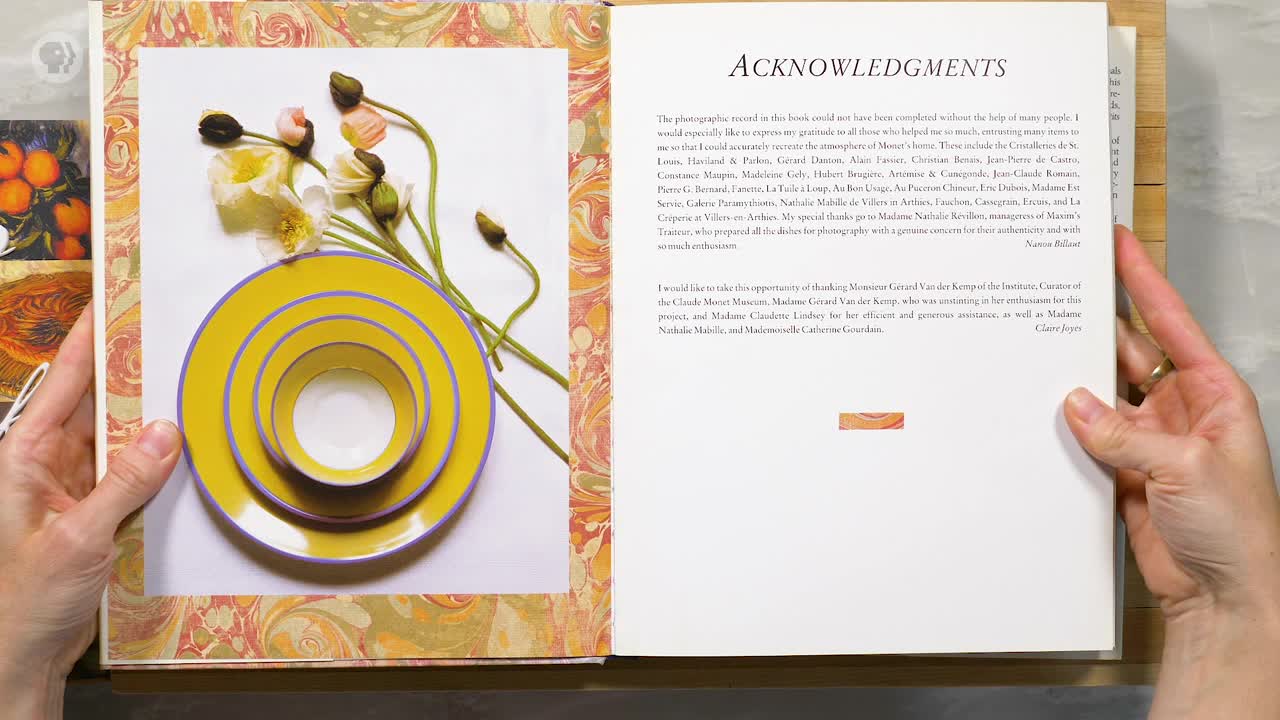
Hi friends, we're back with another edition of Art Cooking, and our primary source for today is going to be Monet's Table because yes, we're exploring the life, art and eating habits of none other than French artist Claude Monet, the subject of not just one but numerous cookbooks.
This isn't even all of them, but this book was, for me, the most faithful to the recipes and eating adventures the artist recorded in his journals.
And look it even shows off the special occasion china he had made to order in Limoges, which communicates a key piece of information about our subject.
He took the details and decisions of domestic life extremely seriously.
You've likely heard of the glorious gardens at his home in Giverny, which he rendered in all their glory.
But today we're going to investigate what actually happened there.
In the kitchen, where his meals were prepared by his favorite cook, Marguerite.
And in his garden, tended by his trusted gardener, Floremond.
And also in the sunny yellow dining room, where he'd entertain fancy guests for elaborate lunches.
Food and fine living were a focus in Monet's life and also an integral part of his approach to art, part of the tableau of modern existence he carefully constructed around him and that he also very much liked to paint.
We're going to cook our way through a typical day in Monet's life at Giverny.
But first let's bring in some fresh cut flowers, because Monet liked to have them in every room in his house.
Flowers, he said.
I must have flowers always.
He liked to paint them too, of course, both in indoor settings and still life arrangements, and outdoors, in compositions capturing urban gardens and in the countryside, where he enjoyed painting in plein air, the French term for painting outside.
Our man Claude, liked to arise early at 5 am or first light to explore his environs and look for things to paint.
He'd return home for breakfast around 7 AM.
And we're not going to do a spread quite like the one recreated in Monet's table, but we are going to make an egg dish called Eggs Orsini, included in Monet's table and also in the Monet cookbook, where it's pictured beautifully.
His breakfast usually involved eggs gathered from the chickens raised right next to his main house.
And for this, we're going to need six of them.
Grab a towel.
Yours doesn't have to have chickens on it, but it is a nice touch.
And scrunch it up.
Then break the eggs and separate the yolks from the whites.
And store your yolks in a half shell and cradle them upright in the towel.
Next, you're going to take your egg whites and season them with a bit of salt before setting about whisking them until stiff.
While I'm testing my forearm strength, let's take this opportunity to look back at Monet's early life, when he was just a spring chicken.
Sorry.
Oscar Claude Monet was born in 1840 in Paris to fairly well-to-do parents who soon after moved him to Le Havre, in France's Normandy region, where he grew up.
He didn't talk a lot about his childhood, except his son-in-law would later report that Monet often repeated that friends are worth more than family.
While you appreciate the not-so-passive-aggressive dig there, I'm going to call in reinforcements to help with the egg-white beating cause.
Because none of us gets anywhere in life completely on our own, and Monet grew up drawing and painting from a young age with the encouragement of his mother, who loved art and music and theater.
By the age of 15.
Oscar, as he was then known, made a name for himself making charcoal caricatures of locals around his town, which he sold for 10 to 20 francs each.
And soon after he met Eugène Boudin, a painter who took Monet under his wing, taught him his plein air technique and passed along his deep appreciation for the play of light in natural scenes, mostly seascapes.
When your egg whites look like the peaks of boudin's waves and are stiff enough to support the weight of a small spoon without sinking in, they're ready.
You'll then need to liberally grease an oven-proof dish and pour in the whites, spreading them around to smooth the surface.
Make little divots for your yolks and then carefully slip them in and curse when the very first one you do breaks.
Then try a little harder and place the others even more carefully, before sprinkling with a couple tablespoons of grated Gruyere cheese and dotting with little pieces of butter, before sending it on to a 300-degree oven for 20 to 30 minutes, or until the yolks are just set.
While that's in, we'll get the rest of our breakfast ready, which is going to involve this lovely melon that I found at the farmer's market and reminded me of this one that Monet painted.
His is reported to have been an early frame Prescott melon, aka Paris favorite, grown in his gardens.
But I'm going to keep by the ethos the painter lived by at Giverny to eat the best and freshest produce possible.
And here we have it.
But living wasn't always this easy for Monet.
Young Monet was supported and encouraged by his aunt, Marie-Jeanne Le Cadre, an artist in her own right, who supported him financially, since his father didn't approve of his chosen profession.
Monet found his way to Paris by the age of 22, where he met and befriended artists including Pierre-Auguste Renoir, Frédéric Bazille and Alfred Sisley, who would soon become his compatriots in Impressionism.
Monet did OK in his early years, but when his most ambitious painting to date was rejected for display in the Royal Academy's annual salon, he carved off with other artists like Edgar Degas and Edouard Manet and Camille Pissarro to hold their own independent exhibition in 1874.
Their brushwork was looser and forms and figures less distinct than the academic artists of the time.
And soon after they began to call themselves Impressionists, inspired by a critic's disparagement of one of Monet's contributions to the show titled Impression Sunrise.
Later on, Monet explained the approach like this.
When you go out to paint, try to forget what objects you have before you a tree, a house, a field or whatever?
Merely think here is a little square of blue, here an oblong of pink, here a streak of yellow and paint it just as it looks to you, the exact color and shape, until it gives you your own naive impression of the scene before you.
But at the time, impressionism was not a household word, and that painting did not sell.
While he did sell some canvases here and there, Monet struggled greatly during this period.
He was dogged by creditors and more than once borrowed money from his friend Manet, who captured the artist afloat in the Seine at work in his boat studio, where he was well able to capture the play of light on the water and views along the riverbank.
Now let's check on our eggs, and oh no!
We have not watched this carefully enough, and our eggs are now way past just set.
Gah, Monet would not approve.
But we're going to make the best of it and serve it up for two, adding some good French cheese, as Monet would often have Normandy's famous camembert along with some bread and butter.
And we'll add in our melon, too.
Many mornings Monet's oldest stepdaughter Blanche, also an artist, would join him for breakfast and then follow him out the door again by 9 am to assist with his setup wherever he was painting that day.
This comfortable life full of elaborate meals only became possible for Monet in his 40s, when his work finally began to sell to American collectors.
It was only in 1883 that Claude was in a position to afford to decamp to Giverny and eventually buy the house and walled garden where he would live for the remainder of his life.
It was private, had good light and a garden that he would meticulously cultivate and shape over the course of decades.
He planted chrysanthemums and poppies and sunflowers and nasturtiums, carefully constructing not just a garden but an environment made specifically to be painted.
He diverted the course of a nearby stream to anger his neighbors and create a pond which he filled with you guessed it water lilies.
He later added a bridge and hanging wisteria, elements in his compositions whose style had become increasingly abstract as the years passed.
While Monet's off painting for the morning, we're going to get a jump on lunch.
And to do that, we're going to start with apples, another famous foodstuff of Normandy.
His main home at Giverny, now referred to as the Pink House, was then called La Maison du Pressoir, because it was originally a farmhouse with a cider press.
And that's right, with apples, you make cider, which can be fermented like this one to become alcoholic.
We should probably have a taste while the boss is away and to drown our overcooked egg sorrows.
Monet often enjoyed cider at the table or served at picnics.
And ugh, this one is not good.
Or has a musky taste I'm just not sophisticated enough to appreciate.
Let's try another.
Monet was very choosy seeking out recipes from restaurants.
He enjoyed carefully planning and selecting menus for Marguerite to prepare and finding the best seeds for his garden.
Ah, that's better.
Nice and dry and the perfect fuel for making something of these apples which is going to be a tarte tatin.
We'll follow the recipe in Monet's table, but also check the nice photography in the Monet cookbook to see the general appearance we're aiming for but will no doubt fail to duplicate effectively.
We're first going to set about peeling our apples, also sourced locally from the farmer's market.
The recipe says six, but we're going to go ahead and prepare the nine we have.
And critique our peeling style all you want, but do know our scraps are not going to go to waste.
We have a special guest coming soon who's going to help us make use of them.
Monet had fruit trees espaliered against the boundary walls of his kitchen garden pears and plums and also apple trees of the Reine de Renette variety that they'd use for this recipe.
The Tarte Tatin originates with none other than the Tatin sisters, who ran a hotel in the Loire Valley that Monet and Alice liked to visit.
You might be wondering why we're going to the trouble of making such a nice dessert for lunch.
And it's because lunch was when the Monets liked to entertain guests.
The midday and early afternoon light was too harsh, and thus Monet's least favorite time to paint.
So why not use that time effectively?
Whether or not guests were involved, Monet and his second wife Alice, would devote time to devising the menu and like to cater to the preferences of special guests, including close artist friends, valued art dealers, as well as political and literary luminaries of the time.
OK, so now you're going to core the apples and cut them into fairly large pieces about like this.
Then find a deep pie dish or cast iron skillet or whatever roundish oven-proof dish you have, and grease it with butter.
Then start fitting the apple pieces tightly into the pan.
When you've fully occupied the base of the pan, dot the apples with one cup of unsalted butter cut into pieces.
I didn't measure this because I misread the recipe and thought the one cup was for the sugar.
That goes on next.
I should be sprinkling over top two and a half tablespoons of confectioner's sugar, but I'm going all out here and using most of a cup of regular sugar.
But hey, this kind of has to taste good, right?
What we're functionally doing is putting all the ingredients for a caramel into the pan and letting it caramelize in the oven all around the apples.
Because I'm well aware of my own shortcomings, I've skipped making my own pastry and purchased pre-made puff pastry from the freezer section of my market.
You can and should make your own, but I've used this stuff before and I'm 100 confident that this will come out much better than if I did it myself.
Once I've done the hard work of unwrapping it, I fold it over and roll it out enough so that I know it will cover my pan of apples.
I have a plate that is roughly the same size as my pan, so I use that as my guide to cut the pastry in a circle that will fit perfectly over the apples.
And miracle of all miracles, it does.
I tuck in the sides a little and send it into a 400 degree oven to bake for 45 minutes.
Now for all meals.
Monet would have been sure to carefully select the very best produce that would have been prepared the next day.
We sourced our spread from the farmer's market, but Monet's would have come from his two and a half acre vegetable garden that was at the opposite end of the village from the main house.
Tended by Florimonde, who lived in the blue house.
On the property, the garden provided a constant supply of Claude's favorite fruits and vegetables.
Zucchini, or courgette in French, was a favorite.
But we're going to pull out these great looking mushrooms.
Monet's sons would go out and forage wild mushrooms for him in the local woods, and he also grew his own in the basement of the Blue House.
Let's pull some onions for later as well.
The only recorded recipe that was truly Monet's and not gathered from other sources was one for seps, which are wild mushrooms very much prized in France.
They're close to porcinis, but have a thick edible stem that look like this.
Again, I went with what was local and fresh, but we'll follow his recipe that instructs us to separate the caps and keep them whole and then chop the stems finely.
Now living at Giverny, not only allowed Monet to live the good life, But it also provided him a subject that he would observe and record as it changed over time.
Different times of day offered vastly different lighting effects, as did weather conditions and, of course, the seasons.
He created over 250 paintings of water lilies, but also examined the changing appearance of other subjects, including his Haystack series and also his paintings of the Rouen Cathedral, which he depicted again and again renting a room across from its facade and moving from canvas to canvas as the light changed throughout the day.
This painting of exactly what is seen before.
You may seem pretty basic now, but then it was wildly different than the static composed history pictures lauded by the establishment.
Okay, so now we're to arrange the stems in a shallow oven-proof dish and lay the caps on top of them.
Then sprinkle with four tablespoons of olive oil, finally turn around this knife that's been ominously pointing at me and whisk them off to a 325-degree oven for 20 minutes.
While they're in, we mince two cloves of garlic and chop four sprigs of parsley and mix them together.
After 20 minutes, pull the mushrooms and sprinkle them with the mixture and season them with salt and pepper.
Then send them back into the oven for another 20 minutes.
Okay, now time to contemplate what protein we're going to have for lunch.
And to do so, I'd like to invite in our aforementioned special guest to help us decide.
Please meet Mary Lou, a male chicken whose loving owners didn't realize his sex when they named him.
And here we are.
As you know, Monet did raise chickens, but not just for eggs, and kept them, and also turkeys, in pens conveniently close to the kitchen.
But let's get you out of here, Mary Lou.
You've helped me decide.
There will be no chicken for lunch today, but please know that Monet might not have been so kind.
He also raised ducks, who had a small pond to swim in and shrubs under which to nest.
While we admire Mary Lou exploring my backyard, we might as well note that one of Monet's favorite subjects to paint, other than gardens and landscapes, was his first wife, Camille Dancieux, who he met in 1865 and married in 1870.
She appears in over 30 of his paintings and even posed for all four figures of women in the garden.
Tragically, Camille died shortly after giving birth to their second child, and a grieving Monet painted her for the last time on her deathbed in 1879.
Claude then linked up with Alice Hoschedé, who would become his second wife, joining their families, including Monet's two children with Camille and Alice's six children from her previous marriage.
It was this large crew that occupied and enlivened the Monet's home at Giverny, where they arrived in the spring of 1883.
All right, so it's not going to be poultry.
Let's go with seafood instead.
How about mussels with fresh herbs or, in French, moules au verre, translated to green mussels in the Monet cookbook?
We're going to work between these recipes and also consult some internet methods, first getting out our mussels, which we want to wash well in lots of cold water.
Be sure to discard any that are broken or not tightly closed and pull off the little beards that sometimes extend from where the shells split.
Then we're going to coarsely chop two small onions and a couple stalks of celery and set them aside with a few sprigs of parsley.
And we also need to prep our green for the green mussels, which is going to be chives standing in for the requested chervil and arugula standing in for the requested sorrel, along with more parsley and also some tarragon.
We're gonna give these all a good chop-chop.
And while I do this, let's talk about Monet's affection for both seafood and the sea.
He grew up, of course, on the coast at Le Havre and much enjoyed painting the coastline near there in his younger days and the coastline near Dieppe when he was a mature artist.
Not terribly far from Giverny.
The seaport of Dieppe was Monet's source for fresh seafood which they would go to the trouble to get for special lunch guests.
Renoir very much liked Marguerite's bouillabaisse and Cézanne liked a particular cod recipe recorded in Monet's journal.
Now that we've got everything prepped, let's head to the stovetop, where we're going to heat up a large pot that has a tight-fitting lid and melt some more butter in there.
Throw in the onions and celery to saute a bit, and also the parsley sprigs.
Let's cook those for a minute while we open up a bottle of dry white wine and make sure the mussels are close by too.
Add in a good amount of the wine, give it a stir, and tip the mussels over into the pot.
Cover it with the lid and cook over high heat for about 10 minutes, giving it a good shake every once in a while, like this, or maybe a little more gently.
While that's going, we're going to get our salad ready, which would accompany most meals.
And Monet had to have it precisely his way, you'll be surprised to learn.
Fresh greens were harvested from the garden, usually chicory or dandelions or purslane, and a bowl of them would be presented to Monet by Marguerite's husband Paul, who was their valet and butler.
Paul would hand-clod a large serving spoon which he would fill with a tremendous amount of freshly cracked pepper, some salt, olive oil and a drop or two of white wine vinegar.
Paul would pour the contents over the greens and toss it, creating a salad so unbearably peppery that a separate salad had to be made for everyone else.
If you want to know how the pepper happened, let's flash back for a moment.
Here we are with my ceramic spice grinder.
And into it we'll pour our peppercorns and set about grinding them in much the same way.
Cookie Monster eats cookies.
This is an excellent activity for anyone with some tension to release.
And Monet certainly did have tension in his life.
The uncontested patriarch of the household, Monet was closely tracked by his family, who would try to guess at whether he was in a good mood or not.
If everything wasn't just right, he could burst into a rage about anything, especially when the schedule was not kept and especially if he felt his work was not going well.
Monet destroyed as many as 500 of his own paintings during his life, once taking a knife to more than 15 water lily canvases before a show in 1908.
He experienced bouts of depression throughout his life and was his own harshest critic, continually seeking perfection.
This is all to say that lunch had to be served promptly at 1130.
So let's get to it.
Remove the mussels when their shells have opened, making sure to discard any ones that didn't open fully in the steaming process.
Add some butter to the remaining cooking liquid.
Throw in the greens, and then spoon the mixture over the mussels.
We're gonna enjoy these with our mushrooms and some good bread and also our way too, peppery salad, in a manner not at all like the formal setup Monet would have had in his dining room.
The strict schedule they followed continued throughout the day, with dinner for the family served promptly at 530, beginning with soup and proceeding with Monet helming the table and carving the meat that would be served.
Because he got up so early, Monet also went to bed early, 9.30 p.m. at the latest.
We are exhausted from all of this cooking, and not at all the perfectionist Monet was, so we're going to skip over dinner and just wrap things up by enjoying our apple tart.
That was ready ages ago, by the way, and came out quite nicely.
When it finished baking, we pulled it from the oven and overturned it onto a plate.
Or at least we tried that and then had to loosen the pastry from the pan with a knife before it smoothly slid out.
We clearly used apples that weren't firm enough for this endeavor and have ended up not with nicely coherent segments of apples, but kind of a caramelized applesauce sitting atop the pastry, which can't be too bad.
Let's dish this up and serve it along with some crème fraîche, and also raise a glass to our man, Monet of Calvados, a distilled liquor made from apples, another famous export of Normandy.
Monet once told art dealer René Gimpel I have always been a hearty eater and it has never done me any harm.
In fact, I think it was hearty eating and enjoying quality ingredients and the good company of family and friends that kept propelling Monet forward. helping him through rough times, whether they were rough financially or psychologically or creatively.
He developed cataracts later in life and was deeply troubled by its effect on his work, which you can tell from the change of color tone in his later canvases.
He underwent surgery on just one of his eyes and, as a result, he could see violets and blues through his right eye, but not his left.
He had long brought to his works vibrant colors rarely seen before in art, until the end gave us a stirring glimpse into the world around him, precisely as he perceived it.
Monet died of lung disease in 1926 at the age of 86.
And his work would go on to influence so many others who would follow his lead in rejecting the establishment style and pursuing their own creative visions.
But while he was alive, it cannot be denied that this man knew how to live and how to appreciate and capture the world around him just as he wanted it to be.
Thanks to all of our patrons for supporting The Art Assignment, especially our grandmasters of the arts, Vincent Apa, Josh Thomas and Ernest Wolf.