NPR. It is election season!
And that means debates over economic policy.
Our favourite kind of debates.
Yes indeed, and yesterday we put Donald Trump's economic proposals under a microscope, and today it's Kamala Harris' turn.
Even though her policy platform has been a little light so far.
Look, she's only been the Democratic nominee since August.
OK, fair enough. And even from what she said, there is quite a bit to scrutinise.
It's a very different economic vision than Donald Trump's.
This is the indicator from Planet Money.
I'm Weyland Wong. And I'm Darren Woods.
Today on the show, the Kamala Harris economy.
We talk to an economist who's broadly on board with Harris' direction of travel.
Even she quibbles of some of the detours along the way.
The following message comes from Weyze, the app that makes managing your money in different currencies easy.
With Weyze, you can send and spend money internationally at the mid -market exchange rate.
No guesswork and no hidden fees.
Learn more about how Weyze could work for you at Weyze .com.
Support for NPR comes from NPR member stations and Eric and Wendy Schmidt through the Schmidt Family Foundation.
Working together to create a just world where all people have access to renewable energy, clean air and water and healthy food.
The Schmidt Family Foundation is part of the philanthropic organisations and initiatives created and funded by Eric and Wendy Schmidt to work toward a healthy, resilient, secure world for all.
On the web at the Schmidt .org.
This message is brought to you by Warby Parker.
Their glasses start at $95, including anti -reflective, scratch -resistant prescription lenses that block 100 % of UV rays.
Try five pairs of frames at home for free.
Go to warbyparker .com slash covered.
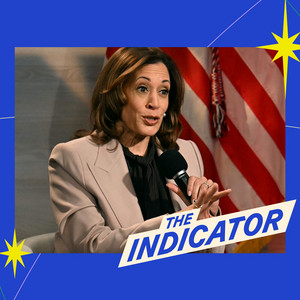
On Tuesday, Kamala Harris sat down for an interview.
Vice President Kamala Harris.
The audience, the National Association of Black Journalists.
So I thank you for hosting me today.
And after talking down the economy the Biden administration inherited four years ago and talking up their achievements since then, she moved into her policies.
Coaches, we need to expand the child tax credit.
High on the list, taxes.
That's the first of three economic themes we'll talk about today.
Harris's plan is to raise the child tax credit substantially for the first year of a newborn's life.
It's currently up to $2 ,000 per child.
Harris wants to raise it to $6 ,000.
To analyze this and other key Harris proposals, we caught up Katherine Ann Edwards, an adjunct economist at the Rand Corporation and a policy consultant.
Katherine points out that we as a country have kind of tested out what it would mean to expand the child tax credit.
That's what we did during the pandemic.
And child poverty decreased a lot.
So now the question is, are we going to walk away from a solution?
Harris's campaign and as well as a bipartisan House and kind of Senate negotiation have said this was good.
It helped a lot of families.
We should expand it.
And what do you say to those who argue that maybe it should be more targeted to those who are really in poverty as opposed to the more middle or upper middle class families?
If we wanted to end child poverty in the US, we could do it at the snap of a finger.
I don't necessarily like the politics of it.
I don't necessarily like the reality of it that in order to give poor kids a benefit, we have to give it to middle class and upper class kids too.
But it has been really effective.
It's probably one of the most popular policies related to children that the US has seen in a long time.
Katherine believes that the policy just wouldn't be as popular if only lower income families were eligible.
And expanding the child tax credit has support across the aisle.
Trump has supported the child tax credit and vice presidential candidate J .D.
Vance has said he wants to raise it to $5 ,000.
Although Vance didn't vote on the failed bill this summer that would have expanded it.
Another part of Harris's tax plan relates to the corporate tax rate.
Currently businesses face a 21 percent tax.
Kamala Harris wants to raise it to 28 percent.
The Committee for a Responsible Federal Budget estimates that this would raise a trillion dollars over 10 years.
Katherine says there is a real need for that trillion dollars.
The US does not collect enough in taxes.
It simply doesn't. Not for the amount of spending that it has and we can talk all we want about how like actually we should squeeze spending.
But I'm telling you no party seems capable of doing it.
And the three biggest sources of spending are Social Security, Medicare and defense.
So we have to raise more in taxes over the next 15 years.
And I think having corporations contribute to that too is only fair.
28 percent is high by international standards.
But Katherine notes that economists can't find strong evidence that the US economy benefited much from a big corporate tax cut in 2017.
So she can't see a reason why a raise back up would have a damaging effect.
That said, the Tax Foundation, a think tank, estimates in the long run the higher corporate tax rate would reduce wages and GDP by around half a percent.
Less charted territory is Harris's proposal to tax unrealized gains for people with more than 100 million dollars in wealth.
That means that you would apply a tax when someone has not sold or valued the asset in the market.
Katherine sees this idea of taxing wealth before it's been sold as responding to a somewhat hidden issue.
Very rich families restructure their wealth in a way that has meant they've minimized tax for a long time.
One example is how billionaires won't necessarily sell their shares to fund their living expenses.
They'll simply borrow money from a bank against those shares.
That gives them flexibility to sell their shares when they might face a lower tax rate later in life or even after they die.
So there is a lot of wealth in the United States that has never been taxed.
We are now in a state of wealth inequality that approaches late September 1929, and the tax system has not evolved to keep pace with it.
Even though this by definition only affects the ultra wealthy, it is a highly unusual policy that, according to the Cato Institute, few other countries have.
Still, Katherine thinks it's worth a try.
I don't know if it would work, but I do think that we should try to make people who are very good at reducing their taxes pay as much as people who don't have the type of resources to reduce their taxes to the same degree.
At her talk to the National Association of Black Journalists on Tuesday, Harris talked about her second big economic priority, housing.
We have a shortage of housing supply.
Harris reiterated her plan to try to get more houses built, with things like a $40 billion fund tied to building new affordable housing.
The biggest impetus for most households in buying their first house is the down payment.
So on that front, Kamala Harris is proposing up to $25 ,000 for first time home buyers.
But... The problem is that it has to work in tandem with the creation of new homes.
And depending on who you ask, the shortage of available housing for purchase in the United States is somewhere between $1 to $5 million.
But you're going to create the credit before you create the housing.
I imagine it's easier to write checks than it is to build houses.
It's a lot easier to write checks than it is to build houses.
And so I'm worried about the implementation of this.
You could just imagine another swell of home prices.
Basically, you're going to eat this $25 ,000 in a higher home price.
And that brings us to our third and last big tent poll of Kamala Harris' economic marquee today.
It's one of the more contentious ones, at least among policy wonks.
It's related to grocery prices.
Kamala Harris alluded to this to the National Association of Black Journalists.
Is the price of groceries still too high?
Yes. Do we have more work to do?
Yes. Ah, yes. Kamala Harris has pledged to make a federal ban on price gouging of grocery prices.
And because feelings are so high on this, let's look through the actual wording of what she's put out.
OK, here's the quote.
Advance the first -ever federal ban on price gouging on food and groceries.
Set clear rules of the road to make clear that big corporations can't unfairly exploit consumers to run up excessive profits on food and groceries.
Our economist, Catherine Anne Edwards, likes the spirit but doesn't think this will be a silver bullet to bring down prices.
It's simply hard to do well and easy to do poorly.
Some economists love coming down hard on this and saying, like, we did this in the 70s, and, like, hey, there, little missy, you don't know what you're doing.
Like, it can be really condescending.
Yeah, most economists hate laws like this, and they see price gouging as a red herring.
I think it's just wanting to create a window for finding price gouging and stopping it as opposed to setting the price of food for, you know, a several trillion dollar size economy.
In other words, Catherine expects any action will be more restricted to extreme circumstances, like how New York state recovered $100 ,000 from a distributor when they raised the price of Lysol more than 50 % in the early days of the pandemic.
So those are three key areas where Harris stands in greatest contrast to Trump.
But just stepping back, it's interesting to look at what's not being discussed by both candidates.
Syria's plans to reduce the national debt.
The federal debt has been hovering around levels not seen since World War II.
And yet from both candidates, crickets.
According to four think tanks, over 10 years, Trump's plans would increase the deficit by three and a half to six and a half trillion dollars.
While Harris's plan would increase the federal deficit less, but still at a sizable $400 billion to $1 .4 trillion.
At that talk this week, Harris didn't mention the federal debt once.
Donald Trump has said he'd solve it, but with no definitive plan.
This episode was produced by Julia Ritchie with engineering by Neil Rauch, who was fact checked by Sierra Juarez.
Cake in Canada is our episode and The Indicator is a production of NPR.
Hey, it's Mike and Ian.
We're the hosts of How to Do Everything from the team at Wait, Wait, Don't Tell Me.
Every week we take your questions and find someone much smarter than us to answer them.
Questions like, how do I safely jump out of a moving vehicle?
How do I dangerously jump out of a moving vehicle?
We can't help you, but we will find someone who can.
Listen to the How to Do Everything podcast from NPR.
Nervous about the new school year?
Whether you're a student or a parent, life kick gets it.
You're so worried about where you fit in.
Your body is changing.
It's braces. It's bras.
It's all of the above.
And I think nobody is comfortable for quite a while.
Whether those changes with Life Kit's Guide on transitioning back to school, listen to the Life Kit podcast from NPR.