This is the TED Radio Hour.
Each week, groundbreaking TED Talks.
Our job now is to dream big.
Delivered at TED conferences.
To bring about the future we want to see.
Around the world.
To understand who we are.
From those talks, we bring you speakers and ideas that will surprise you.
You just don't know what you're going to find.
Challenge you.
We truly have to ask ourselves, like, why is it noteworthy?
And even change you.
I literally feel like I'm a different person.
Yes.
Do you feel that way?
Ideas worth spreading.
From TED and NPR.
I'm Manoush Zomorodi, and on the show today, natural intelligence.
And we're going to kick things off by going back in time to the 1750s.
And a marshy, swampy, subtropical wetland in North Carolina. where a man named Arthur Dobbs lived.
Yeah, no, I like Arthur Dobbs.
This is our tour guide, Greg Gage.
He was the governor of North Carolina.
This is back in the 1750s, still under British rule.
And Arthur, he says, was a curious man, a bit of a gentleman scientist.
So when Arthur started to hear a rumor about a very unusual plant growing not that far away...
He decided to go check it out.
And he heard these stories about this plant.
He says, well, I'm the governor of this land.
I should go investigate.
He went out to the swamps.
And so there's a little small area.
I think it's about six square miles.
And then there, low to the ground, are these little tiny plants.
And if you watch them long enough...
A bug will eventually fall into its little or walk across its little leaves and it snaps shuts and it eats this bug.
And so, of course, he's pretty fascinated by this.
Understandable because, well, no Europeans had ever documented a plant like this before.
So he does what scientists do at the time.
They take out a letter and they write to their colleagues in Europe.
The great wonder of the vegetable kingdom is a very curious unknown species of sensitive.
He writes, it's a dwarf plant.
Leaves are like a narrow segment of a sphere consisting of two parts, like the cap of a spring purse.
Upon anything touching the leaves or falling between them, they instantly close like a spring trap.
To this surprising plant, I've given the name of fly trap sensitive.
The flytrap sensitive, or as we call it today, the Venus flytrap.
The news of this remarkable animal-eating plant took off across Europe.
And 100 years later, Charles Darwin would write an entire book called Insectivorous Plants.
Eventually, the great Charles Darwin got to study this plant, and this plant absolutely blew him away.
He called it the most wonderful plant in the world.
Here's Greg Gage on the TED stage.
This is a plant that was an evolutionary wonder.
This is a plant that moves quickly, which is rare.
And it's a plant that's carnivorous, which is also rare.
And it's in the same plant.
But I'm here today to tell you that's not even the coolest thing about this plant.
The coolest thing is that the plant can count.
So let's pause for a moment.
Greg Gage is not just an amateur fly trap historian.
He is actually a neuroscientist and educator.
And on the TED stage, he conducted a live science experiment.
So I'm going to pretend to be a fly right now.
Surrounded by monitors, microscopes, and of course...
And here's my Venus flytrap.
And inside the leaf, you're going to notice that there are three little hairs here and those are trigger hairs.
And so when a fly lands, I'm going to touch one of the hairs right now.
Attached to the flytrap, EKG sensors, measuring any electrical signals generated by the plant.
Ready?
One, two, three.
And there, the monitor lit up as Greg grazed the hairs inside the flytrap.
What do we get?
We get a beautiful action potential.
However, the fly trap doesn't close.
That's because it's waiting to see if it gets touched again within 20 seconds or so.
Venus fly traps don't want to be hasty for several reasons.
Number one is that it takes a long time to open the traps back up about 24 to 48 hours if there's no fly inside of it.
And so it takes a lot of energy.
And number two, it doesn't need to eat that many flies throughout the year.
It only needs to eat a handful.
It gets most of its energy from the sun.
It's just trying to replace some nutrients in the ground with the flies.
And the third thing is it only opens and closes the traps a handful of times until that trap dies.
So therefore, it wants to make really darn sure that there's a meal inside of it before this fly trap snaps shut.
So how does it do that?
It counts the number of seconds between successive touching of those hairs.
I'm gonna touch the Venus fly trap again.
I've been talking for more than 20 seconds.
And then if I'm a fly moving around, I'm gonna be touching the leaf a few times.
I'm gonna go and brush it a few times. and immediately the fly trap closes.
So here we're seeing the fly trap actually doing a computation.
I mean, that sounds like this plant is pretty smart.
It's, well, I mean, it definitely is competing.
I always think that plants are kind of cool because you know humans.
If there's a rough situation, we can just run away right.
We can just kind of like get out of dodge.
But these plants are stuck there.
They're in the ground, right?
And so they've got nothing to do except for try to feed themselves.
They come up with very incredible ways of doing that.
We hear a lot about the powers of artificial intelligence.
But all around us, nature continues to find extraordinary ways to survive and communicate that we are still just beginning to understand.
So today on the show, natural intelligence.
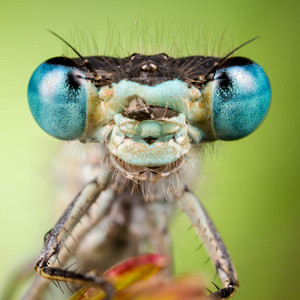
New findings about the brilliance of dragonflies, our immune system and whales, and how they are influencing human behavior.
First, though, back to Greg Gage.
He brought another surprisingly sensitive plant onto the TED stage.
The mimosa, not the drink, but the mimosa pudica.
Greg, during your stage experiment you also had this other plant that kind of looks like a fern and it's called a mimosa.
And this is a plant that's found in Central America and South America, and it has behaviors.
And you just lightly touch the leaves, and it kind of like wilted away from you.
If I tap the leaf, the entire branch seems to fall down.
And my dad actually had a mimosa plant when I was a kid, and I was fascinated by this response.
I would touch it, and it would pull away from me, like, get off me, you know?
Yes, it's actually very, very similar to humans, right?
So there's like a touch receptor, just like we do in our skin.
And when we press down on something, we feel it because an electrical impulse is being sent back up to our brains.
And we interpret that impulse as the feeling of touch.
Inside of this leaf, very similar cells are within there that will send an electrical current.
Only this time, instead of using muscles, it again uses water.
It flushes the water out and makes the plant move.
But why?
Is it always about survival?
I suspect so.
And it's funny because there's a couple of theories of why.
If an animal brushes past, it doesn't look as I mean looking at mine right now.
They don't look very tasty, right.
Maybe I would eat another different plant if I saw that one.
Or maybe it kind of freaks out some insects that would want to land on it.
So that's a learning mechanism they can do, but it's kind of boring compared to some other experiments that have been done.
Experiments where you can take a pea pod and you let it grow in the dark.
You have like a little tube that goes up and it kind of goes like a Y.
It's called a bifurcated tube.
And if you shine a light in one of the tubes, say on the right side, and you blow a fan on the other one, you can do this protocol where you kind of blow the fan on the left and then you shine the light on the right.
And then the next day you blow the fan on the right, you shine the light on the left.
Each day it's kind of growing up this tube, trying to get to that top of it, right?
And then on the experiment day, right where it's about to make a decision, you flip it again, but you only blow the fan.
And then you ask the question, which way will the plant grow?
Will it grow where it last saw the light, which makes sense, right?
Or did it figure out the relationship between the fan and the light and grow to where the light would have been if it's going to come on soon?
You get a majority of the plants that kind of figure it out.
They kind of figure out that they have to go in the other direction and go away from where it lasts on the light but where the fan was indicating where we go.
To me, that's kind of flexible.
And that's starting to show some decisions, right?
That's starting to show a little bit of intelligence.
So it's the ones that made it are the ones that can sort of live on to tell the story, right?
So then those genes get inherited and move forward.
So we have covered plants which seem like a more simple life form than say mammals, yet kind of display some very seriously smart behavior.
But you are also really interested in it seems strange to say this, but you're really excited about slime mold, which is not a plant.
No.
No, but a mole is a cell, right?
A slime mole is a single cell.
They kind of sit in a Petri dish and you feed them.
You feed them little oats and they kind of wrap around it and they kind of suck up the nutrients and they kind of can go dormant for many, many years and they can come back alive again.
Wow.
Yeah, they're absolutely fascinating.
You can see them, though, even though they're single-celled?
Yeah, a single cell could be a meter long.
They could be big, so they're macro.
We were doing an experiment.
One of the experiments we did was we put a piece of food in there.
We watched how often would it go towards the food.
Not surprisingly, it goes towards the food a lot, right?
But slime molds, they don't want to be dried out, so they don't like sunlight.
So if you shine a light there, you know, then they will shy away from it.
They'll try to go around it, but they won't go through that.
They try not to go through the light.
That would make sense if it was an animal.
You're like, okay, well, their eyes are seeing it.
The eyes are sending the message back to the brain and the brains are telling the muscles which way to go.
But then you realize, wait a minute, there's no brain, right?
There's no, there's just, it's just cells, right?
So they have these sensors on the outside of the cell that's sending back information, but that information is being processed inside the cell itself.
And so I think there's a lot to be said about the cell.
I mean, the cell is basically a little computer.
It's got a little Turing machine inside of it, and it has goals, right?
It tries to do things.
And so it has a lot of things and its resources to be able to do.
I recently went to a lecture about the crows.
That are the only birds that we know that use or fashion and then use tools.
Oh, yeah.
Corvids, yeah.
They're amazing.
And just every so often, you hear this incredible story that shouldn't blow our minds but does, about how the natural world is so incredibly smart.
And I guess I'm wondering, you know, should it expand our definition of intelligence?
In simple terms, how do we define what intelligence is?
Yeah, I think the simplest way, given what you've got right, you've got to figure out how to be able to get to what you want, right.
And so that's kind of my kind of the back of the envelope sketch of intelligence is being able to get to what you want, given what you have.
That's what intelligent things do.
You look at a dog trying to get through a door, it'll kind of go check the other door.
It's trying to figure out what it needs to do.
And so you can look at these plants.
In the case of these plants that are trying to find the light they're taking, what the information they have to figure that out?
You can look at single cells doing that.
I think...
Joy of intelligence is really in every living thing.
I think every cell is intelligent.
I think everything that comes from cells is intelligent.
That's Greg Gage.
He's a professor at the University of Michigan and co-founder of Backyard Brains, a company that builds neuroscience experiments for kids.
You can find all his talks at TED.com.
On the show today, natural intelligence.
I'm Manoush Zomorodi, and you're listening to the TED Radio Hour from NPR.
We'll be right back.
Thank you for having me.
Because when work works, everything works.
Learn more at ukg.com slash work.
UKG, HR pay and workforce management.
This message comes from ServiceNow.
People should do the creative work they actually want to do, not boring busy work.
Now, with AI agents built into the ServiceNow platform, you can automate millions of repetitive tasks in every corner of your business IT, HR and more so, your people can focus on the work that they want to do.
That's putting AI agents to work for people.
It's your turn.
Get started at ServiceNow.com slash AI dash agents.
This message comes from NPR sponsor, Zoom.
Work isn't just meetings.
It's calls, chats, docs, emails, calendar invites, events, and more.
And Zoom brings it all together on one platform.
Everything flows together so that you can finally focus on what matters.
With Zoom, ideas happen faster, projects move forward, and your workday finally works for you.
Zoom is more than meetings.
It's a unified platform powering how people get work done.
Learn more at zoom.com slash podcast and zoom ahead.
It's the TED Radio Hour from NPR.
I'm Manoush Zomorodi.
On the show today natural intelligence, which is actually where some computer scientists are looking for inspiration to design the next generation of artificial intelligence.
Yeah, so African dung beetles.
They roll up balls of feces and balls of dung and roll them away as quickly as they can.
Because even the smallest creatures on Earth can execute some amazing feats.
So they're standing on their head, they're rolling the ball of dung with their hind legs and they're using various cues to roll in a straight line.
If they're nocturnal, they're known to use moonlight to be able to make sure that they're going in a straight line.
And I wouldn't be able to roll anything standing on my head.
This is Frances' chance.
Sahara desert ants.
When they find food and they want to bring it back to their nest, they know how to calculate the straightest path back to their nest.
Frances sounds like an entomologist.
Oh, and honeybees, you know, they also forage.
But she's actually a computational neuroscientist.
At Sandia National Laboratories.
She researches how natural intelligence can help develop new security technology.
For example, what missile defense systems might learn from the dragonfly.
So they're very good at what they do.
These graceful, flittering creatures also use a very special technique to hunt.
Dragonflies are really good at hunting.
We know that they fly to intercept their prey.
They fly really fast, and they're very successful.
It's known that dragonflies catch up to 95% of the prey that they choose to go after.
And even though they're really fast, they don't just fly straight at their prey.
They fly on an interception pathway, which means they're aiming slightly ahead of where their prey are.
So is that like Gretzky the hockey great saying like don't go to where the puck is, go to where the puck is going to be.
Exactly.
We need to aim ahead of where the puck is going to be.
And so the dragonfly is constantly reacting to to changes of the prey's direction or the prey's speed, to calculate how far ahead of the prey they need to aim.
By understanding how these nearly instantaneous calculations happen in the dragonfly's brain.
Frances hopes to build AI that mimics it and is just as efficient.
Here she is on the TED stage.
So when dragonflies are hunting, they do more than just fly straight at the prey.
They fly in such a way that they will intercept it.
They aim for where the prey is going to be.
To do this correctly, dragonflies need to perform what is known as a coordinate transformation, going from the eye's frame of reference, or what the dragonfly sees, to the body's frame of reference, or how the dragonfly needs to turn its body to intercept.
And dragonflies are fast.
This means they calculate fast.
The latency or the time it takes for a dragonfly to respond once it sees the prey turn is about 50 milliseconds.
So in the brain, a computational step is a single neuron or a layer of neurons working in parallel.
It takes a single neuron about 10 milliseconds to add up all its inputs and respond.
The 50-millisecond response time means that once the dragonfly sees its prey turn, there's only time for maybe four of these computational steps, or four layers of neurons working in sequence one after the other, to calculate how the dragonfly needs to turn.
In other words, the neural circuit that I need to understand can have at most four layers of neurons.
This is a small neural circuit, small enough that we can identify it and study it with the tools that are available today.
And this is what I'm trying to do.
I have built a model of what I believe is the neural circuit that calculates how the dragonfly should turn.
In a computer simulation, I can predict the activities of individual neurons while the dragonfly is hunting.
To test the model, my collaborators and I are now comparing these predicted neural responses with responses of neurons recorded in living dragonfly brains.
These are ongoing experiments in which we put living dragonflies in virtual reality.
Now, it's not practical to put VR goggles on a dragonfly.
So instead we show movies of moving targets to the dragonfly, while an electrode records activity patterns of individual neurons in the brain.
If the responses that we record in the brain match those predicted by the model, we will have identified which neurons are responsible for coordinate transformations.
The next step will be to understand the specifics of how these neurons work together to do the calculation.
But this is how we begin to understand how brains do basic or primitive calculations.
So you are building computer models based on the dragonfly's brain that can intercept things in just a few steps.
The dragonfly, it must be doing really complicated math really fast.
Is that what you are trying to figure out?
Those calculations?
Yeah, so what I'm really interested in are what are the fundamental operations that neurons are capable of?
Or what are the fundamental operations that neurons do?
And that's what I want to bring to a computer.
It may be something like basic trigonometry or it may be something that's kind of a different type of math than we're used to thinking about.
But that's what we're trying to understand, because if we can understand the operations, then we can begin to understand what the algorithms, or say the computer programs of the brain are.
The way that these neurons compute may be different from anything that exists on a computer today.
And the goal of this work is to do more than just write code that replicates the activity patterns of neurons.
We aim to build a computer chip that not only does the same things as biological brains, but does them in the same way as biological brains.
This could lead to drones driven by computers the same size as a dragonfly's brain that capture some targets and avoid others.
Personally, I'm hoping for a small army of these to defend my backyard from mosquitoes in the summer.
The GPS on your phone could be replaced by a new navigation device based on dung, beetles or ants that could guide you to the straight or the easy path home.
And what would the power requirements of these devices be like?
The human brain is estimated to have the same power requirements as a 20-watt light bulb.
Imagine if all brain-inspired computers had the same extremely low power requirements.
Your smartphone or your smartwatch probably needs charging every day.
Your new brain-inspired device might only need charging every few months, or maybe even every few years.
You know, computers touch us in all sorts of ways that we totally take for granted.
But one resource that limits what computers can do today is being able to power them.
Yeah.
And you mentioned a future scenario where maybe we wouldn't need to charge our devices every day.
Maybe we could go months or even years.
Could that we potentially scale back big time from using all the energy we need right now to run massive servers and data centers all over the world?
Yeah, I think that it could have long-reaching impacts by decreasing just human carbon energy footprint on the world.
Definitely.
As it is, a lot of these data centers need to be next to some natural resource, like a river, to be able to generate enough power to use these algorithms like Google search.
So I think that there's a lot of potential there that we may be able to bring that cost down.
So bring this back to what you do at Sandia for us.
I mean, I know you can't get into the details, but when it comes to national defense it makes me think of Israel's Iron Dome.
And, Leaving aside the politics, is the aim to find ways to make missile defense systems like those more efficient.
Well, Sandia is interested in national security missions.
That requires a lot of computer power.
I'm not necessarily going to talk about what those are.
But if we're doing our job, you won't necessarily see the impact of that.
So being able to understand how neurons do what they do, for low power means that the cost of each of these individual operations, or the cost of each of these interactions of a human with say, something in the cloud, is gonna come down.
And so what I'm interested in is how the dragonfly brains are able to do this calculation with low power and really remarkably fast.
There is a debate about whether artificial intelligence can actually be intelligent.
What about the dragonfly?
Do you think of it as intelligent?
Yeah, so I think there are a lot of different definitions to what intelligence is.
When I think about human intelligence, it's our ability to adapt or take in new information and behave differently based on new situations.
For dragonflies.
They're examples of neurons solving a task in what I would say is maybe even an optimized way.
You know, the dragonflies evolved to do this particular task very well, very fast, very efficiently.
So I call them clever, you know, clever solutions.
They're examples of what intelligence could produce.
That was computational neuroscientist Frances Chance.
You can see her full talk at TED.com.
On the show today, ideas about natural intelligence.
So far, we've heard about plants that can count and dragonflies that intercept their prey in milliseconds.
But what about our own natural intelligence?
The one in our bodies.
How are you feeling?
I'm feeling not so good.
That's our senior producer, Sanaz, and her daughter, Mina.
I feel a little nauseous, like there are pebbles or rocks in my stomach.
And my head just occasionally hurts.
Mina is homesick with a virus, and she doesn't want to do much of anything.
Right now I'm sitting on the couch.
I just want to watch a movie and, like, watch something on my iPad.
As we know, these symptoms are coming from Mina's immune system that is trying to fight off that virus.
Leading the charge are molecules called cytokines.
They're basically like the chemical messengers of the immune system.
Keely Muscatel is a psychology and neuroscience professor at UNC Chapel Hill.
That's where she studies the links between our physical and mental health.
And she says these cytokines float around in our bloodstream looking for anything suspicious.
And when they find something, they sound the alarm.
It's like, oh, there's a problem here.
We need to do something to try to contain this.
And it's trying to signal to other immune cells to come and try to figure that out.
And that causes inflammation.
And that's what we tend to experience when we have been infected with a virus or some sort of other pathogen is that widespread systemic inflammation.
Now, in doing this, cytokines cause the physical symptoms we commonly have when we're sick.
Keeley Muscatel continues from the TED stage.
Things like fever and achiness and fatigue.
So, even though we usually think of those symptoms as being caused by a virus or a bacteria itself, they're actually caused by our own immune systems activating to try to eliminate the pathogen.
But in addition to those physical symptoms, decades of research in both animals and humans clearly shows that cytokines also cause changes to our mood and to our social behavior.
So inflammation in the body can signal to the brain to cause us to feel down, depressed and even hopeless.
Inflammation can also make us want to socially withdraw from other people, to avoid interacting with individuals in our social networks.
So this research shows the powerful influence that the immune system can have on our mood and on our social behavior.
Changes in inflammation in the body can signal to the brain to cause us to feel depressed and even lonely.
You know, earlier we heard from our colleague's daughter who was homesick.
And she loves school.
She loves sports.
But she did not feel like doing anything that day.
And that's exactly what you're describing.
When we are sick, it is actually our immune system saying, stay home.
Yeah, it's okay that you're a little depressed.
Just lie down.
Exactly.
Exactly.
So your body is going to send signals to your brain that cause kind of a loss of joy or a loss of interest or pleasure and things that normally would bring you tons of joy, like going to school or you know, whatever it is that makes you really happy.
And the idea is that that's a really good thing, right?
Because if you're sick, then you really should be staying home and letting your body recuperate and recover, letting your immune system do its job.
And also kind of containing the possibility of spreading whatever you have to other people.
While we can't know for sure why this happens, evolutionary theory provides some good food for thought.
The fact is, revving up and running the immune system takes a lot of energy.
Getting cytokines to swim through the bloodstream and send signals to immune cells takes calories.
And what else takes calories?
Pretty much everything.
Especially things like going out and seeking pleasurable experiences, interacting with strangers and just generally moving about the world.
So the theory is that the immune system is telling the brain to feel depressed and to withdraw from socializing because it wants you to stay at home and rest.
And if things that would normally sound fun just don't seem all that fun, And if interacting with other people seems exhausting and maybe even a little threatening, then we'll be less likely to do those things and more likely to stay at home and let our immune systems use our calories.
But it turns out, the influence of inflammation on our social lives isn't as simple as always, making us feel more disconnected and socially withdrawn.
One of the most important discoveries that we've made in this area of research recently is that inflammation might actually make us more motivated to seek some social interactions, specifically those with the people who we're closest to.
So it's not that inflammation makes us less social across the board.
It may just make us more motivated to seek interactions with people who could provide us with comfort or care, those who could be a shortcut to chicken soup.
This all feels incredibly intuitive, but it's also fascinating that there are evolutionary reasons why my body is making me feel this way when I don't feel well.
Totally.
Would it be fair to say, though, that our immune system is smart?
Yes, I think it is.
I think it is smart.
I think it evolved to do its job and do its job very well.
What I think is really interesting for humans is that it's also evolved in the context of having this brain that is able to ignore it.
There's kind of that push and pull there where I think The immune system sends those appropriate signals to the brain, but we have this beautiful prefrontal cortex that can say I hear you, immune system, but no, I'm not going to take these steps to help myself recover.
And that's the cutting edge of being a human and having the brains that we do.
The brain can be the idiot no matter how smart the immune system is being.
Yeah, kind of.
I kind of think that's true.
In a minute, Keeley Muscatel explains what can happen when inflammation doesn't go away and becomes chronic.
On the show today, natural intelligence.
I'm Manoush Zomorodi, and you're listening to the TED Radio Hour from NPR.
Stay with us.
It's the TED Radio Hour from NPR.
I'm Manoush Zomorodi.
On the show today, ideas about natural intelligence.
We were just talking to Keeley Muscatel.
She's a social psychoneuroimmunologist, which means...
I study the relationship between the immune system and social behavior.
Keeley says that over the years, research has shown that inflammation in our body affects our mood and our behavior.
So we hear about inflammation I feel like all the time right now.
Like.
The hot thing is to be on an anti-inflammatory diet and to eat blueberries and almonds rather than processed foods.
But are we talking about a different kind of inflammation?
And if you – don't eat healthy.
We think of that.
You know you're not consuming the right fuel to give you energy and maybe you do feel depressed.
But are those different?
No, exact same process.
Same inflammation that you have in response to like an acute infection is part of what's contributing to chronic disease.
And that is responsive to the types of things you put in your body, the amount of physical activity that you engage in, the amount of sleep you get.
I'm a new mom.
I've been chronically sleep deprived for the last 11 months, and it's been great.
But also I often wonder how much of an impact is this sleep deprivation having on on the levels of inflammation in my body and how is that influencing, you know, my mood and my ability to think clearly and engage with others?
So yeah, it's not to say that these responses that the body has to the acute instances of sickness or infection, or even stress are, I think, adaptive.
But if they play out over a long time course, that could be really tough for people.
And I think, especially in the face of chronic stress, it's sort of this spiral right where stress can cause inflammation and then inflammation can signal the brain, you know, for people to maybe disconnect or withdraw, which can lead to more stress.
You don't have the same support network that you had or that you need.
And that can be a really tough cycle to break.
So it's not just a matter of, come on, go and get yourself out there.
There's a lot more going on behind the scenes.
100%.
All right.
So this baby that you've got, when they grow up and they're like, mom, I don't feel well.
I want to stay home.
What will you say?
Oh, my God.
That's such a good question.
I've thought about this a lot.
I mean, because this is the other thing about human brains, right, is they can also be deceitful.
And I guess I hope that little baby Archer doesn't want to just stay home to hang out with me and watch cartoons or whatever.
Yeah.
What I hope is that we can teach him that signals from our bodies are important to listen to.
And the other thing this makes me think of is that I'm so fortunate to have a job and a position where I could stay home with him.
I would be able to accommodate those signals.
And I really feel for people who don't have that safety net and who might have to push their kids to go out and go to school even when they're not feeling well.
So maybe Archer can also push for some broad-scale society change in terms of giving people the sick time they need.
No pressure, Archer.
Yeah, exactly.
That's Keeley Muscatel.
She's a professor of psychology and neuroscience at the University of North Carolina, Chapel Hill.
You can see her full talk at TED.com.
And many thanks to Mina Meshkenpour Aghdam, too.
Do you want hugs from mommy?
And kisses.
To close our show on natural intelligence, we want to talk about how animals communicate to each other and what they're saying.
Scientists are using new technologies to try and translate different species' conversations, specifically using artificial intelligence to interpret their sounds.
Environmental researcher Karen Bakker explained how these technologies work and what they're revealing in a talk she gave in 2023.
Tragically, Karen died just a few months after giving her talk.
And so we want to share with you now the entirety of it.
Here's Karen Bakker on the TED stage.
So we're in the middle of a fierce debate about how artificial intelligence will change human society.
But have you thought about how AI will transform your relationship to the non-human world?
So these are bioacoustic recorders, and I've spent years studying how scientists use devices like this, combined with AI, to listen to the hidden sounds of nature and decode non-human communication.
Hidden sounds because much acoustic communication in nature occurs in the high ultrasound above your hearing range or in the deep infrasound below your hearing range.
So I'm going to play a sound.
I want you to listen and try to guess who or what this is.
So that was a bat.
That was bat ultrasound recorded above your hearing range, but slowed down so you could hear.
So that was an advertisement call from the peak of the mating season.
Scientists can decode these calls.
So a sample bat to English translation would be, and I quote, pay attention.
I'm a Pipistrelis natusibat, specifically male.
My name is X, I am landing here and we share a common social identity and common communication pool.
For a pickup line by a bat, not bad.
So scientists have recorded millions of bat vocalizations like this, and they've decoded many of them using AI.
And they've revealed that bats have dialects that they pass down from one generation to the next, and that baby bats learn to speak just like you did, by listening to the adults around them and babbling back until they speak adult bat.
So bats have far more complex communication than we knew, and they're only one of many examples.
Listen to this.
So those are orcas.
Scientists can decode individual orca calls using AI, and they've revealed that orcas also pass down their dialects from one generation to the next.
So when we first learn about these secret sounds of the world, we're often surprised, because humans tend to believe that what we cannot perceive does not exist.
And so we miss a lot.
One of my favorite examples is this peacock.
So to you, this looks like a visual mating display, and it is.
But this peacock is also making very loud infrasound with its tail, which you cannot hear.
But female peahens can, and it is an important factor in their mating decisions.
So this peacock is giving a rock concert.
Now, we have lived with peacocks for millennia, but we only just figured this out.
Even creatures without ears are exquisitely sensitive to sound.
So this is a coral larva.
When coral larvae are born, usually at a mass spawning event, a few days after the full moon, they wash out to sea.
So scientists used to think that these little larvae, these tiny dots that you see here, were helpless, randomly pushed around by wind and waves and currents.
But it turns out that coral larvae are acoustically attuned.
They can hear the sounds of healthy reefs.
They can hear the sound of their home reef, their mother reef, and they swim back home across miles of open ocean.
So these are tiny creatures with no central nervous system.
But we think they do that with these hairs that you see on the outside of their bodies.
They're a lot like the hairs inside your ears that are enabling you to listen to me right now.
So you can think of a coral larva, a little bit like an inside-out ear, except that its sense of hearing is profoundly more sensitive than your own, because they hear with their entire bodies.
Even our planet makes sound.
Volcanoes earthquakes, sound so low and strong and powerful.
They travel very far, passing through soil and stone and even solid walls.
So in nature, sound is everywhere and silence is an illusion.
So scientists are also listening to the vast extent of interspecies communication.
So this bat is using ultrasound to hunt this moth.
Its echolocation beam is locked onto its prey.
But the moth is also emitting ultrasound.
It's jamming the bat sonar in an attempt to escape.
This plant is also emitting ultrasound, which varies depending on its condition.
Scientists have trained an algorithm to listen to this plant simply by listening.
It can detect with about 70% accuracy whether the plant is healthy, dehydrated, or injured.
So this is peer-reviewed research, by the way.
So we cannot hear these sounds, but we think many insects can.
Does this mean that humans could use digital tech to one day communicate with other species?
Well, some scientists think so, and they're using machine learning to try to decode the acoustics of other species.
So there are teams of computer scientists and linguists and biologists working on decoding sperm whale bioacoustics.
They're also building entire dictionaries. an elephant dictionary with thousands of sounds.
Elephants, for example, have a specific signal for honeybee.
So I'd love to share just one of these sounds with you.
It was recorded at a moment of great joy and celebration, the birth of a new baby.
So the further we listen across the tree of life, the more complex interspecies communication would be.
Listen to this honeybee.
Now, listen to this honeybee queen.
So you thought you knew what honeybees sounded like.
OK.
Honeybee communication is incredibly complex.
It's acoustic, positional, spatial, vibrational.
The queen has her own signals.
So scientists are encoding these signals into robots.
This robot is attempting but not succeeding to communicate with the hive.
The bees mostly ignore or attack it.
But one day We hope, the inventors hope that this robot will communicate well enough to allow scientists to monitor the health of the hive.
Now, would that be a good thing?
Some believe that interspecies communication would help foster respect and empathy for nature.
Others believe that it is profoundly disrespectful and unethical to eavesdrop and engage in this way.
Interspecies communication needs strong ethical guardrails.
And anyway, maybe it's a bit self-centered to think other species would even want to communicate with us.
So what if we were to use bioacoustics for something of immediate practical value, like doing something about our massive biodiversity crisis?
Let's go back to the coral reefs.
Listen to this healthy reef sound.
Pretty lively, right?
But coral reefs are disappearing.
If you were to go to most coral reefs today, you'd hear something like this.
It's like a ghost town of the sea.
When we lose species, we lose voices.
When we lose landscapes, we also lose soundscapes.
There is a ray of hope.
The healthy reef stones that you just heard can be used to regenerate coral reefs.
Scientists are doing this.
It's a bit like music therapy for nature.
So this is not going to solve all the problems coral reefs face, notably climate change.
But if we can address the massive epidemic of noise pollution that is harming and killing marine creatures, we could use bioacoustics to restore some biodiversity.
Bioacoustics could also help protect animals on the move.
So this baby whale was killed by a ship.
Tragically, this is a common cause of death of North Atlantic right whales, one of the most endangered species in the world.
So, to address this, scientists are now launching a new bioacoustics program off the east coast of North America to triangulate the locations of whales and convey the information to ship's captains in real time.
The ships then have to slow down, stop, move out of the way.
Not a single right whale has died of a ship strike in this zone since this program was launched.
So this may be the thing that saves this species.
So think about it.
A few decades ago, we were harpooning these whales nearly to extinction.
Today, we've invented a technology that allows a community of less than 400 whales, simply by singing, to guide the movements of tens of thousands of ships in a watershed that's home to tens of millions of people.
One day, these whale lanes may be everywhere in the oceans.
For the orcas who live here in the Salish Sea.
This would be just in time, because there are only a few dozen left.
A final thought.
About 400 years ago, the inventors of the telescope were gazing up at the stars not knowing.
Their invention would allow humanity to look back in time to the origins of the universe.
Optics decenters humanity within the solar system, within the cosmos.
Bioacoustics decenters humanity within the tree of life. our commonality is greater than we knew.
Now, today we're using bioacoustics to protect species and decode their communication, but tomorrow, I believe, we'll be using bioacoustics combined with machine intelligence to explore the frontiers of biological intelligence.
Many biological intelligences are very different than our own, but they're no less worthy of exploration.
And maybe one day in a speculative future, instead of a human here on stage, maybe bioacoustics would enable an orca to give a TED Talk.
Why not sharing orca?
Stories about dodging ships and seismic blasts and human hunters.
Stories about desperately seeking the last remaining salmon.
Stories about trying to survive on this beautiful planet in this crazy moment, in our era of untethered human creativity and unprecedented environmental emergency?
Now, those would be ideas worth spreading.
That was Karen Bakker.
Her latest book is Gaia's Web How Digital Environmentalism Can Combat Climate Change, Restore Biodiversity, Cultivate Empathy and Regenerate the Earth.
And we want to dedicate this entire episode on natural intelligence to her.
Thank you so much for listening.
This episode was produced by James Delahousie, Harsha Nahada, Katie Monteleone, Matthew Cloutier and Fiona Guerin.
It was edited by Sanaz Meshkenpour and me.
Our production staff at NPR also includes Rachel Faulkner-White.
Irene Noguchi is our executive producer.
Our audio engineers were Robert Rodriguez and Gilly Moon.
Our theme music was written by Ramteen Arablui.
Our partners at TED are Chris Anderson, Michelle Quint, Alejandra Salazar, and Daniela Ballarezzo.
I'm Manoush Zomorodi, and you've been listening to the TED Radio Hour from NPR.