You cannot go through life doing okay without knowing anything about money.
What seems like common sense to everybody is how can I get rich the fastest?
That's the cause of every financial failure.
My guest is Morgan Housel, best-selling author to the tune of millions and one of the smartest thinkers on the psychology of money.
He has spent his career finding the financial lies we tell ourselves and getting us to the truth on how to become really wealthy.
I'm so excited for this episode.
I think you're going to be too.
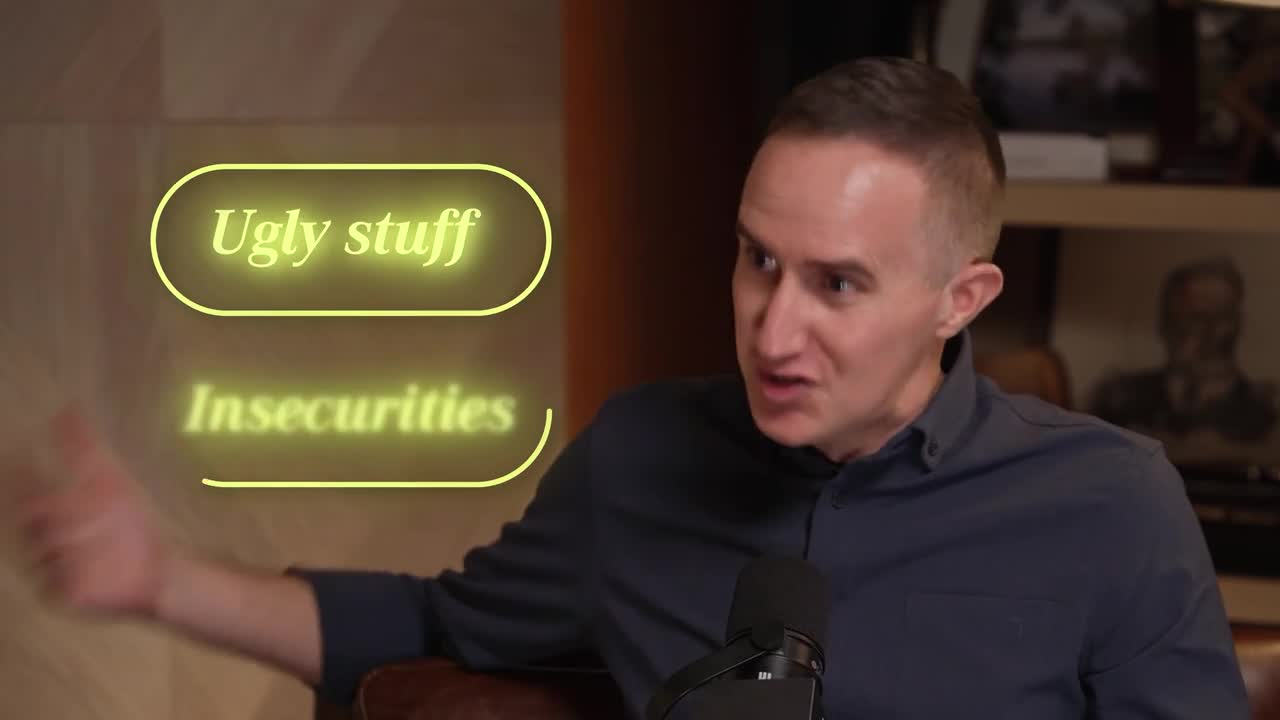
Nobody's thinking about you as much as you are.
And that goes for your ugly stuff, for your insecurities and what you might think other people will really admire you for.
And so it's easy to tell ourselves if I had this and that and this house and this car and these clothes, other people would give me a level of respect and admiration that they're not right now.
What are the habits of rich people versus poor people?
It's a combination of obsession and long-term thinking.
They wake up thinking about their business.
They go to bed thinking about their business.
They've been doing the same thing for 30 years.
What have you found is the number one lie or untruth we are told about money?
You don't need intelligence and connections and education and experience to do well.
All you need is like First, I want to read a story from your new book, which I'm obsessed with.
A story goes like this.
A man notices his coworker drinking a latte, and he asks, how often do you drink lattes?
Every day, says the coworker.
Wow, every day for 30 years of your professional career, says the man.
That's so much money.
Proceeds to talk about how much money that would be.
It's like more than enough to buy a Ferrari.
The coworker looks puzzled.
Do you buy lattes, she asked the man.
No.
He says, so where's your Ferrari?
I love this story because your book is about saving in many ways and how to spend properly, just like your other book is about the psychology of money.
But it's not fucking boring advice about how to not. buy a five dollar lattice.
I think so much of financial advice and financial media is based off of two things.
A lectures and B formulas.
So let me give you a lecture to tell you that what you're doing is wrong.
And let me give you a formula for how to fix it.
And nobody is interested in that.
Nobody's interested in being told that they're living a wrong life.
And nobody wants a formula that is indistinguishable from like algebra one in high school kind of thing.
They don't want that.
What people want is advice on how you can be yourself and be independent and live a life that is true to yourself.
And to learn about that.
Tell them a story about somebody else and how they've done it wrong or have done it right.
I think that's what's sorely lacking in all financial education.
Finance is one of very few topics that affects everybody.
No matter who you are, where you're from, money will impact your life.
Health is the other one.
Because of that, like people have an obligation to learn about this stuff, you can go through life just fine knowing nothing about chemistry and have a great life.
You cannot go through life doing okay without knowing anything about money.
It's so important, but the way that it tends to be taught, I think, is completely broken.
And so that's why I just want to tell silly little stories like that.
You actually told a couple of stories I really loved in the book.
One about Ronald Reed and Richard Fuscone.
Can you tell us about them?
Ronald Reed, I've never met either of these people.
Ronald Reed was a guy who was a gas station janitor.
No, I'm sorry, a gas station attendant and a janitor at a mall.
Just as humble, low key or, dare I say, like low class, poor kind of person that you would ever meet.
And when he died he ended up leaving millions and millions of dollars to charity and people were like what, like this guy's mopping the floors and pumping gas?
Like where in the world do you get all this money?
And it turned out that he took what tiny dollars he could save from his minimum wage job and he bought stocks that he held for like 50 years and turned into millions of dollars and gave it away.
But he could not have been a more ordinary kind of person.
Richard could not be more polar opposite.
He's born into wealth and went to Ivy League schools and worked on Wall Street and worked his way up to senior leadership on Wall Street, made tens of millions of dollars.
And very soon.
Not that long after Ronald Reed died, he filed for personal bankruptcy and just blew himself up with debt and leverage.
He had a house in Florida that had multiple elevators and like a swimming pool that you could stand on top, like all these crazy things, all heavily levered.
Financial crisis hits, boom, he's out, he's bankrupt.
And I use that juxtaposition to be like you don't need intelligence and connections and education and experience to do well.
All you need is like a couple of behavioral attributes that Ronald Reed had patience, low ego.
That's all you need.
And even if you have all of the intelligence in the world, you can go broke.
What I should have written, I kind of regret not writing, because some people pointed this out.
I don't think Ronald Reid is a role model.
I think he had such a unique personality that he could have lived a much better life than he did than living in a trailer.
So someone asked after he died, one of his friends, what his hobbies were.
And he said, the only hobby he can think of was splitting firewood kind of thing.
So someone who has millions of dollars in the bank and is just living like that, like that's not a role model.
I should point that out.
But he had the psychological attributes that you need to get wealthy of just low ego and patience, even if you took it to an extreme.
That i think was detrimental.
And so but the and again, there's very few endeavors like that.
You will never meet someone who is just an uneducated country bumpkin who can do open heart surgery better than a harvard cardiologist.
That will never happen.
It's impossible.
But not only does it happen with money.
It happens pretty often where ordinary people with good behavior outperform extremely educated people who don't have control over their emotions.
There's so much freedom in that and realizing that the game is not actually that stacked against you, as long as you are willing to put your finger on the scale of patience.
Because a lot of people think like, why would I try investing?
It's just a rigged game against me.
And I think what's closer to the truth is that it's rigged against professionals who have to compete against each other on a 90-day clock.
What were your returns last quarter and how do they rank next to your peers?
That's what you live and die by.
The game's rigged against them.
But for ordinary people who are like I'm just going to invest in my 401k and leave it alone for 30 years.
I don't even know what my password is.
I don't care.
I don't know or care if somebody else outperformed me last quarter.
I'm just going to do this and follow my goals.
That's where the money's made.
And so I think that's the irony is, we think it's rigged against you when it's rigged against the pros.
Fascinating, because you're right.
I mean, I know a ton of hedge fund guys that have all and not that have all.
I have a few that I know that have had hedge funds for 28 years, 30 years plus, but most of them flame out pretty spectacularly.
I mean the pressure that they have, because some of the hedge funds it's not how'd you perform last quarter, it's what'd you do literally last week.
Oh, yeah.
What were your returns last week?
And that lifestyle, A, I think is nearly impossible.
There's probably a dozen people in the world who can actually outperform under those terms and just unbelievably stressful at the same time.
I mean look at Carl Icahn today, which I think is a tragedy, but supposedly almost bankrupt, highly levered, potentially not going to make it, and arguably one of the best investors of all time in many instances.
Fascinating.
One of the most interesting is Jesse Livermore.
I wrote about him in Psychology of Money.
He was the best stock trader of the 1910s, 1920s. and he was one of the only people who in the crash of 1929 was short the market and made a fortune and actually after the crash of 1929 by most accounts he was the richest man in the world he made during the crash where everyone else was going bankrupt and literally jumping out of windows the equivalent adjusted for inflation of like three billion dollars in the crash and and he was he was already unbelievably wealthy just he was the best stock trader in the world And he made and lost several fortunes.
Because after every big win, when he'd make the equivalent of 3 billion, 5 billion, he would take more risk, more risk, more risk and blow himself up.
And so he went effectively bankrupt like three times.
He went from billionaire to bankrupt to billionaire to bankrupt, over and over again, and eventually took his own life.
The last time he went broke.
And so he's always so interesting to me of like nobody in the world was better at getting rich than Jesse Livermore.
Literally the most talented person on earth at getting rich.
And he had no ability whatsoever to stay rich.
He couldn't do it.
And so I think back to, like the Carl Icahn.
There's lots of people like that who are very good at getting rich and much less skilled at staying rich.
And to do well financially, you need an element of both.
And they can be conflicting personalities of, like a personality that says I'm gonna take a risk and swing for the fences and try to get this done.
And I'm gonna be a little bit scared and a little bit paranoid and be scared of debt.
You need both of those at the same time.
And I think a lot of times with entrepreneurs and traders.
They have a lot of skill in the first bucket, take enormous risks.
Very smart and intelligent.
But the kind of personality that you need to be a billionaire hedge fund manager is not the kind of personality who also says that's enough.
Maybe I should put a bunch of money in treasury bonds and take money off the table.
That's not the kind of person.
That's why I think like Elon Musk will either be a trillionaire or bankrupt.
And at this point, it's much closer to trillionaire at this point.
But if you looked at him 10 years ago, when he was not the richest man in the world, you could see that.
Like this guy's either gonna be the richest man in the world or he's gonna go bankrupt very quickly here.
And there's a lot of that in the world.
You know I was chuckling at some of your tweets because it was like Elon Musk is Warren Buffett richer than Jeff Bezos this week?
And that was, I wrote that probably years ago.
Now I think Elon Musk is like, multiple Jeff Bezos is richer than Bill Gates kind of thing.
It's just a completely different universe.
That's so wild.
Let's talk about this for the many.
So I was reading some updated statistics on Americans living paycheck to paycheck.
62% of Americans live paycheck to paycheck.
A couple that astounded me though, was that 50 of Americans earning over 100K also do, and 36 of Americans earning over 200000 annually say they're also living paycheck to paycheck, which kind of shocked me.
What should you do every time you get your paycheck so you're not like apparently most of America? there's two things to pick apart here one is that we should not pretend in most parts of the country particularly if you have kids that a hundred thousand dollars is a fortune it's like the austin powers like one million dollars thing and he's like no no you gotta like update that it's not of course what it used to be and particularly if you have kids in child care and a big mortgage that for an inflated house that you bought in recent years a hundred thousand dollars in many parts of the country it's not going to do it for a lot of people but to answer like to really answer your question what should you do when you get a paycheck i think when you're looking at your expenses, you got mortgage, car payment, whatever it might be, taking care of future you needs to be near the top of that pack.
And I think a lot of finance is understanding and like being kind to your future self, having empathy with who you're gonna be 30 days from now, 30 years from now and being really kind to that person and taking care of that person.
And I think that's a big part of this.
One part of saving too, is that I've always been a big saver and I don't feel like I'm necessarily saving for the future.
I don't feel like I'm saving money.
I feel like I'm buying independence.
I feel like every time I save money, I'm buying a little bit of independence and I get benefit from that.
Today,
When I save money, it's not like, oh, this will help me 10 years from now, even though it will.
That helps me tomorrow.
If I can wake up and be like I have a level of independence that I didn't before.
That's going to give me control over my life.
And I think that's ultimately.
What people want out of money is freedom and independence and the ability to wake up and just say I can do what I want today and make my own choices and live my own life.
You have a thesis that I really believe, which is you don't have to be smarter to make more money.
You actually just have to know more and be more knowledgeable to make more money.
I think the key is that you actually just have to have the right behaviors.
And this is where a lot of people get thrown off in finance, where we associate people who do well financially with big brain intellectuals.
Harvard MBA, worked at Goldman Sachs, hedge fund manager.
We assume that's who's going to be the best.
And I think that can be true, but there's also in a way that exists in almost no other field, you have a complete nobody living in the middle of nowhere no education, no background, no connections who does amazing financially because they have the right behaviors.
They're calm, they're patient, they lack a big ego.
They have a couple of behavioral traits, even if they know nothing about money, and that's all they need to do.
And on the flip side of that you can have the Harvard MBA hedge fund manager who blows himself up financially.
Or even if they don't blow themselves up, they are actually living paycheck to paycheck.
They have a lot of financial sophistication, but they have no control over their behaviors, their sense of greed and ego and patience and long-term thinking.
I think you'd be surprised how many Wall Street pros fit that bill of like big brain intellectual, not a lot of the behavioral aspect that actually is needed to do well financially over time.
Oh, yeah.
I mean, I saw it all the time.
When I was on Wall Street, that was the norm.
I remember one of our sales managers when I was at a company off of Wall Street.
Actually, at this point he said a line to me I'll never forget, which is with his sales guys.
And so they're selling financial investments to like pension, sovereign wealth funds, et cetera.
And he said hey, when you go to hire your team, because I was a managing director, he was a managing director, he goes.
You always want them to optimize, for one thing.
I'm like, okay, what?
He's like, as many spots in the garage as possible.
And I was like, why?
That seems sort of irrelevant.
He goes because if you get them hooked on cars, you'll also get them hooked on employment for the rest of their life.
And I saw it firsthand.
It was like, you know, look at my Ferrari, my Lamborghini, my whatever.
And then these guys were slaves to the paycheck and used to look at you know, myself at the time like a dual income no kids.
I think they called us dinks.
And they were like, God, this is so great.
You must like not have anything to spend on.
I go.
Well, it's also because I don't give a fuck about like cars and huge houses and all of that stuff.
Yeah.
But how do you trick yourself into that?
Because I think society tricks us into believing I can spend so that other people will like me or so that I can show off to other people.
Do you have a trick that you use every day where you go?
No no no, I actually trick my brain into thinking that saving and spending wisely is better.
I think it's a healthy selfish motivation with money to say like I want my money to benefit and be a tool for happiness for myself and my immediate family.
And that's about where the goals end.
Because I think we always overestimate how much other people are paying attention to us.
And so it's easy to tell ourselves if I had this and that and this house and this car and these clothes, other people would give me a level of respect and admiration that they're not right now.
And you always overestimate how much those people are actually thinking about you.
There have been some incredible studies.
One, I thought it was so ingenious how it was framed.
These group of researchers put a woman in a very ugly sweater, like an objectively hideous sweater, and sent her into a party.
And she mingled about and she came out and they asked her.
They said how many people in the party do you think noticed your hideous sweater?
And she's like, all of them.
It was humiliating.
And then they go in and ask people in the party, did you notice the woman in the ugly sweater?
No, no, no, no, no.
Nobody's thinking about you as much as you are.
And that goes for your ugly stuff, for your insecurities and what you might think other people will really admire you for.
And so I desperately want the attention and the admiration from like seven people in life, right?
Whose love and attention are actually a big part of my life.
My family, a handful of very close friends.
And you should not pretend that the other people Walking down the street driving past you care whatsoever.
It's not quite black and white.
I want to fit into the social group that I choose.
And to do that, I need to talk a certain way, dress a certain way.
It's not to just ignore everybody and do your own thing, but we overestimate the benefit that we get from it.
And I first started thinking about this when I was about 19.
I was a valet at a five-star hotel in Los Angeles.
And when somebody drove into the hotel in a Ferrari or a Lamborghini, I would stop and stare in admiration.
But I never thought about the driver.
What I would do is I would look at the car and I would say if I was the driver one day, people will admire me.
But I didn't care about the actual driver.
And one day I was like, do you see the irony here?
Like nobody cares about the driver.
But they want to be the driver because then they think people will care about them.
And it was just like no one's, and I think that was a big revelation for me of like I see how this game is played now.
We just overestimate the number of eyeballs that are on us.
And once you come to terms with that game, you can be like okay well, how can I then use money rather than as like a useless tool to show off for other people who aren't paying attention, but as a tool to selfishly, in a good way, improve the circumstances and the happiness and the independence of the life for myself and my family and a small group of friends around me?
I've never thought about the Ferrari that way, but you're absolutely right.
Nobody cares about the driver.
No, in fact, I negative affect the driver.
I go, that guy's probably, you know, or he's doesn't have a lot of cash.
And so he wants to show it off this way, or he's like scamming people.
So he's got to project that he's X, Y, Z. That's what I think when I see it on the internet.
And it's not just cars, but even clothes.
By and large, if someone looks at you and says, wow, really great jacket.
By and large, what happens is they're not actually admiring you.
They're thinking, if I had that jacket, people admire me.
Know what's interesting, though?
I think there's one area where i've realized there's there's pushback differential and i've even seen it in myself which is um, physical fitness.
Yeah, so like if you're fit or if you're physically good looking or well styled.
But you're right, it's not i have a hot gucci jacket or something.
It's like if i am a type of person that is able to style myself and i am attractive, that actually has real reciprocal effects and probably is worth spending money on which, to me, is bizarre, because i never cared about any of that before.
Yeah, but a lot of science seems to show that.
I think it's.
It's attractive to people who either want to be part of your social group or you want them to be part of your social group, but that's a minority of people, and i feel like a lot of spending is this big broad, trying to get the attention of people who don't necessarily care about you.
And, to your point uh, what do my wife and kids and close friends hopefully, admire about me?
It's not the square footage of my house or the horsepower of my car.
It's like, am I a good dad?
Do I play football in the driveway with my son?
Do I sit and play with toys with my daughter?
Am I responsive and receptive to my friends and go out and have dinner and laugh for a couple hours?
That's what they care about.
And I wrote about this in the book.
I have a very good friend.
I've known him for 20 years.
One of my favorite people in the world.
I love spending time with him.
And of our social group, he earns the least amount of money by far.
And it bothers him.
And he talks about how much it bothers him.
And I told him one day.
I was like, If you are a good friend, a good listener, a funny joke teller, and you're hardworking and taking care of your family, you've earned like 90 of the points that I'm capable of giving you as a friend.
And if you also happen to be rich and successful, maybe it would go up to like 9.2.
But don't pretend like, I like people because they make money.
Some people will, like, I only want to be friends with rich people.
And those are the fakest, shallowest, shortest living friendships that will exist.
That's such a good point.
What do you think about?
I mean now, you've sold millions of copies of your first book and I'm sure you will of this one as well.
You've talked to some of the richest people in the world.
You've talked to some of the most successful people in the world.
What have you found is the number one lie or untruth we are told about money?
I don't know if it's told so much as just expected, but there is a very clear expectation that if you wake up in the morning and you feel a little bit empty or diminished or anxious or in pain, that you can tell yourself if only I had more money, those problems would go away.
And I think to some extent it can be true.
Money can give you a comfortable life and solve a lot of your problems.
But what you see with a lot of rich people is that once they gain the money, they still had a lot of problems in their life.
And that can be such a jarring feeling, because you told yourself if only my net worth is X dollars, then I'll be good.
And you get there and you're like, wait a minute, My friendship's still not that great.
My health is still not great.
My marriage is still not that great.
I still don't sleep that well at night.
I still have all these anxieties.
And so then you kind of lose your sense of hope or you double down.
And so a lot of people are like, once my net worth is a million dollars, I'll be great.
And then you get there and you're like well, I feel the same.
So maybe it's 2 million.
You get there and you're like, i feel the same, maybe it's 10 million and you're just constantly chasing the high that you think you're going to get from it.
Money can solve a lot of problems in your life, but this is another area that we just overestimate what it can do for you.
What is the research that you've done showed is the amount of money for which we do derive a lot of happiness, like how much for somebody listening, how much you're like you know what.
You really don't feel bad for going up until this amount of money.
It's so different for person to person and geography to geography.
But certainly at the lower levels.
The more money you earn, the more that you can like massively increase your happiness.
If your income goes from 10,000 a year to 20,000 a year, you change your life completely.
And going from 50 to 100 can change your life.
Probably going from 100 to 200 can change your life.
Different for everybody based off of their ambitions.
But I think for a lot of people, once you own a house that has enough bedrooms for you and your kids and you like the neighborhood that you live in and you have good neighbors, that you enjoy and your car isn't breaking down and you're eating healthy food and you're doing like checking some pretty basic boxes,
You have adequate healthcare, those things like that.
And most areas in life.
You might be able to get that for different region to region, but 200 250, whatever it might be.
Then after that, It's not that the money can't make you happier, but it diminishes quite quickly from there.
And at the extreme levels.
Is there any difference in lifestyle between Elon Musk, who's worth, I think, 600 billion, and Jeff Bezos, who's worth 200 billion?
Of course not.
$400 billion difference.
There's no difference in lifestyle whatsoever.
For most people, there would be no difference in lifestyle between $100 million and $100 billion.
You have too many houses, you have planes, you have everything you could want.
It just diminishes quickly from there.
A more important point though, is I think for a lot of people, there is a net worth at which not only do you stop getting happier, but your life gets more complicated and you start dealing with like big existential questions of who am I and what do I do with this?
And it becomes a social liability.
There's a level at which your friends and your family are going to start come asking you for money.
You have such higher expectations of like, how do I raise kids without spoiling them and whatnot?
There's all those questions.
And that level of net worth is probably lower than people think.
I remember when I didn't have much money at all.
I would listen to something like this and be like, Yeah, I'm gonna try it.
I don't know, I'm gonna try it.
We'll see what happens.
And when I get there, if I'm still unhappy, fine.
But I think the other thing to push back on here and I feel this strongly is you have to.
What does Munger always say?
Incentives, always incentives.
And the incentive in the world today is to make you consume more, spend more, keep up with other people.
That is just how our economic, In a competitive world, yeah.
Yeah, and our society works.
And so you have to push back slightly on that and go at what point is this all just memetic desire, where I'm chasing somebody else's dream, somebody else's hope, and I'm stuck in a rat race that I didn't even want to enter in the first place?
And I think...
You have a lot of reasons why we do that and I love some of the quotes you have, like spending money to show people how much money you have is the fastest way to have less.
And so even for the person that's listening out there, it's not like oh don't worry, stay poor, we don't care.
It's really psychologically, if you don't rewire your brain, you actually never will get wealthy.
And then simultaneously, you will have a counterproductive result, right?
I think people should have a lot of ambition to have more money for independence.
I think that should be the ultimate goal.
It's not that money won't do anything for you and you should stop chasing it and enjoy being poor.
It's not that in the slightest.
You should want more and I want more for that reason.
I just want to be completely independent.
And everybody is talented in their own way, can be happy in their own way if they have independence.
And it's actually very difficult to express that talent and to express who you are if you are completely beholden to somebody else's goals metrics incentives, which most people are.
And so that's what I think the ambition should be.
It's not ambition necessarily for a greater material life or greater social status.
It's ambition for independence.
So how do you tell if you're spending to show other people you're cool versus you're spending to get independence?
This is like an imperfect way to think about it, but I think a lot about this in my own life, which is just asking if I was on a deserted island and nobody could see how I lived nobody could see a single possession that I have would I still want this thing?
And a lot of people in that mental exercise would say, in that world, I wouldn't change anything.
I'd have the same cars and the same house and the same clothes, and they're great.
And I think a lot of people would answer that.
But I think we would see- Do you think a lot of people would say that?
I think for the most part- Then why do you need like doesn't the average American have like 20 pairs of shoes?
That wouldn't make sense.
Well-
There is a lot of spending in the world that is purely social status.
It's just purely that.
And so in that mental exercise, you understand the difference between utility and status.
Between like, what am I doing just to impress other people?
And what is actually making my life better?
And you can spend a lot of money to make your life better.
It's not to say like, on that desert island, I would have an awesome house.
I would have very comfortable clothes and I wouldn't want to dress, feel like a slob.
I want to feel good about myself.
So maybe it wouldn't be that much different.
And, but you start thinking about things differently.
If nobody was watching, how would I live?
Because the truth is almost nobody is watching.
Like that's the truth for most people.
So in that situation, you go to, you just brought up Charlie Munger.
And I just read this article about him about a month ago.
That was describing his last week of life, or his last year of life, I should say.
And I might be getting a few of these details slightly wrong, but he built an incredible house in Santa Barbara overlooking the ocean, amazing house that a multi-billionaire would own.
And then he had his house in Pasadena that he had lived in for like 60 years.
And by every account, it was not just a middle-class house.
It was like, dare I say, a dump.
But he had lived there for 60 years.
And in his last couple months of life, that's where he wanted to be.
That's where he wanted to be.
Not in the palace overlooking the ocean, the house that felt like home to him, that had the memories that he had, that was probably, I assume, surrounded by neighbors who he enjoyed and friends nearby and whatnot.
And I think that model explains a lot of things in life of like What you want out of this material possession is not just the price or the square footage or like the things that you can measure.
Like that.
So much of it is just like, well, do you actually enjoy it?
It's the intangible things of what you enjoy them for know.
It's so interesting because you have a quote that i really liked, which is somebody saying quotes.
Renting is throwing your money away is the kind of thing you said by a guy who has never had to replace the roof on house he owns.
I wrote that tweet, uh in in anger, after replacing the roof on our house.
I feel i felt that from you like i'm curious, do you think it's better to own or rent a house?
I can tell you my experience.
My wife and I rented for a decade or more and it was the greatest thing in the world.
We lived in like five different cities and we could just pick up and go.
And that flexibility at that phase of our life was unbelievable.
And I was very pro-renting.
I don't believe houses are great investments, financial investments.
That's always my view.
About a week after our first child was born, I felt this overwhelming sense that like, I wanna buy my own house and I wanna do it right now.
The idea of like i don't want to be a transient renter, i want a firm, solid home base for my family.
That feeling was so strong, so we went out and bought, and it was, and it's been great.
Um the the important thing though is, like you should buy when you can afford it and when you think you're gonna settle down, and the idea of like people doing these calculations of like oh well actually, if i bought, i would save a hundred dollars a month versus if i rent.
This is not a spreadsheet endeavor.
Like you should do it when you can afford it.
But so much of it is just the value and stability that you want for you and your family.
I think we did a lot of harm in society when we taught people that A rising home prices are a good thing.
That did a lot of damage to people.
It's a terrible thing.
And B, that in the decision of whether you should buy or rent is a spreadsheet decision versus just the quality of life and the kind of life that you want for you and your family.
Those two, I think, things inadvertently did a lot of damage to society.
I think you're right.
I mean because when you look at the math it's actually quite hard to argue that home ownership is better than renting.
If it's just looking for math.
If all you're looking for is the financial outcome.
I would not be surprised.
In fact, I think it's almost certain that I've been a homeowner for 10 years that if I had rented the whole time, my net worth would be higher.
I think that's probably right.
Well, of course.
And not a single cell in my body, if I had a time machine.
Would go back and do it.
Would do it differently.
Yeah, that's a good point.
I'm like, I'm not doing this to maximize my net worth.
I'm doing it so I have a stable place for my children.
That's it.
And we can live in the school district that we want to.
And I think the sense of ownership that comes with owning your house is a really good, fulfilling thing if you're in the phase of your life where you're ready for that.
I want to talk about something else that I think maybe is a detriment to society and that people have categorized wrong at least I think.
But I'd be curious your take.
Let's talk about passive income.
Is it real?
Can you get it?
Is this reasonable for people to want?
I think it rarely, if ever exists, because what people think of passive income is I don't have to work to get this.
And anyone who's been a landlord realizes that could be a full-time job for doing it or owning small businesses.
The idea like, oh, you just buy them and collect the checks tends not to be the case.
You understand this better than anybody.
If you're investing in the stock market, The psychological price you can pay for the uncertainty and the volatility, or investing in somebody else's private equity fund, and the psychological price tag that you pay of dealing with that person, trusting that person, lack of trust with that person.
The returns aren't coming in like you thought.
You don't know when the returns are gonna come in.
That's a cost.
And it's a different cost than driving to work and working nine to five in a cubicle.
It's a different cost.
But let's not pretend that it's not a cost, that you just give money to people and then the money just starts flowing back.
You don't have to do anything for it.
It's easy to underestimate the price tag of those things.
That's very true.
Even if you're just talking about the K-1s and the tax complications most of it in public stocks, it's.
It's the volatility and the uncertainty yeah, and once or twice a decade that will be harrowing.
It'll be, you will.
You will not be able to sleep as a stock market's falling 50 and you don't know if this is a run-of-the-mill correction or the second great depression and you'll deal with that twice a decade.
How do you protect your mind and your psychology for those horrible financial life events like that?
I save a lot of money.
Am I saving for a new house?
No.
Am I saving for retirement?
Not necessarily.
I'm saving for a world in which things are going to happen in the broader world and in my life personally that I can't foresee, that I am not thinking about today and will have a major impact on my life.
And so, that's the psychology of it.
I think a lot of financial advisors might look at my net worth allocation and say like, what are you preparing for?
It's not that conservative, but probably more cash than people would generally recommend.
And I think a lot of it is just being an amateur student of history.
Like all, history is a constant chain of surprises that nobody saw coming, that fundamentally shaped the world, usually in bad ways.
And the people who do okay over time are the people who have a conservative enough financial arrangement and mental flexibility to endure those episodes.
What are the habits of rich people versus poor people you found in all your research?
Well, there's obviously a lot of survivorship bias in rich people.
So you can look at someone who's very wealthy and be like, well, look what they did.
They started this business and they took a huge risk and they didn't do this.
So like, here's their morning routine and all that.
And for every one of those things there are a thousand other people who did something very similarly and failed.
And also that I think there's a Paul Graham quote where he says half of the attributes of very successful people are actually liabilities to them.
And so we can look at an entrepreneur and be like oh like, he wakes up at three in the morning and runs 20 miles.
Like, yeah, but that's not why he's successful.
That's just, he's a crazy person in general.
And he has all these other crazy attributes.
Like there's no cause and effect in that.
And so, but I think, if you wanted to create a common denominator of it, it's a combination of obsession and long-term thinking.
It's a combination of like, these people don't obviously work nine to fives.
They wake up thinking about their business.
They go to bed thinking about their business.
When they're playing baseball with their kids, they're thinking about work.
It's the only thing that they can think about.
And they don't wanna do it for two years and sell their business.
They wanna do it for 50 years.
They wanna do it for 70 years. all wealth comes from compounding.
And when most people think about compounding, they're like well, how can I earn the highest returns?
What is appealing is how can I earn the highest returns for the shortest period of time?
And where most wealth actually comes from is like how can I earn merely good returns for a very long period of time?
That's where it tends to come from.
So if you find someone who's very good at their job or very wealthy, the common denominator of those people tends to be they've been doing the same thing for 30 years, or whatever it might be.
And if anyone does the same thing every day for 30 years, of course you're going to get good at it.
It's so true like you have another quote i love, which is that everything that ends up working in finance stems from patience and self-control.
Everything that doesn't work stems from instant gratification and fomo.
I've done a lot of work with young students, high school students.
Two things stick out.
One is, I think, relative to previous generations, they're smarter because they have more information than we did.
They're just constantly drinking from a fire hose of information.
So they know things about the world that we didn't when we were 17.
And the other thing is every single group among these very intelligent kids, everybody will ask me some version of the question what penny stock should I buy to double my money this week?
And I have to remind myself that like, These kids aren't dumb.
They're very smart.
But the knee-jerk reaction, what seems like common sense to everybody is how can I get rich the fastest?
It's just what's the fastest way to get there?
And that's the cause of every financial failure, is usually like trying to take something that naturally should take 10 or 20 or 30 years and being like well great, but I don't have the patience for that.
How can I compress it as fast as I possibly can?
And I think that's what it comes from.
And the idea of being patient is not intelligence.
It's not education.
That's purely just behavioral.
There's some people who have no education that can be the most patient people in the world, and people who are extremely intelligent, who have the attention span of a fly.
They can't keep it going.
And I think it tends to be in finance that sometimes the smartest people are the most impatient.
And because they want to use their intelligence and their IQ to be like well.
How can I speed this process up and get it as fast as I can?
And that's the source of every blow up.
That's fascinating.
It does feel like.
I mean I go back to like the Buffett quote of you know, why do you tell people all of your secrets?
And it's like, because nobody else wants to get rich slowly.
They're not going to do it.
Right.
Yeah.
Which is so true.
It's like, Morgan, why would you write a book on how to make a bunch of money and keep it?
Because probably most people who read it aren't even going to do anything.
I think about my parents.
They have no financial education.
Moderate financial knowledge that was self-taught just from very modest interest in it.
And so they are not the persona of like financial sophistication.
But they did one thing, which is they dollar cost average into index funds and they haven't sold anything for 40 years ever.
And if you compare their returns to professional fund managers, they're literally not.
It's beyond top 1.
It's probably top 01 at this point that they've outperformed for doing nothing and for knowing nothing.
Because all they had was.
All that you actually needed was just like a profound sense of patience and leaving it alone.
Do you think that most people should just put money into a diversified investment portfolio?
Leave it there?
Maybe dollar cost average and that's it.
I'm not a passive investing zealot.
The person who's like nobody can beat the market.
Don't even try.
Of course some people can beat the market.
People have beat the market and they'll continue doing that.
And some people have done that profoundly well.
But it's like asking, should most people try to get in the NBA?
Like, no, like some people can do it.
Like, let's not pretend that I can do it.
And they were that anyone else, like, of course it's hard.
So whenever people bring up the statistics of like 99 of mutual funds will underperform their benchmark.
They use that as a indication of like, see the industry is a scam.
My response has always been like, no, that's of course it's how it works.
What world do you expect to live in and where everybody who tries to beat the market and make a fortune can do it?
Like of course that's never gonna exist.
Just like everybody who wants to join the NBA is not gonna be able to.
And I don't know what the statistics are like.
What percentage of high school basketball players Make the NBA?
I don't know.
It's probably 0.00001, like whatever it is.
And people are like, yeah, that's how it should work.
And it's the exact same in investing.
So your question is like, should most people dollar cost average and index?
Yes.
Does that mean it's impossible to beat the market?
No.
And also humans.
We are the like you talked about optimism bias, but we are such funny little creatures in that we will try to go beat the market.
I mean, I talk to a lot of young people today too, and that's always what they want to know is you know, how do I buy a business for 0 in 30 days?
That makes me millions.
That's an absentee owner that I don't need to work at.
Right right, i'm like the second you figure that out.
Fill me in, let me know, i'll be right there with you.
I think a lot of it is because the barriers to entry of investing in the stock market are zero and you can.
Any any 17 year old can open up a robin hood count and transfer 20 into it and start trading the same stocks that citadel is trading at the same time.
And there's not a lot of other things in life, in life, that are like that.
If i said, if you said to a 17 year old, like hey, do you think you can go build the golden gate bridge?
Like no, of course it's impossible, but you can open up a robin hood account and start pretending that you're the next george soros right, so because the barriers to entry are so low, it gives everyone the shot of like maybe this is my ticket.
Let me convince myself that i can do it.
It's so true and you get this.
I mean, i remember back in the day i had a chance to invest in robin hood when it was like super, super early on And I'm an idiot and I didn't.
But the reason why I didn't I actually kind of stand by, which is that I really don't think you should gamify stock market investing.
And so I remember when I saw the pitch in the background, I just thought I don't think this is going to be good for society.
I think most people who work at Robinhood and work at Kalshi and Polymark are good people who wanna do the right things.
This is not a complete moral indictment on them.
But no, I don't think we'll look back at those kind of tools as having helped a generation of people.
I think, if you compare Robinhood to Vanguard, Vanguard is an index fund company, super low cost long term.
That I think you could look back at something and say like that did a lot of good for people.
But something that gamifies it is really important.
There's a great interview with Jon Stewart when he was on The Daily Show.
He interviewed Jim Cramer.
And this was in 2008, kind of the teeth of the financial crisis when the market imploded.
And Jim Cramer went on the show.
And Jon Stewart's bringing up example after example of in in a mockery fashion, of like what CNBC was.
And Jon Stewart had a quote that I loved.
He was like, I know you wanna be entertaining, but this is not a game.
This is people's retirement.
This is people's life savings.
This is not, this is not the casino.
This is not entertainment.
It should not be entertainment.
It's a very serious thing.
And you can see how, like, if we gamified health, people be like, no, no, no.
It's like, this is not a game, but you don't wanna do that.
Especially if the, the, the.
Risk of losing is cancer or something that people like you.
That's not a game.
Don't do it.
But we do that with money and we do it to the most vulnerable segment of the population, which are young kids, particularly young boys, whose prefrontal cortex won't fully develop for another 10 years, as they're day trading these things.
Never thought about it that way.
But you're exactly right.
My first job was a Vanguard out of college and what i remember is like going to the cafeteria in um in pennsylvania i'm totally blank uh, valley forge pennsylvania, where the headquarters is and walking in the cafeteria.
And that was when bogle was still alive uh, the founder, and he would just sit at the cafeteria table every day and you could go up to him.
He was an old gent and he would get his little you know things And he was like the opposite of what you think about as a flashy billionaire these days.
He kind of famously, I think like Buffett drove a Buick.
I can't remember exactly what it was, but it was some old car.
But what I really respected out of him is that he kind of believed, he drank his own Kool-Aid.
He like really believed what he was doing there.
And they actually I remember at the time they had this like they actually had an intellectual patent, like a on their shareholders structure, where this is like slightly technical but like it's kind of interesting where they're one of the only like mutual holding companies in the finance space.
You know, and I remember I know one of the guys that was the one who came up with this model and so It basically mandated, just like an insurance company, that you'd put all the earnings back into the funds to lower the costs.
People don't understand this.
Most people don't understand this about Vanguard.
Vanguard is effectively a nonprofit.
And the reason Bogle didn't look like a flashy billionaire is because he wasn't.
He did this incredible thing when he started it.
He took an entrepreneurial risk and an entrepreneurial effort and built effectively a nonprofit that he was never going to get rich off of.
And Vanguard pays dividends, so to speak, in the forms of lower fees to average ordinary people saving for retirement.
And so like you look at that like that's a public benefit.
That's something you look back, you're like that benefited society.
The ability for 17 year olds to wager their life savings on a football game is is not.
It's not.
I totally agree.
So I think so.
I mean, is there a good way?
Like, how do you learn investing without just learning gambling in the public markets?
It's harder today than it was 10 or 20 years ago, because so much of the material and the tools for young people investing are strictly around gambling.
And so it's harder to do.
I think, in a lot of endeavors in life, if you start off not necessarily by trying it, not necessarily by like oh, open an account and start trading start out by reading as many books as you can, and not books that teach you how to invest.
I would read books about the history of the economy.
And like that can be boring and dry for some people but you learn very quickly about how people's susceptibility to greed and fear and regret and and copying other people and that kind of.
If you can understand the basic tenets of those kind of things, you can learn so much about how you should invest and the forces of investment, of greed and fear and long-term thinking and short-termism.
If you can wrap your head around those concepts, you've learned 90 of what you need to know about investing before you've bought a single stock.
What are your favorite books on investing, if you had to pick?
I think the most interesting period in US history was the 1930s and 1940s.
Great Depression, World War II.
And less about the specifics of what happened, about the military battles.
It's just that there was a wider range of emotions in that 15-year period that I think has ever existed, at least in periods that we've documented very well.
So you read about that period of the uncertainty that people went through, of the fear, the torment and the trauma, the happiness and elation when it was all over.
The range of emotions during that period, I think, is just astounding.
And so there's a trilogy of books written by a guy named Frederick Lewis Allen.
He wrote his three books.
One's on the 1920s, so a little bit before.
One's on the 1930s.
And then his last one is on how America changed from 1900 to 1950.
And that's been kind of one of my three favorite history books.
And Frederick Lewis Allen, he was not writing about the big characters of the day.
He's not writing about Churchill and FDR.
He's writing about a farmer in Iowa, like what was his life like?
And how did his life change when the car and the airplane and the radio came about?
What was life like that?
What were his fears during the Great Depression?
It goes into detail about ordinary people doing ordinary things in a way that I think is really fascinating.
This is why I think people should read more history and fewer forecasts.
Like everything that we deal with today.
It's a different cast of characters, but it's the same movie, over and over again, of dealing with uncertainty and risk and regret.
And so if you read a lot of history, even about periods that you think have no analogy to today, like the 1920s or the 1820s, it's the same emotions that people are dealing with today.
And that gives you a totally different perspective of what we're going through today, when you're like you think it's unprecedented what we're dealing with, whatever it might be.
AI, Trump, whatever it might be, you think it's unprecedented, it's totally not.
People have dealt with this same thing in different forms for all of history.
Yeah, I'm reading one right now called Software by Larry Ellison.
Well, on Larry Ellison.
It's a great title, by the way.
I know, isn't that so good?
Software, I just got it.
Like, yeah, that's good.
But the interesting part is that it is all this repetition.
So you know he was building software companies and kind of, in some ways you could say, the initial AI companies back in the 90s.
And you can see the rhythms to today.
And so it's a really fascinating book if you're into building things.
You ever made a really reckless money decision, but it actually paid off.
I wouldn't say it was necessarily reckless, but we bought a house uh, you know, i don't know eight years ago or so and we, we came up with a budget and here's our budget for the house, and then we're house shopping and of course, i think a lot of people have this experience.
Oh, we found this one and it's way out of budget, but like, look at that thing, like that's fantastic.
And it gave me a lot of sleepless nights, the decision to buy it.
I'm really gonna do this.
But we knew our life would be better.
It was a better house in a better neighborhood with better schools.
And I could check all those boxes.
And since I had set an arbitrary limit of what our budget was, it felt reckless.
It really did feel reckless.
And I should say this was during a period when my career and the economy were not going that well.
And so it was like, this feels wrong, but we did it.
And looking back at that, it was like, I'm so, so glad that we did that.
So glad that we did it.
To me that's always been a thing of like.
Of course you can use money as a tool to live a better life.
Too many people get caught up in the frugality movement of like the best way to do everything is as cheap as you possibly can.
Like no, you can live an awesome life and have a lot of material things that are fantastic, that you will have no regrets of later.
So that was an area where I'm like, I'm so glad.
Even though it may not have been reckless, we could still afford it.
But I'm so glad that I exited my comfort zone in that area.
And I think a lot of people's comfort zones are self-imposed.
And sometimes you have to be like look for this thing.
That means everything to me.
I want to go outside of it.
Do you ever buy anything really ridiculous?
Are you ever like, oh shit, I bought that diamond encrusted Rolex?
No.
I mean, it's all relative, I guess.
We have a cool house.
My wife is really into gardening and landscaping.
And the amount that she spent on like rocks and trees.
Surprisingly expensive.
Surprisingly expensive.
That is a, yeah.
We travel well.
My kids travel well.
So everyone's got their little thing.
We go out to dinner a lot.
But there's not like a Morgan house, like if the internet only knew.
I spend a lot on ski equipment.
I grew up skiing and that's my thing right now.
I don't know if it's moving the needle that much, but if they make a better version, even if it doesn't improve anything at all, I'm like give me, give me.
Are you one of those people that knows the names of all the fancy ski towns in like Europe?
Oh, yeah.
Yeah.
That is not me.
I wish I were talking about that with I think it was Vivian, too, who I really like, too.
But she was like, you know what I realized?
That, even though I had gone to the fancy schools and I was making money on Wall Street and whatever, she realized that rich people speak a different language.
Because they were like oh, we're going to Bimini, and then we're going to, and she was like what are we?
Where's this?
What's happening?
If you know what Chamonix means, I can guess your net wealth, your new net worth.
What do you think it is?
What do you have to be at least?
If you're skiing at Chamonix, 10 million.
Yeah.
Wow.
Yeah.
So if you're single, looking for a rich dude.
Shaman.
Shaman.
Okay.
Not that I would really pick up men that way.
I don't have any experience with that.
I married a sailor.
Okay.
Rapid fire.
So I'm going to read some common money cliches.
I want you to tell me true or false.
And you can give me a short explanation for ones that you feel like it.
Talking about money is tacky.
Can be if you're bragging and flexing with other people.
But we should talk about it more because everyone's dealing with the same problems.
Talking to your friends, parents, spouse, essential.
Yeah, good idea.
Follow your passion and the money will come.
I will mimic Scott Galloway when I said the people who say that made all their money in iron ore smelting.
And now they say it.
Buying a house is always a smart move.
No.
Renting is throwing money away.
No, it can be fantastic at that phase of your life.
All debt is bad debt?
I think all debt can be bad debt.
You can blow yourself up with any form of debt doing it wrong.
That's true.
Credit cards are dangerous.
Credit cards are alcohol.
You can use them and have a great time and a great night.
You can easily abuse them and a lot of people do.
That's a good line.
Diversification is always safer.
I think that's right because if you're saying that safer...
Now, if you're diversified, you're not going to be the richest person in the world.
That's always the case.
But I think the vast majority of people don't want to.
They don't want to outperform.
They just want a comfortable retirement without putting too much effort into it.
You can't beat the market.
You can't be in the NBA.
That's so true.
Max your 401k no matter what.
Some nuance here, particularly for young people who might stay at a company for two years.
Your company probably has a vesting schedule on the match.
So a lot of people are like, it's free money, get the match.
It's true if you vest into it.
If you're gonna leave a company after a year or two and a lot of young people do you're gonna lose all that anyways.
Explain to them what vesting is, if somebody listening doesn't understand that.
Vesting is if somebody gives you money, it can be stock options, it can be a match in your 401k.
I give you a dollar, but you don't actually get access to it at some point in the future.
So I give you here's a dollar, but you actually get 25 cents a year from now and another 25 cents a year after that.
And in four years, you can have all of it.
And so that's what a lot of times the match on 401ks is.
That's a really good point.
I also think people don't understand enough about stock options when they take jobs.
Our mutual friend Brent B Shore had this quote where he was like yeah, I talked to a guy and he said I joined a tech startup and I'm making 500K a year.
And Brent said, how much of that is options?
And he said, well, it's 400 in options.
I make 100K salary and 400 in options.
And Brent goes, what's the strike price on the options?
I don't know.
What's the vesting schedule?
I don't know.
Is there a preferred stack?
I don't know.
And Brent goes, you make 100 grand a year.
There's so many things in between there that such a big gap between the headline number and what you could actually get afterwards to make those things very different.
Yeah, you can't eat equity.
I think it's like the big actual falsity of our generation is that so many people I mean I read a study the other day that said somewhere between 70 and 90 of stock options end up worthless.
And so if you didn't actually optimize for some degree of salary and I really do believe in upside, like take a little money off the table sure, but all of it oof.
Okay, two more.
Stop buying avocado toast and you'll be rich.
No, enjoy it.
It's delicious.
The only thing that moves the needle in most people's lives is school house car childcare, health insurance.
It's the only thing that moves the needle.
Everything else, you're just spitting around the edges.
So enjoy your toast.
Sponsored by the avocado industry.
Save 20% and you'll be fine.
Take 20% and you'll be ahead of most people and better off than you otherwise would be.
But you can still and will have challenges every day in your life.
Money won't solve all your problems.
So Morgan Housel on all the socials.
Which one's your favorite, Twitter or Instagram?
Pretty much the only thing I spend time on is X, Twitter.
I have Instagram, but I don't use it that much.
I don't know why.
So on both, I really like your stuff on X. And then the book, obviously, Psychology of Money.
I feel like if you haven't read that, oh my God, you better get there.
But I think your new book, The Art of Spending, is almost it's not even a 20, i almost might even start with that in some ways before psychology of money it's.
I feel like you could read either of those book interchangeably.
Part of the reason i wrote it is because a lot of psychology, money is about building wealth and investing, which is important, but not everyone is going to get to that point.
But spending money impacts everybody, from every income level, every generation.
How you spend, what you spend, what you aspire to spend on that impacts everybody.
And the other thing about the book that i really like that sounds like a god awful boring book and it's not.
Thank you, like.
You're so good at the stories and you know.
Here's some specific takeaways, without it feeling like i'm getting lectured to or there's a 372 step process or there's a formula or something like that.
It's like no, this is just you got me, you got me here.
When you said that i was like right no, but that's what most finance books are is a formula in a lecture.
This is just let me tell you some stories that i think you'll like about risk and greed and fear, And they'll stick with you.
And then you might actually just change your life and save more money.
I hope so.
Morgan Housel, I've just adored your books over the years.
Thank you so much for writing them.
Thank you for being here.
Thank you for talking about money.
So often, you know all of us, once we make it, we don't talk about it anymore because it seems kind of gross in some ways.
So I really appreciate you sharing all your wisdom today.
I appreciate everything you've done.
Thanks for having me.