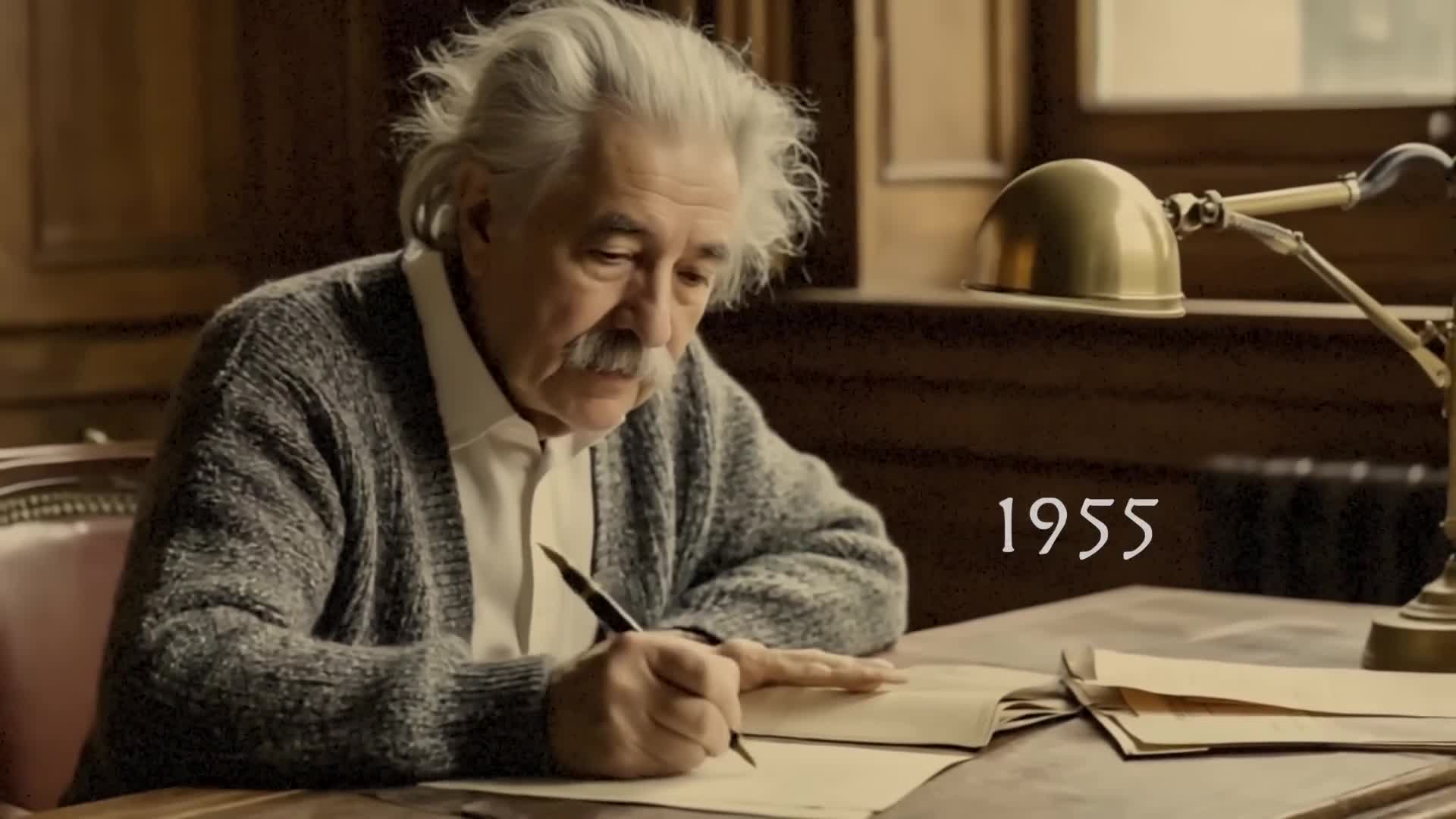
In 1955, Albert Einstein wrote a letter to the family of a close friend who had just died.
He said, The distinction between past, present, and future is only a stubborn illusion.
Decades earlier, his own equations had revealed that time doesn't behave the way we think it should.
It bends, it stretches, and it depends on how you move.
Two people in different places, or moving at different speeds, don't agree on what's happening now.
There's no single moment that everyone in the universe shares.
Which means the past and the future might not be gone or waiting.
They might still be there, right now.
This leads to one of the strangest consequences in physics, a theory called the Block Universe.
It says that time is like space, already mapped out.
Everything that ever happened, or will happen, exists together in a four-dimensional structure.
The reason you don't notice it?
Your brain experiences time as a sequence, not a whole.
If the flow of time, if our subjective sense of the flow of time is an illusion, we have this clash between physics and neuroscience because we live in the block universe and this comes in large part from relativity.
We live in a eternalist universe in which the past present, future is equally real.
Think of a movie reel.
All the frames already exist, but the projector light only shows one at a time.
Your consciousness works the same way.
It scans through moments, one frame per second, but the rest of the film never disappears.
It's just not lit up right now.
This isn't a metaphor.
According to Einstein's math, it's the natural conclusion.
And it gets even weirder.
Now, imagine this.
You and a friend are walking down the same street.
You're just a few steps apart.
Nothing feels different.
But according to Einstein's relativity, even that tiny motion, if you're walking in opposite directions, creates a slight tilt in your personal experience of time.
And that tilt affects what you each consider to be happening right now, in places far beyond Earth.
Like the Andromeda Galaxy, two million light years away.
In your frame of reference, a major event might have already started there.
In your friend's frame, it hasn't happened yet.
Neither of you would notice.
But physics say.
You now disagree on what's real in the same moment, in the same universe.
That's the Andromeda Paradox.
What is the Andromeda Paradox?
Well, the Andromeda Paradox is the fact that if you and I are looking at Andromeda two and a half million light years away, then what happens is suppose you're sitting in your chair and I'm running by.
And at the second I run by you, we both look up at Andromeda.
Because I'm moving and you're stationary, we're going to see events that are days apart.
How far away from me are you when you're running by me?
You're in the same place.
We're in the same place essentially.
And the thing that you see and I see are days apart.
Days apart.
Because of our physical perspective.
Motion changes the perception of time.
If two people standing side by side can disagree on what's happening in a distant galaxy, the idea of a universal now starts to fall apart.
The Andromeda Paradox, first proposed by physicist Roger Penrose, reveals just how fragile our sense of time really is.
And the numbers don't lie.
According to special relativity, even a small change in velocity alters your slice of spacetime.
It's not something you feel, but mathematically it shifts which events lie on your now line, especially when you project that line across cosmic distances.
Imagine this.
You pause for a moment.
Somewhere far away, an alien civilization decides to send a signal toward Earth.
For you, that decision has already happened.
But for the person next to you, walking a little slower or faster, it hasn't yet.
So on the Earth we're all the same now, but it's just this.
Proxima b, which is the closest star, has its own now.
There's no sense of putting them together.
You can send signals from one to the other, signal back, but in between there's no way of saying, there's no meaning.
And in fact people work in general relativity theoreticians work in general relativity study, solution of Einstein equation.
They know very well that there's this four-dimensional solution.
There's no preferred now, no objective now that you can pick up.
It's easy to dismiss these effects as theoretical, but they're real, and they've been measured.
We've seen this with satellites.
GPS systems must constantly correct for time distortions caused by motion and gravity.
Without Einstein's adjustments, your location would be off by miles in just a day.
And if those shifts matter over 20,000 kilometers, imagine the implications across light years.
So when we say the future already exists, we're not talking philosophy.
We're describing a structure where every event your birth, your death, your next decision is already part of the landscape.
The question is, which part are you standing in?
This doesn't mean you're frozen, but it does mean that your experience of time is a narrow beam moving through a vast four-dimensional territory.
And if time works like space, then every step you take reveals a different section of that terrain.
Not because it's being created in real time, but because it's already there, waiting to be seen.
The Paradox isn't just about galaxies.
It's about you, your now, your choices, and how they might already be part of something much larger and much stranger than anyone expected.
If time isn't something that flows, but something that simply is, then where are you, really?
That's where the block universe hits harder than any sci-fi theory.
Because if every moment exists, then the future version of you already exists too.
Not metaphorically, not as potential, as part of the structure.
It doesn't mean you're locked into fate.
It means your future is already written, just not yet experienced by the version of you watching this video.
So we automatically, right from the start, treat time and space differently.
We treat space as somehow more important or relevant to what the universe is, whereas time is just a label that tells us which moment of the universe we're talking about.
In this video, you're like a needle on a record.
You experience one groove at a time, but the entire song, the full track list, is already pressed into the vinyl.
When you make a choice, you don't generate the future.
You navigate it.
The options were already there.
Your movement reveals one path, but the others don't disappear.
They're part of the structure too.
This might sound far-fetched, but it's exactly what relativity demands.
Once you accept that simultaneity is relative, that different observers have different nows, then you can't see that one moment is more real than another.
So if your childhood still exists in one part of the block and your future old age exists in another, which one is the real you?
Here's the twist.
You don't exist at a single point.
You're a space-time worm, a stretched out line through the block.
Every version of you, every thought, every breath, is encoded along that thread.
And from a higher perspective, one outside of time, you'd look like a full shape, not a moving point.
This view isn't limited to fringe theorists.
It's been part of mainstream physics for decades.
But few people realize what it really implies.
If your future already exists, then maybe what matters isn't whether it's real, but how you decide to show up when you get there.
And maybe that future version of you is already watching, waiting for you to catch up.
Stay with me, because next, we'll take this idea even further.
In the Block Universe model, when you make a decision, you don't erase the paths you didn't take.
They still exist, just in different coordinates of spacetime.
This isn't metaphysics.
It's how branching timelines behave in certain interpretations of quantum mechanics, like the Everett or Many Worlds Theory.
But let's stay grounded.
Even if only one version of reality unfolds in your experience, the others don't vanish.
They're still part of the block, like rooms in a hotel you didn't check into.
They're there, just not yours.
There are going to be a lot of split versions in the future.
But if we're at a point now, and if we go forward, there's more possibilities.
Each one has their own past.
In space time, they all exist.
Every possibility that ever was or ever will be, trillions of times a second, they all exist.
Now, here's where it gets interesting.
If you zoom out far enough, your timeline doesn't look like a straight thread.
It's more like a fractal, a branching structure where each moment leads to multiple possibilities, each forming its own path, not infinite, but more than one.
Always.
These branching paths are shaped by your choices, but also by randomness, probability and outside events.
They intertwine, they rejoin, some die out, others amplify.
So why does this matter?
Because it means you're not navigating a flat road.
You're exploring a dense, living terrain of paths, some visible, some not.
The path you remember is one path.
But there are versions of you just slightly off course.
One chose differently last week.
One missed that train.
One never made that phone call.
You'll never meet these versions, but they're not fantasy.
They're embedded in the same 4D geometry that holds your current self.
And this fractal structure doesn't just apply to your personal life.
It applies to all systems.
From atoms, to economies, to galaxies.
If time is space, and choices carve trajectories, then the universe itself is a tangle of timelines.
Branching, looping, and crossing in ways we've only begun to understand.
You're not a line.
You're a network of possibilities.
And that changes everything.
If every moment, past and future, already exists in the structure of spacetime, then what exactly are you choosing?
This is where philosophy crashes into physics.
There are three major theories of free will, and each one reacts very differently to the idea that the future might already be there.
First, there's libertarian free will.
It says your choices are not predetermined.
You could have done otherwise at any moment.
You're a true agent, not just reacting to causes.
But in a block universe, this runs into problems.
Because if your future already exists, even just structurally, how could you have chosen differently?
Of course we all make choices.
We are parts of nature.
We make choices every day.
Thousands of choices every day.
The idea of determinism does not deny the obvious empirical fact that we are always making choices.
What it denies is the abstraction that we call determinism.
The could have been.
I could have chosen differently.
Then I would say you could only have chosen differently if you were different.
Nature was what it was.
So the could have been is an abstraction and I think it's a fantasy.
Second is hard determinism.
It claims that free will is an illusion.
Everything you do is the result of prior causes, genes, environment, physics.
The block universe seems to fit this view.
Your life is like a film reel.
Every frame fixed, playing in order, but already complete.
But the illusion of free will is an illusion in that as you pay more attention to your experience, you begin to see that it's totally compatible with an absence of free will.
You don't know what you're gonna think next.
You don't know what you're gonna intend next.
Third is compatibilism, a middle path.
It says determinism and free will can coexist.
You may not control the universe, but you still act according to your intentions.
Your choices are yours, even if they arise from a chain of cause and effect.
This is the view most modern philosophers and physicists lean toward.
Not because it's perfect, but because it matches what we experience.
We feel free, but everything seems causally connected.
Now, here's the twist.
In a static universe, free will might still be meaningful. just not how we usually imagine it.
Imagine a mountain range frozen in time.
You're not climbing it in real time.
You're unfolding your path through it.
The terrain is fixed, but your experience of it is real.
Your intent still matters.
It's just part of the structure.
We recognize that every decision is, in fact, at the level of particles, nothing but those particles coursing through our minds and going this way or that, resulting in us saying either yes or no, or going left or right.
There is no justification for the intuition that we are the ultimate authors of our actions, that we can somehow supersede the strings that are pulling us, that are governed by the equations of physics.
So, are you choosing freely, or just discovering the version of you that already chose?
The deeper we look into the fabric of reality, the more time itself stops behaving the way we thought.
Take GPS satellites.
They orbit Earth at high speed and far from its surface.
According to Einstein's theory of relativity, both their velocity and the weaker gravity they experience affect their clocks.
Without correction, GPS would drift by about 10 kilometers per day.
The only fix adjusting their time to account for relativistic effects.
The GPS satellites orbit higher than our space station.
That is far enough away from Earth's source of gravity for them to have a measurably different space-time condition.
We pre-correct the time signal from the GPS satellites so that by the time the time reaches us it's been properly corrected and it matters to us and our space-time continuum, not the one that's in Middle Earth orbit.
Oh my goodness.
That's not science fiction.
That's your phone.
Working right now.
Because time bends.
This bending happens in two ways.
First, gravitational time dilation.
The stronger the gravity, the slower time ticks.
Astronauts on the International Space Station actually age slightly slower than people on Earth.
Second, velocity-based time dilation.
The faster you move, the more time stretches for everyone else.
Both were proven in 1971, when atomic clocks were flown around the world on military jets.
When compared to identical clocks on the ground, they disagreed, exactly as relativity predicted.
Now here's where it connects to the block universe.
If time can stretch, slow down or accelerate depending on your position and motion, then there is no single universal now.
Each observer carries their own timeline, and that means the idea of a moving present, something sweeping forward through time, isn't real.
All moments exist, but you experience them differently depending on where and how you move.
In relativity.
In Einstein's point of view, there is no such thing as one moment of time all throughout the universe that everybody agrees on.
To Einstein, space and time are combined into space-time, but space by itself and time by itself are not absolute.
This is the foundation of the Block Universe.
Space-time as a four-dimensional structure where events don't happen, they just are.
Now, layer in quantum entanglement.
Two particles, separated by vast distances, can instantly reflect each other's state.
Einstein called it spooky action at a distance, but it's been confirmed repeatedly.
And it raises a serious question.
If information updates instantly beyond the limits of space, what does that say about time?
It suggests time isn't the primary framework.
It's emergent, a side effect of how we interact with the block, not how the block itself functions.
You've never really moved through time.
You've only moved through coordinates.
In 1949, Kurt Gödel yes, the same Gödel who shattered mathematics with his incompleteness theorem sat down with his friend Albert Einstein and proposed something strange.
He had found a solution to Einstein's equations of general relativity a rotating universe where time loops back on itself.
In this model, you could theoretically travel into your own past.
Not with a machine, but as a consequence of how space-time bends and twists.
Einstein was shaken.
He said Gödel's model, though mathematically valid, disturbed him deeply.
Not because it was wrong, but because it might be right.
Here's the issue.
If time travel is possible, even just in theory, it implies that past and future are equally real.
You can't visit something that doesn't exist.
That's why Einstein once wrote in a letter after his friend's death For us believing physicists, the distinction between past, present and future is only a stubbornly persistent illusion.
He wasn't being poetic.
He meant it.
Einstein's equations don't need a flowing now.
They work just fine without it.
And Gödel pushed this idea further.
He believed that our psychological sense of time, this feeling of moving forward, is a human projection, not a feature of the universe.
So, what does this mean for your everyday life?
It means that, from the standpoint of spacetime, your birth, your death, every moment in between, they all coexist.
Just as every location exists in space, every event exists in time.
It's only your consciousness that's locked into one slice at a time.
Imagine watching a film frame by frame.
That's how you live.
But the real is already complete.
This wasn't science fiction.
It came from the two minds who redefined logic and gravity in the 20th century.
And they were both whispering the same thing.
Time might not move.
You do.
And, if time is static, then what do you call change?
Growth, memory, even choice, might just be the unfolding of a path that's always been there.
Psychology has long known that our perception of time is elastic.
When you're in danger, time seems to slow down.
In flow states, it disappears entirely.
In deep meditation, the present can feel infinite.
And in dreams, entire hours unfold in seconds.
The way we estimate duration has a lot to do with how much memory we've laid down, how much footage we have to draw from.
Why does time speed up as you grow older?
Well, it's because when you're a kid, you're trying to figure out the rules of the world and everything is novel to you.
As you get older, you've figured out the rules of the world, which is advantageous for operating in the world.
Things aren't that novel to you anymore.
You've sort of seen all the patterns before.
And, as a result, when you get to the end of an adult summer and you look back, there's just not that much new.
Your brain doesn't measure time like a clock.
It constructs it out of sensory input, emotion, and memory.
And sometimes it loses the thread.
But there's more.
In near-death experiences, people report seeing their entire life in an instant.
Not like a movie, but all at once.
Simultaneity.
Outside time.
These aren't just anecdotes.
Studies at NYU Langan, the University of Michigan and others have recorded bursts of neural activity just before and after clinical death.
Brainwaves normally linked to consciousness, memory, and vision spike, despite no blood flow.
That entity we call the human mind consciousness does not become annihilated just after a person has died.
That entity continues.
And it continues even when the brain does not seem to be functioning, raising the question that consciousness may be a separate entity from the brain.
What's being processed, and where?
Some neuroscientists speculate these final surges are just dying noise, but others aren't so sure, because the experiences described often defy time, entirely realer than real, as if they step outside the linear flow.
And then there's psychedelics.
Under the influence of DMT or psilocybin, subjects report the same thing.
Time fractures.
Seconds stretch.
Hours collapse.
Some even claim to exist outside of time entirely.
And people have also reported losses of concept of time.
And that's something that you can't really put into words and just explain to people.
You know, I can't feel time anymore.
It's mind-blowing what happens to your brain when you take the time perception out of the equation.
This doesn't prove the mind exists outside space-time, but it points to something strange.
Your sense of time can dissolve, yet you still exist.
Maybe the mind is less like a clock and more like a spotlight, moving through a structure it didn't create.
And if the universe is a block, maybe consciousness is what animates it.
But those moments, when time stretches or collapses, might not just be distortions.
They might be something else entirely.
Think about deja vu, that eerie flash where everything feels familiar, like you've already lived it, not imagined, remembered only from when.
And then there are the dreams vivid random forgotten, until they play out days later, detail for detail.
Or that strange gut feeling you can't explain, right before something happens.
If time is a block, if every moment already exists, then maybe these aren't accidents, they're leaks.
Little glimpses of frames you're not supposed to see yet.
You're not predicting the future, you're brushing up against it.
And for a second, your mind steps outside the stream.
Not fiction.
Not fantasy.
Just evidence that consciousness might not be sealed to now, and what comes next might be the most convincing proof yet.
Watch closely, because this next video shows real-world cases and experiments that suggest the future isn't waiting to happen.
It's already happened.