This message comes from NPR sponsor Capella University.
Interested in a quality online education?
Capella is accredited by the Higher Learning Commission.
A different future is closer than you think with Capella University.
Learn more at capella.edu.
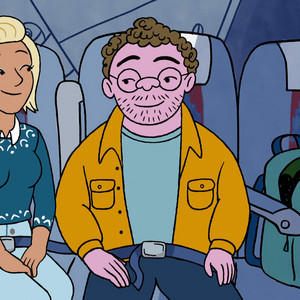
Long story short is a very funny and surprisingly moving new Netflix animated comedy series.
It's from the folks behind two shows that were big pop culture happy hour favorites BoJack Horseman and Tuca and Bertie.
We meet several members of one Jewish family by hopping around in time.
We see the three siblings as kids, as young adults and also in middle age, as they start having kids of their own.
They deal with all the things families deal with the ups and downs of romantic relationships parenting, work and ultimately, loss.
But it's funny.
I'm Glenn Weldon, and today we're talking about Long Story Short on Pop Culture Happy Hour from NPR.
This message comes from Cook Unity.
Fuel your day with fresh, fully cooked meals from award-winning chefs.
Every dish is crafted with handpicked ingredients and delivered to your door.
Commitment-free subscriptions start as low as $11 a meal.
Skip, pause or cancel anytime.
Go to cookunitycom slash happy or enter code happy before checkout for free premium meals for life cookunitycom slash happy or enter code happy before checkout.
Terms and conditions apply.
This message comes from Schwab.
Everyone has moments when they could have done better.
Same goes for where you invest.
Level up and invest smarter with Schwab.
Get market insights, education, and human help when you need it.
This message comes from NPR sponsor, Capella University.
Sometimes it takes a different approach to pursue your goals.
Capella is an online university accredited by the Higher Learning Commission.
That means you can earn your degree from wherever you are and be confident your education is relevant, recognized and respected.
A different future is closer than you think with Capella University.
Learn more about earning a relevant degree at capella.edu.
This message comes from Moises, proud supporter of NPR music and the 2025 Tiny Desk giveaway.
Win a trip for two to see a Tiny Desk concert live at NPR's headquarters.
Enter for free by September 12th and boost your odds by donating to the NPR network.
And follow where the music takes you with Moises, your AI powered studio created by musicians for musicians.
Learn more at Moises.ai.
No purchase or donation required for entry.
Must be 18 years or older to enter.
Links to the entry page and official rules can be found at npr.org slash tinydeskgiveaway.
Joining me today is entertainment journalist Christina Escobar.
She's the co-founder and editor-in-chief of Latinamedio.co.
Welcome back, Christina.
Thank you so much for having me.
Of course.
Great to have you.
Long story short is about the three Shwooper siblings, mostly.
They're Bay Area Jews who are just trying to get by.
There's the sardonic oldest brother, Avi.
He's voiced by Ben Feldman.
There's the emotional sister, Shira, voiced by Abby Jacobson.
And then there's their weird little brother, Yoshi, voiced by Max Greenfield.
Their father Elliot, is voiced by Paul Reiser, but the real heart of this show is their mother Naomi, voiced by the great Lisa Edelstein.
Naomi loves her kids very much and she never lets them forget it, which complicates their relationships with her.
You think love is passive.
You just sit there and love.
No, I push you because I love you.
You push us away.
Season one is streaming now on Netflix and a second season has already been ordered.
I am gratified to be able to report.
Christina, what'd you think?
I really loved this show.
I was surprised by how much I loved it because I'm not generally a adult animation person.
I feel like there can be a kind of smugness or like in-group thing that happens on those shows that I don't find appealing.
But I am a family drama person and on that note this show just sang.
It had all of these Beautiful and hilarious truths about what it is to be in family, what it is to be a kid, a grown kid, a little kid, a parent, and these really specific pieces of relationships with each other.
And that they captured a specificity and a heart that was just really, really wonderful.
The other thing I would say is the name of this show is Long Story Short, and it delivered on that.
It gave us a lot of long stories and short, digestible bits where you could go, you could visit with the Shroopers, you could take a break.
And I thought it really made the most out of its medium, which, you know, can be difficult.
Yeah, yeah.
I think this needs to be an animated series, and I'm glad it is.
I mean, I also think this is a pretty terrific show.
Really absurd.
It was really hilarious.
But that was just the stuff on the surface.
I mean, you're not going to find a bigger fan of Mr Peanutbutter than this guy, but you could always sense that there was a deep well of melancholy and loneliness in that show.
And I don't know, not to say it didn't make it a good hang.
It made it never an uncomplicated hang, put it that way.
This show has some really great jokes, some really funny character dynamics, which I want to get to.
But there is also a sadness here, but it's a kind of everyday sadness.
It's like, it's not the kind of sadness that makes you want to lie on the floor in the dark.
This show focuses on people who are just getting through it.
You know, they're really trying to be there for each other, to have each other's back.
I mean, they get exasperated with each other, yes.
And certainly the Naomi character is exasperating yeah, but she's also funny as hell turns out, and that helps, you know she's.
Yes, she slots very, very neatly into a kind of jewish mother stereotype, but But she is also part of that specificity you mentioned.
For sure.
The stereotype is a Jewish mother is not down with her son's Gentile.
Never good enough.
Yeah.
Never good enough.
And so it slots into that.
But the way she gives Avi's wife Jen, who was voiced by Angelique Cabral, absolutely no quarter, seeds no ground is hilarious because not because of what she's doing, but because of how she does it, what she says.
Oh, before I go, I brought something.
Oh, it's lovely.
I have to find something to put in it, which is more work for me on the busiest day of my life, but it's lovely.
My parents taught me to never show up empty handed.
So she shows up empty faced.
By the end of the season, I started to feel about Naomi the way I think the kids feel, which is yes, she's a monster.
She makes everything about herself, but she's our monster, right?
For sure.
I really appreciated they did an episode that was all about Naomi.
And it's relatively late.
You've learned along the way what the dad does, but you don't learn anything about Naomi outside of her relationship with her grown kids until that episode.
And it was interesting when it came on.
I was like, I haven't even thought.
I haven't even wondered what her job was, you know, because we're so primed to see TV.
Moms as purely moms.
And that episode complicated that beautifully and was able to show how she showed up outside of her family very differently than how she showed up with her kids, which I think is very human and very true.
And so to be able to see her as a whole human, as someone we see some of her – time as a girl, explaining a little bit why she is the way that she is, how she is with her kids and how she is in the community.
I thought it was so smart because, even though yes, in many ways she does embody this stereotype, We're able to see more and deeper without negating any of that other stuff.
I thought it was just excellently done and like a totally different TV mom than we normally get.
Yeah.
Yeah, it reminds me of the Rami Youssef animated series number one, Happy Family USA, which focuses on a Muslim family.
But that also plays with stereotypes and it doesn't set out to like dispel stereotypes or shatter stereotypes.
What it's interested in doing, I think is the same thing this show is interested in doing, which is kind of locating something real and, I'll say it again, specific and human.
Like it shows you the flat stereotype and then says here is the truth that the stereotype is keeping you from seeing.
If that makes sense, right?
Like the Jewishness of this show is so central.
I think it's its animating principle.
But that means that they're not going to cheat out the jokes.
They're not going to do the explanatory comma.
And I'm sitting there and if a joke, I can hear it whistling past me.
I'm fine with it because I know somebody behind me is going to get it.
It's going to land on them.
Plus also the nature of this show.
The writing is so good that I know that there is another joke coming down the pike.
That's just for me.
Ta-da!
I made your favorite vanilla ice cream cake.
My three least favorite musical acts.
That is what this show is doing, even as it's engaging with pretty broad stereotypes.
Yeah, and I loved the specificity of this show.
Like, listen, my name is Christina.
I am not Jewish.
It's clear, right?
Abby Jacobson's character is trying to cook her mom's meal.
And I don't necessarily know those foods, but I know that feeling of trying to reproduce something that your family has made, and how emotional it can be and how important it can be and how you can get it to be good but not right, and the huge disparity between those.
Yeah.
What is wrong with them?
They're not my mom's.
I felt like that was such a specific, but also then that thing where it sings out and is universal type of device that just like really, really worked.
And the show does that over and over and over again where it's super rooted, but somehow then also kind of makes sense again.
And I do want to say there are jokes for all sorts of folks, like that episode where they're also the two moms are dealing with their kids and they're trying to get them to soccer practice.
And it's just so hard.
They have their own stuff like that's my stage of life.
And I thought it was represented perfectly like capturing the intense angst of it, but also the joy and also the frustration.
And the joke about papa troll, which is the fictional tv show.
I just it was spot on and clearly created by people who know and have lived and have done it and it just it popped.
You know Yeah, and it works, because these voice actors have jokes that they're just tossing away.
They are so naturalistic.
They're just so unforced that you sometimes forget.
I sometimes forgot it was an animated show.
But once or twice an episode...
It seems like the show will do something that pushes the reality on screen into magic or into absurdity.
And that is very, very welcome because if you're an animated show, be an animated show, right?
Like, remind me that there's a reason that this isn't live action.
And that goes for, like, the structure of the show.
Yeah.
Which means each episode will come with a revelation of some kind, big or small.
But we get up to speed quickly because we have to.
A relationship has started since we saw the last episode.
A relationship has ended.
And we may or not get the how and why for a few episodes.
But I like that.
I like hanging out with this family.
Absolutely.
And I really appreciated the time jumps and how they did it.
Like that, to me, was making the most out of the animation.
Because man, if there's one thing Hollywood has not figured out, it's like how to do good makeup to make people look worse, older.
They're terrible at it.
They're terrible.
I don't understand why they haven't figured it out, but they haven't.
And so to be able to be with these characters across decades, to see the changes but have like the same voice and the same reminders, i felt like it enabled us to see into them quite Again.
Long story short, in a way that was effective and charming and allowed to just have the really needy funny, important parts, even if it wasn't the exposition.
Maybe you missed...
If somebody got divorced, or exactly when it happened, or whatever.
But you don't need it because that's not what we are getting at.
We're getting after.
Who are these people and why, and what are they going to do next with information they have?
Yeah, yeah, absolutely.
And this show was created by Raphael Bob Waksberg, who also created Bojack Horseman.
He was the co-showrunner on Tuca and Bertie, which was itself created by Lisa Hanawalt, and she is a supervising producer here.
He said in a Vulture profile of the show by Rebecca Alter...
I'll paraphrase, but basically those time jumps are something you can do in animation that you would definitely need prosthetics or CGI to do live.
And it's a empathy cheat code, right?
You're fast-forwarding our attachment to these characters, because we feel like we've grown up with them, because we've seen them at so many stages of life.
It's really smart.
And Lisa Hanawalt designed these characters, and I like the design of this show, which is intentionally lo-fi.
Everything's supposed to look hand-drawn.
Of course, it wasn't, but it's supposed to look like that.
And there's a real method to it, because if you notice...
Avi and Shira have their mother's nose, but Yoshi has his father's nose, which is a visual shorthand for why Avi and Shira butt heads with Naomi so much and why Elliot, the father, coddles Yoshi.
There's an episode where the parents rent a beach house and...
That beach house's decor is so obnoxiously nautical.
But haven't you stayed there?
I feel like I've stayed there.
Everybody has.
Everybody has.
Oh, here's some netting.
Great.
In case you forget.
And they even make those jokes.
You know those jokes that we've made, but they're somehow smarter and funnier coming out of those characters' mouths, you know.
Like, of course, you're not going to forget you're at the beach, but so good.
It's so good.
This show's heart has a way of sneaking up on you.
I mean, you get the sense.
I get the sense it's really pulling for these characters.
It wants them to find meaning.
There is a surprising lot about faith in this show, which usually leaves me cold.
But I don't know.
I could see how much it meant to these characters who are having that struggle.
So I just went with it.
Yeah, the faith stuff didn't feel extra or moralizing.
And I think that's usually the places right, because I'm with you where it ends up, where it either feels like tacked on, maybe to market to a specific group, or it feels like this is the way you should be, and nobody in this show is doing that right.
Like it's a show about persevering, right?
So they're all just trying to persevere and figure out their own identities, how they exist in the world.
And for them, faith and also Jewish culture is a huge part of that.
And they have to negotiate it in different ways and they come up with different solutions.
And maybe that's why it's not so moralizing is it's like none of them have it all the way figured out and are even none of them are even pertinent.
Pretending that they have it all figured out, right?
They're just like, here's a thing I found that maybe makes things better.
Naomi's pretty convinced she knows exactly what's going on.
But that's the joke, of course.
That's the joke.
There's no one right way to be Jewish.
But there is a progressive egalitarian, conservative Judaism with an emphasis on ritual and community over faith and blind practice.
That's literally the only way it makes sense.
I figured it out.
Can I take your temperature on one thing?
My one...
Not critique, but like when this show gets close to a kind of conventional satire, I feel like it lags a bit.
There's an episode where Avi becomes involved with some moms at his daughter's school.
Yeah.
That goes exactly where you expect it to go.
The targets of the jokes are the ones you expect them to be.
That felt a bit tidy, and I think the appeal of this show is not the tidy zinger, but something messier and more human and fallible.
What do you think?
I hear that.
Yeah.
I thought that the double meaning of wolves was smart on that episode.
But yeah, the PTA politics were less interesting, although they could be true to someone's experience.
Yeah, I don't think that was its strongest.
I do want to say it's really hard to do anything about COVID on TV and have it be watchable.
And I felt like this did a pretty good job.
I think the structure... made it so that we didn't get stuck.
Being stuck is not great TV.
So I was able to dip in and talk about how that time affected its characters, what it meant, but we didn't get stuck there.
And I thought, in terms of media I've seen trying to depict the height of the pandemic, that it did a pretty good job.
What did you think?
Yeah.
No, I thought that was great, too.
I also think it definitely benefits from the structure where You're exactly right.
You dip in, you get a sense of the lay of the land, the kind of chronological lay of the land, the narrative lay of the land, and then you're out right.
Because you go back to a different time or you flash forward in time.
And usually an episode begins with a little glimpse of a time period and they go to a different time period.
But the whole point of that episode is how those two periods talk to each other and how they impact each other.
Yeah.
I admire how much of this show is about the compromises these folks make, how adult this adult animated comedy is without being like raunchy.
It's just smart.
It's dealing with themes of compromise, disappointment and little joys, everyday joys.
I'm making it sound schmaltzy and I don't mean that in any way.
They're going to phrase, but it's not at all.
It's earned.
It's completely earned.
Yeah.
And it's not particularly earnest.
It's about family, right?
Which sometimes can get schmaltzy or earnest, and this feels more like a slice of life type, multiple slices of light artfully put together like a dessert from the bear.
Like there you go like, Cutely put together in a way that like it hits all of the notes on your palate, every single episode, and then moves through.
Like there's a artfulness that doesn't feel personal precious, or like overly contrived slice of life really done well.
That's also not navel gazing, because that's the other place.
Sometimes these go wrong and it doesn't because we're moving through.
We're moving through.
And they're moving through, too.
And that's what we're saying, folks, is like, check this out.
This is one of the good ones.
Yeah, go watch it.
But do check it out.
Then let us know what you think about Long Story Short.
Find us at Facebook.com slash PCHH.
And that brings us to the end of our show.
Christina Escobar, thank you so much for being here.
And I'm glad we got to share this show.
Yeah, me too.
It was a joy.
And just a reminder that signing up for Pop Culture Happy Hour Plus is a great way to support our show and public radio, and you get to listen to all of our episodes sponsor-free.
So please go find out more at plusnprorg or visit the link in our show notes.
This episode was produced by Carly Rubin, Janae Morris and Mike Katziff and edited by our showrunner, Jessica Reedy, and Hello Come In provides our theme music.
Thank you for listening to Pop Culture Happy Hour from NPR.
I'm Glenn Weldon, and we'll see you all next time.
This message comes from NPR sponsor, Capella University.
Interested in a quality online education?
Capella is accredited by the Higher Learning Commission.
A different future is closer than you think with Capella University.
This message comes from Warby Parker.
What makes a great pair of glasses at Warby Parker?
It's all the invisible extras without the extra cost, like free adjustments for life.
Find your pair at warbyparker.com or visit one of their hundreds of stores around the country.
One purchased equals one donated.
Go to bombus.com slash NPR and use code NPR for 20% off.