Thank you for joining us for today's Spotlight program.
I'm Ruby Jones.
And I'm Liz Waid.
Spotlight uses a special English method of broadcasting.
It is easier for people to understand, no matter where in the world they live.
In the developing world.
The two largest killers of children are diarrhea and respiratory tract infections.
Diarrhoea causes children to lose the vitamins and nutrients their bodies need to survive.
Respiratory tract infections affect a person's breathing.
They include sicknesses like influenza, But experts say that people can change these facts.
People just need to perform one simple process.
If they did, children's deaths from diarrhea could be cut in half.
Deaths from respiratory tract infections could be cut by one third.
What is this simple process?
It may be even simpler than you think.
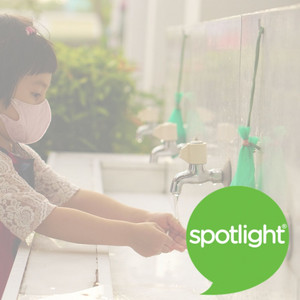
It is hand washing.
Some experts say that hand washing may be more effective than any single vaccine or other self-cleaning behaviour.
About 100 years ago, wealthy countries suffered the same problems, with sicknesses like diarrhoea and influenza.
Since then, cases like this have dropped.
Experts believe that improved public cleanliness, like hand washing, has been the reason.
Hand washing seems like a simple act.
But experts say that many people do not wash their hands at suggested times.
And even if people do wash their hands, they may not be receiving good results from it.
That is because many people do not wash their hands in the correct way.
Today's Spotlight is on washing your hands.
Do you think you already know everything you could possibly know about washing your hands?
Keep listening to find out.
Think about all the things you touched today.
A telephone.
A door handle.
A book at a store.
A handrail.
You may not think about it, but each of these objects could be covered with hundreds or thousands of very small creatures.
Germs like bacteria and viruses.
Germs are too small for people to see with their eyes.
They may only be about one cell big.
For example, one small drop of fresh water may contain as many as one million bacterial cells.
People's bodies naturally contain some helpful bacteria.
Our bodies need bacteria to function.
However, some bacteria can cause infectious diseases like diarrhoea tuberculosis, cholera and respiratory infections.
Viruses do not exist naturally in the body.
A virus enters the body from the outside environment.
Then it copies itself quickly, causing a person to become sick.
Viruses cause diseases like influenza and rabies.
Germs are everywhere.
On food, on animals, on objects, on people, in waste matter and more.
During a normal day, a person may gather hundreds of them on his hands.
From a person's hands, the germs can invade his body.
They usually enter a person's body through his mouth, nose or eyes.
These places are wet.
It is easy for bacteria and viruses to grow in these kinds of wet environments.
When a person is carrying a germ on his hand and puts his hand near his nose, mouth or eyes, he easily passes the germ into his body.
From there, the germ begins to cause problems.
This theory of sickness is called the germ theory of disease.
Scientists first suggested this theory hundreds of years ago.
At that time, many doctors did not agree with it.
However, doctors today all agree that this theory of disease is definitely correct.
Germs cause disease.
To stop disease, people must avoid or destroy harmful germs.
It is impossible for people to avoid every harmful germ.
But when a person washes his hands, he can get rid of many of the germs on his hands.
However, if a person wants to get rid of germs, he needs to wash his hands correctly.
He needs more than just a quick splash of water and a quick touch to the soap.
Health care experts around the world agree that there is a particular way people should wash their hands.
First, wet your hands with warm moving water, like from a sink faucet.
It is not necessary to use very hot water.
Very hot water will not kill more germs.
Second, use the cleaning soap.
You need enough soap to produce many soapy air bubbles, or lather, on your hands.
After you have a soapy lather on your hands, rub them together with energy for 15 to 20 seconds.
Make sure to clean every surface of your hands well.
This includes the backs of your hands, wrists, between your fingers and under your fingernails.
Many people like to sing or hum a 15 to 20 second song in their heads.
This helps to pass the time and to keep the timing correct.
Third, use moving water to remove the lather from your hands.
Do not let the water run down your arms to your elbows.
Finally, dry your hands with a clean, dry towel.
The cleanest method is to use a paper towel and then throw it away.
Use the paper towel to turn off the moving water.
This is the most effective method for getting germs off your hands.
Soap and hot water do not kill the germs.
Instead, soap and the rubbing action remove germs.
They push the germs from your hands onto the soap and into the water.
It is important for people of all ages to use this hand washing method.
The Mayo Clinic has important health resources on the internet.
The clinic says that children under age 3 living anywhere are at the most risk from diseases like diarrhea and influenza.
And children often pass these diseases along to the rest of their families.
The diseases can even spread to the whole community.
So it is important to make sure that even children wash their hands correctly.
And people should wash their hands often.
You should wash your hands in any of these situations.
After touching animals or animal waste.
After using the toilet.
After changing a baby's dirty diaper.
After blowing your nose or sneezing into your hands.
Before eating, serving or preparing food.
After visiting a person who is sick.
Before and after treating wounds or cuts.
After doing things outside the house.
And of course, you should wash your hands when they are clearly dirty.
Experts say that lack of soap is not usually the issue.
The issue is that people have not made washing their hands a normal, everyday part of their life.
This is true in every country, including wealthy and poor countries.
Health workers everywhere agree.
Washing your hands is the single most important thing people can do to avoid spreading diseases.
Parents must teach their children how to wash their hands.
And they must also practice these methods themselves.
Children follow the example of their parents.
It is possible to reduce the number of children who die.
The answer is as simple as washing your hands.
The writer and producer of this programme was Liz Waid.
Computer users can hear more Spotlight programmes on our website at wwwradioenglishnet.
This program is called Washing Your Hands.
You can write to us by email at radio at radio english dot net.
Goodbye.