

[The Therapeutic Essence of Warm Cozy Cabin Ambience]-[Warm Cozy Cabin Ambience | Gentle Stove Hum & Comforting White Noise]
📋 Summary
Introduction: The Sanctuary of Sound
The Deep Sleep Sounds podcast provides a curated auditory escape, specifically designed to facilitate relaxation and restorative rest. In this episode, titled Warm Cozy Cabin Ambience, the listener is transported into a secluded, tranquil environment. By utilizing specific sensory triggers, the podcast aims to decouple the listener from the stressors of daily life, inviting them into a state of profound stillness.
The Anatomy of Comfort: Stove Hum and White Noise
The episode centers on two primary auditory elements: the "gentle stove hum" and "comforting white noise." These sounds are not merely background noise; they are carefully selected to provide a sense of architectural and atmospheric safety.
The Gentle Stove Hum
The "gentle stove hum" acts as an anchor for the listener’s consciousness. In the context of environmental psychology, low-frequency, consistent mechanical or natural sounds—like the soft roar of a stove—mimic the feeling of hearth and home. It evokes a primal sense of warmth and security, signaling to the brain that the immediate environment is stable and protected from external threats. This "hum" serves as a sonic blanket, effectively softening the sharp edges of silence that can often lead to anxious overthinking.
The Comforting White Noise
Complementing the stove is the "comforting white noise." White noise is scientifically recognized for its ability to mask sudden, jarring sounds that might otherwise disrupt sleep cycles. By providing a steady, broadband frequency spectrum, the podcast creates an acoustic shield. The term "comforting" here is significant; it suggests that the white noise is not harsh or clinical, but rather textured and organic, designed to blend seamlessly into the background until it becomes indistinguishable from the listener's own internal rhythm.
The Psychological Impact of Cabin Ambience
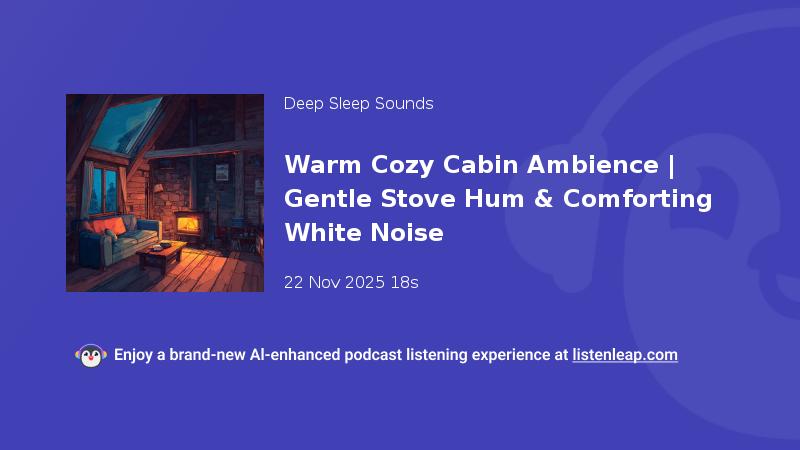
The choice of a "warm cozy cabin" as the thematic backdrop is a deliberate psychological strategy. The concept of a cabin represents isolation, detachment from technology, and a return to basic comforts. When the listener focuses on the "warm cozy cabin ambience," they are engaging in a form of guided visualization. The audio serves as a bridge, helping the listener transition from the high-beta brain wave states associated with active work and stress to the alpha and theta states required for deep, refreshing sleep.
Conclusion
Through the minimalist application of a "gentle stove hum" and "comforting white noise," the Deep Sleep Sounds podcast successfully constructs a virtual sanctuary. This episode proves that complexity is often the enemy of rest. By focusing on the elemental, repetitive, and soothing qualities of cabin life, the podcast provides an effective tool for anyone seeking to improve their sleep hygiene and cultivate a sense of inner peace in an increasingly noisy world.
Deep Learning with ListenLeap


