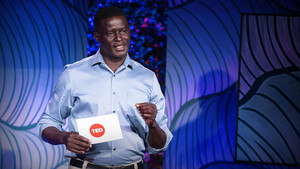
Ted Audio Collective You're listening to Ted Talk's Daily, where we bring you new ideas to spark your curiosity every day.
I'm your host, Elise Hugh.
The transition to clean energy has to happen, but it comes with a cost in certain parts of the world where minerals needed for renewables are sometimes violently fought over.
Hugh Gondon, peace and reconciliation advocate Victor Ochen reminds us of this reality, and the need to remember the global south as we confront our climate future after our short break.
Like Ted Talks, you should check out the Ted Radio Hour with NPR.
Stay tuned after this talk to hear a sneak peek of this week's episode.
And now our Ted Talk of the day.
The world today is no longer news that we are grappling with the devastating effects of climate change.
Communities are searching for solutions, trying to turn the tide onto the future that at times really looks so depressing.
And there is no place this is more real than in the continent of Africa.
But of course, conversations about climate change often miss out on accounting for the most critical barrier to climate solution, which is conflict.
I got to know about this through my personal experience as a survivor of war, but also working with a population that has been living through conflicts for the against.
If you may, I would love to share with you a story based on my personal encounter with the communities that I work with and were going through the difficult times of climate change.
I'm from Uganda. Recently in my home district of Lera, a woman was arrested because she had cut the shared trees and burns the charcoal into fuel and it's a crime in Uganda.
I saw her being walked to the police station and I decided to ask her, say, my sister, I see you are being taken and you'll be charged for this crime.
But I have a question for you.
If you were forgiven for this crime today, do you promise that?
But you will never do it again.
The frustrated woman looked at me and told me and said, you know what?
Even if they released me right now, I would do it again.
I would do it again because only through burning charcoal that I can raise money to pay for my children's education.
And it's only through burning charcoal that I can raise money to meet the medical bills for my children who are always falling sick of malaria.
So the truth is, I would do it again.
This is the story for many in Uganda.
Beautiful country with so much potential but always undermined by a near, constant state of violent conflict.
And you know, in a community where poverty and unemployment is so high, fight against climate change.
It's an almost a losing battle.
But when you look through across Africa, you find that most of the count is most vulnerable to climate crisis, going through some sort of conflict.
When you look through Sahel region, you find there's always constant attack, classes between the hiding, the farming and the fishing communities over diminishing land and water resources.
Of course, with not so much option, humanity will always do anything possible to for survival.
I myself had to cut the trees to burn charcoal to raise money to meet the basic needs but most important pay for my education.
And education that has enabled me to be able to stand before you to give this speech today.
Now, the big question is, how can we make it?
What can we do to create an alternative to environmental destruction and provide economic means that will support conditions necessary for peace?
That's the biggest question we should be asking ourselves today.
I remember a think about this a lot through my work at African Youth Initiative Network INET.
We are for decades. We have been supporting war survivors from Uganda, from Congo, from Sudan and South Sudan.
And we have been able to mobilize young people to make them game changes for peace and development.
We made it in community conflicts and supported agricultural activities as a mechanism provide youth economic alternative to violence.
And we have been successful.
So the success of this work we have done is a clear manifestation of how a local initiative can greatly impact on economic empowerment on conflict resolution and climate change.
And every time I think about this, I do believe this is an opportunity for Africa to also impact on the world peace.
And I sincerely know for sure that for us to achieve this goal, the following three points have always come very strongly in my heart.
And first is, we need to change the way we are talking about climate change.
It is time that we take the climate dialogue beyond just mere weather patterns.
And all of people understand what they are fighting for, who they are protecting, what will they win or lose based on their action or in actions.
This has always helped us.
I remember Alilastia, I went to my village with my twin brother Jack.
We were welcome by one of the community elders Charles.
He was so happy to see us to welcome us home and he was sad that he couldn't give us some sugar cane which he used to be a traditional gift to us.
Simply because to wetland that used to grow sugar cane and dry that.
And he was really sad about it.
My twin brother, Comforted him and told him whether it's changing, whatever it encourages, let the community do our part by planting trees so that they can attract more rain.
When he heard this, he asked my brother, said Mr.
O'Peo, are you saying, as you are saying, trees is good to bring rain.
Now that you have planted so many trees in your community, is it raining in your garden?
To me this was sincerely the most basic important organic question that could come from this community.
But also it made me reflected if at all our global discussions about climate change is actually responding to the needs at the grass root.
So today in Northern Uganda, share trees are no longer producing enough fruits because there's local knowledge that share trees do need bush burning in order to stimulate flowering.
But also we know bush burning is bad for environment, creating a lot of confusion.
And this brings in the issue that Comforted the current account from experts, from activists, from the government, which leaves the local communities as collectible victims of global disagreements.
And this has kept everyone of us in the merry-go-round of climate confusion.
And now back to the episode.
Creating a lot of confusion.
Secondly, we need to engage the population that is most affected.
This gives the young people the youth.
With 70% of Africa below the age of 30, youth represented the largest demographic opportunity for the continent.
We have to engage including youth would be an opportunity to uplift the continent from the devastating poverty.
And excluding young people in all the climate activities will benefit conflict.
So we must engage young people.
This is because we do know youth are the legitimate owners of the future.
So their inclusion is mandatory.
And finally, as we seek to mitigate the effects of climate change and conflict, it is time to all corporations, government and individuals accountable for committing climate crimes, home and abroad.
This should be done by establishing international climate courts.
Today, the world is celebrating the transition to clean energy.
We are celebrating the progress.
And we cannot celebrate the transition to clean energy while being silent about the death and suffering of millions of people.
In democratic republic for instance, populations have been displaced, millions have been killed, lost properties, just because companies or corporations are exploiting their natural resources.
And we have seen also rebel groups fighting to take on the fertile lands, lands rich with minerals in the democratic republic of Congo.
The truth is, the suffering, the death, the humanity we have seen Congo is a proof that the road to clean energy is so far that that is road on the planet.
Of course, I'm also worried.
I'm worried that the climate crisis will leave the world more divided, especially between the global North and the global South.
I'm also worried that the rich and the poor will be divided.
The rural and urban, why?
Because 10% of the world wealth is discussing on reduction of global emissions by flying less.
And yet, greater poor and majority are dreaming for only one time opportunity to fly.
And to them, all these climate regulations being proposed appears as unefort to reinforce the preexisting inequality which has always been meant to keep them poor.
This is going to create the division.
Lastly, there is an African proverb by legendary South African musician Lucky Dube.
Usang the song that says, the night is long for an angry child.
The night is long for an angry child.
What an image. That child could have been your child.
Think about that mom, that dad, who are powerlessly waiting for the morning to try to get something for the child who can't sleep because he went to bed with empty stomach.
If we have opportunity, we should have leadership that are willing to create conditions that will help build the community tomorrow that our children can count on.
And lastly, may we realize that the birth of a new era would mean we must all understand that climate change and war are intertwined global long-term challenges.
It requires all of us to work together and most importantly, mobilize a generation that is so willing to defy violence and work very good of all of us.
Apoyamatek, thank you very much.
That was Victor Ocean at the Ted Salon Big Bats event in 2024, supported by the Rockefeller Foundation.
If you're curious about Ted's curation, find out more at Ted.com slash curation guidelines.
And that's it for today.
Ted Talks Daily is part of the Ted Audio Collective.
This episode was produced and edited by our team, Martha Estefanos, Oliver Friedman, Brian Green, Autumn Thompson, and Alejandra Salazar.
It was mixed by Christopher Faisy-Bogan, additional support from Emma Taubner, Daniela Balorezo, and Will Hennessy.
I'm Elise Hugh. I'll be back tomorrow with a fresh idea for your feed.
Thanks for listening. On the Ted Radio Hour, paleontologist Ken Lakhavara says a spot in New Jersey sheds light on exactly what happened when an asteroid hit the Earth.
This makes this the best window on the planet and that pivotal, calamitous moment that wiped out the dinosaurs and really made the modern world as we know it.
The day the dinosaurs died.
That's next time on the Ted Radio Hour from NPR, subscribe or listen to the Ted Radio Hour wherever you get your podcasts.