Welcome to Spotlight.
I'm Liz Waid.
And I'm Bruce Gulland.
Spotlight uses a special English method of broadcasting.
It is easier for people to understand, no matter where in the world they live.
Imagine you are in a meeting at an office building.
Your boss is speaking about next week's project.
Then everyone takes a break for lunch.
But you do not go to a restaurant or store.
Instead, you exit the room.
Inside the walls of the building are thousands of plants.
Some produce fruit.
Some produce salad greens.
You grab a small plate, go to the wall, and pick the ingredients for your lunch.
Then you sit down under a tree and begin to eat.
You are 30 stories above the ground.
This may seem like a fantasy, but this describes plans for a real building called the Xianmu Tower.
It will be built in Shenzhen, a city in southern China.
And it may represent the future of cities.
Today's Spotlight is on the Jianmu Tower and the future of cities.
The Jianmu Tower is a kind of vertical farm.
It is not the first vertical farm.
Vertical farming is already happening in some countries.
The country with the most vertical farms is the United States.
But there are vertical farms in many countries, including Japan Thailand Germany, the Netherlands and the UAE.
Many of them grow leafy green vegetables like lettuce and kale.
Economic experts consider vertical farming a growing market.
But the Jianmu is one of the biggest planned projects.
The Jianmu Tower will be a tall glass skyscraper.
It will be 51 stories tall.
It was designed to have offices and apartments.
But it is also designed to grow plants.
Each window will be filled with them.
And the building will produce 270,000 kilograms of food every year.
Carlo Ratti is an Italian architect.
He designed the Jianmu Tower.
He named it after a tree from old Chinese myth.
In the story, this tree connected heaven and earth.
Rati designed the tower for the Chinese grocery business, Woomart.
The tower will be Woomart's new headquarters.
People can also rent rooms there.
Each person living in the Jianmu Tower will have their own garden.
But these are not just any gardens.
They are vertical gardens.
And the whole tower is one big vertical farm.
Vertical farms are different than traditional farms.
Traditional farms need soil to help plants grow.
But vertical farms use methods like hydroponics.
These methods give water and nutrients to the plants directly.
They do not need soil.
Vertical farming also lets farmers put plants anywhere.
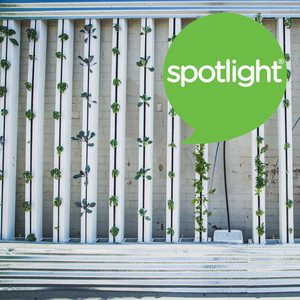
In a vertical farm, farmers hang plants above and beside each other on a wall.
Sometimes they use special lights to help the plants grow.
Others, like the Jianmu Tower, hang plants by windows.
The tower is so high, the plants get plenty of sun.
Doing this also has another benefit.
When plants take in sunlight, they also take in heat.
This helps control the climate in the tower.
So the tower will use less energy.
Vertical farms can be very efficient.
Traditional farms can only grow food at some times of the year.
But vertical farms can grow plants all year.
Some vertical farms trap rainwater.
They can recycle the water they use.
So droughts or reduced rain do not affect the farms.
The Xi'an Mu Tower will even get moisture from the air.
But vertical farms are a very good use of space.
They use far less land than a traditional farm.
Brian Mullady is the manager of a vertical farm.
He told spectrum news.
With the area of growing you usually expand out, but with this you are expanding up.
You use less water and land and you create less waste.
It is a more sustainable way to farm.
Today, Environmental experts encourage people to use land efficiently.
They want people to use natural resources in the best way possible, with the least amount of waste.
Land efficiency will be especially important as the world's population grows.
Dixon DesPommiers is a former professor at Columbia University.
He invented the modern idea of vertical farming.
He talked to the website Big Think.
We expect the human population to increase.
So over the next 40 years, you might have three billion more people to feed.
And you look around for the land where that food will come from, and you do not find it.
It is not there.
So the biggest problem facing the global population is where will the food for the next three billion people come from?
So it could come from some place other than a traditional farm.
The question is, could vertical farms solve that problem?
Efficient use of space is important for another reason.
It helps fight climate change.
According to the World Health Organization, Over 50% of the world lives in cities.
But most of our food does not come from cities.
It comes from the country.
This means that people living in cities must ship food into the city.
The food must come from even farther if it is not in season.
Some fruits, like avocados, can travel for thousands of miles before people buy them.
This uses a lot of fuel.
Food producers must also use preservatives to keep the food fresh.
This damages the environment.
It also adds to climate change.
Vertical farming might help reduce these problems.
A traditional farm cannot fit in a city.
But a vertical farm can.
The Jianmu Tower shows that even if you live in the city, there can be a farm in your home.
Much of the food people eat in the tower will come from the tower itself.
They will not have to go anywhere to get it.
They will not have to ship as much food in.
And the food will be grown without pesticides or preservatives.
It will be better for the people and the environment.
Vertical farming can even help in places where people cannot grow food.
Fukushima is a city in Japan.
It once had several nuclear power plants.
In 2011 there was a big earthquake.
The earthquake caused a tsunami.
This huge wave hit Japan and caused terrible damage.
The power plants in Fukushima melted down.
This contaminated the area with radiation.
People could not go there without getting very sick.
People in Japan were very scared of the radiation.
They did not want to eat food grown anywhere near Fukushima.
So the government funded vertical farming.
These new farms were safer than traditional ones.
They allowed people to have fresh food without fear of radiation.
Vertical farming is not a perfect solution to these problems.
A vertical farm can cost a lot of money to build and run.
Some vertical farms use lights to grow plants.
They also keep their plants in controlled climates.
This uses a lot of energy.
It can even lead to more pollution, making climate change worse.
But many people believe that they can overcome these problems.
They believe buildings like Xiamen Tower will help.
Carlo Ratti even believes that buildings like this are the future of cities.
He writes, That is, how do we bring the natural world into building design?
Would you live in a place like the Jianmu Tower?
Would you like to work in one?
You can email us at contact at spotlightenglish.com.
You can also find us on YouTube, Facebook, Instagram and Twitter.
The writer of this program was Dan Christman.
The producer was Michio Ozaki.
The voices you heard were from the United States and the United Kingdom.
All quotes were adapted for this program and voiced by Spotlight.
This program is called, Vertical Farming and the Future of Cities.
Visit our website at wwwspotlightenglishcom to download our free official app for Android and Apple devices.
We hope you can join us again for the next Spotlight program.
Goodbye.