All right, let's keep it simple.
How about darts?
No, that's not fair either.
Why not?
Darts is a bar game.
You've been frequenting drinking establishments since you were of legal age.
Yeah, that's when it started.
57, 58, 59.
That's one minute.
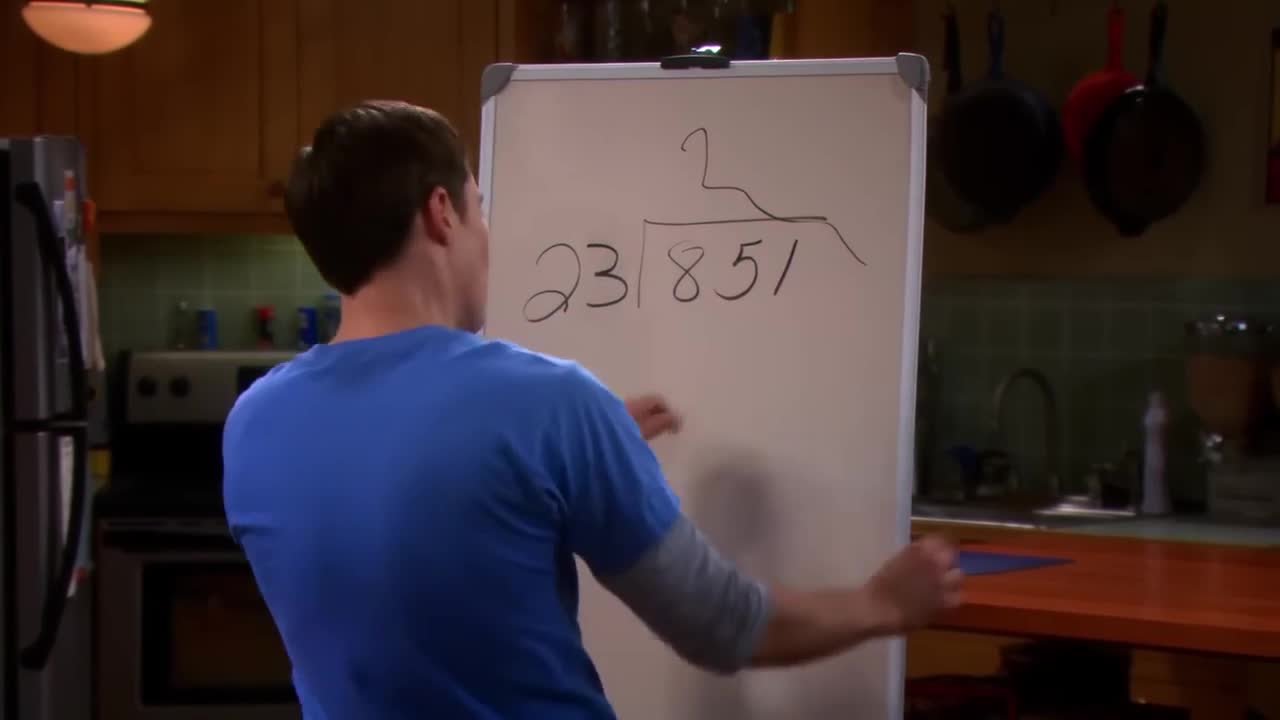
Long division.
Long division.
Go, go, go.
Remember, show your work.
I'm okay.
I'm okay.
Not okay.
Get up.
We can't lose in math.
37!
Yes!
First there was PlayStation, aka PS1.
Then there's PS2, PS3, and now PS4.
And that makes sense.
You'd think after Xbox, there'd be Xbox 2.
But no.
Next came Xbox 360.
And now, after 360, comes Xbox One.
Y1.
Maybe that's how many seconds of thought they put into naming it.
Can you get the butter, please?
However, with the Xbox One, I can control my entire entertainment system using voice commands.
Up until now, I've had to use Leonard.
Then get the other one.
Pass the butter.
Hang on.
I don't feel like you're taking this dilemma seriously.
Fine, Sheldon.
You have my undivided attention.
Okay, now, the PS4 is more angular and sleek looking.
No way.
It's true.
But the larger size of the Xbox One may keep it from overheating.
Well, you wouldn't want your gaming system to overheat.
No, you absolutely would not.
And furthermore, the Xbox One now comes with a Kinect included.
Included?
Yes.
Not sold separately.
Although the PS4 uses cool new GDDR5 RAM, while the Xbox One is still using the conventional DDR3 memory.
Why would they still be using DDR3?
Are they nuts?
See, that's what I thought.
But then they go and throw in an ES RAM buffer.
Wait a second.
Who's they?
Xbox.
You're kidding!
And this ES RAM buffer should totally bridge the 100 gigabit per second bandwidth gap between the two RAM types.
This is a nightmare.
How will you ever make a decision?
You see, I don't know.
What should I do?
Please pass the test.
I'm proud of you, Sheldon.
Yeah, I'm proud of me, too.
I've done all my research, I conducted an informal poll and I've arrived at the rock-solid certainty I've made the right choice.
Well, that's got to be a good feeling.
Oh, it is.
Although... Oh, crap.
No, I had the same feeling when I made my dad buy a Betamax instead of a VHS.
You were just a little kid.
Yeah, a little kid who picked the wrong format to record the McNeil-Lehrer report.
I also was certain that HD DVD would win out over Blu-ray.
How old were you then?
Old enough to know better.
You know, and now that I think about it, I stood in front of a case of iPods and I bought a Zune.
What's a Zune?
Yeah, exactly.
It's an MP3 player brought to us by the makers of Xbox.
No, what are you doing?
No, pick that back up.
You know it's good.
You did the research.
But what if I'm wrong?
You know what?
How about I buy it for you?
How about I buy you both?
You know I only have one slot available on my entertainment center.
Then I'll buy you a new entertainment center.
Okay, sure.
But which one?
How about this?
I've heard that if you flip a coin, it will tell you how you actually feel, because you'll either be disappointed or excited by the outcome.
Interesting.
So heads, it's PS4.
Tails, it's Xbox One.
All right, I'll try.
What is it?
A quarter.
Could have given it back to me.
That was a choice.
On the one hand, the Xbox One has a better camera, but the PS4 has a removable hard drive.
Thoughts?
I can't feel my legs.
Oh.
I'm sorry, guys, but the store closed five minutes ago.
But I haven't decided yet.
You have to come back tomorrow.
The registers are closed.
Let's get you some food.
You'll feel better after you eat.
Okay.
What do you want?
Like Thai food?
A burger?
I don't know, like a quarter.
The more i told him about my lab, the pissier he got.
You know what he said to me.
He said i hope all your correlations turn out to be specious.
Is that your face?
What a dick.
You know you're a successful woman.
You should be able to brag about your accomplishments once in a while.
So should you?
I mean, the guys are never shy about bragging.
Tell me about it.
How he texts me every time his dog levels up in Warcraft.
Has he ever called you to tell you he found three peanuts in one shell?
Because Sheldon has.
We should be able to do that too.
I guess we can brag to each other.
It's a great idea.
Damn right it is.
I came up with it.
That felt good.
You know, there's so much money in pharmaceuticals, we don't even wash out our test tubes.
We just throw them out and get new ones.
I just got a brand new state-of-the-art fMRI machine.
Oh, those things are so expensive.
I know.
Sometimes I just lie down in there and take a nap.
It's like a million-dollar bunk bed.
I have two assistants.
I don't even know their names.
I just call them Thing One and Thing Two.
That's great.
I don't have assistants.
I guess that's one of the benefits of being in the private sector.
That and all the money I make.
Yeah, you've got that.
I've got my integrity.
Hard to say which is better without making you feel bad.
I may not make as much money as you, but at least I know that I'm actually doing something that makes people's lives better.
Hey, my work makes people's lives better.
Especially if you have moderate to severe eczema and don't mind if you lose teeth.
You're right.
We both do important work.
I'm trying to map the structures of the brain and you're trying to convince people that itchy hair is a real thing, is a real thing.
It happens to be a side effect of our cholesterol drug.
I'm just saying that my research may actually change the world forever.
I hope it does, because I'm gonna see that world from a yacht so big you can land a helicopter on it.
Okay.
Her apartment's on the fourth floor, but the elevator's broken, so you're gonna have to.
Oh, you're just gonna be done.
Okay, cool.
Thanks.
I guess we'll just bring it up ourselves.
I hardly think so.
Why not?
Well, we don't have a dolly or lifting belts or any measurable upper body strength.
We don't need strength.
We're physicists.
We are the intellectual descendants of Archimedes.
Give me a fulcrum and a lever and I can move the earth.
It's just a matter of... I don't have this.
I don't have this!
I do not have this!
Archimedes would be so proud.
You have any ideas?
Yes, but they all involve a green lantern and a power ring.
Easy.
Easy.
Okay.
Now we've got an inclined plane.
The force required to lift is reduced by the sine of the angle of the stairs.
Call it 30 degrees, so about half.
Exactly half.
Exactly half.
Okay.
See, it's moving.
This is easy.
All the math.
What's your formula for the corner?
What?
Oh.
Okay.
Uh... Okay, yeah, no problem.
Just come up here and help me pull and turn.
Ah, Gravity, thou art a heartless bitch.
You do understand that our efforts here will in no way increase the odds of you having sexual congress with this woman.
Men do things for women without expecting sex.
Yet those would be men who just had sex.
I'm doing this to be a good neighbor.
In any case, there's no way I could lower the odds.
Almost there.
Almost there.
Almost there.
No, we're not.
Watch your fingers.
Watch your fingers.
I've got my fingers.
Hey, Raj.
Hey, Stuart.
What are you doing here?
Oh, I'm living here again.
Do Howard and Bernadette know?
Or is it like a possum in the walls kind of thing?
No, I needed a place to stay.
With the baby coming, I figured they could use some extra help.
Okay, cool.
Anyway, come on in.
Dinner's ready.
Oh, but I bought Chinese takeout.
Oh.
Okay, well, if Bernadette wants her ankles to swell up even more, she can have that.
So I was reading how it's a good idea for new parents to take an infant CPR class.
Yeah, we've been meaning to do that.
Oh, I know a CPR instructor who'll come to the house.
That'd be great.
I'll give him a call.
We met when I was sleeping on the beach and he thought I was dead.
Thank you again for cooking.
It's getting tough for me to be on my feet all day.
You just kick back and relax.
I got it all under control.
Although it was already under control.
I'm sorry?
You mumbled something?
It's just that they've had plenty of help.
Oh, you know what they say, it takes a village.
Well, they already had a village.
I noticed the village couldn't find time to put the crib together.
Yeah well, maybe the village was too busy checking out the local Montessori school for the new arrival.
You mean the one with the empty beer bottles in the sandbox?
We'll pass, thank you.
Do something, Batman.
Hey, tomorrow, who wants to paint the nursery?
I'll do it.
Why do you get to do it?
I'm the artist.
Just because you're starving doesn't make you an artist.
Just because I look sickly doesn't mean I'm starving.
Howard!
Guys, you heard her.
Go see what she wants.
I think I'm in labor.
Oh, okay, okay.
I can do this.
We have a plan.
Somebody please tell me the plan.
I'll get the hospital bag.
I'll pull the van up.
Me outside in two minutes.
Team Baby, go!
I love you.
I love you too.
Are we hugging or having a baby?
Let's go!
Hey.
Okay, now that everyone's here, we can begin.
Before we do.
I just talked to Leonard, and if you're going to spend all your time trying to belittle me by making this class unnecessarily hard, then I'm out.
If you're interested in making a sincere effort to be a good teacher, then I'm willing to give this a shot.
I suppose that's a fair request.
There's no reason we both can't benefit from this experience.
Okay.
Well then, first things first.
Are you familiar with the brachistochrone problem?
I am.
Good.
And how it relates to the calculus of variations?
It's an inverted cycloid.
Wonderful.
Now, what about Euler-Lagrange theorems?
That's where I'm a little fuzzy.
Ha!
I knew it!
All right.
We have a lot of information to cover before your first test which, by the way, is in eight minutes.
The good news is I'm grading on a curve, so you're pretty much guaranteed a C.
All I do is win win win, no matter what.
What are you doing?
Everybody hands go up.
And they say they'll.
What are you doing?
If you're going to be a crappy teacher, then I'm going to be a crappy student.
Huh, ludicrous going in on the verse cause I've never been defeated and I won't stop now.
Yeah, but now stop it!
This is a classroom.
This is not American Bandstand.
Okay, now where was I?
Let's see.
Oh yes, over here.
What are you doing now?
Making a straw.
Why?
So I can shoot you with a spitball.
You're not going to do that and I'll tell you why.
This is an institution of higher learning.
I am your professor, and you're going to treat me with the proper- You shot your spit in my mouth!
Is that gonna be on the test because I don't think I can do that again?
You reported me to human resources?
You violated the sanctity of my mouth.
Well, I dropped your class, so I hope you're happy.
I told you you weren't smart enough to take it.
I'm smart enough, Sheldon.
Asking me a bunch of questions about a topic I'm not familiar with doesn't prove anything.
I could do the same to you.
Try me.
Okay.
You enjoy making fun of engineering so much.
How do you quantify the strength of materials?
Young's modulus.
Is that right?
Yeah.
Okay, how do you prevent eddy currents in a transformer?
Laminate the core material.
Come on, give him a hard one.
That was a hard one.
All right, how does the flow rate in a pipe depend on its diameter?
You don't know, do you?
What's the matter, smart guy?
Don't know Poiseuille's law?
Thank goodness I got it!
But now I can quit checking my stool.
Lava serpent.
Nest of snakes.
Underworld guardian.
Underworld guardian.
We skirmish to the death.
Invisibility spell.
Luminescence spell.
Water nymph.
Fire demon.
Two-headed tiger.
Three-headed lion.
Sulfur.
Brimstone.
Problem, Wil Wheaton?
Hang on.
You're holding two moderate spell cards, a small rock and a potion of Zancor, which will be about as much help as an air conditioner on the ice planet Hoth.
Your only move is to play the potion, lose the skirmish, and two moves later, the game.
I think he's got me.
The year was 1995.
The place, Jackson, Mississippi.
Having spent 10 hours on a bus, during which I had to twice violate my personal rule against relieving myself on board a moving vehicle.
Finally arrived at the fourth annual Dixie Trek convention, only to find that my idol Wil Wheaton decided he had better things to do than to show up and sign my action figure.
What?
You betrayed me, Wil Wheaton.
Now, I have my revenge.
You went to the 95 Dixie Trek?
Oh, dude.
My grandmother had just died, and I had to go to her funeral.
Your Meemaw died?
That's terrible.
Yeah, it was.
I'm really sorry that I disappointed you.
No, no, I understand.
Well, if anything happened to my Meemaw, I'd be one inconsolable Moon Pie.
I should clarify that statement by explaining that she calls me Moon Pie.
It's a special relationship, isn't it?
Between a boy and his grandmother?
Oh, yes.
Okay, great, everybody loves their grandmas.
Now, come on, Sheldon, finish him off.
Yeah, it's okay, Sheldon.
I let you down.
I deserve it.
Potion of Zancor.
What are you waiting for?
Kill Will Wheaton from Hell's Lord Stabatim!
I can't.
Sure you can.
Do it.
Do it.
I came here to defeat Will Wheaton, the man who destroyed my dreams.
But I can't defeat Will Wheaton, the man who loved his Meemaw.
Enchanted Bunny.
No!
Not Enchanted Bunny!
I call my Meemaw Nana.
And she's going to be very happy to hear that my small rock kills your enchanted bunny.
Game over, moon pie.
I don't understand.
Your grandmother's alive?
You catch on quick.
Come on, Stewie.
Let's get our prize money.
That was fun.
Hey, Emily, listen.
I've been thinking, and I'm not sure it's a good idea that I come over.
Oh.
Okay, I understand.
No, no, please don't cry.
Okay, I'll stop.
Hello?
Hey, so listen, Claire, change of plans.
Fine, do what you want, but she's playing you.
I don't think so.
She sounded pretty upset.
You mean like, I was just really looking forward to seeing you.
I'm having such a rough day.
Emily, listen.
I'm sorry, but I can't come by.
Why not?
I think we both know if I come over, we're going to get back together.
I told you I needed a friend.
What do you think is happening here?
Call you right back.
What the hell are you doing?
You said I'm not using my space, so I'm using it.
Okay, you need to move now.
No, I don't.
But you can't stay there forever.
Actually, I have a plastic baggie strapped to my leg that says I can.
Give up, Wolowitz.
You've chosen to tangle with a superior intellect you can't defeat.
There is nothing you could possibly do to... Those aren't going to help you, Sheldon.
Oh, yes they are.
I mean, what?
I'm warning you, Sheldon.
Your threats are empty.
Nothing can move me.
That's it.
I am calling campus security.
You prepare for the scolding of your life.
What are you idiots doing?
He's trying to kill me, Leonard.
Video games and rock music have desensitized him to violence.
Would you please talk some sense into your lunatic roommate?
You're both acting like lunatics.
It's just a parking spot.
It's not just a parking spot.
He can't handle the fact that I'm a bigger deal than he is now.
Oh, preposterous.
I have been solely responsible for this university's six-loop quantum gravity calculations.
I have changed the way we think about Bose-Einstein condensates.
And I am also the one who got Nutter Butters in the cafeteria vending machine.
And maybe you missed that news while you're floating around like a goof in outer space.
Now, if you'll excuse me, I have work to do.
Can you believe this guy?
What I don't believe is that you tried to run him over.
Oh, like you've never thought of doing that.
Don't hate me just because I lived the dream.
Hey, Sweet Rock.
What are you doing in there?
Just breaking in your new car.
Stop that!
You stop that!
You know what they say.
Revenge is a dish best served nude.
So Dennis, how long have you been in America?
A year and a half.
No kidding.
You speak English really well.
So do you.
Except for your tendency to end sentences with prepositions.
What are you talking about?
That.
He's not wrong.
All right.
And this is my office.
Is this part of the tour?
Nope.
Goodbye.
Come on, Sheldon.
We've hardly shown him anything.
All right.
This is my desk.
These are my books.
This is my door.
Please close it behind you.
Goodbye.
Looks like you're doing work in quantum loop corrections.
Keen observation.
Goodbye.
You see where you went wrong, don't you?
Leonard?
Yeah?
Get him out.
Come on, Dennis.
I'll show you the rec center.
They've got Nautilus equipment.
Do I look like I lift weights?
Not heavy ones.
It's startling to me you haven't considered a Lorentz invariant or field theory approach.
You think I haven't considered it?
You really think I haven't considered it?
Have you considered it?
Get him out, Leonard.
Come on, Dennis.
I'll show you the radiation lab.
Wow.
You won the Stevenson Award?
Yes.
In fact, I am the youngest person ever to win it.
Really?
How old?
Fourteen and a half.
You were the youngest person ever to win it.
It's like looking into an obnoxious little mirror, isn't it?
Good afternoon, and welcome to today's Physics Bowl practice round.
I'm Penny and I'll be your host, because apparently I didn't have anything else to do on a Saturday afternoon, and isn't that just a little sad?
Gentlemen, are you ready?
Yes.
Of course.
Fire away.
You know it's none of my business, but isn't a guy who can't speak in front of women gonna hold you back a little?
Oh, he'll be okay once the women are mixed into the crowd.
He only has a problem when they're one-on-one and smell nice.
Aw, thanks, Raj.
It's vanilla oil.
I was actually the one who noticed.
Okay, let's just start.
Okay, the first question is on the topic of optics.
What is the shortest light pulse ever produced?
Dr. Cooper.
And of course, the answer is 130 attoseconds.
That is correct.
I knew that, too.
Good for you, sweetie.
Okay, next question.
What is the quantum mechanical effect used in code data on hard disk drives?
Howard.
And of course the answer is giant magneto resistance.
Right.
Hey, I buzzed in and I answered.
It's called teamwork.
Don't you think I should answer the engineering questions?
I am an engineer.
By that logic, I should answer all the anthropology questions because I'm a mammal.
Just ask another one.
Okay.
What artificial satellite has seen glimpses of Einstein's predicted frame dragging?
And of course, it's gravity probe B. Sheldon, you have to let somebody else answer.
Why?
Because it's polite.
What do manners have to do with it?
This is war.
Were the Romans polite when they salted the ground of Carthage to make sure nothing would ever grow again.
Leonard, you said I only had to ask questions.
The objective of the competition is to give correct answers.
If I know them, why shouldn't I give them?
Some of us might have the correct answers, too.
Oh, please.
You don't even have a PhD.
All right, that's it.
Howard, sit down.
Okay.
Maybe we should take a little break.
Good idea.
I need my wrist brace.
All this button pushing is aggravating my old Nintendo injury.
I agree.
What did he say?
He compared Sheldon to a disposable feminine cleansing product one might use on a summer's eve.
Yeah, and the bag it came in.
Leonard, excellent.
I want to show you something.
Can it wait?
I need to talk to you.
Just look.
I've designed the perfect uniforms for our team.
The colors are based on Star Trek, the original series.
The three of you will wear support red, and I will wear command gold.
Why do they say AA?
Army ants.
Isn't that confusing?
AA might mean something else to certain people.
Why would a physics bowl team be called anodized aluminum?
No, I mean...
Nevermind.
Check it out.
I got you a Batman cookie jar.
Oh, neat.
What's the occasion?
Well, you're a friend and you like Batman and cookies and you're off the team.
What?
Howard, Raj, and I just had a team meeting.
No, you didn't.
Yes, we did.
I just came from there.
Okay, I don't know where you just came from, but it couldn't have been a team meeting, because I'm on the team and I wasn't there.
Ergo, the team did not meet.
Okay, let me try it this way.
I was at a coffee clatch with a couple of friends and one thing led to another and it turns out you're off the team.
Why?
Because you're taking all the fun out of it.
I'm sorry, is the winner of the physics bowl the team that has the most fun?
Okay, let me try it this way.
You're annoying and no one wants to play with you anymore.
I see.
At this point, I should inform you that I intend to form my own team and destroy the molecular bonds that bind your very matter together and reduce the resulting particulate chaos to tears.
Thanks for the heads up.
You're welcome.
One more thing.
Yes?
It's on, bitch.
Time to do your laundry, huh?
It's Saturday night.
Saturday is laundry night.
I know.
Every Saturday at 8.15.
Easy to anticipate.
What are you implying?
I'm implying that you're a creature of habit.
And if something were to prevent you from doing your laundry on Saturday at 815, you might find it unpleasant.
Knuckle under my ass.
Oh, no.
Are all the machines taken?
What are you gonna do?
No problem.
I'll just do my laundry another night.
Another night?
Well, I guess you can try, but deep inside your heart you'll know that laundry night is always Saturday night.
Woman, you are playing with forces beyond your ken.
Yeah, well, your ken can kiss my Barbie.
If I'm wrong, prove it.
Okay.
Here's where we derive the mass of the dark matter particle.
No, no, no.
You've misstated the atomic weight of the target.
Let me finish defacing my work.
I'm not defacing it.
I'm fixing it.
Give me the eraser.
No.
I said give it to me.
Come and get it.
Fine.
Dr. Kuntrapalli is your superior.
I forbid you from writing on my board.
You are not my superior.
I am in every way.
Oh, yeah?
Can you do this?
Nice working with you.
I'm sorry.
For you.
Wait, you saw her apartment?
I did.
Still a mess.
Why are you speaking Klingon?
Why are you speaking English?
This is ridiculous.
Penny, do you remember when I taught you obby-dobby?
A-babs-a-bull-a-boot-la-bee-da-bye-da-boo.
A-babs-a-bell-a-boot.
Da-buzz-she-bell-da-bin-na-bow-a-bime-la-bye-a-bing.
A-bits-la-bum-da-bird-ta-bull-da-bim.
A-bits-a-poss-a-bib-ba-bull.
All right, stop that.
You stop that.
De George, ah?
Uh, Kuvok.
Okay.
All right, I'm moving my infantry division, augmented by a battalion of orcs from Lord of the Rings.
We flank the Tennessee Volunteers, and the North once again wins the Battle of Gettysburg.
Not so fast.
Remember, the South still has two infantry divisions, plus Superman and Godzilla.
No, no, no, no.
Orcs are magic.
Superman is vulnerable to magic.
Not to mention, you already lost Godzilla to the Illinois Cavalry and Hulk.
Why don't you just have Robert E. Lee charge the line with Shiva and Ganesh?
Alright, you guys ready to order?
Hang on, honey.
Shiva and Ganesh?
The Hindu gods against the entire Union Army?
And orcs.
I'll be back.
Excuse me, Ganesh is the remover of obstacles and Shiva is the destroyer.
When the smoke clears, Abraham Lincoln will be speaking Hindi and drinking mint juleps.
Alright, my boss says you have to either order or leave and never come back.
Take him down.
He's got you, Sheldon.
Come on.
Hey, guys, guys.
Some of the other waitresses wanted me to ask you something.
It's called tressling.
It combines the physical strength of arm wrestling with the mental agility of Tetris into the ultimate sport.
Yeah, that's terrific.
But what they wanted me to ask you is to cut it the hell out.
All right, come on, guys.
Come on.
Happy birthday to you.
We might as well stop.
It's a stalemate.
You're beating me in Tetris, but you've got the upper body strength of a Keebler elf.
Keebler elf?
I go to Keebler elf right here.
Okay, it's a stalemate.
Seems we're at a, uh, stalemate.
Not technically.
In chess, a stalemate refers to a situation in which there are no remaining moves.
You have plenty of moves available.
You could beat us up and steal the money.
You could kill us.
Really, you're only limited by your imagination.
All these years I've been using stalemate when I really mean impasse.
I feel foolish.
I don't think it matters if this is a stalemate or an impasse or a Mexican standoff.
What are we going to do here?
Oh, how can it be a Mexican standoff?
Everybody knows you need three sides for that.
Not necessarily.
Many argue that the essence of a Mexican standoff is that no one can walk away from the conflict without incurring harm.
I don't follow.
Let me give you an example.
Earlier today, I decoded the headers on your email, and I know that your name is Kenneth Fitzgerald.
From that, I figured out where you live and where you work.
Now, to make this a Mexican standoff, I would say something like you give us the helium or I'll turn you into the authorities.
Is that a threat?
Yeah, exactly.
See, you're getting it.
So I heard your relationship with Penny crashed to the ground like blue ice falling out of an airplane lavatory.
Where'd you hear that?
Actually, I read it.
Wolowitz texted me.
Like blue ice falling out of an airplane lavatory, yeah?
Yeah, I thought it was a pretty good one.
I gave him an LOL.
Anyway, it got me thinking.
Now that you're unattached, maybe we can revisit our previous attachment.
Are you suggesting another bout of stress release?
No, I'm all done with casual sex.
From now on, I'm fully committed to the traditional relationship paradigm.
Really?
What changed?
It's hard to say.
I guess it's just a time in every woman's life when she gets tired of waking up on a strange food tone with a bunch of people she doesn't know.
Yeah, I can see how that would... A bunch of people?
Anyway, I just figure it's time to slow things down.
And who better to slow things down with than you?
I'm flattered.
So, how do you suggest we proceed?
Your place, we'll order Chinese.
You'll rent a movie artsy but accessible, then light petting, no coitus.
Sounds fun.
I'll leave the details up to you.
I think it's better if you assume the male role.
Thank you, that's very thoughtful.
Great.
Call me.
When the two of you reach a natural stopping point, I'd like to have a word.
If the word is pee-pee, just do it.
Leonard, you're my friend.
And friends support their friends, apparently.
So I'm withdrawing my objection to your desire to have a relationship with Leslie.
Thank you.
I will graciously overlook the fact that she is an arrogant subpar scientist who actually believes loop quantum gravity better unites quantum mechanics with general relativity than does string theory.
You kids have fun.
Hang on a second.
Loop quantum gravity clearly offers more testable predictions than string theory.
I'm listening.
Amuse me.
Okay well, for one thing, we expect quantized space-time to manifest itself as minute differences in the speed of light for different colors.
Balderdash.
Matter clearly consists of tiny strings.
Are you gonna let him talk to me like that?
Okay, well, there's a lot of merit to both theories.
No, there isn't.
Only loop quantum gravity calculates the entropy of black holes.
Sheldon, don't make that noise.
It's disrespectful.
I should hope so.
It was a snort of derision.
You agree with me, right?
Loop quantum gravity is the future of physics.
Sorry, Leslie.
I guess I prefer my space stringy, not loopy.
Well, I'm glad I found out the truth about you before this went any further.
Truth?
What truth?
We're talking about untested hypotheses.
It's no big deal.
Oh, it isn't?
Really?
Tell me, Leonard, how will we raise the children?
Guess we wait until they're old enough and let them choose their own theory.
We can't let them choose.
They're children.
Wait, where are you going?
I'm sorry.
I could have accepted our kids being genetically unable to eat ice cream or ever get a good view of a parade.
But this?
This is a deal breaker.
Look on the bright side.
What's the bright side?
Only nine more months to Comic-Con.
Oh, yeah.
God, what is that smell?
Oh!
Yeah.
What are you doing in there?
I'm making hydrogen sulfide and ammonia gas.
Just a little experiment in pest control.
It's not going to work, dude.
I grew up in India, an entire subcontinent where cows walk in the street and nobody has ever had a solid bowel movement.
Well, we'll just see how long you can hold out.
Well, we'll just see how your noxious gas fares against my cinnamon apple scented aromatherapy candles.
Didn't you say you're making hydrogen sulfide gas?
Yes.
Isn't that flammable?
Highly.
Oh dear.
This is not over.
All right, Sheldon, your bird death ray is ready.
It's not a death ray.
It's just a little ultrasonic blast to scare him off.
Trust me, if I had a death ray, I wouldn't be living here.
I'd be in my lair enjoying the money the people of Earth gave me for not using my death ray.
All right, and in three, two, one.
That is one tough birdie.
This is ridiculous.
I'm a grown man from Texas.
This isn't a terrifying bird like a swan or a goose.
It's just a blue jet.
That's a pretty big blue jay.
One, two, three.
Burn the apartment!
No!
Read another one.
Okay, okay.
The analogy between space-time and a supercooled fluid is either meaningless or false.
I wish this blog would devote itself to real science instead of wasting our time with crackpot wannabe theoreticians in a rush to publish.
Who wrote that?
Anonymous.
Username General Relativity.
Well, I'm responding to it.
Don't lower yourself to their level.
Look, I am simply going to defend our work, scientist to scientist.
And failing that suggests that his mother enjoys a string of both human and non-human lovers.
Sheldon, my name's on that paper too.
There's no upside to doing this.
He just left another comment.
What does it say?
Upon review.
I've changed my mind about the Cooper-Hofstetter hypothesis that space-time is like a super fluid.
In fact, it's inspired me to come up with my own theory.
Maybe space-time is like two clowns with their heads in a bucket, much like Cooper and Hofstetter.
Can I respond now?
Do it.
You mess with the bull, you get the horns.
I'm about to show this guy just how horny I can be.
Somebody else do it.
Did he respond yet?
No, not yet.
Maybe we shouldn't have sunk to his level.
It wasn't that bad.
Read it back one more time.
My good sir, we are neither crackpots nor wannabes.
In fact, we are experts in our fields.
And while you hide behind your anonymity, we stand behind our paper. and later tonight, your mother.
All right, this is one-on-one.
First person to five wins the office.
Any questions?
Yes, Sheldon.
Five what?
Balls in the basket.
What's up, white?
Time went out of womb.
You know all those terrible things bullies used to do to us?
Yeah, I get it.
He did that on purpose.
No, he didn't.
Nothing that's happening here is being done on purpose.
Okay, forget one-on-one.
Let's try a free throw contest.
First person who makes a basket wins the office.
Making it too easy there, Hofstadter.
Nope, no, I'm not.
He is the force, Sheldon.
He is the force.
I'm gonna need more force.
All right, Cooper, prepare to have your heart broken.
Do I get points for that?
All right, we gave it 45 minutes.
It's no longer funny.
Let's try something else.
What do you propose?
On the count of three, both of you bounce the balls as hard as you can.
The highest bounce wins the office.
You are going down, Koopa.
I don't think so, Kripke.
I've bounced many a rubber ball in my day.
All right, that's enough trash talk.
One, two, three.
Sheldon was higher.
Congratulations, Sheldon.
You win the office.
Who's unsatisfactory in PE now?