This is Planet Money from NPR.
Hi, it's Kenny Malone.
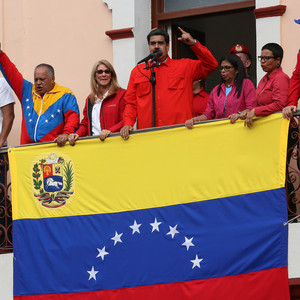
And over the weekend the United States military struck Caracas and brought Venezuelan President Nicolas Maduro to the United States for trial.
American President Donald Trump is saying the US will, quote, run Venezuela.
And when he announced that on Saturday, he linked his reasons for the strike to economics, to increasing oil production, to conditions in Venezuela, to the impact of socialist policies in that country.
Now We at Planet Money have been covering Venezuela going back 10 years now, talking to people on the ground, hearing what it's like.
And so today's episode is about the recent economic history of Venezuela.
The first part you're going to hear was reported in 2016, at a particularly low point for the country.
The second part was reported in 2024, after a period of economic stability in Venezuela, after an unexpected cause of economic improvement the US dollar.
So we begin with Robert Smith and Noel King in 2016.
Hello and welcome to Planet Money.
I'm Robert Smith.
And I'm Noelle King.
Venezuela used to be a relatively rich country.
It had money and prestige.
And most importantly, it had oil.
Venezuelans used to brag that they had the largest reserves of oil in the world.
Today on the show we have an economic horror story about a country that made all the wrong decisions with that oil money.
It's a window into the fundamental way that money works and how, when you try to control it, you can lose everything.
A decade ago, Venezuela was riding so high.
Its leader felt that he could take on the United States of America.
This was Hugo Chavez, former revolutionary.
But he had been elected president of Venezuela.
And Robert, do you remember this?
In 2006, he came here to New York to talk at the United Nations.
And President George Bush had just spoken at the U.N. the day before.
Chavez stands there and he says...
Yesterday, the devil stood right here.
The devil.
And then I love this part.
Chavez is a total straight man.
He crosses himself.
He makes prayer hands.
And then he waves away and he says, I can still smell the sulfur.
And everybody cracked up, except probably George Bush.
But it was kind of funny, right?
Back in those days, Hugo Chavez made a sport of straight up trolling the United States whenever he could.
He would point out how terribly the U.S. was treating its poor and how sad it made him.
We Venezuelan people love you.
We want, I want to be your brother.
And then he makes the people of the United States an offer.
He says Venezuela has so much money and so much oil that we're going to give discounted heating oil to poor people in the US.
The Venezuelan state owns an oil company.
You may have heard of it, Citgo.
And they put out a bunch of ads in Boston and New York featuring Joe Kennedy.
These ads were all over TV, basically saying to the United States, look at us.
We are Venezuela.
We are the champions of the world.
I'm Joe Kennedy.
Help is on the way.
Heating oil at 40% off from our friends in Venezuela and Sitco.
This is Hugo Chavez's style, right?
He uses oil money to buy love and to buy power.
The foundation for the collapse started, as it always does, during these boom years.
Chavez wasn't big into saving any of his oil money for, you know, the day when it will run out.
He was a socialist.
He was a populist.
He wanted to spend the money, especially on programs for the poor.
Food subsidies, you know, education programs.
Pretty much it was a time of economic bonanza.
Alejandro Velasco grew up in Caracas.
He's a professor at NYU now.
And he says all that oil money started to dominate the economy.
Oil was by far the biggest export.
It paid most of the government's bills.
And in the meantime, everything else in the economy wilted.
No one wanted to build a factory.
No one wanted to grow food because the oil business was lucrative enough.
Yeah, when the country needed something, it just bought it from someplace else.
Why make it yourself?
When you could just buy the import with very cheap dollars.
Yeah, why make auto parts when you can buy auto parts from abroad?
Why...
Make shoes.
Make shoes.
Buy shoes.
Milk.
Anything.
Cheese.
Anything.
Just buy it.
Just buy it.
Absolutely.
Ready-made.
Not have to worry about having to go through all the procedures and you know investment domestically to have to do that.
You just buy from abroad.
Right?
And so it makes you hugely dependent on imports.
So you have a country that is living and breathing oil money.
They would sell the oil, which is priced in US dollars, then convert it to the Venezuelan currency called bolivars.
And then every centimo of it is spent to keep the country running, to feed and clothe themselves.
And then all of a sudden, there's a problem.
In 2003, the oil workers go on strike.
There is no oil.
There is no money.
Venezuela desperately needed cash, desperately needed dollars to do everything.
Anything that we've been talking about buy imports that it required, right.
Chavez freaks out.
He has bills to pay.
He's worried about his own currency, the Bolivar, losing value.
And so, to keep the whole economy stable, he decides to fix the exchange rate between the Bolivar and the dollar.
Chavez essentially said the value of our money is what I say it is.
And if you want dollars, you have to come to the government.
You have to come to me.
So it makes financial sense.
It actually makes economic sense as an emergency measure.
What happened is that this measure was kept and maintained throughout even to today.
And this, this was the economic time bomb.
Right.
Even after the oil workers' strike was settled, Chavez kept it so that every major transaction in the country still involved the government.
If you wanted dollars, you needed permission to have them.
The government set the exchange rate.
The government could approve or reject any transaction.
Here's how it worked.
Alex Rosenberg was a clothing importer in Caracas.
He brought in underwear, jeans, dress shirts, casual shirts, sweaters, jackets, blazers.
And would these have your name on them?
No, they wouldn't.
They would have a couple of brands on them.
He was no Calvin Klein.
He was Alex Rosenberg.
Now, in order to import clothing, he needed to pay his suppliers in dollars.
And in order to get the dollars, he now had to go to the government and prove that he wanted to bring in something essential.
So the government would give him the list.
They printed entire official Gazette documents where— Like books of numbers?
Books of code basically, where you would check whether or not a particular material or a particular article of clothing had been centrally authorized by the government.
What is this, alphabetical?
You'd go down and you'd find underwear?
You would find men's underwear made out of polyester, cotton, other fabrics.
And then you would check in the book if the government deemed this important enough to buy.
Essentially,
Basically.
And you know the government didn't just believe you when you said oh, there's a shipment of underwear out there.
No, no, no.
You had to show them proof that the underwear existed.
Here's a picture of the underwear.
Here's a picture of the brand.
Here's what they're going to look like.
Here's what they're made of.
And here's what they cost.
And then you say, I need $10,000?
And you say I need X amount of, you know, pieces of underwear at X dollars, totaling X amount of dollars.
And I should note, Noel, this is all for permission to spend his own money.
I mean, Alex was paying for the underwear.
All this bureaucracy was just to see if he could exchange his local boulevards for dollars.
And this might seem insane.
It's a little insane.
This might seem very insane.
But as long as the price of oil was high, there weren't actually a lot of serious problems.
The government would eventually give you your dollars, and your underwear came into the country and all was well.
Then two things happened.
Number one, Hugo Chavez dies.
Mothers weeping, children weeping, adult men weeping.
And the unluckiest man in the world takes his place.
His name is Nicolás Maduro.
He had been the foreign minister for Chávez for eight years.
And after all the drama and the excitement and the love of Chávez Maduro was like.
It's like comparing a log of wood to the circus that rolls into town.
And then poor President Log of Wood gets hit with an axe.
In 2014, the oil price, the oil price, which they depended on, drops.
Like the price drops in half over six months.
And this causes panic within the Venezuelan government.
Everything they have, everything they do depends on oil money.
And now they have half as much oil money.
So the new president, Maduro, goes to OPEC and he begs them, we have to do something.
We have to do something to keep oil prices up.
Please help us.
Countries like Norway and Saudi Arabia had been saving their oil money.
Not Venezuela, though.
Not only are we not ready for this, but there's nothing that we can do to stem the decline of blip.
This is the end of any kind of boom years, but there's nothing that we can do now that isn't going to hurt a tremendous amount.
So what do they do?
They did nothing.
And every trap set by Hugo Chavez gets sprung at the same time.
The first thing that happens is that the Venezuelan government all of a sudden has fewer US dollars.
That spigot is turned off.
So the government starts being stingy with them.
There's this huge shortage of dollars.
And of course, when there's a shortage of something, the price goes up.
People were now willing to pay hundreds of bolivars for a single U.S. dollar.
There are black markets everywhere dealing in U.S. dollars.
Yeah, but the government insists on selling dollars at the old rate, which was around six bolivars for a dollar.
They don't want the price for basic things like food to go up.
They're desperate to keep things stable.
But we know what happens when there are different prices in different markets.
The Venezuelan people aren't stupid.
They looked at this and they said oh well listen, I can buy a dollar for cheap from the Venezuelan government and then sell it on the black market and make a fortune.
Of course they started to do that.
And Alejandro says there was this amazing scam.
Raspar tarjetas.
It was called el raspao, the scratch.
The scratch.
Scratch.
The scratch.
People would buy an airplane ticket to New York, say.
They would tell the government, oh, we really need dollars for our essential trip to New York.
But then they wouldn't travel.
And so you had the mystery of the airplanes that had all their seats sold, but no one was riding on them.
But there was so much profit to be made, you could just buy a plane ticket and not get on?
Absolutely, because you could make so much more from the black market rate of dollars.
Now, normally when this sort of thing starts happening, the country will eventually give up.
They will admit that their currency is screwed up.
It's worthless.
People are scamming them.
And eventually they'll let the exchange rates go back to normal.
And I'm not saying it's easy.
It is super painful to do.
If Venezuela had accepted the true exchange rate, everything would have gotten more expensive.
The poor people that Chavez had cared so much about would not be able to afford milk. and bread.
The country would have to rebuild its industry, rebuild its agriculture, but then things would have gotten better.
But Venezuela decides to do exactly the opposite, and it doubles down on its mistakes.
They even did something which sounds so confusing.
They created different exchange rates for different people and different products.
Yeah, and since it was confusing, there were more ways to scam the government, more ways to make money off these fake exchange rates.
So the government thinks, OK, we'll print more money.
Absolutely wrong move.
Inflation sword.
OK, so we'll stop reporting our inflation numbers or any numbers.
In fact, we will hide how badly the economy is doing.
But of course, people figure it out.
They can see the prices for items in the stores and the prices are going crazy.
OK, so prices are going crazy.
We will mandate price controls.
We'll say you can only make so much profit.
This is even worse because businesses find that they're losing money every month.
I mean, why keep selling products if you can't make any money?
And even if you do make a little bit of money out of your business, that money is increasingly worthless because of the inflation.
This is really bad for Venezuela.
It is incredibly bad.
And it becomes impossible to import anything.
I mean, that's what happened to Alex, the clothing guy with the underwear, right?
But his last big shipment was for something essential.
It was for medical supplies.
We wanted to import a shipment of non-woven fabric, which is basically that blue fabric that's used for surgical ropes.
Oh, so the stuff you'd see in the hospital.
Yeah, yeah.
But you wanted to bring in bolts of this so you could make surgical clothing.
Yeah.
Literally the stuff that the neurosurgeon would have needed for surgery to save people's lives.
And Alex goes to the government for approval to spend dollars on it.
And every day he waits for that approval.
You go to your computer every morning.
Once you get to the office, you open that system and you're like okay, let's see if I hit the lottery today.
And they've authorized my goods.
And you're hitting refresh and just seeing like, no, no, no, no, no.
Or no change in status, basically.
How long can this go on for?
We're still waiting to have those goods cleared and we still owe that money to our suppliers in Asia.
So Alex does what he never wanted to do.
He freezes his business.
He steps away from it and stops importing anything.
And this happens over and, over and over again with all of the things that Venezuela is importing, which is basically everything.
Everything. clothing and medicine and electronics and food.
No one can get any dollars to bring anything into the country.
And this is how a crisis gets built out of simple economic decisions.
Without a real currency, there are massive shortages.
There are these dangerous hospitals.
The government is cutting school days and office hours just to save electricity.
And all of this in a country that is still exporting oil.
It is still bringing in billions of dollars and it is not enough to save them.
And no one seems to know what should happen next.
This is a country in the middle of a political stalemate, because no politician wants to do the drastic things and they would be drastic that are going to be necessary to fix this.
The NYU professor Alejandro, says that everyone's still just praying that the oil prices will go back up, that more dollars will just solve everything.
It's not like we don't know this story.
I'm an historian of Venezuela.
I wrote about this.
I wrote a book about it.
Right.
And so but we we we just really crave those good times.
And it seems like every time the bad times come, we just say well, at least sometime in the future we'll have another good role.
Instead of fixing the problem, which is that the whole economy is based on something volatile.
And if you try to maintain control no matter what, you're going to lose it.
That was where we left things back in 2016.
And, after the break, our update from 2024 about an economic recovery and the power of the American dollar.
We checked in again eight years later in 2024.
Amanda Aronchik picked up that story.
Since our episode first aired, the Venezuelan economy has stabilized a bit, but not before inflation spiraled even further out of control, like truly wildly out of control.
At some points, you would see people walking around with bags full of cash.
This is NYU professor Alejandro Velasco in 2024.
He reminds us that almost right after our episode published back in 2016, Donald Trump was elected president.
Trump piled on sanctions and more sanctions, further cutting off Venezuela from the global economy and making it even harder to sell oil on global markets.
When sanctions hit, that became the catalyst for most significant hyperinflation, where we saw going from levels of several hundred percent to several thousand and eventually dozens of thousands of percent.
By 2018, it was estimated that inflation peaked at 65000 percent, making even those bags of Venezuelan bolivares essentially worthless.
Those who are able to begin to sell off their local currency and try to trade it as much as they can into a more stable currency like the dollars.
That year, when hyperinflation peaked, Venezuela's population, according to the International Monetary Fund, dropped by 5.
Much of that was because people were fleeing the humanitarian crisis.
And many of those folks who left the country, they now send money back home.
They send remittances.
And those remittances have been key to what happened next.
The U.S. dollar started to take over.
And this, Alejandro says, is how the turnaround began.
You started to see targeted sectors of the economy turn over into dollars.
And you know the reason why this is significant is because the government controls the flow of currency and, at the time, tightly controlled the flow of dollars.
And so this was really an acknowledgment that it was no longer going to control that flow.
The government eventually relaxed currency controls in 2019.
But even before then, people started turning to the stability of the dollar to pay for things like groceries and household supplies.
American dollars allowed people to plan for the future again.
It is the single greatest factor to the stabilization of Venezuela's economy, without a doubt.
The economy for the average Venezuelan also shifted to rely more on those remittances, that cash that was being sent or brought from relatives outside of the country.
If you travel and go back to Venezuela to see relatives, which is something that we've been seeing in increasing amounts over certainly the last year and a half to two years people come with cash.
They pack it in, hide it in various places, sometimes have to use a little bit of it to pay off authorities.
But that's how some of that cash is being brought and then it's stored in, You know, under mattresses and other ways to try to keep safe.
After Trump left office, some of the sanctions were walked back by the Biden administration and oil production stopped cratering.
It even picked up like a tiny bit.
And throughout this process, the American dollar has stuck around.
And this has made a type of inequality in Venezuela worse.
If you have, for instance, relatives abroad who can send remittances in dollars, if you have access to state resources that are increasingly paid out in dollars, if you have access to the private sector, especially the large-scale banking and other sectors then yes, you have access to the dollarized economy.
But if you're shut out of that, which is the case for most of the population, you continue to struggle.
More than 7 million people have left Venezuela since all of this started.
Inflation is more stable, but it's still high.
And oil production is down and GDP is way down from what it used to be.
So hopes for a big recovery tend to hinge on hoping for some big government policy changes.
And those, they are not likely to happen anytime soon.
There was a presidential election on July 28th.
The official results put Nicolas Maduro as the winner.
But the U.S. and most international observers question that outcome.
The consensus is that the opposition candidate, Edmundo Gonzalez, got more votes.
This kicked off a tighter crackdown on opposition to the government.
And then, after weeks of standoff, Maduro all but secured his third term in office when his rival Gonzalez signed a letter accepting defeat and he fled to Spain.
He now says he was forced to sign it.
And because of all this, our NYU professor, Alejandro Velasco.
He is not expecting big changes in economic policy anytime soon.
But, he says, at least the economy has stabilized.
That was Amanda Aronchik in 2024.
Before that, Robert Smith and Noel King in 2016.
We'll have more coverage of what's to come in Venezuela.
Keep an eye on our feed for that.
And listen, we're watching this and making sense of this just as you are.
And so we'd love to know what questions you have about this.
Or if you have family or friends in Venezuela, maybe you live in Venezuela.
Please tell us what it's like there.
You can send us emails at planetmoneyatnpr.org.
That's planetmoneyatnpr.org.
This episode was produced by James Sneed.
The original was produced by Nick Fountain and Sally Helm.
And the 2024 update was produced by Sean Saldana and fact-checked by Sierra Juarez.
Alex Goldmark is our executive producer.
I'm Kenny Malone.
This is NPR.
Thanks for listening.