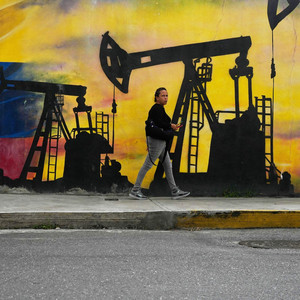
When President Donald Trump explained the Nicolás Maduro seizure at his press conference, he mentioned one word a lot.
We're going to take back the oil.
Yeah, there was a lot of oil talk.
As everyone knows, the oil business in Venezuela has been a bust, a total bust, for a long period of time.
He said that U.S. companies were going to take what he claimed was American oil.
You know, they stole our oil.
We built that whole industry there.
On Tuesday, the president announced next steps.
He posted on Truth Social that Venezuela would turn over between 30 and 50 billion barrels of oil to the US.
Meanwhile, American oil companies have been either silent or very measured in their comments.
A spokesperson for Texas energy company ConocoPhillips told the Associated Press it would be premature to speculate on any future business activities or investments.
So how likely is a Venezuelan oil renaissance?
This is The Indicator from Planet Money.
I'm Darian Woods.
And I'm Waylon Wong.
Today on the show, the sticky history of Venezuelan oil that got us here.
Socialism, sanctions and sour crude.
We explain it all after the break.
Over the weekend, President Trump said that Venezuela had made the greatest theft in the history of America.
He said they took our oil away from us.
So what really happened?
Francisco Manaldi is the director of the Latin America Energy Program at Rice University.
Yeah well, it's hard to know exactly what he means, but let me give you sort of some bits of history that might illuminate whatever he's thinking.
Francisco says that the Venezuelan oil industry was developed in the 1920s, led by what are today two companies ExxonMobil and Shell.
Exxon was American and Shell was Dutch and British.
The contracts that these companies have basically authorized them to produce oil and pay royalties and taxes to the Venezuelan government were going to expire in 1983.
But in the mid-1970s, the Venezuelan government decided to take over the oil drilling themselves.
They made the contracts expire seven years early and, after some renegotiation, paid the company's compensation.
They were well compensated.
In fact, it was not controversial at all with the oil companies.
What was controversial was what happened decades later.
In the 1990s, Venezuela invited foreign oil companies back.
Venezuela would still have its national oil company, but private firms like Chevron, ExxonMobil and ConocoPhillips were invited to invest in what's known as the Orinoco Belt.
This is an area of Venezuela with large deposits of oil.
Eventually, Hugo Chavez comes to power in 1999.
Chavez, the predecessor to Nicolás Maduro, was elected as a far-left president after years of economic stagnation.
For the first five years, he doesn't touch the companies.
At this time, the foreign companies were still building out their rigs and their pipelines.
Then he basically says to them I'm going to change the contracts, I'm going to dramatically increase the government take, and I will become a majority shareholder the Venezuelan National Company of those projects.
So it's basically the president strong-arming the oil companies into giving up more of their profits.
Sounds a little familiar for some reason.
Of the major American companies, Chevron accepted the deal.
Basically, they came to an agreement.
And in fact, Chevron has been able to make money after they were partially expropriated.
And so Chevron is today paradoxically, the only licensed company to operate in Venezuela by the US government.
The other two major oil companies, ExxonMobil and ConocoPhillips, refused to accept Hugo Chavez's ultimatum.
And so Venezuela then basically expropriated them.
And they offer a very low compensation compared to what was sort of the actual market values.
So they took Venezuela to international arbitration for disregarding their contracts.
Exxon was awarded about $1 billion, and ConocoPhillips was awarded almost $9 billion plus interest.
Venezuela has only paid a fraction, and this happened almost 20 years ago, right?
So Conoco is one of the largest creditors of Venezuela.
This leads to an important point.
Francisco emphasizes that, unlike what President Trump says, the oil in the ground was never owned by the companies.
Venezuela always owned it.
But Venezuela has been very slow and unwilling to pay back what it owes to Exxon and Conoco.
So, after two rounds of Venezuela nationalizing the oil industry, first in the 1970s, then in the 2000s, you might wonder why American oil companies might want to be involved again.
And you'd be right.
As mentioned, there's been a deafening silence among energy executives after the apprehension of Nicolas Maduro.
But what people like Donald Trump see is potential.
Venezuela has huge oil resources, but doesn't pump out that much at the moment.
The estimates are around a million barrels of oil per day.
That's less than 1% of global oil production.
That's less than Algeria, which we don't usually think of as an oil superpower.
Venezuela used to produce much more, more than 3.5 million barrels per day.
And Venezuela could produce potentially technically, you know, four or five million barrels of oil per day.
Francisco says that at full capacity, Venezuela could probably produce more than Texas does today.
Now, Venezuela's oil does require more processing than oil from, say, Saudi Arabia.
It's thick and sulfurous, what's called heavy sour crude.
That sounds like reviews of my stand-up comedy set.
Ouch.
Just keep workshopping your bit, Gary, and you'll get there.
Yeah, with enough dilutants, maybe I'll get a light sweet cream.
More processing, yeah.
Now, the oil isn't the best quality, kind of like Canada's tar sands.
But Francisco says that shouldn't obscure from the fact that Venezuela does have the capacity to be a major oil player again, like the top five in the world.
Bottom line, Venezuela has plenty of oil.
That's not the issue.
The issue is that Venezuela can't extract much of it.
Francisco says the main reason for this goes back to an incident in 2002.
The opposition organized a general strike across the economy asking for Hugo Chavez to hold a new presidential election.
Workers and executives from the state oil company were involved.
So Chavez fired them, day after day.
He fired 20,000 of the 40,000 employees.
Among them almost all the top executives.
And The more the scientists you know, the geologists, the petroleum engineers the more technical people.
In fact, to give you one number, 95 percent of the PhDs working in the companies which had a lot of them, like more than a thousand, were fired.
And so that made the oil industry, the national company in Venezuela, really decay.
And basically it got destroyed.
A few years after this brain drain, the US started imposing sanctions on the country for not cooperating on anti-drug and anti-terrorism efforts.
But Francisco points out that the oil production cratered well before the big sanctions against Venezuela's oil company in 2019.
For the most part, the collapse of the Venezuelan oil industry is a self-inflicted wound.
But in the last few years, there is a component of U.S. sanctions.
Sold on the wound, basically.
Yes, not only assault, but they impeded a potential recovery.
Let's put it that way.
Yeah, it's hard to get investors and expertise to go back to Venezuela when there's U.S. sanctions.
All right.
So Venezuela has a lot of potential to drill more oil, but political dysfunction has collapsed its capacity.
Meanwhile, foreign oil companies worry about getting shaken down by the government in the future.
That sounds like a pretty barren starting place to revive Venezuela's oil industry.
Unfortunately, I'm not optimistic because of history and because of if there is no smooth sort of transition in Venezuela to democratic government and political stability all big ifs you will not see the kind of investments that will be needed to develop the oil sector.
And you will continue to see Venezuelans leaving the country.
Francisco himself left Venezuela for the US in 2012.
He wants people outside of the country to know that Venezuela was once a relatively prosperous, relatively well-functioning democracy for 40 years.
The country's economic and political turmoil brought it down hand in hand.
This episode was produced by Cooper Katz-McKim with engineering by Robert Rodriguez.
It was fact-checked by Julia Ritchie.
Kaking Cannon edits the show, and The Indicator is a production of NPR.