This message comes from the Center for US Voters Abroad Foundation.
If you're a US citizen living abroad, the Center for US Voters Abroad Turnout Project's online form will walk you through requesting your ballot in just five minutes.
Visit internationalvoter .com.
This is Planet Money from NPR.
Being vice president is a pretty sweet gig.
You get free housing, access to a plane, you get to vote in Congress, but only when the vote really matters.
It's kind of like being president, but way, way less pressure.
And because of that normally, we do not care that much about what any given vice president thinks.
But this is not a normal year.
There is a vice president running for president, and I don't think I'm going out on a limb here.
In this very close race, it just seems like the VP picks, they really matter because their place on the ticket says something about where each party is headed.
Hello and welcome to Planet Money.
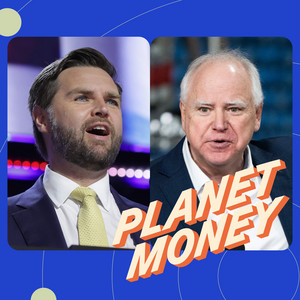
I'm Nick Fountain. Today on the show, we're going to dig deep into the economic thinking of both campaigns, vice presidential picks, JD Vance and Tim Walz.
Where did they come from economically?
Where do they stick to party orthodoxy?
And more interestingly, where do they buck the trend?
Support for this podcast and the following message come from Wyze, the app that makes managing your money in different currencies easy.
With Wyze, you can send and spend money internationally at the mid -market exchange rate.
No guesswork and no hidden fees.
Learn more about how Wyze could work for you at Wyze .com.
This message comes from Indiana University.
Indiana University is committed to moving the world forward.
Working to tackle some of society's biggest challenges, IU makes bold investments in the future of bioscience and cybersecurity, cultivates visionary work in the arts and humanities, and prepares students to become global citizens by teaching more languages than any other university in the country.
Indiana University.
Nine campuses, one purpose.
Creating tomorrow today.
More at IU .edu. All right, so our mission today, should we choose to accept it, is to figure out the economic principles of the two potential vice presidents.
For that mission, we have tapped Greg Rizalski, who writes our newsletter.
Hi, Greg. You ready?
Nicholas Fontaine. Not how you say my name.
Whatever. Greg, we're going to talk to you today about some of the reporting that you've been doing for the Planet Money newsletter about these two vice presidential candidates, about J .D.
Vance and Tim Walz, and about how they think about economics.
Where do you want to start?
You want to start with Vance or Walz?
Yeah, let's do J .D.
Vance. Why not? Advance with Vance.
All right. How do we know what J .D.
Vance's economic thinking is?
Where did you even begin to look to try to figure that out?
You know, J .D. Vance doesn't have the biggest paper trail when it comes to what he's actually done in government or in politics.
He's pretty young. He just turned 40 years old, and he hasn't served in the Senate that long, only about a year and a half, maybe a little bit longer.
He was sworn in in January 2023.
And he's had this kind of well -documented, self -acknowledged political transformation over the last decade.
So a lot of what we know about his economic positions is kind of what he said and what he's done in the Senate.
Perfect. So today we're going to focus on three policy areas that he has taken a stance on that are a bit unconventional and kind of telling ways.
So industrial policy, aka jump -starting American manufacturing, also antitrust, also unions.
Which of those do you want to tackle first?
Let's start with industrial policy, because I think it is illustrative of his kind of break from sort of traditional Reagan -style conservatives.
In fact, when Donald Trump was thinking of selecting him, there were a number of notable kind of old -school mainstream conservatives who were actively lobbying against his selection.
So describe that position.
What is traditional mainstream conservatives' views when it comes to using a heavy hand to boost strategic industries?
Yeah, like so traditional conservatives like Milton Friedman or Ronald Reagan, they kind of were distrustful for the most part of the government playing too active a role in the economy.
They opposed picking winners and losers, they supported free trade, they wanted to lower taxes on corporations.
Not Vance though. He's supported higher taxes on corporations, at least before he was selected as VP candidate.
He's been a strong advocate of using federal power to sort of revitalize strategic industries, in particular manufacturing.
He argued that the government should intervene to boost and protect domestic industries, with policies like tariffs to rebuild America's industrial base and create more good jobs for American workers.
So yeah, in short, Vance believes any more sort of muscular role for the government in reshaping the economy than conventional Republicans.
So Vance is a little unorthodox when it comes to industrial policy.
How about on this topic that you were talking to me about earlier today, antitrust, which is when the government comes in and says this company is too big, it's a monopoly, it is bad for consumers.
This is another area where he represents sort of a break from not only just traditional conservatives, but also conservatives in Congress right now.
So a lot of conservatives, they really dislike Lena Khan.
So Lena Khan is the head of the Federal Trade Commission, a Biden appointee.
Yeah, we've talked to her on the show before.
She's maybe the most aggressive antitrust cop we've had, I don't know, in the generation.
She's been taking aim at the Biggies, at Facebook and Amazon, which we should say is an NPR sponsor.
Yeah. And a lot of Republicans dislike that.
They're like, what the heck?
Why is the government mucking around with the free market?
But J .D. Vance, actually, he's kind of gone out of his way to sort of praise Lena Khan a few months before he was selected as a VP candidate.
He actually spoke at this event.
It was called Remedy Fest.
It was put on by Bloomberg and Y Combinator.
And Vance walks to the front of the room.
He grabs the mic and he starts talking about Lena Khan.
A lot of my Republican colleagues look at Lena Khan, who I think you either have heard from or will hear from at some point today.
And they say, well, Lena Khan is sort of engaged in some sort of fundamentally evil thing.
And I guess I look at Lena Khan as one of the few people in the Biden administration that I actually think is doing a pretty good job.
And that sort of sets me apart from most of my Republican colleagues.
That is a very unusual thing for a Republican to say right now.
Also, it's kind of weird for someone who used to be a venture capitalist, right?
Lena Khan is going after big tech.
What's going on there?
Yeah, so Vance does have some pretty strong connections and some benefactors in Silicon Valley.
It's no secret. He's a big friend of Peter Thiel.
Elon Musk apparently was one of the people lobbying on his behalf for Trump to pick him as a VP candidate.
But yeah, he thinks that big tech has gotten out of control.
He talks sometimes about like little tech versus big tech and how hard it is for kind of small startups to challenge the big guys and how a lot of these startups are operating in sort of a fundamentally non -competitive market and how this lack of competition in the tech industry, it's empowering big
companies to censor Americans and it's hurting free speech.
He also talks about how it hurts workers.
So some people in the media have called him a conservative.
What does that mean?
K -H -A -N? I don't know if people are conservative.
Yeah. Vance, by the way, he didn't just praise Lena Khan.
He also seemed to indicate he was against what's sometimes known as the consumer welfare standard.
This is the dominant approach that the federal courts and antitrust regulators have used for, I don't know, like decades now.
And in that approach, when they're, you know, looking at whether a company is too big or whether, you know, a merger acquisition should be blocked, they really focus on price and how corporate decisions affect consumers.
And Vance is saying, actually, there's a lot of other things that should matter, you know, like it's not just all about price.
It's not all just about consumers.
Like, what about free speech of Americans?
Like, if Google gets too big, then maybe that's a problem for, you know, our rights as Americans or what about, you know, the welfare of workers?
And he's saying like, wait a second, there's all these other things that we should be concerned about.
And that really kind of puts him on the same page as some progressives, like Lena Khan, who believe that, you know, the government should be playing a more active role to ensure that we have a more competitive economy.
Yeah. Amazingly, he has been an ally of Elizabeth Warren of all senators.
They've done some stuff together in Congress, right?
Yeah, that's right.
So, one bill they worked on together was this effort to claw back executive pay for banks that failed.
And then Politico actually dubbed them the new power couple taking on Wall Street.
Of course, after he was selected as VP candidate Warren, kind of, I think they sent Warren out to make the media rounds, making clear that she was not on the same page as JD Vance.
But yeah, like he kind of went out of his way to form an alliance with progressives in Congress.
He also in an interview he gave with The New York Times, he said, quote, the people on the left I would say whose politics I'm open to, it's the Bernie bros.
All right. So a lot to unpack there, but it seems like Vance is pretty unorthodox when it comes to antitrust, when it comes to sort of taking on Wall Street, as far as conservatism goes.
Greg, our final stop on the JD Vance tour today is going to be about unions.
So you've mentioned before he's from Ohio, which is a big union stronghold.
I've seen him on the news, I've seen him walking the picket line back during those UAW strikes, I believe.
But you have reported that his relationship with unions is pretty complicated.
It is complicated because he certainly talks a lot about the need to help working class folks.
But when it comes to his record in Congress, it's kind of a mixed bag.
I mean, the AFL CIO has given him a 0 % score for his voting record when he was selected.
Liz Schuler, the AFL CIO president said Senator JD Vance likes to play union supporter on the picket line, but his record proves that to be a sham.
Is that true? What is his record on union stuff?
So one of the big things that organized labor has been pushing for is this legislation called the pro act, the protecting the right to organize act.
And this would have various provisions that would enhance the ability of workers to unionize.
And Vance is actually opposed the pro act.
So there's kind of this contradiction in many people's minds, who like, why are you saying you're pro worker, but you're opposed to like one of the biggest legislative goals of organized labor.
And pretty interestingly, he gave this interview to Politico earlier this year where he sort of tried to square that circle.
And one reason was basically, maybe I'll just quote him.
I think it's dumb to hand over a lot of power to a union leadership that is aggressively anti -Republican.
So there's kind of like the, the meat of potatoes like, Hey, if we, this is going to hurt us politically, which is maybe a little cynical, you be the judge.
But he also provided a more sort of intellectual argument, which I thought was pretty interesting.
Um, basically that it would further ensconce the existing system of bargaining in this country, which happens at the establishment level as opposed to the sectoral level.
Let's just explain what that means.
What we have here in the US unions have to work hard organizing individual workplaces, individual establishments.
You got to go Starbucks by Starbucks or auto factory by auto factory.
And there's this other thing sectoral bargaining.
That is what they have in many countries in Europe.
And that's where there's this national union that comes together, meets with industry and hammers out a deal that covers all baristas or all auto workers.
Yeah, that's right.
So actually, um, a year or so ago, I spoke with Suresh Nadeu as one of the foremost scholars of unions in America.
And like Vance actually, Nadeu expressed support for sectoral bargaining.
He thinks it's like a better system.
It makes more sense and it removes incentives for firms to fight unions because all of a sudden your competitor is subject to the same union rules that you are.
And another thing, when a whole sector is unionized, it means even new companies that form in that sector are subject to the same union contract.
In the system we have here in the United States, Suresh said, unions have to work just a lot harder to bring new employees into unions.
So what I sort of thought was just like this hamster wheel, where to keep union density up, you need to be, you know, every time there's a new employer, you've got to be like, they're trying to organize it just an incredibly slow and costly process to be engaged in.
But, you know, interestingly, Suresh, while he thought that sectoral bargaining was a much better system than the one we have in America, he also supported the pro act.
So he didn't see them as contradictory.
And JD Vance supports sectoral bargaining, but not the pro act, even though sectoral bargaining isn't happening in the US anytime soon.
Probably not. I mean, who knows?
Maybe, I don't know.
Probably not though.
So tie it up for us, Greg, what is JD Vance's view on unions, on worker power?
I would say it's a mixed bag.
He's a bit of a wild card Nick.
Like he's talking a lot about supporting American workers.
At the same time, he is not really on board with some of the big goals of organized labor.
So this is something that's evolving.
It will be interesting to see going forward if he were to win how this would shake out.
All right. So JD Vance, unorthodox views on how to revitalize American industry on breaking up big corporations.
And he says he is a fan of European style sectoral bargaining.
Greg, you are a gentleman and a scholar for bringing us on this journey through the economic mind of JD Vance.
Thank you for that.
Well, Nick, it's been a pleasure.
You know, oh, there's still one other VP candidate isn't there.
That's right. You're not.
After the break, we're going to journey to the other side and to the economic mind of Tim Walz.
When voters talk during an election season, we listen, we ask questions, we follow up, and we bring you along to hear what we learned.
Get closer to the issues, the people, and your vote at the NPR Elections Hub.
Visit NPR .org slash elections.
It's a high stakes election year.
So it's not enough to just follow along.
You need to understand what's happening.
So you are fully informed to come November every weekday on the NPR politics podcast, our political reporters break down important stories and backstories from the campaign trail.
Do you understand why it matters to listen to the NPR politics podcast wherever you get your podcasts?
This election season, you can expect to hear a lot of news, some of it meaningful, much of it not.
Give the up first podcast 15 minutes, sometimes a little less, and we'll help you sort it out.
What's going on around the world and at home.
Three stories, 15 minutes, up first every day.
Listen every morning, wherever you get your podcasts.
The candidates for November are set.
I know Donald Trump's tight.
Between now and election day.
We are not going back.
A campaign season unfolding faster.
Kamala Harris is not getting a promotion.
Than any in recent history.
Make America great again.
Follow it all with new episodes every weekday on the NPR politics podcast.
Greg, what do we need to know about the economic mind of Tim Walsh?
And again, how do we know it?
What's his track record?
Well, he's older. He's about 20 years older than JD Vance, and he has a much longer record because he's served as governor of Minnesota.
He was also a Congressman for a long time.
So he's got much more of a paper trail of things he's actually done than JD Vance.
Broadcast through what he's done as governor.
So walls did a lot of things, but if I were to single out, you know, one big thing, Nick, it would probably be his work to increase the economic security of kids.
He did this through tax policy, through education policy, and through other types of legislation.
One thing I do want to provide a little context for because, you know, I reported on this in the Planet Money newsletter.
If you were to compare the United States to almost 40 other countries in the OECD, only Turkey spends less per child as a percentage of the GDP.
It's a significant reason why the United States has a much higher rate of childhood poverty than other rich nations and even higher rate of poverty than like some not so rich countries.
And just a little bit more context.
So we have this policy in the United States.
It's a child tax credit right now.
It's about $2 ,000 a year during the pandemic, though, thanks to the American Rescue Plan that was passed under President Biden, there was this expanded and enhanced child tax credit, and that expanded the child tax credit to much higher.
And scholars have, you know, credited it for reducing child poverty by about 30%.
Some say it reduced it by half.
Then in 2021, this provision, it expired.
Tim Wallace did not like that.
And he passed his own version of the child tax credit at the state level instead of the federal level.
And according to the tax policy center, it was one of the largest in the country.
So starting in the tax year 2023, every Minnesota taxpayer with kids can claim $1 ,750 per qualifying child with no limit on the number of kids they can claim.
And because the credit is fully refundable, it means that even low income Minnesotans who don't pay much or anything in state taxes are eligible for it.
Another thing that walls did was this universal meal program for K through 12 students.
So breakfast, lunch, you get it free at school, you know, everyone I know about this school lunch thing, because oddly enough, it's become controversial.
Can you explain the controversy here?
Well, there were a number of Republicans in Minnesota who were like, what the heck, you're giving free breakfast and lunches to rich kids, like they don't need this.
This is a waste of taxpayer money.
And it kind of illustrates this tension for, you know, social welfare programs between making something as means tested and making something universal.
Means tested means you qualify usually based on income.
Universal means everybody gets it.
Exactly. So means tested, at least hypothetically, it's going to be cheaper because you're not giving the benefit to everyone.
Sure. At the same time, it means there's got to be a lot of bureaucracy involved.
Parents all of a know, got to fill out paperwork.
They got to prove that they're at some income level.
And waltz actually specifically has talked about that as something he didn't really like something, you know, you should know about waltz.
He was a teacher for a long time.
And he says he actually used to monitor school lunchrooms.
He gave an interview to Ezra Klein at the New York Times.
And he talked about this issue.
That lunchroom then became a very clear have and have nots.
And in fact, until you know, some schools maybe still do it yet a different colored lunch ticket if you're on free and reduced lunch.
Yeah, I remember this from my school, if you were on free and reduced lunch, you had to like, type in a little code at the cash register when you were getting your free lunch.
And if you didn't, you weren't and there was a sort of stigma around it.
And so he's saying, let's get rid of that stigma.
And he says additionally, you know, beyond just the stigma that means tested programs have for, you know, poor kids who need assistance.
He was also saying that, you know, by making it universal, it kind of takes a lot of labor off the plate of, you know, hard work and middle class families.
The most feedback on this was families and it's especially mothers because of the unequal distribution of domestic labor is still falls heavily upon women.
And these were women who said, Look, we didn't qualify before we do now.
It's an absolute tax cut for us, but it's an absolute lifesaver for me that I don't have to get up in the morning and either make breakfast or send one to school for this.
So it's a double benefit for us.
I have less work. My kids eat.
So it was actually middle class folks who were most jazzed about this.
Jazzed. I love that's a very Midwestern dad word to use such a dad phrase.
All right. A lot of economic policies to support families.
What else did he do as governor?
He also signed legislation that gave Minnesotan workers up to 20 weeks of paid family and medical leave.
In addition, he also passed paid sick leave for Minnesotans.
And as I've reported before in the planet money newsletter, the United States is the only rich country without a national paid leave program.
So this was, you know, walls showing his priorities again, sort of helping families, increasing the economic security of kids, that sort of stuff.
And he also did a bunch of stuff on tax policy.
Yeah. Let's talk about that for a second.
Tax policy is our wheelhouse.
Tell us about the tax policies of walls.
So to set the scene a little bit, according to the Institute on Taxation and Economic Policy, most states in our country actually have somewhat regressive tax systems.
They tax the rich at lower rates and therefore are taxisms that aren't progressive at all.
Walts help make Minnesota one of the few tax systems in the country that is progressive.
And he did this through a series of tax cuts, rebates and credits for low and middle income Minnesotans and a series of moderate tax hikes on the rich.
I feel like when we were talking about JD Vance, Greg, you kept being like, this is where Vance goes against the traditional conservative norms.
But these walls things helping out families, you know, making tax systems more progressive, they seem like sort of standard democratic fare.
Where has he differed with his democratic colleagues?
Yeah. As a congressman, he actually represented this rural conservative district in Minnesota.
And while he was there, he supported a bunch of stuff that kind of was against what most Democrats support.
So he was a big supporter of gun rights.
He actually had an A rating from the NRA.
He supported the creation of the Keystone XL pipeline, which was broadly opposed by progressives and environmental groups.
He also opposed the bailouts of the big banks and also the auto companies under both President Obama and President Bush.
And he also opposed most free trade agreements that he had the opportunity to vote for, including ones that were being pushed by President Obama like he, he opposed free trade deals with Peru, Panama, Colombia.
In one 2015 statement he made as a congressman, he said, trade can be a powerful tool for good.
But as we've seen in the past with agreements like NAFTA, sometimes these agreements work against the American worker.
So he's built this populist record over the course of his career that has opposed more centrist moderate Democrats.
So like his competitor on the other side of the aisle and the other side of the debate stage pretty soon, he's a complicated character.
Greg, you have spent hours and hours reading every statement you can by these guys.
I guess my question for you is, what does it tell us about both of these campaigns that both of these sort of heterodox thinkers were chosen to be on their respective party's tickets?
I mean, one thing I will say about the selection of both of these candidates, which I find really interesting is it seems like neither of them were selected for some narrow electoral strategy reasons.
That used to be why you picked your VP because they would help you win over Florida or Pennsylvania or whatever.
Yeah, even in Vance's case, like Ohio used to be a swing state, doesn't seem to really be a swing state anymore.
It seems like the Republicans got that on lock.
In both cases, they seem to be more of a signal to working class folks that, hey, look, we got people on the ticket who are going to support you.
And it's kind of like they're both white dudes from the middle of the country who have staked out these sort of heterodox positions that buck a bipartisan consensus that had taken over in this country for a long time.
They're skeptical of free trade.
They're saying a lot of things about helping American workers.
And what I'm going to be looking at when I'm watching this debate that's coming up, it's almost like this populist showdown.
That's how I guess I'm looking at it these days.
I like that. So both an embrace of populism, which we've also seen at the top of the ticket, but also a rejection of whatever you want to call it, the dominant free market friendly approach to the economy that has become the norm.
All right, Greg, thank you for doing this, for bringing your newsletter reporting over to the podcast.
If someone were to make the wise choice of signing up for the newsletter right now at NPR .org slash Planet Money newsletter, what sort of stuff would they find?
Well, in addition to deep dives on wonky econ subjects like the economic minds of Tim Walls and JD Vance, I've been covering more fun stuff like this downturn we're seeing in music festivals.
I dubbed it the Music Festival recession.
Check that out. I've been covering AI.
I recently covered how it's important to pay attention to unit prices when you're grocery shopping.
We give this thing away for free.
All you can find it at NPR .org slash Planet Money newsletter.
Listen, I wouldn't call it a gift to humanity, but Nick, if you wanted to say that, that would do no.
Sure. It's a gift to humanity.
All right. This episode was produced by James Sneed and Emma Peasley.
It was edited by Meg Kramer.
Sarah Wattis back checked it and was engineered by Valentina Rodriguez Sanchez.
Alex Goldmark is our executive producer.
I'm Nick Fountain. And I'm Greg Grzalski.
This is NPR. Thanks for listening.
This message comes from Grammarly.
The work we can be fast paced, and it's hard to focus on getting everything done.
93 % of professionals report that Grammarly helps them get more work done.
Download Grammarly for free at grammarly .com slash podcast.
Once again, we find ourselves in an unprecedented election.
And with all that's happening in the lead up to the big day, a weekly podcast just won't cut it.
Get a better grasp of where we stand as a nation every weekday on the NPR politics podcast.
Here are seasoned reporters dig into the issues that are shaping voters decisions and understand how the latest updates play into the bigger picture.
The NPR politics podcast.
Listen on Spotify.