It is a myth that Vincent van Gogh was ill his entire adult life.
As far as we know, he didn't have his first major episode until Christmas of 1888, when he was 35, and two years later he was dead.
So just the last couple of years.
He did however, spend 11 of the last 18 months in an asylum, and his illness would eventually claim his life shortly after his 37th birthday.
The artist understood that madness was an illness like any other and that between episodes he wasn't mad.
It was through his work he would recover and stay well longer.
But there is no doubt that Van Gogh's mental health colours how we look at his work, and that includes his last painting.
There was always debate about which painting was the artist's last.
For many years it was thought to be this painting, mainly because it featured in a 1930s book and the 1956 film adaptation of that book.
And the painting's dark and gloomy subject matter seemed to perfectly encapsulate the last days of Van Gogh, full of foreboding of his eventual death.
But now it is widely accepted that this unusual work is his last painting.
The mystery of what it was and where it was painted would take over a century to solve.
And that was only thanks to a worldwide epidemic.
What it means is that now we have a deeper insight into what van Gogh's final hours were like before his tragic death.
In May 1890, Vincent checked himself out of the San Remy Asylum and headed to Paris to see his beloved brother Theo, his sister-in-law Jo and their new baby Vincent, who they had named after him.
He created this picture to celebrate the birth.
In the asylum he had worked every day, except during his four mental breakdowns when he made several attempts to take his own life.
As I explained in my earlier Van Gogh film, he still managed to complete an incredible 150 paintings there, about one painting every other day.
In the end, he spent only three days in Paris with Theo and his family, as he found the city overwhelming.
The restless artist, who had already moved 36 times in his lifetime, was on the move again, this time to Auvers-sur-Oise, about an hour's train ride from Paris.
Théo Vincent's champion had completely supported his brother financially since 1882, but paint was expensive and Vincent often used up his allowance buying supplies rather than food, endangering his health.
The arrival of the new baby meant that Teo, whose finances were already stretched, had even more financial responsibilities.
Along with problems at work.
It is no surprise he was less than sympathetic with Vincent and his problems.
So by the time the artist left to go back to Auvers he was convinced he was a financial and emotional drain on Teo and it was a huge worry to him as he moved to his new house.
By the time Vincent moved to Auvers, it was already famous as an artistic hub.
Paul Cézanne, Camille Pessarro, Auguste Renoir and Charles-François d'Aubigny had all painted the region.
But it would take Van Gogh to immortalise it.
The artists were all friends or patients of Dr Paul Ferdinand Gachet, a doctor, an amateur painter and an art collector who also knew Claude Monet and Victor Hugo.
Theo had set up an introduction for Vincent so that Dr Gachet could keep an eye on his health and the doctor would accept paintings by the artist in lieu of payments for treatments.
On May 20 1890 the artist moved into the Auberge Ravoux Inn for 3 francs, 50 cents per day for bed and board.
He had room number 5, a simple attic room of 7 square meters, where he would spend his last 70 days.
He also had a painting studio he shared with other resident artists.
Dr Gachet recommended that van Gogh work as much as possible to prevent his illness from taking over.
And it was his work and his prodigious output, often seen as a descent into madness, that in fact drove him to keep going.
Auverso was energised.
Van Gogh, who saw something to paint everywhere he looked, and he set out to capture the warmth and security of rural life, and did so with vibrant colours in which green often dominated.
Vincent, even more frenzied than before, would produce 75 works and over a hundred sketches in his last 70 days.
He worked so fast that he sometimes ran out of canvas and painted on tea towels.
And we can clearly see the red checked cloth coming through here.
Dr Gachet and Vincent became close immediately.
The artist would describe him as a ready-made friend and something like a new brother in a letter.
And Gachet, who would care deeply for the troubled artist, would be a pivotal man in this story, as well as in the later dissemination of Van Gogh's legacy.
After another visit to Theo and his family in Paris on July the 6th, Vincent learned that his brother was thinking of quitting his job at the art dealers he had managed over many years.
Theo was also starting to show signs of the syphilis that would kill him six months after Vincent.
On his return to Auvers, the artist's behaviour darkened.
His anxiety, began to overwhelm him and he stopped socialising with Dr Gachet's family after some petty arguments and began to spend more and more time alone, sinking into dark thoughts and drinking excessively.
No doubt his brother's health and financial affairs began to play on his mind.
Vincent signed his paintings with his first name, mainly because he knew his surname was difficult to pronounce.
And he rarely dated his paintings, but we can date his works by reading his letters, of which he is estimated to have written over 2000, of which 903 survive, which are all dated.
In them he often described what he was working on or did sketches of paintings he was creating, even writing the colours on the sketches.
It's thanks to these letters we can accurately work out the date of individual, undated paintings.
And thanks to one of those letters, we even know the colours he had on his palette.
In the final weeks of his life, Vincent worked on a series of landscapes on the hills above Auvers.
The paintings are unusual in that they are 50 centimeters high and a meter wide, an entirely new format of canvas that he had not used before.
He painted no fewer than 12 of them, including wheat fields with crows and tree roots.
On the 10th of July Vincent, feeling dreadfully alone in Auvers, wrote to Theo that he wanted to express extreme solitude and sadness in these wheat-filled paintings.
And they are dreadfully poignant.
He had painted many portraits in Auvers and saw portraiture as representing his best work.
But these last works were vast expanses totally devoid of any human figures, not even farm workers.
He had previously dotted his landscapes with
It is as if he has given up on humanity.
In the same letter to Theo of July the 10th, he wrote, my life too is attacked to the very root.
And a painting which a friend described as an underwood full of sun and life the day after Vincent's death is now considered by scholars to be his very last painting.
It is a strange work.
It too is devoid of people, but it is also devoid of form.
It is unfinished, which is extremely unusual for Van Gogh, and a sign it was still being worked on when he died.
Due to its experimental nature and abstract quality, experts were puzzled as to whether the location of the painting even existed outside of Vincent's head.
And it would take over a century to find an answer.
Wouter van der Veen, the scientific director of the Van Gogh Institute, was lent a collection of antique postcards which he never had time to look through until lockdown, when we all had more time on our hands.
He just happened to have one of the old postcards on his computer screen at home in France when something clicked in his mind.
The postcard, which dated to 1900, reminded him of Van Gogh's tree roots.
He pulled up a digital version of the painting and compared them side by side and realised it was the same place.
We now know that Tree Roots was painted on the Rue d'Aubigny, a main road through Auvers-sur-Oise, about four minutes' walk from the inn that Vincent lived in, thanks to this bizarre coincidence.
The slope with the exposed tree roots is in a coppice or thicket, where the wood was used for firewood.
But miraculously, when vegetation specialists inspected the site, they found that the tree stumps were still more or less intact.
And we can now view the very site where Vincent van Gogh painted his last work on his last day.
As I show in my video on Starry Night, Vincent didn't reproduce nature scenes exactly, but painted what he thought worked better aesthetically, and tree roots is no exception.
It's an unusual painting, tightly cropped, which brings to mind the Japanese works he so admired, with no real sense of space or perspective, almost abstract in its composition, with several parts left unfinished, as if he just suddenly stopped, maybe with the intention to finish it in the studio back at the inn.
We see the short, sharp brushstrokes we are familiar with, and the work is painted with Van Gogh's usual sense of urgency.
It is now thought he started the painting on the morning of the 27th of July on Rue d'Aubigny and worked on until late afternoon.
The sunlight direction on the painting suggests that the last brushstrokes were painted towards the end of the afternoon, as the sun was beginning to set.
It is thought that Vincent then took the painting back to the inn unfinished and left with a revolver to take his own life.
As he said in a previous letter, I have lived, just like those tree roots.
I've done my best.
I've struggled with life.
He then went to the outskirts of the village, to a peaceful wheat field as the sun was setting, possibly one he had already painted and shot himself, staggered back to Dr Gachet's house sometime after supper and died two days later, on July 29 1890.
Eight years before Van Gogh had painted this image of tree roots, of which he wrote to Theo.
I wanted to express something of life's struggle in those gnarled black roots with their knots, and it is tempting to see his final painting Tree Roots as a similar life struggle, with its tangled and exposed, broken roots and jagged brushstrokes reflecting his disturbed mind.
The unfinished canvas as a sign of frustration and despair with a difficult work.
Theo was told the morning after the incident and immediately made his way to Auvers in time to see his brother alive for the last time.
Around one o'clock in the morning, Vincent looked to Theo, his closest supporter, his brother and his protector, and said I would like to be able to leave like this.
And that is what he did, on his own terms.
Since 1890, Vincent van Gogh's death was seen as self-inflicted.
Then, in 2011, a biography was published that stated that Vincent did not take his own life, but was killed by two local boys.
It is a theory that is now dismissed by most historians, but conspiracy theories have a habit of catching on.
Two films and numerous press articles have presented this theory.
Why is this?
Van Gogh has come to be epitomized as the artist wronged by society and as such, it is easier to place blame on others.
But the simplest answer is often the correct one that Vincent, whose letters show that he was anything but optimistic about the future, had enough of suffering.
Vincent said so to his brother, and he said so to Dr. Gachet, a man who knew gunshots.
When Vincent's clothes were being sorted out, the day he shot himself, the draft of a letter to Theo that he never sent was found in his pocket, stained with his own blood.
We will never know if he kept it on him deliberately, but in it he wrote about what was troubling him on that day, saying he was writing in a state of crisis and was worried about being a burden on Theo, complaining that work by dead artists sells better than living ones, and ending with I risk my life for my own work.
Like his last painting, the letter was unfinished.
Dr Gachet sketched this portrait of Vincent on his deathbed, which shows the artist's mutilated ear.
The funeral was arranged to take place in the church at Auvers, which Vincent had immortalised in an earlier painting.
But taking one's own life was still considered a sin by the Catholic Church, and the request was refused.
So instead, the funeral took place at the next village.
It is another myth that only a handful of people came and it was very well attended, with friends, artists and locals.
Vincent's body was laid out in the room that he used as a studio, surrounded by his last canvases and masses of yellow flowers including, of course, his beloved sunflowers.
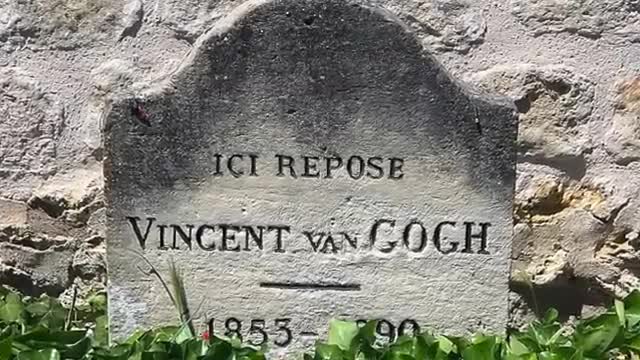
The route of the funeral cortege took them past the church that had denied Vincent a Christian burial, and he was laid to rest in what Theo described as a sunny spot among the wheat fields.
Then, in October 1890, just three weeks after the death of Van Gogh Theo, with advanced syphilis, lost his mind and was confined to an asylum, where he too would eventually die on the 25th of January 1891 and be buried in the Netherlands.
Then in 1905, the lease on Vincent's original grave in Auvers ran out and he needed to be reburied.
Theo's widow Jo, decided to move her husband's remains from Utrecht to France and to unite the two brothers together again for an eternity.