Discussion keeps the world turning.
This is Roundtable.
Hello, welcome to Roundtable where we serve up piping hot debates on the issues that sizzle in China and beyond.
I'm Niu Honglin.
If you ask any university student about public courses, chances are you'll hear two very different stories.
The inspiring class they never wanted to end, and the one where even the professor seemed a bit bored.
With universities now cutting credits and reassessing course design, the conversation is shifting from how many credits do we need to what kind of learning actually matters.
Today we explore how university public courses can become more meaningful, memorable and worth showing up for.
For this episode, I'm joined by Yuxuan and Steve Hatherly.
Now grab your virtual compass and follow us to the heart of the discussion.
General education was designed to broaden horizons, to ensure students didn't just master a major but understood the world beyond it.
Yet somewhere along the way, some courses lost their spark, turning into checkboxes for graduation rather than gateways to curiosity.
As universities rethink their curricula, the challenge is quite clear.
How do we rebuild a system that nurtures critical thinkers, not corrected collectors?
To answer that question, we should first know the concept, or at least differentiate the concept from other kinds of courses.
The concept public course.
Exactly what is a public course in the context of Chinese universities?
To start with,
Yeah, public courses are courses that offer to all students across all majors, aiming to provide foundational knowledge, interdisciplinary exposure, cultural literacy and maybe civic education and personal development.
So these courses are part of the university-wide curriculum.
Some courses are required because they're directly connected to their professional knowledge and skills and maybe even some graduate requirements, such as college english and political economics, and others are electives, like film history or cultural exchange, that you can elect for having a little bit more knowledge on, maybe another from another major.
Yeah, so these are classes that you would take outside of your major that would give you college credits, right?
They're still going to give you the credits that you need to graduate.
But the difference is they're not required classes, in the sense that they're not asked to graduate, complete your major.
It's basically the same thing.
In canada we call them free electives, where students can choose basically anything they want, and typically i guess we'll get into this a little bit later the strategy is not to choose something how shall i say beyond your current skill set.
And I think, when it comes to public courses, actually there are at least two types the ones, like you said, that you have to take no matter what your majors are.
Those, for example, I had to learn high level mathematics, which is not that essential to my major at that time.
But a lot of students would have to learn about it.
And I think in certain universities, even for those students who have the majors, as for example a medical student, technically speaking their major does not require math as a must study kind of course.
They still have to sign up for it because of the requirements from the universities.
But the other type is the focus of today's conversation.
That is the ones that students can choose to sign up for or to drop.
You took high-level math?
Yeah, it was really hard.
As a free elective?
It's not a free elective.
That's what I'm talking about.
Some of them are mandatory.
Yes, it's the kind of public course that you have to take.
Just like what we mentioned before, every university student has to pass their English test.
Right, right, right.
So they're taking college English as a mandatory course.
And PE.
Yeah, technically speaking, if you are going to stay in an office and work with your computer all the time, you don't have to, you know, learn PE classes, but it's for your bodybuilding, exercising good for your health and stuff understood yeah, but those are the ones that you have to take, which means the teachers need to be good.
We are encouraging more, or better, more creative way of teaching, for sure, but for, like Steve said, the free electives um, we have been had this discussion at, at least among university students for a while.
Um, in canada, the ones that are popular in america too, i just looked it up public speaking is a popular one for students to take.
Creative writing psychology.
I remember that was popular when i was in school.
Um yeah, physical education courses are sometimes available.
Then there's other, more artistic things, like ceramics or dance or some type of sporting activity.
I think it depends on your school and what they offer.
But if my memory serves me correctly, I was kind of excited about these classes because it was outside of my regular studies.
So it was something different.
And it was just an opportunity to explore the university a little bit more than I would have been able to within my own um restrictive class.
Ideally it's supposed to be like that.
Right, these electives, and these they're supposed to like, broaden students perspectives, offering content that may not encounter within their majors.
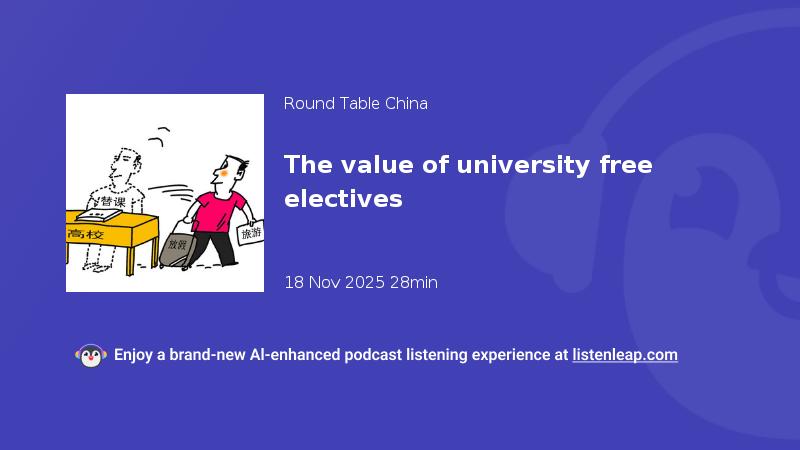
But the problem is or the debate, debate is about the quality of these courses, so some of them are of very poor quality.
Some of students are saying that after a whole semester they didn't learn anything, that the classes were all the same and nothing memorable.
And then everyone was just doing their own thing during classes.
Do you have a term for it in Chinese?
In English, we call them bird courses.
I think that's Canadian slang, actually.
Bird courses?
Yeah.
Because you fly away or your soul flies away?
No, because you can fly through the class, no problem.
Oh.
These tend to be easier classes than the ones that you're studying in your major, or that's the goal anyway.
We call it water classes because we believe that the dry stuff is the essence.
It's the stuff that would serve as water, the kind of staple food that can nurture your spirit and your brain, and if it's too watery, then it's diluted, it's watered down and the super watered down classes are water classes or water courses.
So that right, there tells me a difference in perspective, because the term bird course implies that you can fly through it easily, which means that the students might be interested in those classes because you can fly through the class easily and therefore bump up your gpa.
But water class kind of implies a lesser qual.
Am i wrong when i say that it implies a lesser quality, right or not as fun?
So um, a lot of people, or some of these judgments, are saying that these courses are having the content that they feel is quite shallow and there's little, just little, interaction and challenge in some cases, courses that could be interesting like, as I mentioned film, culture or cross-cultural studies, and then they fail to deliver because the instructors lack specialized expertise or the teaching relies heavily on just watching materials without discussion, or the teachers are just reading off, reading out the PowerPoint slides.
Which are usually 10 years or 15 years old.
I'm talking about the presentation material.
Outdated material as well.
And I think there are so many, definitely so many different factors contributing to the situation.
We have to take a look at why the teachers are not concentrating enough in designing their courses.
At the same time, maybe students play a role, because I remember when I was a university student I deliberately took some classes that have the rep of being a bird course, easy to pass and easy to get to the credit.
And at my time, we already have to sign up for those classes online, which means you have to grab them.
You have to fight for them.
They're popular.
They're popular.
So there must be different reasons.
Of course, teachers is part of it.
Like the motivation that teachers are lacking, they may lack the incentive to dedicate their effort to these public courses because the existing evaluation system often prioritize their scientific research over teaching.
Yeah, so they're busy with their research so they don't have as much time or they don't put as much time into these classes.
When you are a university teacher, you kind of have different duties, and some of them they have to be both teaching teaching courses and finishing their study and research goals.
Because they need to spend a lot of time and energy on their own research, which means they may have not enough time to prepare for their courses.
There was a survey done in 2019 by National Governance Weekly and what they found from that survey was that 70 of those young university teachers they talked to work extra hours and they also have pressure coming from publishing papers and title evaluations and things like that.
I think we need to take that into account, that when teachers are teaching a class, it's not the only one thing they are doing in their job.
There is plenty of other things on their plate.
Now, is that a good excuse or is it not?
You could probably come up with some reasons to say that it is a good excuse.
But for the students who are, you know, these classes aren't free.
They're being paid for right through their tuition.
Expecting more is a pretty reasonable ask, I think.
But for some students, instead of expecting more, they're expecting higher scores because they are looking forward to further education.
They love their major and they're not interested in the outside of their majors, which means that these kind of courses, which are supposed to be broadening their horizons, are not that important to them.
Their horizons do not want to be broadened.
They just want to dig deeper in their own majors, which is personal choices.
I don't see that as something wrong.
And also today's day and age.
You can get different types of open courses and free courses on the internet just as easy as you can imagine.
And do we still need these free electives?
What are some benefits they're providing?
Well, as I said in our opening of this chat, one of the things that I really enjoyed about having the freedom to choose those classes was taking a break from my regular course studies.
And I think that still holds true today, right?
You have your academic pressures, where you're competing with the other students in the class to do very well in your major studies.
So having a chance to explore outside of that is a really nice mental break.
And I think that's something that might be overlooked.
Because you don't feel that same pressure, perhaps, right?
Also there are things that you could find interest in that maybe you didn't know you had interest in before.
Things like art or music or debate or creative writing, like I said before.
Maybe you have a talent there.
Maybe you've never had an opportunity to discover that talent.
Having these free elective courses, who knows, could have an influence on your future.
It could even have an influence on your career choices.
I exactly experienced that.
I majored in English, but we can have some elective courses like video editing and also coding, to be honest.
I chose two of them and it really helped me because in career, when you're choosing your career, it's really hard to actually choose something that you studied.
And in this kind of a society and era, you cannot just you know work with only one thing that you learned.
It got to be some combined skills that you're going to have.
So having some video editing skills is absolutely helping me to get into a new job or a new job environment.
Just out of curiosity, what was your favorite free electives in university?
Or is there one that you wanted to sign up for but failed?
Any regrets?
Video editing is absolutely one of them.
Because yeah, I actually enjoyed doing these editings when you can actually have these polished and transforms that you can have.
Yeah.
Transitions.
It's like storytelling.
Yeah.
And it's telling your own story.
And you take videos by yourselves and make them.
That kind of peace that you will have, it is really amusing, I would say.
I enjoyed... I think I've mentioned this on Roundtable before.
I took two classes.
One was called Love and the other was called Death.
And they were cultural studies about how relationships and marriage and things related to love existed in different cultures around the world.
And the Death course was the flip side of that class.
So they were kind of taught together.
I really enjoyed it because when you're from nova scotia canada, it's a peninsula way on the east coast, so you're kind of isolated there.
And i think it's fair to say i'm not criticizing nova scotia and i'm not criticizing canada.
I love my country and i love my province, but i think you're kind of culturally isolated there too.
So when i took those classes and we were talking about asian culture and indian culture and how they deal with love and death and african culture and marriage rituals and things like that, that was all my first exposure to those types of things and you might say that started my brain thinking about maybe moving or living in other parts of the world.
I totally understand that.
And also all of these kind of public courses are also turning into free, open courses on the Internet.
I think the death from Yale University has been very, very popular.
They discuss issues like including Well, the kind of issues that arise once we begin to reflect on our mortality.
They possibly... well, the possibility that death may not actually be the end is considered.
And also, are we in some sense immortal?
Would immortality be desirable?
Also a clear notion of what it is to die.
And it is examined, this kind of issue.
And there's also the course Justice from Harvard University.
This course explores critical and analysis of classical and contemporary theories of justice, including discussion of present day applications.
Topics include affirmative action, income distributions, the role of markets, debates about rights and all different kinds of things in different parts of the world, the kind of understanding about justice in different backgrounds cultural backgrounds, legal backgrounds around the world.
And those are very, well, relatively classic ones.
And there are modern ones, more contemporary and more um towards future kind of courses including, I think this one is interesting Introduction to Robotics.
The purpose of this course is to introduce you to basic modeling designing, planning and control of robot systems.
And there's also a hands-on introduction to building AI-enabled robots.
That is fun, isn't it?
It offers a hands-on introduction to AI-powered robotics and the Well.
At the end of the course, you would be able if you're a good student, you'll be able to build your very own robot.
Now you have love death robots.
Well done there.
Because I think these days, even though we're talking about the fact that people are discussing public courses here in China, and especially university students are talking about oh, are we enjoying some of the courses?
Are we disliking some of the courses?
There definitely are some good examples here in Chinese universities, some very popular open or public courses.
Yes.
At Nanjing University of Posts and Telecommunications, The course Comic and Illustration Creation or It's All About Creation by teacher Fang Zhongwei.
This class brings students together to explore the composition and color emotion for many engineering majors.
It opens the door to the arts and becomes a highlight of their campus lives.
You know, the course focuses on hands-on exploration of composition, color and visual storytelling, making the learning process very, very engaging and accessible.
Some students saying that it enriches their campus life by offering an artistic experience barely found in their regular curriculum.
Because imagine, they are just engineering majors.
They do with the mechanics and that kind of thing.
And then in these classes they, This teacher, is turning the class into a semester highlight with all of these artistic expressions.
There's another one at Nankai University called Beyond Culture An Overview of Chinese and Western Cultures.
And it engages real life examples from both cultures.
They talk about sweet tofu pudding in southern China versus the salty tofu puddings in the north.
That I did not know about.
It also introduces Chinese dining customs and has real-world case studies.
It also talks about Chinese companies' overseas investment projects with cultural conflicts.
And all of that is to teach students how to analyze and solve practical cross-cultural problems.
And it gets the students involved in discussions about cultures and it connects classroom examples to kind of broader cultures, cross-cultural communications themes.
And again, these types of courses are really fun for the students.
They're really important, I think.
There was a report from the World Economic Forum that talked about the fact that soft skills like analytical thinking and creativity and leadership those skills are among the most growing in demand in the workforce.
So These classes are not a waste of time by any stretch at all.
Yes, and the one that got my attention was one from Shenzhen University.
They have a creating or creative design kind of class, but instead of design only the pattern or the graphics, they ask students to pick a traditional Chinese festival and they pick the mid-autumn festival.
For example, they used several courses to design the mooncake package, to design the poster for your product and also everything related to the promotion, the advertising, the marketing, business administration class, and it can be really, really useful and also really fun.
It can transform your creativity into the reality.
And I think those classes, those courses would definitely be very enriching.
Yeah, or not.
And what I mean by that is I just thought of this right now.
I was an economics major for the first two years of my university life.
And one of the classes I took was marketing.
And I learned in that class, our group project was to market air freshener.
So we had to come up with this marketing plan like TV commercials and all these kind of fake things to sell air freshener.
And I remember sitting in the classroom thinking, I don't care.
I do not care.
It wasn't that.
I just remember that moment where I thought, I don't care about this.
I either want the air freshener or I don't.
But I'm not interested in trying to convince someone... to buy this air freshener.
If they like it, they like it.
If they don't, they don't.
And no offense to anybody who's involved in marketing at all.
But for me personally, I realized in that moment, oh, this is not for me.
And that's the other thing that these free electives can serve, as any class can.
But when you take the class, you have an opportunity to figure out if you're going to love it and it'll influence your future in one way, or if you don't love it and therefore it'll influence your future in the opposite way.
Well, I think it is established that in a perfect, ideal world, we want all the free electives to be really fun, to be able to provide a hands-on experience, to be able to give you the opportunity to examine yourself, to understand yourself in a way that you haven't had the chance to.
You can know what you like.
You can open yourself to new possibilities.
Yes, of course, these are all quite fun, but we also have to be cost effective for teachers, for students, for the schools.
If we ask teachers who are teaching these kinds of public courses to devote 100 to the designing of these courses, to all of these courses, and ignore or at least put a little less energy and time in other of their responsibilities, is it really that important?
How can we strike a balance between improving the quality of the public courses, making the whole system better and more beneficial to the students, to the teachers, to the entire education system, and at the same time, also make sure we're not putting too much in it?
Actually, that was why I was wondering from the perspective of all of these students do they really not want these quote-unquote bird courses or watery courses?
In fact, for a lot of students.
If these courses are interesting, it's absolutely beneficial for them.
If they are not as interesting as they think, but they have a nature or characteristic as we mentioned.
They are easy to pass.
It is a course that they chose for boosting their GPAs and that is kind of the easiest and fastest way for them to get a better score.
But that's unfair.
You're taking a course that you're not putting a lot of energy and brainpower and time in, whereas one getting the same kind of credit where another student from the same class or a different school is taking a course that is really hard, really challenging, and they contribute a lot to that course and get the same credit.
Yes.
So thinking about that.
So I was thinking maybe the issue uh, we need to pay attention to is about the underlying logic of the credit system itself.
Sometimes this um um, when you are having that set amount of credits, then you need to achieve.
Maybe there is a gap that you need to fill in.
That is why I saw that in this academic year many universities have uh, or many netizens have noticed that um Reducing the total number of credits has become a new reform trend in universities.
Among these changes, scaling back a group of these low-value general or public courses has become a common choice across many universities and institutions.
I think it's kind of an easy fix.
If I'm the academic director at a university and I'm hearing that there are complaints about some of the water classes or whatever, I'm not going to remove the water classes.
Why?
Those are good for my university.
Why?
They bump up the GPA of the students, which bumps up the academic performance when my school gets evaluated.
I like that.
That's bad.
It doesn't matter.
It's a fact.
And I like that.
But if the students are complaining about it, about the quality of the students, or the teachers aren't preparing enough and they're not putting enough into the class,
Then I talked to the teacher and I said, do you want to teach this class or do you not?
And if the answer is yes, put your effort into this class.
If the answer is no, then don't.
That's what I mean when I say simple fix.
Now the other side of this coin that I feel I want to talk to the students who are complaining about this.
Shut up.
What are you doing?
You're bumping up your GPA here, right?
This is the point.
This is kind of a universal thing.
Don't complain too much.
You know that English expression, be careful what you wish for?
Oh, I want this class to be more challenging.
Oh, really?
Okay.
Here's something that you really, really have to dedicate time and study for.
I get what they're wanting, but just, you know, maybe relax on the complaints a little bit.
And if I have the opportunity to give suggestions to, like you said, the curriculum director or those who are in charge of the design of different courses, maybe it's also possible to make sure some of the really popular public or general courses can be moved to open courses.
You move the teacher, you move the entire class to a bigger, much bigger classroom and you record the session so that students from not only your university but around the world will be able to enjoy it, if it's a really good class to start with.
And also maybe, I think, for the kind of courses that are often complained by students.
If students are complaining about it,
There must be different reasons.
Sometimes it's because the course is not fun enough.
Sometimes it's because the teacher is not dynamic.
It's not necessarily the fault of the content.
And sometimes maybe it's just the teacher's too strict and students don't like the teacher.
That will give them low scores.
So go attend some of the classes.
Really listen to one of the class and you will know.
I was thinking a lot of these students saying that oh, I'm just doing my own things during these classes.
But I...
I had that kind of same classmates before.
But I was thinking you are spending your time sitting here.
And money, your parents' money.
Right?
Why don't you just listen to them?
Maybe you can get a little bit benefit from it.
I mean, I made jokes before, right?
But I do understand that hands-on robotic class, right?
Maybe you're really interested in that type of thing.
And then you go to the class and and it's just poorly planned and there's actually not a lot of hands-on activities and it's outdated you know, it's robot teaching from 2014 then of course you're going to be disappointed.
I totally understand.
And, at the end of the day, we just want to make sure that everybody's time and energy, including the teacher and the students, to be well spent.
And it benefits each and every one of us.