were brought to you today by on being a gear head.
I'm all about testing the latest sports tech, but you know what often gets overlooked apparel.
Apparel is crucial to performance and that's why I was blown away by the folks at on Swiss Labs.
Their cutting edge approach from sustainability to precision testing for performance enhancement is next level.
It is truly Swiss innovation at its best. Visit on .com slash richroll.
That's on .com slash richroll.
We have an opportunity being in an independent office that's driven by science offices of Surgeon General, where we not only can say things that need to be said, but we should.
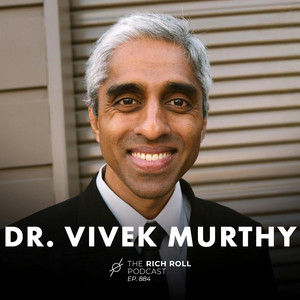
When Dr. Vivek Murthy became the US Surgeon General, he did something unprecedented.
He identified loneliness as a public health crisis.
In other words, at the very heart of what most ails us, both as individuals and on a societal level, is our disconnection from each other.
And so now, upon the conclusion of his eight -year term, Dr. Murthy offers one final parting prescription for America.
A powerful call to action to choose community.
Now, while most public health officials focus on symptoms, Dr. Murthy has really dedicated his efforts to addressing root causes.
His work reveals a profound truth, which is that our physical and mental well -being are inextricably linked to the strength of our relationships and the depth of our connections.
This is a moment where we find ourselves at a time of great pain and division and polarization.
Where every institution needs to be asking itself, what can I do to rebuild the fundamentals of community because that is a foundation for health happiness and fulfillment.
Final note, last week Dr. Murthy issued a landmark advisory on alcohol warning labels that created quite the news cycle.
At the time of our conversation, however, this initiative was under embargo.
It wasn't yet public, and thus not part of this conversation.
Which does include, in addition to exploring his broader vision for public health in America, America, the crisis of parental mental health, the influence of social media on youth, and why rebuilding community may be his most vital prescription to date.
With that, please enjoy Dr. Murthy in his second appearance on this podcast and what is likely to be his final interview as Surgeon General.
If America leads in how to rebuild community, how to bring people together to achieve extraordinary doing incredible things in the world, that would be one of our greatest exports.
Thank you for returning, it's just a delight and an honor to resume a conversation that we began last, I guess it was, we posted that one September last year.
And here we are now, and you are on the very tail -end sort of farewell tour, for a culminating in two terms in office.
And so I guess before we go further and there's plenty of things I want to talk to you about, I just wanted to kind of check in, make my own house call see how you're doing and kind of maybe solicit your thoughts, your reflections on the office that you've held, the role that you've played in that office and perhaps the kind of current state of America from a health perspective as you see it, as you kind of emerge out of the government sector and back into the private sector.
Roger, I have so many reflections as I finish up and it's nice to actually have this time together to be able to think about these last few years and about what's to come for our country, but I think what's pretty poignant for me is that this was never an experience I thought I would have serving in government.
It wasn't one that I necessarily sought out.
When my parents came to this country, it was with hopes that their kids, my sister and I, would be able to get a good education, maybe have some good opportunities to learn, contribute to society, get a good job, raise a family ourselves.
But they also never thought that I have a chance to come and serve in government.
So it has been an unexpected blessing.
It's been hard in a lot of ways, challenging, and public service always is.
But I found that I've been able to learn so much about people all across our country about actually going out and meeting them.
And it's in the same way that I found great satisfaction from taking care of patients one -on -one.
I have found that being able just to meet people at a much greater scale all over the country and to hear about their lives has just been incredibly enriching.
And so I am very grateful for all of that.
There's a lot that I've seen that has concerned me for sure in terms of the state of our health, I in particular worried about our mental health in America on about not only the rising rates of depression and anxiety and suicide, but also the sense of pessimism and cynicism and despondency.
That feels like it's become more and more common over my two terms. And that worries me because I think that even if you have the best technology and great financial resources as a country and the incredible programs to support people, if there's a to really make progress, and take care of people.
There're plenty of other challenges we face when it comes to chronic illness.
We need to learn a lot from COVID but need to do more to protect against future pandemics.
We're still dealing with a really profound epidemic of chronic illness, like obesity, in particular, and heart disease.
And opioid deaths, drug overdose deaths, continue to be a real challenge in America, even though they've come down finally in the last year.
But I also leave with a tremendous sense of hope about what our country can do because in these conversations with people all across the country, Rich, I've sensed something really vital which is that people still are profoundly good.
People are still helping their neighbors out, still staying up, trying to figure out how to do right by their kids.
They're taking care of their elderly relatives.
They're trying to give back to their community in some way.
People are still demonstrating and exhibiting the kind of generosity and kindness and hope in their private lives that we need more of.
But we just don't see that very often, right?
When in terms of what we find online or what we may see in the news.
And so the perception can be that those are vanishing qualities or values.
But the fact that I still see them so often, that gives me hope that we still have what it takes to ultimately help our country heal, to ultimately help us come together and build a better path forward for everyone.
it's going to take a lot of work and it's going to take fundamentally rebuilding something I've come to feel is of essential importance, which is rebuilding community in America.
And that's the subject of a parting prescription that I'm writing as I leave. But I leave with a sense of hope that it is possible and it's what I want to work on in the years after I leave office.
That's good to hear.
You know, I think we can get caught up when we scroll our feeds and bear witness to all the discontent and disagreements, and it's easy to lose connection with that sense of optimism.
And so the fact that you've traveled and your boots on the ground and you still are able to kind of walk away with that sensibility, I think is encouraging to me at least. When I reflect on your career in office, I think what's really unique and extraordinary about the approach that you've taken is that it really is qualitatively different than your predecessors in that, I guess for example, like we have surgeon general coop, very focused on smoking or single issue kind of surgeon generals, all looking at kind of aspects of health in the physical sense.
And I'm not sure what your predecessors had to say or didn't have to say about mental health.
But your conscious choice to really focus on this as a core aspect of the message that you are trying to impart, I think is not only unique and interesting, but also almost the more I think about it, a practice like in the medicines of root cause health.
Like there's a lot of talk about functional medicine and preventative care.
and we can look at what are the root causes of disease XY or Z, but fundamentally your job is to kind of diagnose the country, right?
And so in the sort of Maslow's hierarchy of needs, yes, there are things that are driving chronic lifestyle ailments, but what's beneath that and what's beneath that and what's beneath that.
And at the very core foundation of all of it is this malaise that you're talking about, is this sense of loneliness, is our lack of connection to our neighbors and a sense of despondency that comes with, you know, all of those things put together and all of your advisories and your initiatives, although specific to different things are of a piece in the sense that, you know, you are kind of trying to get to that base level because if you don't address our inability to cohere as a community or, you know, our loneliness epidemic, like all of these other things, like do they really matter?
Because fundamentally, if our heads aren't right and our kind of interior lives and our spiritual lives aren't intact, then it's very difficult to then address the issues that sort of stack up on top of that.
Well, thank you, Rich. And you're right that I think for a long time, I think we've assumed that health was primarily physical health.
And we focused 90 plus percent of our effort there.
There wasn't a ton of training I got in medical school around other dimensions of health outside the physical.
It's a bit on mental health, not a whole lot, and much of it was focused on severe psychiatric illness, which is an important piece of it, but not the whole pie.
And I think it's, over time, what we've realized is health is more complex than that.
There are more roots to our wellbeing than just what's happening to our bodies.
And what I've tried to do during my term is to widen the aperture through which we look at health to recognize that, yes, physical health matters, but mental health matters too.
That social health is the third dimension of health, that also our relationships with one another, for example, that influences the other two, our physical and mental health.
And there's a, I think of even a fourth dimension of health that we're talking more and more about, which is, I think of it our spiritual health and wellbeing, which is about where we find meaning.
It's not necessarily have to be through a faith or through a religious tradition.
And so where we find meaning and purpose like in our lives and all of these four dimensions of our health, mental and physical, social and spiritual, they all interact and intersect with one another.
So if we really want to thrive as human beings, if we want to live in a society where people are truly fulfilled, we've got to recognize all four of those dimensions of health need feeding.
They're also kind of ephemeral ideas, right?
And so I'm curious, your focus in making these issues such a priority.
Like how is that received within HHS?
Like it is a bit of a different direction, right?
Like how exactly do we pinpoint these problems and issues and then in turn like address them?
Yeah. It's easy when it's like heart disease, not easy, but like if you talk about heart disease or diabetes or any number of other kind of like physical maladies, it's more concrete.
Well, it's been interesting because And you guys, I'll tell you that some of the best feedback we get and strongest feedback is from individuals inside HHS and inside the government more broadly whether it's on Capitol Hill or whether it's across executive branch of the administration, individuals working in government who say, wow, this really meant a lot to me.
This resonated with me.
I've been struggling.
My child has been struggling with loneliness and isolation or with mental health and wellbeing.
And I feel seen this feels validating to know that this matters and that there may be a path forward. So on an individual level, we get a lot of positive feedback.
At an institutional level as well, we have found just growing feedback.
The interesting thing I found about serving in this office is that we have an opportunity of being in an independent office that's driven by science offices surgeon general, where we not only can say things that need to be said, but we should.
I think that's our job, And I always tell our team that if there's an issue that seems like it's important, but no one else has really talked that much about it from the public health community.
We're wondering maybe we should wait until it's safer and somebody else has gone out on that.
That's a wrong instinct.
The instinct should be if it's important, and even if no one else has talked about it, we should.
That's sort of the imprimatur of the office.
Yeah, and when we do that, and if we do it in a thoughtful, scientific way, then we also open the doors up for people to talk about it.
That was what we, for example, did on the issue of loneliness and isolation.
It's also, though, what we did on the issue of social media and youth mental health, which is the most common question I was getting from parents as I traveled the country was social media safe for my kids.
And they were worried it wasn't.
And they were asking, well, nobody said that it's not safe or no one said what to do about it from medical or public health.
So we guess it's okay, is that right?
And in my mind, that reflected not necessarily the fact that was okay, but the fact that the public health establishment had not spoken up early enough about the health harms that we were seeing in the data.
And so it was our job as an office to step up and do that.
So sometimes it involves taking risks, sometimes you get pushed back, but I feel confident that we made the right choices about these issues.
And the reception overall has been not only quite positive from individuals and institutions, but interesting has been actually quite bipartisan, which is not a common thing these days in in a very polarized society.
But all of these issues have garnered strong support from members of both major parties.
The social media advisory was focused on advocating for warning labels essentially, right?
And that came out this summer, June or something like that?
So yeah, we just needed two things on social media.
One was an op -ed this summer, earlier this year, calling for a warning label on social media so that parents, kids and other caregivers or as understood the harms associated with social media use for kids.
But last year in the spring of 23, we had actually put out a full advisory on social media and youth mental health, which actually laid out a series of policy steps that we needed to take to, one, make social media safer for kids.
Two, actually enforce the age restrictions which were in placement, not being enforced by the companies.
And third, that also called for measures to demand transparency from the company so that they shared the data they had about the impact of their platforms on the mental health of kids.
Cause researchers were routinely telling us they couldn't get that information.
So we called for a series of policy measures.
And on top of that, this year, we called for the warning label as well.
Like the warning label is not the entire solution.
The warning label is meant to tell parents and kids what's going on while we work hard to enact those policy solutions.
But it's a step, right?
Like, this is a multi -factor where This is a long road, right?
And somebody has to first speak up about it and then it gathers energy and things start to fall into place over an extended period of time.
But we're already seeing this.
I mean, the under 16 ban in Australia was a huge step and it's easy to point a finger at that and say, well, it's sort of a toothless kind of initiative and how are they gonna police it and there's privacy concerns and the like.
But it is a symbolic gesture as much as anything else for a nation to kind of step forward and say, we're gonna do this.
And I think it makes it easier then for further changes to be made in the wake of that.
It does. And I think you made the exact right point, which is that someone's got to step up and talk about these things first and then it can build energy.
And what I've been really struck by is that even though sometimes it can feel like policy takes forever to change and these conversations take years to develop, In the last year and a half since our advisory, we have seen so much such a shift. And we've been in conversation with so many legislators from around the world who have come to us and said how can we work on implementing these in our country?
But in addition to Australia you mentioned, we've seen in the United States multiple states actually pass measures to make social media safe or restrict use for vulnerable kids.
We've also seen 42 attorneys general from around the country, come forward and ask Congress to pass the warning label that we called for in June.
42 AGs don't often come together across parties to do a whole lot because it's a polarized environment we live in, but it speaks to just the importance of this issue.
And when given some of the, I would say the, when you're opening the door and giving people the foundation and the scientific credibility to say, yes, this is a concern and yes, there are solutions to it.
we've seen people run with that in ways that are promising.
Now, at the end of the day, the job is not done until the platforms are ultimately made safer, until kids aren't being harmed anymore.
So we've got more work to do, but the last year and a half has reminded me that progress is possible.
In the real politic of all of that, like what is your estimate or sense of where that's gonna lead in the coming years?
Like, do you think that we are tiptoeing towards some kind of federal initiative or ban, or is it going to be a state by state thing?
what is your prediction?
I think that there is a good chance that we actually get federal legislation on this.
In fact, we're actually closed at the moment, you know, the Senate already passed a bill and the House has taken that bill up, whether or not they pass it before they, you know, recess before the end of the year remains to be seen.
But this is a bill that actually has had broad bipartisan support at the federal level.
So I think what you're seeing in parallel to that is you're seeing a growing movement among parents to actually step up and call for these changes because they're the ones who are living with the consequences of it, right?
No, along with their kids.
So I actually feel optimistic that we can get it done, but it won't happen unless there is ongoing conversation and advocacy driving this because it's too easy in DC for other issues to make issues of the day to sort of take precedence and to shove aside things that are important, but may not necessarily be making the headlines and time a given day?
Yeah, I think there is a lot of energy happening and we're seeing schools, individual teachers, et cetera.
The problem is the social connection issue on an individual basis.
Like it has to be the entire class or the entire school.
So you're not ostracizing certain kids and I think Jonathan Haidt's book, The Anxious Generation has done a lot towards kind of educating the broader populace about that and parents as well, Because every parent is looking for a solution to this, right?
Your children are six and seven?
Is that how... Six and eight now?
Yeah. So you're nearing that age where this is going to be an ongoing kind of negotiation between you and your kids.
That's absolutely right.
And look, I'm worried about that time coming.
It's already, we can see the tussle with our kids who would like to be on the iPad all day long, watching videos if we gave them the chance, no we don't.
But managing technology with your kids is a struggle that starts really early.
And when it comes to the end phones and social media during adolescence, that can be really tricky.
That's why I think not only for my own kids' sake, but for all our kids' sake, I think the faster we can make these platforms safer, the better off we'll be.
But you mentioned just a really critical component I want to underscore, which is a collective action challenge, which is if you've got the situation many parents are in right now, where their child is coming up to them and saying, everybody else in the class has a phone, is on social media.
I'm the only one who's not gonna have it.
If you don't let me, open up an account, then you get worried.
You're like, I don't want my child to feel isolated or alone.
But this is what's been hardening to me to see not only schools stepping up more and more now to restrict the use of social media and phones in classrooms, but more parents actually banding together to say, you know what, we're actually gonna wait until after middle school to start and allow our kids to use social media.
And we're going to come together and do that so our kids don't feel like they're alone.
You wrote in this op -ed in the New York times in June that adolescents who are online three hours or more a day are at twice the risk of anxiety and depression.
And that's set against a situation in which average use is 4 .8 hours a day for adolescents.
But what's interesting is that the adolescents themselves they don't want to be in this problem.
They want a solution just as much as the parents do.
50 % of adolescents say social media makes them feel worse about their body.
So, if nobody can use it, I think, by and large, or for the most part, like they would be happy with that.
And the kind of recent experiments with this have borne that out.
Yes, I mean, there have been studies on this where the kids are actually a lot happier when the classrooms say, not during school hours.
Yeah, it's so interesting because I think there's a myth out there that we're pitting, you know, adults against kids when it comes to these social media decisions.
But just as you said, the, some of the voices that have been most prominent, the loudest voices that I've encountered across the country, raising the alarms about the harms of social media, have been kids themselves who are seeing what's happening to them and their classmates.
But they also know that it's really hard not only to be the sole actor, but it's really hard to detach yourself from these platforms because they're designed to maximize how much time you spend on them.
And when you've got an adolescent whose brain is still developing and who's trying to figure out how to manage their impulses, and that impulse control doesn't develop until later in life more fully, you've got a situation where you're pitting them against the best program developers in the world and some of the best resource companies who are designing these platforms with the intent of keeping them on as long as possible.
That's a little of the definition of an unfair fight.
Without transparency.
Without transparency.
So young people do want solutions and I was in Lincoln, Nebraska actually not long ago and was with a group of high school students and they had just had a policy enacted maybe within the last year in their school that restricted the use of phones during classroom time.
And I asked them, what did you think about that?
And they were like, you know, juniors and seniors in high school.
And they sort of said, well, you know, initially we weren't sure if this was really necessary and important, but after a few weeks, we realized as if we were really getting to know each other.
These are students who had been in school for a couple of years together already, but because they were always on their phones, they actually didn't really have real conversations with each other and now they finally were.
There's another school, I went to an Indiana where the administrators came up to me and they said, after you put out your advisor, we actually decided to finally enforce the rule we've had on the books for a long time about not using your phone during classroom time.
And like many schools have these rules on the book, by the way, but they just don't enforce them because, for a bunch of reasons.
So they said we finally decided to do that.
And guess what we saw?
They said what? They said, well, we noticed that the volume in the hallway started to go up because kids were actually talking to each other.
And then we went into the library and we saw something we've never seen before, which is the kids were actually sitting on the floor playing board games with each other and having fun and laughing.
And wow, isn't that incredible?
And you talk to people a couple of generations ago and they're like, well, that was kind of normal as part of childhood.
But I think this is where I think we have to just appreciate the extent of what's happened to kids today, which is they're no real choice of their own.
They have been dropped right in the middle of a profoundly different digital environment that's consumed so much of their attention and focus and fundamentally transformed their relationships with each other.
And I believe contributed to more loneliness and isolation.
So, yeah, kids are asking for solutions and I think that...
I've risen, I feel such urgency around this is that rich, you know, kids, a year in their life is a lot of time.
There's a lot of development happening during that time.
And this is why I worry that Congress is not done enough to respond to the urgency of the moment in getting legislation done fast enough.
But these steps that schools are taking, the steps parents can take in terms of waiting until after middle school to let their kids start using social media, working with other parents so that they're not alone, drawing tech free zones in their lives, kids' lives to protect sleep and in -person time.
That's why these steps really, really matter and they make a big difference in our kids' lives.
Yeah, it's easy to forget that time is so precious.
The plasticity in your brain you know is not time to be wasted, right?
Like once it kind of gets anchored in, you become who you are.
And trying to create new neural pathways or rewire yourself becomes a laborious process when you're that age and you're so receptive to learning in a certain way.
Like that should really be revered and respected.
And I guess of two minds when it comes to kids being at the sort of leading edge of calling for change.
Like on one hand, like, that's so encouraging.
Like they're raising their hands and saying do something about this.
But at the same time, it's like, where are the adults in the room?
Like they, they're like, you guys are supposed to be taking care of us and we're the ones who have to like, call out and say do something about this.
It's well put the way you did.
And we should be stepping up to do more for our kids.
and this particularly includes our policymakers who I think obviously have a lot on their plate, but I can't think of a responsibility rich that's more important than making sure our kids are okay.
And that feels like one of our most sacred responsibilities in society to take care of our kids.
And by that measure, Congress has really failed to do that over the years.
Social media has been around for 20 years.
It's not like that's just popped up on the scene last year.
There've been bills languishing in Congress for years.
There was ever a time to step up and get something done.
It would be now. And it would be on this issue.
And again, there's broad, popular support for this, there's broad bipartisan support for it.
It's a question of leadership and stepping up to make it happen, because even after you've passed a law, you need time to implement it, right?
And that every day that goes by without a safer social media environment is one more day that more kids are being harmed.
At the same time that there's bipartisan support for this, you also have to take into consideration the extent to which Congress is captured by K Street.
And the lobbying efforts, which are not insignificant on behalf of meta and the sort of tech conglomerates out there who, you know, I don't know what their lobbying budgets are, but they're gigantic, right?
And so that exerts pressure on these bipartisan representatives with respect to ushering forth with the legislation and the regulatory changes that are required to enact that change.
So you're right, and that's a reality of our system right now, not a reality I like, but that there's a lot of money in politics, right?
And that impacts sometimes the decisions that people make.
But the one thing that can overcome the power of money in politics are just the voices of overwhelming numbers of people who speak up and demand something different.
And I have seen that, you know, like happen in the past and it's what we need right now, you know, and this is actually why it's so important that parents in particular are being mobilized, you know, around this issue.
And why young people themselves are seeing not staying silent.
They're building their own movements at the logoff movement and others to try to help each other develop a healthier relationship with technology and with social media in particular.
But their mobilization, I think is what we need more of to ultimately drive the kind of change because like you said, there are headwinds here, There's the inertia, there's money in politics.
There are a lot of reasons not to do this, but the most important reason is that our kids' wellbeing is at stake.
You mentioned parents.
Another big initiative relates to parents.
You published this New York Times op -ed in August of this year, alongside this general advisory on mental health and wellbeing of parents.
So maybe explain that and also explain and like what inspired you to place your focus on this issue specifically.
That's interesting.
Rich, one thing I learned for my first term as surgeon general was that you can come in with your whole list of priorities that you want to accomplish, but at some level, if you really wanna do the right thing, you just gotta sit down and just take some time to listen to people and ask them what they want.
And some of that is just literally just being quiet and just like listening to what you're hearing.
what are people saying, but also what are they not saying?
One of the things I heard really clearly when I was on the road was that parents were really struggling.
And this wasn't because parents came to me and said, hey, I want to talk to you about how I'm struggling.
Parents usually would come to me to say, I want to talk to you about my kids.
I'm worried about my children and here's what I'm worried about.
But as I dug into it, I started to realize that, well parents themselves are under extraordinary stress.
They don't know how to manage a lot of these new challenges like around tech for their kids.
And they're doing a lot of this alone.
Right and so when reason as I dug into the data what I found is that Parents contrary to what many people believe actually struggle with loneliness at higher levels Than adults who don't have kids and most people think hey if you're a parent you've got kids around you You're not lonely.
You're not struggling But parents are not only like often raising their kids without family, you know without a lot of close friends, you know nearby but they're also on social media looking at how everyone else is parenting and feeling like they're constantly falling short, right, and that makes them less likely to talk about their struggles because they're like huh, I already feel like a terrible parent.
I don't want to go out there and admit that I don't know how to do X, Y, and Z for my kids or struggling with how to get them to manage your phone and so that makes it even more isolating.
The other thing though I realized about parents as we dug into the data is that 48 % of parents say that on most days, the stress in their lives is completely overwhelming, 48 % of parents.
If half of parents are walking around feeling completely overwhelmed, almost paralyzed each day, I mean, that's terrible.
That is not normal and that compares to about a quarter of adults who do not have kids who feel that way.
So these two things are really striking and concerning to me and the third and final thing to know is that, is something that's gonna be obvious to you Rich, which is that the mental health of parents actually affects the mental health of kids, right?
and vice versa. And so, if we're trying to do well by kids and address the youth mental health crisis in this country, which was one of the first issues I started working on, we actually have to address the mental health challenges that parents are going through as well.
We're brought to you today by AG1.
When it comes to goals and habit change, One of the things I'm constantly banging on about is really focusing on the tiny things, drilling down on the small, daily things that, while they may seem like nothing, are actually everything when it comes to advancing you towards your goals.
And one of those tiny things is my morning ritual with AG -1, which is just a non -negotiable part of my life going on something like seven or eight years at this point.
AG -1 isn't really a supplement as much as it is a foundational nutrition solution.
Basically, one scoop in water, first thing, gets it done, covers my vitamin and mineral bases, helps maintain my energy levels throughout the day, keeps my digestion humming made easier by virtue of their travel packs, which I keep on hand, so I'm always good to go when I'm on the road, in my office, in my car, I even keep them in my backpack.
So, this new year, try AG -1 for yourself.
It's the perfect time to start a new healthy habit and that's why I've been partnering with AG1 for so long and AG1 is Offering right now new subscribers a free $76 gift when you sign up you'll get a welcome kit a bottle of d3k2 and 5 free travel packs in your first box So make sure to check out drink AG1 dot com slash ritrol to get this offer That's drink AG1 dot com slash ritrol to start your new year on a healthier note The new year is upon us.
Everybody's thinking about how to get healthier, how to lose weight, how to eat more nutriciously and we have the perfect solution for you.
It's called The Plant Power Meal Planter.
It is our digital platform that provides literally thousands of plant -based recipes created by nutritionists and chefs that are easily customizable based on your preferences and your individual needs.
It's been a tremendous success for our audience.
It's also quite affordable like the price of Starbucks a week or something like that with grocery delivery with access to nutrition coaches and so much more and now for the holiday season we have a special offer for those of you who still have yet to explore the Plant Power Meal Planner.
Right now you can get $20 off an annual membership when you use the code POWER20 at checkout.
So it's a new year, a new you and everybody needs inspiration in the kitchen the plant Power Meal Planner is absolutely extraordinary in supporting you in achieving your health and fitness goals.
So to learn more and to sign up, go to meals .richroll .com and use code POWER20 for $20 off your annual membership.
It is the whole package really.
You said it because it's so much more Well, we need to de -stress parents because it's not good for them and it's not good for their kids.
It's like, if you are a parent who's under tremendous chronic stress, whether it's financial, emotional, the nature of it matters less than just the fact that you have it.
You are inevitably creating an environment for your children in which that is being passed down.
And, you know, that shows up in all kinds of toxic ways.
Sometimes it's unhealed wounds that get unconsciously transmitted to the next generation, and then they have to contend with all of your baggage, right?
And unless they heal it, it gets passed on to the next generation.
So in this kind of root cause health hierarchy of needs, it truly is like the fundamental thing.
Like if you don't resolve that, you're basically giving birth to a whole new generation of individuals who are gonna have the very same problems. Yeah, that's exactly right.
And what is the domino effect of that?
like across basically everything.
Yeah, I mean, what you and I are talking about, Rich, is really about making sure that the foundation is strong for health and wellbeing in our lives.
And all this other stuff that we're building on top of that, well -intended as it is, it feels like building on a foundation of sand sometimes, and it's shaking and it falls apart.
And then we ask ourselves, well, hey, we just made that big investment in this health program where we build all these hospitals, how come people aren't happy, how come they're not healthy?
Well, there's a foundation that's been at risk and it's been eroding for a while.
And that's really a, you know, during these last four years and last few terms really what I've been trying to just dig deeper into understanding what are the deeper root issues that are driving our health issues and more broadly our discontent and our despair.
And I think if we address those, I think we have a really good shot, and not just doing better from a health perspective, but actually enabling ourselves to be really functional as a society, to be able to take on big challenges when they arise, whether that's climate change or a hurricane that comes and affects our community or anything else.
Without that, then, even little perturbations, seemingly little perturbations or stresses can knock us over.
And so, there's going to be, at some point in the future, another pandemic.
We don't know when it is, but just with history and statistics as a guide, like at some point that will happen, right?
And one of the things we have to think about as part of pandemic preparedness is not just how quickly can we develop the tests?
How quickly can we protect people and treat people and develop diagnostics and vaccines?
But we also have to think, how do we build resilience in a community?
So then whether it's a pandemic or anything else, we can respond to these tragedies.
And that's where mental health, social connection and community where all of these become really important, and they're part of our core of resilience.
And without it, again, we're like a house of cards that's easily blown over.
Yeah I mean, not to go down some kind of pandemic rabbit hole here, but my concern is, did we learn the lessons with this past pandemic that are going to adequately prepare us for the next one.
And it seems to me that perhaps we haven't.
Like there is such an erosion of trust and with this fracture of community and the lack of trust in institutions, even in a best case scenario where the testing and all this sort of science aspect of it is dialed in, you still have to get buy in from the public.
And that requires trust. And trust is a product of a cohesive community in which everybody's looking out for each other.
And that's the real piece I think that has to get kind of reconstructed from the ground up on that foundational level.
But when you think of parents and stress, even when you're deeply embedded into a loving community And, you know, it takes a village and you have that village to help you raise your kid.
It's still stressful, like under any circumstances, like any parent will tell you and you know, and I know, like it's hard, it's really hard, but now we're in a position where we're split apart, we've lost our connection to community, we're experiencing loneliness on an epidemic level, and we just feel like we're on our own, right?
And it's incredibly stressful, there's financial duress, and no matter who you are, you feel like you're not really able to completely show up in the way that you would like to, like because of work demands.
And when you're at work, you're thinking about your kids.
And when you're with your kids, you're worried about that email.
We're never fully present in our lives.
And then we go on social media and we see super dads who just look like they're the idealized version.
And then we feel bad because we're not that or whatever.
And so what do we do?
Well, we reach for the ice cream or we go to McDonald's or we light up a cigarette.
or you know, like then it's sort of like the unhealthy lifestyle habits that are contributing to chronic disease are rooted in kind of an emotional discontentedness and sense of you know, not being enough or lack that is fomenting all of that stress and then motivating the need to release that stress in unhealthy ways.
Yeah, you're exactly right.
And I think that the connection between our emotional state and how we eat, and how it affects our physical activity is really profound, right?
Like when we experienced stress and distress, that can really feel painful, like literally can feel painful.
And as human beings, like we will always look to alleviate stress.
And the question is how do we do that, right?
And we live in an environment where, that tells us often that if you're feeling pain, then you either need to optimize yourself more, go achieve more, earn more and get more recognition, et cetera.
or you need to numb that pain somehow.
You know, whether it's with alcohol or with, you know, unhealthy foods or something else, and there's plenty of ads around you to tell you that that's the way to just feel better about life.
And while there's nothing wrong, necessarily, with having dessert here and there and doing any of those things, the challenge is when we come to reach for it as a solution to our pain, right?
And that can often begin an unhealthy cycle in our lives that can then contribute to chronic disease.
And this is where I think part of what this is about not just for parents, but all of us is trying to understand, how do we really address those deeper roots of pain?
When it comes to the stress, you're exactly right that you're never gonna get rid of all this stress and parenting.
Parenting's been stressful forever, right?
Ever since, you know, humans began having children.
But there is a difference between bearable and unbearable stress.
And chronic and acute stress or bad stress and good stress.
Yes. And one of the things that makes a big difference between whether stress hurts you or ultimately is manageable and can, in some cases even help you, is whether you're managing a loan or not.
It's one of several factors that impact that.
But when you're dealing with the stress of parenting alone, it's just very different from dealing with it while knowing that they're people who've got your back, you know, and who can support you.
Sometimes those people don't even have to do something like for you, like go pick up your child when you can, et cetera, but just knowing that they're here about you, that they're not judging you, that they're there to support you, makes a difference.
which is why in the Parenting Advisory that I issued, in addition to calling for a series of policy solutions to better support parents, like paid sick leave so that parents can be with a sick child and not lose their job or lose income, or solutions like making childcare more affordable or investing in the child, tax credit.
In addition to policy solutions, there are also things that we can do as individuals, as parents whenever we are able to summon and the courage to speak more openly with other parents about what we're going through.
What we find nine times out of 10 is that they are often struggling as well.
And then opening up those doors can actually relieve a bit of both of our stress.
The other thing that we found, and my wife and I have found this because we've lived this too.
As parents, we've struggled a lot many nights especially when my kids were infants when I was like trying to Google things, figuring out what to do for them, what kind of diapers to get, why do they have this rash, et cetera.
but I mean, people think that being trained as a doctor means that somehow you like know how to take care of everything for your child and that's absolutely not the case.
It disabusey of that right now.
Plenty of moments where my wife and I both doctors have felt really lost and stressed, you know, in terms of how to take care of our kids.
But a lot, what was, what made that look really hard was the fact that we didn't have family here, you know, that at that time, some of our close friends lived around, but many of them did not, and like we weren't, we felt really isolated.
Like we weren't going out to like see people because we felt like we were just having to, around the clock manage and figure out things with the kids.
And that we just became a really downward cycle.
But what helped is how break that cycle, because at some point we realized that number one, in addition to just being open with other parents and not trying to put up a front that we've got it all together, we also realized that we just need to spend time with other parents.
And we used to say, well we can't because we don't have childcare and this and that and we just realized at one point, you know what?
It doesn't matter that our house is messy and in total chaos, it doesn't matter that we may not be able to cook a gourmet meal for anybody, somebody who comes over.
It doesn't matter that a lot of our dishes are chipped, you know, the plates that we might put on the table, none of that matters, and it doesn't matter that our place is small.
What matters is that we just have time with other people.
So we would just tell them, you know what?
Bring your kids over.
Our house is total chaos.
We don't know what we're gonna make, but we'll eat something.
Let's just go, they'll all hang out.
And then our kids would play with each other and we would just sit and talk with each other.
And what we remember and what our friends remember from those moments are not how chaotic our house was or what they ate.
They remember the conversation.
They remember how it just felt to be with one another, how nice it felt to just see our kids playing with each other.
And so we realized that these seemingly small things can make a really big difference.
And the small things we also do to help each other, help fellow parents, can make a difference too.
Like the other day when I was in a kid's school with my wife and it was after school, so kids were playing on the playground, one of the parents needed to step away and just to make a call and said, hey do you mind watching my kids?
Like sure, of course.
Yeah, we'll watch your kids.
Like they didn't take much effort from us, right?
We're just saying yes to a request. But one, we felt really good at being able to help.
You know, and she also felt really good that there were people who were there to actually help her and watch her child and give her five minutes to go make a phone call.
These seemingly small things help us feel like we're part of something bigger.
Yeah. It's so interesting how in so many ways, modern society is just completely orthogonal to like everything that, you know, we know about like what makes us happy and healthy, right?
And now we have to issue advisories and create, you know, infrastructure to lead us back to where we naturally always were, you know.
And there's something tragic about that, I guess, but also the solution is like, you already know the solution.
The solution is to invite friends over and not worry about the small stuff and make sure that you're connecting with people.
And we're just so individuated.
We're all living our self -obsessed lives and we've forgotten that what makes us human is the village and we need to get back to some version of raising our children as part of a village collective where we're pitching in and helping each other out.
Like that's how we survived over millennia.
And now it's all on the individual and oftentimes the single parent to figure it out on a budget where childcare is not affordable.
And of course that person is gonna be overly stressed and lonely and despairing because we're not wired for that.
That's not how we survived and we're communal creatures and we thrive when we're together.
And on some level, we need to reconfigure like the tectonic plates of modern society to get us back to that place.
We do and I think given what you just said, I think it's important for people to understand the way we are parenting right now, is actually not normal.
It's not the way we've parented for thousands of years.
And I think this is partly the result of forces around us.
I think technology has fractured and changed how we dialogue with each other.
And we've also come to move around a lot more.
So we leave communities behind that we grew up with or we move from job to job and we may leave communities behind that way.
And there are benefits of that but there's a cost that we haven't always figured out how to compensate for.
But there's also a cultural piece of this as well which is that, I think over time we have told ourselves somehow that we need to be able to do it all on our own in order to be successful or to be a real man or real woman or good parent or whatever it is, right?
And if we can't, if we depend on somebody else and hey, somehow we're weak.
And that cultural understanding, I think is at the root of a lot of our pain.
I think a recognition that in fact we evolved to be interdependent and that that's actually a source of strength and nothing to be ashamed of has to be at the heart of what we re -embrace here.
Because the reality is that, like thousands of years ago, when somebody operated with that assumption that strength is going on your own and, you know, making it all happen by yourself.
Like, that person got eaten by a predator or a star because they didn't have enough food, right?
And the truth is that even though that was thousands of years ago when we were hunters and gatherers, like, our nervous systems are very similar to how they were back then.
Now, we are circumsensitive of all the lot, but our brain and our neurological systems are very similar so that when we're separated from our tribe, when we're feeling lonely and isolated, it actually puts us physiologically in a stressed state.
And when we are stressed chronically, it increases levels of inflammation in our body and contributes to heart disease, to other chronic illnesses over time.
So whether it's in parenting or other forms, this notion of moving towards interdependence is really vital.
And to bring it back to parenting, this is why I think one of these parents are struggling with is they're caught in a system that tells their kids that success is about individual accomplishment.
How much can I stack on my resume?
What kind of school can I get into?
what kind of project can I lead, what kind of organization can I found?
I was with a friend the other day who was a senior who was applying to college and also has a daughter who's younger and in high school.
And they were telling me, you know, it's not good enough anymore just to be well -rounded, to get into a really good school.
You've got to really spike at something.
I said, what does that mean spike at something?
And I said, well, you know, you've got to really dig deep and differentiate yourself in some way.
And they gave me some examples of somebody who was like one of their kid's classmates who had like started like a national organization you know, focused on a particular issue that they cared about, or somebody who had put together like a global conference, you know, on an issue that they cared about.
And look, props to them.
That's wonderful to start an organization or organize a conference.
But the notion that, you know, stacking that kind of increasingly, you know, beyond your reach, individual achievement is the only path to success and happiness.
That is driving parents and kids to a place of extreme distress and is I think really detracting from their mental health and wellbeing.
So yes, this is part of the culture we have to change.
And one person of their own, I understand it's hard to say, I'm not gonna follow that system anymore.
Because as much as parents and even young people don't like this system, that equates success or with fundamentally wealth and followers, even though they don't like that they don't want to be left behind either.
There's no real opting out of it.
Yeah, it feels like there's no alternative to them.
There's something acutely American about all of it too.
This idea or importance or emphasis on personal resilience and self -sufficiency.
And it's also an illusion because anyone who's successful is a product of a lot of support in many different ways.
it's like this myth of like greatness sort of emerging out of just one person and their mission to do something extraordinary is basically a lie anyway.
You know, like, so it's all premised on its own foundation of sand, I suppose.
And the pressure on the parents to raise a kid to succeed within this system and then the pressure that the kid has to shoulder who are at a very young age to be essentially extraordinary even have access to education and opportunities is a disease fundamentally, right?
Like everything is upside down in that regard. And yet we have parents stressed because it feels like an indulgence for them to put their oxygen mask on first before they put it on the kid because we're so worried about our children and it's an unsafe world and we wanna protect them and we wanna set them up for success and do all the right things, it's a setup for failure that even for people who have all the resources and do have enough free time to devote the emotional mindshare to raising their children is going to be, extraordinarily stressful.
Yeah. And even though it seems like a really big problem to change, Rich, cause you're talking about shifting an entire culture, right?
Here's actually how I think it could start specifically everyone talking about the culture of achievement for kids.
What has sadly become, I think a very toxic culture of achievement.
If you had the top 10 or 15 universities in the country and the top 10 or 15 workplaces in the country in terms of number of young people that they recruit, like it's any given year, and if they came to an agreement that they were actually gonna fundamentally change their criteria for admission and hiring, right?
such that rather than prioritizing these elements that we're talking about are you spiking, quote unquote, spiking at something, like, are you achieving more and more just for yourself?
Instead of that, if they were shifting to thinking about what are you doing in your life to actually serve other people in your community?
What are you doing in your life to cultivate, you know healthy relationships and contribute to a sense of connection in your broader community?
How are you thinking about your sense of purpose in terms of how you ultimately contribute to the lives of others.
What we know is that those three elements, relationships, purpose and service, that those are the triad of fulfillment that stand in contrast to this drive of success.
And when people are fulfilled, they do better in all dimensions of life, including their health.
But until the places that are essentially driving these criteria change, like their admissions and hiring criteria, If they, if they were able to do that, that will send a very strong message to others that this is a direction we need to start shifting in.
So universities over time gained a sense of pride and, you know, over their exclusiveness, right?
They would boast about how low their admissions percentage was as if that was a good thing.
But rather than closing the doors so that the opening is so narrow, universities should be in the business of opening those doors up more, right?
Like the universities that I have attended and I've been lucky enough to attend, have massive endowments, right?
Yet their class size hasn't really changed all that much, like over the years.
Like, why is that? Why aren't we opening the doors wider so more people can study in universities and can actually focus on the elements of life they truly bring fulfillment, like relationships, purpose and service.
So these are choices.
Culture flows from the choices we make as individuals, as institutions, and the leading educational institutions and employers in our country have an opportunity to not only shift that criteria for the well -being of students and young people, but that ultimately will help them as well.
Because one of the great drains on economic productivity for businesses, is actually the mental health strain that so many employees are under.
It contributes absenteeism, people drop out of the workforce.
It's a serious, serious issue and costs employers billions overall.
So, this is an area where it's sound like good for society, but good for businesses and universities.
But they can help you at the tip of the spear when it comes to changing this unhealthy culture of achievement that we're caught in.
Universities are essentially luxury brands and their value proposition is exclusivity, right?
It's brand recognition.
And what they're selling is like, access, like membership to a club that provides you, you know, provides doors to open for your future.
And I feel like the pandemic provided an unbelievable opportunity for a seismic shift in that when all of learning went online.
That was the moment in which these universities had the opportunity to broaden access to what they were providing.
I mean, truly, they're public utilities, right?
And if they were community -based and oriented around what is in the best interest of the next generation and also, you know, our country's best interest, why couldn't they have offered, like sort of tiered access to education based upon these digital platforms where they could have taken, you know, I guess, you know, take a prestigious private university and said, well, we usually, you know, accept 1500 students or whatever it is a year.
You could make that 50 ,000 or a 100 ,000 and price it according to, you know, digital access versus like on campus or whatever.
And none of that happened.
And I thought it was a massive lost opportunity, but they're all about protecting their endowment and maintaining the luxury status of the brand.
And so, that's certainly something that's upside down.
Especially on a state school basis.
Yeah, well, you know, most of these educational institutions are nonprofit organizations that have tax -exempt status.
And that means that fundamentally, society's supporting them.
And so the question is, are they doing enough to support society?
And that's, I think, the fundamental question that we have to ask.
There are some places, I was talking a few years ago to President Michael Crow from the Arizona State University, who's actually taken a very different approach than most of his university peers and said, we want to blow the doors as wide open as possible to allow people online, in person, people who have families, people who are single, people who are young, people who are old, all participate in getting a good education, because that's what a university should be about.
And we need more people who are taking that kind of approach more broadly.
But look, I think that the bottom line is, this is a moment where we find ourselves at a time of great pain, and division, and polarization, but also great unhappiness and dealing with fundamental physical physical and mental health challenges, where every institution needs to be asking itself, what can I do to rebuild the fundamentals of community in people's lives, because that is a foundation for health, happiness and fulfillment.
What can I be doing to do that?
And if we ask that question, then I think we would operate very differently.
Like I think workplaces, for example, would find that being able to structure opportunities for people in the workplace to hear each other's stories and understand each other is good for their health and it's actually good for the business.
People who are engaged and connected at work are more productive, more creative, they have just greater degrees of engagement and they tend to drop out of the workforce less.
They would also think about what can we do to bring folks in the workplace together to actually serve our community on a regular basis, recognizing, again, good for them promotes team bonding, good for the community as well.
In our schools, we would think also about how do we build relationships and services as part of the educational experience.
If the point of school, and I'm talking about grade school as well, the point of grade school is to give kids a foundation for a healthy and happy life going forward. One of the skills that many kids find themselves without is a skill to actually build healthy relationships.
You and I didn't grow up as digital natives, but if our child is growing up today as a with loneliness as the way a third of adults in America are today.
That child may not necessarily automatically come into the world knowing how to build a friendship, how to start a conversation with a stranger, how to deal with conflict when it arises.
And this is why when I, last year was traveling to universities, I would hear from university administrators that kids didn't know how to have conversations with each other.
There were schools that were trying to train students on how to have a conversation with your roommate about things like, I'm messy, you're neat, how do we manage that?
I get up early, you get up late, how do we manage that?
Because there just wasn't comfort in dealing with conflict.
And even the students themselves would tell me, hey, how are we supposed to talk to each other when it's not the culture anymore for people to start conversations with each other?
And I initially, when the first time they said that at any of those I was like, what do you mean, it's not the culture for people to talk to each other?
They're like, yeah, it's just, you know, everyone's got their earbuds in, they'll have their devices and like, you know, people just don't talk to each other in person anymore.
I even brought this up in my office recently because we were having conversation about online dating, actually, and about just dating in general and how challenging it is these days.
And one of the women in our office who was in her, in her thirties, she said, I just wish that people would just come up and just have a conversation and approach each other these days.
And the folks who are in their office in their twenties actually turned around, they're like, that's just really strange.
We don't know anyone who does that.
Like that's not how people operate.
It's so amazing. And so this is very generational but I don't actually fault young people for that at because the digital environment they're growing up in, it's just fundamentally different from ours.
And so I think we can't assume that those are skills, social skills that people just are born with and they develop automatically.
We have to cultivate those in school.
And if we don't do that, then what we'll see is what we see today which is increasing discomfort with in -person social interaction, challenges with developing relationships and managing conflict, and then a widening epidemic of loneliness.
But with every such challenge there in Lies the Opportunity, and I think it is a unique moment in which we do need to, and perhaps there's a receptivity to, really looking at how we're educating young people, especially at the grade school level.
Because now that we do have these devices, the ones that make it hard for us to talk to each other, they also are repositories of all facts in the universe.
Yeah. Right? So, do we need to be teaching young kids in the same way we always have when we have these super computers in our pocket that can answer every question that we could ever ask it.
What we actually need to do is teach young people not only how to communicate with each other in some basic social skills, but how to operate within group dynamics and how to engage in conflict resolution.
and perhaps most importantly, how do you develop a relationship, a healthy relationship with your own mind and your interior self?
And we've seen some of that, like we have mindfulness or meditation, but I think like just the idea alone that you're responsible for taking care of your interior self and teaching young people how to engage in that conversation with themselves.
I mean, imagine the positive domino effect from that, given the fact that your focus is on these kinds of foundational elements but if you can start kids off right with really well dialed in programs and curriculum around like what that looks like at that age, I think would just be seismic.
It'd be absolutely seismic and like quite literally foundational, right.
because the one thing we know for sure is that at some point in our life, we're gonna be on our own, alone, like physically alone without people around us.
And the question is, are we comfortable with that or not?
You know, when I was growing up, you just had to be comfortable with that or figure out how to be, because that was just life.
There were times where you were just on your own waiting for a friend or waiting for the bus, waiting for, in my case, you know, your parents would pick you up from school.
Now, these days all the white space in our life is filled with our devices, right?
Because we can pull them out very easily and just check email and message your friend, check the news.
But it's reached a point where I think people have actually become quite uncomfortable with being alone.
And there's really important stuff that happens like when we are alone, like that's when we can reflect, it's when we process stuff that's happened, it's when we may have creative ideas or thoughts.
And if we don't have that alone time, if it's squeezed out in our life then that means we don't have of that really important time to reset, reflect and renew.
In many ways, like the analogy is to sleep, right?
Like we used to think, aah, sleep is expendable, right?
It's like, you know, sleep when I'm dead, that was a very popular saying back in the day.
But now we've realized in recent decades that actually sleep is vital for your health and wellbeing, and it's so critical for everything from the processing and consolidation of memories to the health of your brain and the rest of your body, sleep is vital for your health.
In that same way, healthy alone time is important.
It doesn't mean you necessarily need a lot of it.
And we may differ on how much we need, depending if we're introverts or extroverts.
But I always tell people that the secret to building social connection is often in the small things in life, and it's, do I take five minutes a day to reach out to somebody I care about?
Just to say, hey, I'm thinking of you.
Do I make sure that I'm fully present when I'm talking to somebody else and I'm not distracted by my devices.
Do I make sure that I'm doing one thing to like help somebody each day?
Recognizing service is the most powerful antidote to connection?
But the fourth thing actually is around solitude.
Am I spending just a few moments in a day by myself?
It could be allowing the breeze to just blow against your face and sitting on your front step.
It could be walking through nature, it could be a few minutes in meditation or in prayer.
It could be a few minutes listening to a song that really inspires you or stills you.
Whatever it might be for you, those few moments of solitude, that is when we ground ourselves again.
That's when we have the opportunity to let the noise around us settle.
And it's all the more important today because there's a lot of noise around us.
Things coming at us all the time.
Information, stories, all kinds of things.
And without that time to really settle, I actually don't think that we can be our best selves.
We need that just like sleep to help strengthen our foundation for well -being.
Yet another something that we have to, you know, exert great energy to do that just came naturally as a product of being in a body.
It did, but that's one of the things I realized when I was, you know, when I was first in medical training, Rich. And so I realized, you know, you're taught in medical training to counsel patients about certain lifestyle changes, right, to improve their health, be around physical activity, or changing their diet, whatever it might be.
And but really routinely would to happen that I would see a patient that would talk to them about that and the next time they would come back, I'd say, well, how did it go with being able to change your diet or being able to walk in a way every day after dinner?
A lot of times just said, that was really hard, I couldn't actually do it, and we would try and struggle, and it would be tough.
But the one big thing I found made a difference was when people did those things in partnership with somebody else.
So if they had a friend who they decided they were gonna go to the gym with, or even if they weren't going to go to the gym together, but if they both agreed they were gonna get on a gym plan, right, and they helped each keep each other accountable, that was very different success rate, much higher.
Then trying to do it on your own.
So I think with a lot of these things, whether it's reforming like how we engage with our phones and with social media, or making it a priority to reach out and connect with somebody each day or to do one small thing to help somebody, whether it's keeping that five minutes for a solitude each day.
If we do these things with someone else, if we make a pact with somebody to do that, it helps a lot.
That's what I did in my own life, actually.
I was really struggling with a lot of these things.
And, you know, occasionally still do, in fact.
But I have two guy friends.
You know, we call each other brothers because we become brothers over time.
But we decided that we were all struggling in some of these areas and we needed to help each other.
So we make pacts with each other that we're gonna make certain changes.
One of them was, a couple years ago, I was actually, I needed to have some surgery in my hand.
And they said to me, they'd say, they said, okay, for the next day and a half after the surgery, you're not gonna be able to type or do very much. So that's a chance to like make a shift in your life.
What do you wanna make a shift around?
And I said, well, you know, I feel like I've been, I don't know.
I check social media too often, just lose time on it.
Like I'm busy, I don't have time for anything.
But yet somehow I find myself furthering time away on social media.
I'd like to maybe re -engineer my relationship with social media, maybe stop checking, you know, my personal accounts.
And they said, okay, you'll do that.
And in fact, we'll do that together.
And I tried to do that before, by the way.
Yeah. And fail multiple times, but because of them, this time was actually different.
They would text me, peer out to me.
How's it going? I'd be like, I don't know.
I think I sort of almost went on the thing that they said delete your app, delete the app from the phone.
Just make it, make it, increase the barrier to your actually doing that, but they, they stayed on me.
They kept, it kept it up and I did that for them too.
And I will say that what I realized in the weeks and months afterward, is that not only did I have more time that I could put into my family and into work, but I actually found myself reading more, like reading books, right?
Which that level of time had like just dissipated into my life because I was always on my device.
So all that just to say that there's no shame in leaning on other people and making these sort of packs with others when it comes to changing our behavior, because it's really the small things that make a big difference.
And that five minute call, that five moments of solitude, When we do that consistently, that can make all the difference in how we feel on a day -to -day basis.
This show is sponsored by BetterHelp.
As we enter 2025, we each have 365 blank pages waiting to be filled.
So maybe you're ready for a plot twist or perhaps there's a chapter of your life you've wanted to revise, but it's not about resolutions that fade by February.
It's about becoming the author of your own story.
Therapy can be like having an editorial partner on this journey.
It's not just for crisis moments.
It's for anyone looking to develop better coping skills, establish better, healthier boundaries, or simply help you to become your best self.
All of which experience has taught me as someone who's been in therapy for decades is something you really can't do alone.
Everybody needs expert feedback.
So if you're considering therapy, which I think you should, BetterHelp makes it highly accessible.
It's fully online and tailored to fit your schedule.
You complete a questionnaire to match with a licensed therapist and you can switch therapists at any time without incurring extra costs or any charges.
write your story with BetterHelp.
Visit betterhelp .com slash richroll today to get 10 % off your first month.
We're brought to you today by Zoey.
The gut microbiome is not just about digestion, it's literally the gateway to better health.
As somebody who's deeply passionate about nutrition, I can tell you that it's a lot easier to improve and transform what you can measure.
And now thanks to Zoe, we can not only measure what's important to know about the health of our gut but also leverage what we discover with a highly personalized approach to improving it in ways that are truly amazing.
Zoe's at -home testing process is grounded in serious science.
Basically you wear this small sensor that tracks how your body responds to different foods.
You provide a quick blood sample to analyze your metabolism and then you eat their your signature Blue Cookie, all of which creates a detailed blueprint of your unique gut microbiome, upon which ZOE provides actionable guidance to improve it.
No guesswork, just data -driven insights backed by one of the largest scientific databases of its kind.
How healthy is your gut?
Go to zoe .com to order the kit, and find out.
And because you listen to my podcast, you can use the exclusive code RICHROLL10 to get 10 % off your membership.
As a Zoe member, you'll get an at -home test kit and a personalized nutrition program to help you make smarter food choices that support your gut.
That's Z -O -E dot com.
Use code RICHROLL10 at checkout.
It's so interesting that our uncomfortable ability around being with ourselves, the idea that it's so difficult to be alone and we don't have to anymore because we have these phones is actually what's driving our loneliness.
There's a beautiful irony in that.
But yes, accountability is, of course, fundamental to any kind of habit change and making it stick.
But the real magic there is that, it's also a recipe for connection with other people, so it strengthens your bond with your friends.
And I think there is, amidst this epidemic of loneliness, something that's unique to kind of men of an older age.
Like not older than you, but like when you reach a certain age, like I feel like women are better with their friendships than men are.
And just maybe it's a cultural thing or the way we were raised or our notions around masculinity, it becomes very difficult to maintain those friendships that you always had and even more difficult perhaps to like make new friends, right?
And so I'm interested like in your thoughts around that and if there's any research or science to kind of support that inclination that I have. So you're absolutely right that loneliness is a huge challenge for men.
Women are better at relationships generally speaking than men are better at seeing in touch when people are better at seeing each other out.
It doesn't mean that they don't struggle with loneliness who they absolutely do.
Interestingly the surveys show that men and women struggle with loneliness at equal proportions, I actually think that it's probably in reality higher for men because I do think there's a greater discomfort and even admitting, even on anonymous surveys, even admitting to yourself that you're struggling with loneliness when it comes to guys.
So I think, what I have found in the lives of men is that there are a few key things that often trigger acute bouts of loneliness, the loss of a spouse, illness, retirement.
Like those are three big ones among older men.
But as men just get older in general and as they get out of college, for example, and lose a built in community, sometimes that you have in high school or in college, that can start a very lonely journey, like in their life, especially if they don't have a community of friends at work.
And I think that's compounded by the cultural expectation that we've placed on men that somehow being a real man is about not needing anybody else, right?
That notion is fundamentally flawed. It's inconsistent with human development and evolution, but also, I think, is sort of premised on this idea that strength is about not needing other people.
And I think fundamentally what we have an opportunity to do is to redefine strength.
not as the kind of independence that doesn't require others but as interdependence.
And when I think I was, I was telling my team earlier that my, I've been away from my son and my daughter for a few days almost a week.
They went ahead early with my wife to be with my mother -in -law and father -in -law, my sister -in -law for the Christmas holidays.
And, you know, I had work and stuff, so I had to stay back.
And so I really miss them and I talk to them every day and we go through all the things I'm gonna do together than when I finally joined them the holiday.
But I told my son, I said one of the things that I wanna do when we come over, my son is eight years old.
I said, I wanna go on a walk with you.
And he said, okay, we're gonna walk.
And my wife Alice is like, oh, you just wanna go with him?
I say, no, I'll go on a separate walk with our daughter.
I was like, but I wanna have a conversation with him about being a man and about what that means.
Because he's already getting messages at his age from his classmates and others about what being a guy is all about.
But I want him to know that this notion of independence and interdependence, I want him to know that it's okay to depend on other people.
It doesn't make him any less of a man.
I want him to know it's okay to Express what he feels, you know, and to lean into friendship, to take initiative and connect with other people, and that's not a sign of weakness.
When I think about what it means to be a man for me, what my father taught me when I was growing up, He taught me actually what I think has been associated with manhood in different traditions, in different cultures for centuries, which is that it was fundamentally about honor.
That it was about upholding values.
That it was about taking care of people who were vulnerable.
It was about taking care of your family.
It was about generosity.
And it was about kindness.
These are the things my father taught me that were about being a man.
It wasn't that you could get angry if you wanted to, you could hurt somebody if you wanted to, sure.
But it was choosing to be kind and generous, choosing to take care of others, choosing to uphold these core values and virtues around love and generosity and kindness.
That was the kind of manhood, the concept of being a man that my father taught me about that I wanna teach my child about.
And when I look at men around the country and around the world that I admire, I often find those qualities in them as well.
And so I am worried about what's happening with the young boys and men in society today.
I think many of them feel alienated, cast out like they don't matter.
I think people don't care about them.
I think we've got to listen to that feeling.
I think it's real. I hear it all the time.
But I think some of it also is rooted in this deeper isolation and loneliness that many men are feeling.
and I think we have an opportunity to rebuild community for boys and men and to do it around a model of manhood that can not only help them but can strengthen society more broadly.
It's not easy to do, but this is the right moment, I think, to do it.
Within that, we have social media and the kind of incessant messaging that is part and parcel of what we've kind of collectively decided is important in terms of what it means to be a man.
And that revolves around your accumulation of, you know, material goods, power, property and prestige.
Like, this is, this is how we grade and calibrate your ability to measure up to some kind of masquerade of masculinity.
And I think when you expose that to young men and who are lacking an opportunity, it creates a scenario that is gonna lead to kind of toxic outcomes.
And that's the thing that concerns me the most, like, how do you remodel masculinity in its healthiest form, which is strength and sort of celebrating the best of what men have to offer, but in the healthiest way.
Power exerted for the benefit of others, being devoted to your community and principles and values and your family and all the things that you shared.
And I feel like we've sort of gone astray from that.
And I think a lot about like how I can model that in the show that I do and sort of set an example for the next generation of young men.
But the problem is the social media algorithms favor, you know, the other version of that.
And that's what young men are being exposed to, the loneliest of young men.
Yes. I think you're right in that.
I worry about that too.
I think what we need to build in -person community for young men.
There is no substitute for being in person and in the absence of in -person community, young men and boys are spending more and more of their time online, where I do think yes, the algorithms often amplify things that are not necessarily the best about humanity and give them I think a distorted version of what being a man is about.
I like the way you put it, property, prestige, and power.
The challenge, I think with what has happened today is not only that we've equated that with being a man, we've equated that with self worth.
Yeah, finally. And so young men who may not have a lot of money or be famous or powerful feel like they're not worthy.
Their life has no value.
And what a terrible, terrible way to feel.
And I think about so many of the young men that I've spent time with over the years who are desperately trying to claw their way back to some sense of meaning or value in society because they don't have those things.
And what I desperately want them to know is that their value is intrinsic.
It's in their ability to give to others, to support others, to be there for others, to care for others.
They were born with that, they have the ability to express that at any point, and that is where their value comes from.
It's not from what's in their bank account or how many followers they have online, but that is a message that we've got to shift and change.
I think you can shift these more easily in person, which is why I think that we need to think, how do we rebuild actual gatherings and moments and experiences for young people that can bond them to each other and help reset the norms and what it means to be a man?
Because those qualities are naturally emergent, healthy qualities of participating in a healthy community.
That's right. In its person community, all of which is kind of, leads up to this parting prescription for America, that you're like by the time this comes out, you will have shared publicly sort of your kind of culminating thoughts on what you wanna leave behind as your final words as you exit office, like this idea, this call towards community.
So maybe explain the idea behind this.
I mean, we've already touched on a lot of these ideas, but.
Yeah, I decided to put this parting prescription together, Rich, because I was reflecting on everything I've learned over these two terms, everything I've been taught by people across our country and really around the world.
And it was part of a larger journey to understand what the deeper roots of pain and despair were in our country.
And what was really revealed to me through this work, these conversations, the scientific research, conversations with the experts so much, was that there are three fundamental components of our lives that fundamentally matter to our wellbeing and our health.
And they've been eroding over time.
And those are our relationships and purpose and service, those three components.
And when we have those, we have a robust sense of community.
But the call in this prescription is to now revitalize those three elements, to reground society in them, to build our lives around them, to ask ourselves, how can we connect more deeply with people?
How can we do one small thing?
how can we help somebody each day?
How can we ask ourselves, where do I find meaning in my life?
And how can I lean in more there?
Whether it's in raising my child or whether it's in helping take care of people in a hospital or whether it's contributing to the world in some other way.
That is our challenge today.
It's to rebuild that foundation.
Everything else in society is built on a foundation of community.
And community is anchored in relationships, purpose and service.
And I came to this in part, actually, just reflecting on a story that my father shared with me like years ago, he once out of the blue surprisingly told me, he said, you know, I never really felt that sense of emptiness or loneliness until I left my village in India.
And my father grew up in an incredibly poor circumstances.
They didn't have enough money to buy shoes or slippers.
So he was barefoot most of his childhood.
They didn't have running water or electricity.
They didn't have enough money for dinner around the table each night.
in. But even though he lacked so much in material terms, in the village, people knew each other.
Not just their names, but they knew their stories.
They chose to spend time with each other.
If you were in distress or needed help, people would step up and help you.
Whether you needed a meal that night, or in my dad's case when he lost his mother to tuberculosis when he was 10, people in the village stepped in.
They became surrogate parents.
And every day people woke up with a purpose in mind that involved contributing to the village.
some of them are growing crops so that everyone could eat, some of them were protecting the village in other ways.
Some of them were raising the kids in the village or teaching them in the schools.
So that actually made his life deeply fulfilling, even though, yes, there was more that he wanted.
And that is why I came to see, and I lay out this prescription, that we have two triads that we have to choose between here, the triad of success, which is grounded in power and fame and wealth and the triad of fulfillment, which is grounded in relationships, purpose, and service.
And there's nothing wrong, by the way, with making money or being famous or being powerful— nothing wrong with any of that at all.
The problem is when we assume that those three are the determinants of our value, when we think that those three are the key to fulfillment, because the truth is, they're not.
And plenty of people have all three of those and are profoundly unhappy.
So I lay out in this prescription a series of steps we can take as individuals, as schools and workplaces, as government, as society more broadly, to move the pendulum away from the triad of success, toward that triad of fulfillment, to rebuild community in America.
And I would love, Rich, if this could be the example that we set for the world.
If America leads in how to rebuild community, how to bring people together to achieve extraordinary goals, do incredible things in the world, So that would be one of our greatest exports.
It really is at the very core.
It's at the base of this pyramid, right?
This foundation, our declining investment in community is really at cross purposes with everything we need to be able to thrive.
And so as much as what you're saying is diverting attention from quote unquote success to this idea fulfillment, To me it means redefining the words success itself or just understanding the true meaning of success which isn't power, property, prestige, fame, all these things that we've talked about, but is your investment in your community because ultimately success is feeling fulfilled, it's feeling purpose -driven, it's having direction in your life.
Like all of these things that we want, we've just diluted ourselves into believing that the way to get them is through this traditional idea of success.
When all along we know through millennia of human evolution that it's a product of our investment in our communities.
That's what we've lost sight of.
So it's almost like a reclaiming of what we've always known.
That's exactly right.
And this is what happens in humanity, right?
Like we go, sometimes we fall off the path and we have to get back on the path.
I'm - This is my life.
It's like in the micro of my life too, right?
and this is actually gonna happen in all of our lives that we're gonna be clear on what really matters and something is gonna pull us off in some way and we're gonna find ourselves chasing something that actually doesn't truly make us happy but we thought it was what was valued and by society.
But this is our chance to get back on that track and just to recognize that success without fulfillment is not success at all, right?
If we're not fulfilled and we haven't done what we need to do, so this is, as you said, about redefining success and by recognizing what really matters.
At the end of the day, I don't know what my kids are gonna do.
I think most parents don't, can't predict exactly what their children gonna do, but I suspect what every parent wants at the end of the day is for their kids to be healthy, happy and fulfilled.
Those three things we want for our children.
And now we know the key to how to get that.
We know that the key to health and happiness and fulfillment are the relationships they have and the service or engagement and their sense of purpose in life.
Right now, the majority of young adults, 18 through 25 in America, say that they don't have or have very little sense of purpose or meaning in their life.
58%, right? We have to change that.
You know, we want people throughout their lives to feel like they're part of a community, to know that their self -worth is rooted in these intrinsic qualities, is their ability to be generous and kind to others.
The great thing is when you operate from that perspective, you can actually create so much more in terms of wealth and power and fame and all these other material pursuits that you may want because you're functioning from a place of strength.
And that's really the key here, is that community is our great source of strength.
It's weakened over time, but we are now called to rebuild it, and that's what we have to dedicate ourselves to.
Yeah, on a practical level, just sharing like my own kind of struggles with this.
And I'm sure this is like relatable to a lot of people.
Like yes, I understand that.
I get that, I agree with you.
I know that's correct, but let me just put that aside because, I'm climbing this ladder over here.
And when I get to the top then I'll turn my attention to other things, because I think they're important, but like there's only so many hours in the day, I got to put bread on the table and I'm just shy of getting that promotion.
And like I just need to focus on that.
Like this is the reality of it, right?
So on some level, the onus is on us.
We have to shoulder our own responsibility for community building.
And it's difficult because you are kind of having to buck a system where all the incentives are pushing you away from this idea.
But we also need, as you point out in the prescription like we need government, we need the private sector, we need everybody to like kind of contribute to this and fix this alignment problem so that we're establishing incentives that are moving us in the direction of community building rather than away from it.
We have to create the ecosystem that makes community more feasible and possible.
One of the things that I'd love to see, Rich, is a generation of entrepreneurs who see themselves as community builders, who are trying to create the products and services that actually bring us together in person that help us learn about each other's lives that bring us together to work in service to our community.
Like how can we do that?
How can we use technology and creative ways to do that?
Because at the end of the day, I don't think technology in and of itself is evil or bad.
I spent seven years in my life building a technology company myself before I was Surgeon General to actually help advance clinical trials.
But it's helped me design and use technology that ultimately makes a big difference.
But if the idea of building community community can be something that inspires our entrepreneurs that inspires people who are running workplaces now and teaching our kids in schools that we can start to change that ecosystem around us.
Because it does take...
We have to make it easier to do the right thing.
And again, I think just to be really practical as well, for that person who's got one more rung to the climb in the ladder to get their promotion, I think the message of our conversation isn't that that's not important, or that you shouldn't climb that rung and get that promotion.
And I think, if you want to do it, you should go for it.
The key I think is to recognize that those promotions and what we build onto our resume, they're important, but they don't define who we are or our worth and that the greatest drivers or fulfillment are in our relationships and service and purpose, and the final thing I need to say about that is that the pathway to building community in our lives does not have to be incredibly onerous.
It doesn't have to be okay, now we've got to quit our job and like move somewhere else and spend 10 hours a day you know, like talking to our friends on the phone.
Like that's very hard to do, those kind of changes.
But to me, what is actually very attractive and what makes me optimistic about building community is that it's into small things, small actions we take each day that we can actually really robustly build community.
It's like if you laid a brick every day you know, for a few years, you could build a pretty extraordinary house, right?
in a even more powerful way, it's that five minutes reaching out to a friend or five minutes helping somebody each day that can start to build what can be an incredible community for you.
It's that decision where you say, you know what, we're gonna have dinner tonight anyway, I'm just gonna tell these friends, just come over and bring whatever they're eating over and just eat together.
Right, your your connection recipes.
Yes, yeah and in fact, because a lot of people had barriers to connecting in person, we put out this booklet called Recipes for Connection, which was not actual recipes for dishes, but for how to gather, recipes for how to gather.
And I did one of these actually recently with a group of friends who were chefs.
And we gathered around our childhood favorites.
That's one of the things we suggest. And so we each brought a dish that we loved as when we were kids.
And when we came together, not only did we really enjoy the food, but it was also a chance for us to learn stories about each other's lives.
Like, I brought a dish that was a dessert, and Indian dessert that my mother made called rasmalai.
She made it when I was growing up a lot.
And even when I was making it, I was like thinking about my mom, I actually called my mom for the recipe.
When I got there, I got to tell them all about my mother.
I learned about their families and didn't take much time.
Everyone brought something.
We fed each other. But what a powerful way to just gather.
So, it takes some activation energy to do this, but it doesn't have to take a lot of time.
And the more we do it, it's like building a muscle or a social muscle.
Our community muscle gets weak over time.
If we don't use it, but it gets stronger over time when we use it, just like any other muscle.
And I would just love to see us develop a new generation of what I think of as communitarians.
People who recognize the power of community are committed to building it in their own ways in their lives.
And that will help us invest in it, you know, as a society.
And that will leave us stronger, healthier, and happier.
I think than we've been in a long time.
we're craving it, we're starving for it.
We all know we need it and I think we are.
Like I'm optimistic about this too.
I think we are seeing changes and there are changemakers out there across all disciplines who are taking this to heart.
Like did you see Ev Williams one of the Twitter founders just launched this new app called Mozi which is basically like the anti social media app you use it to like it uploads your contacts.
And then if you're going to visit a city or whatever, you can tell your friends that live there that you're gonna be there or something.
So like you can kind of pre -plan real life connections, to coincide with your travels or you get an alert with somebody that you haven't talked to in a long time because they're gonna be coming through your area like next month or something like that to create those like real world, kind of connections and get us off our phone, but using the technology to drive that.
That's exactly right.
If technology can make our in -person interactions easier, it can be an incredibly powerful tool, right?
If it can help us help clue us in when a friend might be in need or help clue us in when something's great is happening in a friend's life, so we can show up for them or visit them in person.
Yeah, it could be incredibly helpful.
But what matters here is really the, our goal needs to be very clear, like as we develop these kind of products, right, which is I think initially in the world of social media, the goal initially seemed to be building community, and then over time, like it became so driven by a revenue model that was tied to maximizing engagement online, right?
Not how much often you're getting together, maximizing online engagement, and that ended up driving a whole series of changes, which I think has actually led us away from the kind of community that we really need.
So this is about being clear about where we want to go.
I think all of us want to go fundamentally to the same place, which is that we want to be happy and fulfilled.
We don't want to be alone.
We want to be with others.
But I think that we've been using the wrong map and we're working really hard, but it's leading us in the wrong direction.
There's a chorus to this idea of building community that you keep returning to, which is these three prongs, relationships, purpose and service, And when I think about that, I can't help but reflect upon a different version of that.
Like I think I told you last time, like I'm somebody who's in recovery, have been in recovery for a long time.
And there are three very similar principles to Alcoholics Anonymous, which are unity, recovery, and service.
Which are only, it's just a twist on exactly what you've been saying, but that's the core foundation of this program, which is an extraordinary community without any kind of organizational structure to it that somehow magically has not only survived for many decades, but has grown and thrived.
And, you know, at the center of it is this idea that we are a community, we know what our purpose is, our purpose is to stay sober and to help another alcoholic achieve sobriety.
And it's all about service in these three ideas which form a triangle surrounded by a circle that draws it all together is basically, kind of like the mission statement of this organization, and the essence of, the energy that infuses the program itself.
And it's so similar to like what you're talking about, and it's a template, it's here and it exists.
And it's one of many communities that I'm a member of, but perhaps the most important community, because if I don't have my sobriety, I don't have anything else.
That is so powerful what you just said.
And I think it helps explain why AA is such an effective force in the lives of so many people.
When I think about my friends who regularly attend AA meetings, it's so clear that they draw so much strength from those gatherings, right?
And one friend in particular who goes to different cities, he travels a lot, but he'll find an AA meeting, wherever he is.
And even though he may not know the people, you know because he's in a new city, those three values that you mentioned are anchored into every gathering.
And in that way I think AA has done a great service not just to the people who are part of the meetings but to society more broadly.
Which it's demonstrating that these three core values can be a source of healing in our lives.
You don't need expensive technology or tons and tons and tons of time.
Like, it's building a community around those core values can make all the difference in the world and can give people great strength.
So I think the world has a lot to learn from the recovery community and from a particular on that front.
I think within that also is this idea of interdependence.
Like you cannot get better until you get over yourself and kind of surrender your self obsession to a group consciousness.
It's like letting go of like your idea of who you are and this like self -sufficiency myth and letting people in with humility and honesty and vulnerability.
And what I've learned over many, many years is all of these things that we keep bottled up and protected and repressed within us out of fear because if they really knew who we were, which is very much part and parcel of a toxic version of masculinity that's driven by fear.
are like, I need to comport myself a certain way in the world, so I'll be accepted and I can achieve these goals.
And God forbid I tell them about my weaknesses.
And what you discover in this kind of journey of recovery is that strength is a product of, strength is correlated to the extent to which you are willing to be vulnerable with others and that vulnerability and that honesty that we so fear is actually the connective tissue that we need that keeps that community so closely aligned?
Like, it is that honesty that is the stuff of intimacy.
And when you kind of get over your ego and your fears and your guilt and your shame, and you let go of all of that and you let people in, that is the place from which true strength emerges and a sense of self that is independent of property, power, and prestige and whatever machinations of the ego have, you know, traditionally led you astray.
And I think there's real magic in that.
And to the extent that someone like yourself who is in an extraordinary position of privilege and power has modeled like very gracefully and beautifully, but we need more of it.
I try to do my part with this podcast by being an exemplar of that to show in aspirational way, like what that can look like in these conversations that I have. Which I have to tell you and a person, you do that really, really well.
I've listened to many of your episodes now over the last few years.
One of the things that comes out is not only your kindness towards your guests and your thoughtfulness, but it's your honesty.
You know, just how open you are about not just the good, but then particularly about the hard parts of your life.
And one thing I'm curious about maybe to ask you is when you first, it seems clear that you resonate deeply with that aspect of the vulnerability, the openness and honesty.
Was it hard to sort of get to a point for you, like where you embrace that?
Did you initially push any of that away?
Oh, of course. And how did you make that transition?
Well, mine, like many in that program is driven by fear.
Like when you're backed up against, you know, the wall and there's nowhere else to go and you have no other choice.
You know, that's usually, you know, the kind of thing that can flick that switch. But once you get a taste of it and you realize like, hey, the waters warm over here, then you start to crave it and you realize like, this is what I need in my life.
if this is what I've wanted all along.
And all of the, you know, alcoholism is a disease.
The drugs and alcohol are not the problem, it's the emotional discontent.
It's a disaffectation of the brain where you feel irritable and discontent and restless.
And the solution is a spiritual solution that is delivered in community via intimacy, openness, and honesty.
And so once you start to realize that, but it becomes easier to kind of give yourself over to it.
But yeah, you go into it kicking and screaming because who wants to stop drinking?
Well, the alcoholics don't want to stop drinking.
I can tell you that and I speak from my own experience.
So yeah, it's difficult.
And I think even for somebody who doesn't struggle with an addiction or has a substance issue, we all have a relationship with the fear of what might happen if we were to let someone in and tell them like, this is how I'm really living or these are the choices that I'm making or I keep struggling with this thing.
There's a lot of shame and guilt around that.
And we fear that if we open up about that, that we'll be rejected or shunned.
And what makes Alcoholics Anonymous such an incredible community is that, that's what's embraced.
And so you go to these meetings, I apologize to people who are listening or watching because they probably heard me say this before but it's worth repeating.
You go to these meetings and there's a group of people and then someone gets up in front of that group and starts to tell their story warts and all.
And they do it with levity and humor while they're telling the most embarrassing stories you can ever imagine that are utterly humiliating in every conceivable way.
And instead of the group rejecting that person or sort of thinking poorly of them, everybody's laughing and hugging that person and celebrating them.
And you realize like, oh this is what, because we see ourselves, we all see ourselves.
We get strength when we see somebody else who has liberated themselves from the prison that like your fear and your shame and your guilt creates for you.
And you realize like, oh, there's a different way and there's a way out of that.
And it's just incredibly empowering and also connective, right?
And so, to the extent that we can all kind of get over over our own shame and guilt and open ourselves up to other people on a one -to -one basis.
That one -on -one conversation like AA takes place in the conversation between one alcoholic and another that is where recovery transpires and you can scale that up into community but it begins with you and me talking right now in an honest way where we feel safe enough to share our deepest fears with each other.
And I think that that is what we're lacking right now and what we need, and really kind of like that's the double helix of community in its healthiest form.
That's so powerful.
I mean, what a way to help you deal with your fears.
Can I ask you, Rich, if you can feel comfortable sharing, is there something that you're fearful of now in your life that you're grappling with?
I'm riddled with fear, are you kidding?
Anything you want to share?
I think I am, it's interesting, I was talking about this with friends of mine who came on the podcast yesterday, who were also in recovery, and one of whom is a very successful person who's gone on this journey with power, property, and prestige, and reach the top of the mountain and realize there's no there there, right?
And I think I've been in a similar journey where I've gotten overly caught up and preoccupied with like what I do for a living, which has a lot of meaning and purpose and there's a service piece to it and it's very kind of like nourishing to me in every regard. But there's an ego piece to it too, right?
Like how am I measuring up to the other people who do what I do and why is that person getting that?
And I'm not getting, like, I can be as petty as anybody, you know, part of that competitiveness and that ambition is fueled to this engine that helps this thing grow and thrive, and that is meaningful for other people out in the world.
But the cost of that comes at the intimacy of my relationships with the people that I care about most, right?
And it's not like there's anything acute to address there, but there's certainly a low grade kind of chronic peace to it that I've long, you know, just sort of for too long kind of compartmentalized.
And I'm in the process of taking inventory of that and rectifying that like getting back to what's really important, which is my recovery, my relationship to the recovery community, my marriage, my relationship with my kids.
Like I'm a present dad.
Like I've been married for a long time and I have this incredible relationship with my wife.
But I'm also intimacy avoidance And I can rush off to work and lose myself in what it is that I have to do that day.
And I think that's very human and normal.
But after being with my wife for 20 plus years and having kids that are now kind of grown, it's an opportunity.
How can I deepen my intimacy with my marriage?
And how can I have a really enriching relationship with each of my kids?
Like that's what I want.
Like I've now reached a certain level of success of their costs and prominence and my bills are paid and all of those things are sort of taken care of.
I don't need to go all the way to the top to see there's no there, there.
I can be, you know, kind of on my way up and realize like I'm at a point in my life where, you know, it's like what is enough and what's really important and where have I not shirked, but overlooked a little bit too much things that I shouldn't have. And part of that also, the vague is my friendships, that I've let kind of fall by the wayside a little bit like a lot of men do, because you're focused on your career and whatever free time you have is devoted to your family.
And there is a sense of loneliness with that.
And I get nourished by having these conversations here.
But if my social life outside of my family is relegated to like, what happens at this table?
Like that's not great either, right?
So these are things I...
This is kind of like where I'm at right now and trying to find a healthier better way forward. And as somebody who's prone to extremes kind of fundamentally like how can I find balance within that, because I know that my life could be more joyful and I know that I could experience happiness more consistently and more intimacy with not only my wife and my children, but also my friends.
And so I think all of this is available to me and their choices, right?
Right? And they're choices that are within my grasp.
So what is preventing me from making that choice?
And where's my ego getting in the way and all of these sorts of things, right?
And I think all this brings me to your recent podcast conversation with a fashion designer, Philip Lim because he was talking about all these very same things.
And I thought it was really, I made some notes.
I thought it was like really profound, what he had to say.
Because this is first of all, like kind of an unlikely guest for your, or podcasts like a fashion designer, you know, on house calls.
But what a beautiful choice because here's a guy who had to overcome tremendous obstacles to, you know, even be able to make a living, let alone become such a successful creative.
And what he talked about was how important, you know, creativity and play are like, how can I, like I'm thinking like, how can I get back to like that state of play?
Because that's where not only you're in your most creative place, but it's sort of a natural by -product of like being as opposed to like this willful pushing, you know, kind of the Western idea.
And what was so interesting about him is that, he talked about, you know, how he was nurtured and how his parents made space for him to explore.
Which I thought was really unique as an immigrant story.
Like usually it's like, you're going to medical school, like they wanted him to be upwardly mobile but they provided that, they didn't laden him or burden him with expectations.
And that allowed him to like explore enough so that he could be like who he actually is and express that and turn that into not only a vocation but really kind of like a gift to the world.
Well, I'm so glad you listened to that episode, Philip is an extraordinary human, and this piece about play is actually so vital.
I was just thinking the other day, so many of the things that we did when we were small kids, we still need to do when we're adults and play is one of those.
I think it allows us to open up our mind and explore and be creative in ways that get closed off too soon.
It's one of the things actually I've been reflecting on is my term comes to an end as I have to think about what life looks like afterward. And if people ask me all the time, well, which job are you going to have?
Are you going to do something you're jumping into, etc.?
And the short answer is no, I don't have something I'm jumping into.
I don't think I'll take a single job.
I'll probably do a portfolio of things, who knows?
But in thinking about what Phillip said, one thing that became clear to me is I need to be able to stretch my mind a little bit.
I need to be able to explore, to be creative, to think and reflect without feeling like I've got to figure this out tomorrow.
and trying to take some of the lessons from that and also have that time to confront some of my fears too.
I'm grateful to you for sharing some of the fears you're grappling with because I find myself grappling with some very similar ones, you know and thinking as my time comes to an end and I contemplate a life after government that part of I realized what I'm scared about as you were talking is part of me is worried about losing significance and relevance in the world and doesn't make me proud to say that but and I know my self -worth is not dependent on that but that's part of me is like wearing I'm added to the world anymore when I'm no longer in this job.
The other thing I realized on the home front that I'm worried about is I, too, even though I feel like I did a much better job this time than the first time I served in terms of managing and caring for my relationships at home, The truth is like a lot has still fallen on my wife to help manage with our kids because their demands of this job.
And I find myself at times a bit scared about how to go and renegotiate all of that, like with my wife, and think about it, how do I make up for this lost time and the burden that she's taken on.
Not a burden, per se, but all the extra, you know, that she's done and what she sacrificed.
and I know I need to do that, you know, and I need to figure out how to do that and how to do that well.
So those are the things I find myself also worried about and fearful about, you know, I was thinking about when you were talking, but this conversation has and reminded me that there's probably nothing more important to do than to grapple with those fears and figure out how to build the kind of relationship I really want with my wife and kids.
And I have a beautiful relationship with them now.
But I know that there's another level of depth and quality and intimacy that is there for me to have with them that they're hungry for too.
That I now need to make time for and be intentional about.
And I don't know exactly how to do all of that, but it is what I want to grapple with.
Yeah, that's beautiful.
I mean, is that ying, that like tension between like, I need to be relevant, you know, it's like, I plead guilty to that too.
But everything that's pushing you towards like what you need to be relevant is moving away, is moving you away from that other thing that you're craving as well, right?
And so this is, you're being pulled in these different directions.
And I think what Phillip had to say, and in my own experience, this rings true, like the answers come, the more that you are able to like, you know, to basically take your own prescription and find those moments of silence and reconnect.
Like in that space, you're in this liminal space now where after many years you're now, like the choice is up to you, and there's probably a lot of people approaching you with interesting things that you could be doing to take that time and reconnect with your why and what's important to you.
And I just know that the more that you do that, the better position you are in to make the right choice, and you'll know in that moment.
And meanwhile, you can like peel that onion back and go to a deeper level of intimacy with your family and see the magic that emerges from that.
Like it's an exciting time for you.
It's a different kind of opportunity, I think for your own kind of like, evolution and growth.
Yeah, no, I'm grateful for it.
And I know that, that I'll need help doing that.
And they did to brothers who helped me with changing my habits around social media.
I was literally texting with them this morning, and because they knew what I was going through and text me to remind me that they were gonna be there, after January 20th when I began this journey.
So we really do need each other.
You have this thing like no one's gonna take your call after you get out of the vice -admiral outfit.
Or just that like I'm not going to have anything useful to contribute to the world anymore.
Uh -huh, it's so insane, right?
You know that's insane, right?
You know, I know it doesn't sort of make sense, but like most of our fears are irrational, you know?
Like in my deepest heart of hearts, I feel like what I hopefully contributed during my time on the job were the same kind of instincts and heart that I had even before I was in uniform and that it will be there when I'm out of uniform as well.
So I know that deep in my heart.
But I have these moments where sometimes I just wonder, oh, is it going to be like flipping a switch and I will no longer have anything valuable to share with the world.
I just have to put those aside.
And I realized a lot of those are deep rooted in years and years of growing up and worrying about what other people thought and looking And I'm looking for approval from others, right?
Those two elements of growing up, I now realize that those are not how I wanna live my life.
Every now and then, they still creep back into the psyche.
Mm -hmm. And what would it feel like if you no longer were relevant in the kind of traditional sense?
Yeah. What would that mean?
I think it would...
I actually think it could feel really good if as long as I felt like I had great friendships and I was enjoying relationships with my family and as long as I felt that I was contributing something of real value to the world.
The thing is, like before having this whole experience this whole chapter of my life as surgeon general, I was practicing medicine in Boston and felt deeply fulfilled taking taking a pair of patients and learning about their lives and hopefully making a difference in their lives.
I wasn't known. I didn't have a reputation.
I wasn't even in their academic ranks.
I was an assistant professor, associate professor, and full professor.
I was below an assistant professor, okay?
I wasn't high up on the totem pole or anything.
But I felt a deep sense of satisfaction because I was investing a lot in my friendships.
I was super close to my family and my parents, my sister, I was going to see them all the time.
And I was doing work that felt really meaningful to me.
And so I do think that even if, you know, it comes to pass that I'm no longer sort of relevant, quote unquote, to the world or known or whatever it might be, the life could still be deeply fulfilling.
And I just, I don't want to lose sight of those like fundamental building blocks.
It goes back to community because relevance In its truest sense, isn't a claim or the validation of strangers across the world.
It's the value that you're contributing to a community that you care about.
That's what relevance is, right?
And that's what you had beforehand.
And then you had relevance in this grander sense but relevance, I think, has to be calibrated with your values.
And I see you as somebody who's just a deeply empathetic person who's wired to be a healer, like not just a doctor, but truly a healer who feels things deeply.
You have a, like such a gentle, sort of sense about yourself and soul.
And so, I believe in you and I trust that you will find, a way to continue to, serve in the way that feels right for you.
And I think we'll be better off for it.
Thank you, everyone.
That means a lot, that means a lot to me.
I want to thank you for your service to all of us, I appreciate it.
I appreciate you coming here today, but come back again sometime when you've made your decision about what you're gonna do next.
And I just wanna say, like I really value the time that you've spent here, but also I think as I emailed you, like I do feel a sense of kinship with you and I appreciate this sort of versioning friendship very much. So thanks, man.
Means a lot to me as well.
Yeah, and I'd like to stay close.
We will, we'll be friends for a long time, Rich. Cheers.
Peace. Thank you. Thank you.
to you. That's it for today.
Thank you for listening.
I truly hope you enjoyed the conversation.
To learn more about today's guest, including links and resources related to everything discussed today, visit the episode page at richroll .com.
where you can find the entire podcast archive, my books, Finding Ultra, Voicing Change, and The Plant Power Way as well as The Plant Power Meal Planner at meals .richroll .com.
If you'd like to support the podcast, the easiest and most impactful thing you can do is to subscribe to the show on Apple Podcasts, on Spotify, and on YouTube, and leave a review and or comment.
This show just wouldn't be possible without the help of our amazing sponsors who keep this podcast running wild and free.
To check out all their amazing offers, head to richroll .com slash sponsors and sharing the show or your favorite episode with friends or on social media is of course awesome and very helpful.
And finally for podcast updates, special offers on books, the meal planner and other subjects, please subscribe to our newsletter, which you can find on the footer of any page at richroll .com.
Today's show was produced and engineered by Jason Camiolo.
The video edition of the podcast was created by Blake Curtis with assistance by our creative director, Dan Drake.
Portraits by Davey Greenberg.
Graphic and social media assets courtesy of Daniel Solis.
And thank you, Georgia Whaley, for copywriting and website management.
And of course, our theme music was created by Tyler Pyatt, Trapper Pyatt, and Harry Mathis.
Appreciate the love.
Love the support. See you back here soon.
Peace, plants, namaste.