This is the Global News Podcast from the BBC World Service.
I'm Ankur Desai, and in the early hours of Monday, the 5th of January, this is our top story.
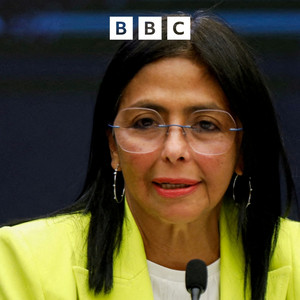
Venezuela's new leader, Delce Rodriguez, has called for respectful relations with Washington after Donald Trump threatened her with unspecified action if she didn't cooperate.
Her predecessor, Nicolás Maduro, is due to appear in court later today.
We'll get the latest developments and analysis from our correspondents on the ground.
Also in this podcast, all victims of Switzerland's New Year's Day fire are identified.
A Nigeria's president steps up security and his defence budget amid rising violence.
And the new Avatar film has box office power.
But I just want it to stop forever.
How is it possible to have come this far? and for the storytelling to still be this bad.
What's made it a sleeper hit?
The US continues to push on with one of the most controversial interventions in Latin America in decades, warning the new interim leader of Venezuela do as we say, or face the consequences.
President Trump said if Delcy Rodriguez doesn't do what's right, she's going to pay a very big price, probably bigger than Maduro.
He's referring, of course, to the dramatic nighttime capture of Nicolas Maduro and his wife, seized by US special forces in the capital Caracas and transferred to New York ahead of a court appearance on Monday on narco-terrorism and drug trafficking charges.
We'll have more on what's happening in Venezuela in a moment.
But first, Tom Bateman has this report from Washington.
Good night.
Happy New Year.
Happy New Year, said Nicolás Maduro as he was led in handcuffs by US drug enforcement agents.
He's now being held in a notorious New York jail facing charges of running a violent cocaine trafficking empire, a claim he has always rejected as a front for regime change.
The Trump administration is attempting to coerce his political allies that remain in power.
It says to end drug smuggling and let in American oil companies.
The Secretary of State, Marco Rubio, long a hawk on Venezuela, says military pressure will be maintained.
There's a quarantine right now in which sanctioned oil shipments.
There's a boat and that boat is under US sanctions.
We go get a court order, we will seize it.
That remains in place.
And that's a tremendous amount of leverage that will continue to be in place.
The raid on Maduro's compound amounts to the US's most controversial intervention in Latin America in four decades.
Mr Trump claims the country's vice president, Delcy Rodriguez, has agreed to comply with what he wants, but in public at least, she is contradicting that, saying Venezuela will not be enslaved.
If there's something that the Venezuelan people and this country have very clear, is that we will never again be slaves, is that we will never again be a colony of any empire, of whatever kind.
Mr Trump says the US, with its vast naval build-up in the Caribbean, is prepared to strike again.
But his Democrat opponents are railing against the action, calling it illegal.
The party leader in the Senate, Chuck Schumer, is pushing for a voting Congress to stop further strikes.
When America tries to do regime change and nation building in this way, The American people pay the price in both blood and in dollars.
President Trump says the US will get its way and secure a stable Venezuela.
America's history of managing its own interventions may suggest otherwise.
Tom Bateman reporting from Capitol Hill.
There's also been strong reaction in the US further away from the corridors of Washington, as our correspondent Peter Bowes told me.
Just like the politicians, the American public is divided.
Before the events of the last few days, opinion polls was one YouGov poll in November that suggested a strong majority of Americans opposed military action inside Venezuela and the use of the military to overthrow Nicolás Maduro.
And over the last 24 hours or so, we have seen some protests against the operation on Saturday.
The main concerns focusing on the legality of what happened, the fact that there was no congressional consultation or approval,
That said, we've also seen celebratory gatherings in Venezuelan-American communities, people expressing their support and, in many cases, relief that Mr Maduro has been removed from power.
Mr Maduro was widely considered head of an authoritarian government characterised by human rights abuses and corruption.
But a question many people are asking, was his capture and extraction legal?
Well, that is the central question.
I suspect we'll hear a lot more about that when the UN Security Council meets in emergency session later on Monday.
Many believe that what happened was a blatant violation of the UN Charter.
Under international law, the use of military force inside the territory of another sovereign state is prohibited unless it is in self-defense or has been authorized by the Security Council.
Now the UN Secretary General, Antonio Guterres, has described the operation as setting a dangerous precedent, but it's also, I think, significant that some of the US's allies are holding back from explicitly criticising the American operation.
The Trump administration says it was aimed at arresting an indicted criminal.
Nicolas Maduro, and not overthrowing a state.
In other words, Washington sees this as an extension of domestic law enforcement.
And comments coming out from President Trump saying that we're in charge in Venezuela, in his words.
A lot of people wondering then, what will the US do next?
What will President Trump do next?
I know it's a question which is very hard for many people to answer.
Exactly.
That remains to be seen, I think.
It is far from clear what's going to happen.
President Trump, as we heard repeatedly reported over the last couple of days.
He initially said that the US would run Venezuela, although that statement has been toned down by his senior colleagues, Secretary of State Marco Rubio and other Republican officials, saying that the US was not going to govern Venezuela day to day or formally take over the government, but rather is using its military leverage to pressure the country's leaders, to put pressure on them, and the new president in particular that you just reported, Delcy Rodriguez, to follow Washington's agenda.
Peter Bowes reporting there.
Well, let's cross over to Venezuela, where the military has told people to resume normal activities after this weekend's dramatic events.
The authorities say there are a number of people that were killed during the US operations to seize Nicolás Maduro.
The streets of the capital are now calm, but there is fear over what happens next, as these people told the BBC.
I was crying.
To be honest, I'm very scared.
I feel a lot of fear everywhere inside.
I'm afraid for my life.
I'm afraid of what might happen.
We've been buying food, just piling up just in case because you never know anything could happen.
It's uncertainty.
Delcy Rodriguez has held her first cabinet meeting and called for respectful relations with the US, inviting Donald Trump to cooperate with Venezuela's development.
Our correspondent, Will Grant, has reported extensively on Venezuela and is currently on the country's border with Colombia.
I asked him about the fate of the Venezuelan regime.
It is a difficult one to say, as you were mentioning to Peter too.
As much as we struggle to get to the exact motivations inside the Oval Office, it is hard to know what's being said behind closed doors and behind some very, very murky sort of smoky curtains, between what's left, in a sense, of the of the Maduro government without President Maduro.
On the one hand, of course, we've heard defiance from Delcy Rodriguez, but yet we've heard from Washington that she's speaking to Secretary of State Marco Rubio.
We have also seen two very influential and important characters In Venezuelan politics.
The defense minister, Vladimir Padrino, and the interior minister, Diosdado Cabello, essentially vow to fight on to the death if need be.
It's an important concept in socialist refrains in this part of the world patria o muerte fatherland or death and in a sense, that is the line that those two members of the Venezuelan government are putting out, as you would expect them to, based on everything they have sort of represented in the Venezuelan government to this point.
Whether or not that reveals a key split in the Venezuelan government is hard to know.
Does that mean that there will be those who continue to want to, as it were, take on Washington, who will go down fighting and who may meet a similar end as Nicolas Maduro?
Ie end up in a in a court in New York, while other parts of the regime or other parts of the government choose to talk to the White House, choose to talk to Washington, try to find some role for themselves in an interim government and avoid criminal charges.
More questions than answers.
But, as you are hearing those voices from Caracas, people have more questions than answers at this stage.
It is a deeply uncertain time for people.
With Mr Maduro's allies still in charge as you touched upon allies of the country's powerful army then how would any possible transition of power work, especially with those quotes from Donald Trump saying the US will now run Venezuela?
Yeah, and as we were hearing, those comments have been walked back a little.
But I think in essence he does see that as a sort of vision for what comes next, that Washington would have the final say.
And this display of pretty awesome power, military power, is a very, very clear message to those ends.
Exactly how the military will fit in with all of this.
They said that they recognized Delcy Rodriguez as the interim president.
But it was quite pointed that they said as temporary leader.
So she can be sworn in.
She's due to be sworn in in front of the National Congress.
All of that is going ahead.
And I think it gives the impression at least of not, while it's quite clearly not business as normal in Venezuela.
At least it gives the impression of the apparatus of the state continuing.
That Venezuela's government remains a cohesive, at least for now, entity.
Just very briefly, Will, before you go.
Venezuela has the largest oil reserves in the world, 17 trillion worth, a resource that the US needs.
And you can't not factor that in.
That is the key takeaway from whatever goes on when it comes to Venezuela.
It is fundamental, vital constant to factor in the element of oil when it comes to discussing Venezuela, when it comes to understanding the political considerations that are taken not just in Washington but also in Caracas, that it is sitting on the largest proven oil reserves in the world.
Donald Trump sees that as an opportunity for US oil companies to be involved.
Of course the Venezuelan government say that is exactly the pretext by which Mr Maduro is removed from office.
Will Grant reporting.
Well, as I mentioned earlier, Nicolás Maduro is due to appear in court in Manhattan on Monday.
And the UN Security Council is also scheduled to meet to discuss his capture.
A New York correspondent, Neda Tawfiq, has the details.
Nicolas Maduro and his wife are being held here in this federal detention center in Brooklyn, which is infamous for its poor conditions and has even been called hell on earth.
Now Monday, at noon, they will be transported to Manhattan under heavy security for their first court appearance.
It will be a brief one.
And just like other federal cases, no cameras will be allowed inside the courtroom.
Mr Maduro will be brought in front of a federal judge to formally hear the charges against him and be informed of his rights.
The indictment charges him, his wife, son and three others with narcoterrorism and weapons offenses, accusing him and his associates of flooding the United States with thousands of tons of cocaine to enrich themselves and to hold on to power.
Now Mr Maduro has long rejected the allegations and has accused President Trump of illegal warmongering.
He will have the opportunity to enter a plea.
And, as that's happening, several blocks away north of the United Nations, an emergency Security Council meeting on Venezuela will be underway.
Colombia, along with Russia and China, allies of Mr Maduro's, called for that meeting, and they have slammed the US military operation as illegal.
And even the U.S.'
's allies, who have underscored now the need for a peaceful transition of power in Venezuela.
Well, even they are concerned about the dangerous precedent this sets, while still being reluctant to criticize the Trump administration.
But for all the strong words that will be exchanged in the council, of course no action will happen there, because the United States holds a veto power.
The UN has already said that Donald Trump's intervention in Venezuela set, in its words, a dangerous precedent.
For territories that the US has recently expressed an interest in, that danger seemed ever more present.
And now one of them, Greenland, has bitten back.
Our reporter Stephanie Prentice has been following developments.
So, if we cast our mind backs to almost a year ago now, Donald Trump was fresh into his second term and he was quick to reiterate sentiments from his first about the US taking control of Greenland.
That was quickly and firmly rejected by Greenland and Denmark, which Greenland is part of.
Directly after, though, we saw Donald Trump Jr. making a visit that sparked a lot of protests there.
His father seemed to really warm to this idea over the weeks and months after that, saying the US needed Greenland for national security reasons.
In fact, let's take a quick listen to him.
And this was in March 2025.
We need Greenland for national security and even international security, and we're working with everybody involved to try and get it.
But we need it really for international world security, and I think we're going to get it.
One way or the other, we're going to get it.
That, one way or the other, sentiment that really caused alarm at the time.
That was rekindled recently when the US suddenly appointed a special envoy to Greenland.
When the news of Nicolas Maduro's capture broke, Donald Trump said in an interview that he absolutely needs Greenland for defense.
Then the wife of a senior Trump aide posted a map of Greenland.
Now, it was covered in a U.S. flag and had the word soon posted above it.
In the past couple of hours, Donald Trump has again doubled down.
He's been telling press on Air Force One.
He needs the territory from the standpoint of national security and said that Denmark can't provide that sort of security.
And so what sort of a response have we heard to those comments?
Well, again, Denmark has strongly rejected the idea.
Danish Prime Minister, Meta Fredriksson, published a post saying it made no sense and reminding President Trump of Denmark's NATO membership, adding I strongly urge the United States stop the threats against a close ally and against other people who've clearly said they're not for sale.
Greenland's Prime Minister, that's Yen's Frederick Nielsen, also posted saying we have been a close and loyal friend of the United States for generations.
We've stood shoulder to shoulder in difficult times, as real friends do.
This is precisely why repeated rhetoric from the United States is completely and utterly unacceptable.
Stephanie Prentice reporting.
We'll look now at some other news stories from around the world, including how the Iranian government is trying to quell protests by opening its wallet.
Police in Switzerland say they have now identified all 40 victims of the New Year's Day fire in a bar in the ski resort of Kranz Montana.
They've given no further details of those who died.
Earlier, a memorial service took place close to the scene of the fire.
Hundreds of people walked in silence through the town to a nearby chapel.
Our correspondent Sarah Rainsford was there.
Hold on to the power of your spirit.
So many came to this memorial mass.
Hundreds had to follow the service out in the street.
In the shadow of the Alps, they stood hugging and crying.
Several fainted and fell, overwhelmed.
Most of those killed when fire tore through a bar here on New Year's Eve were young.
One girl was just 14.
From the church, the crowd processed in silence towards a growing heap of flowers and soft toys.
We saw Leticia there.
We first met her when she was holding on to the hope her son was missing but still alive somewhere.
Now she tells me she knows Arthur died that night.
He's gone to party in paradise, she says.
The quiet was broken for a moment today by this for the rescuers who ran into the fire and now cry for all those they couldn't save.
Their commander says he's sorry, thinking of the dead and their families.
There is a criminal investigation into how this tragedy happened and whether it might have been avoided.
But for now, people here talk far more of their pain and their sadness than of their anger.
Sarah Rainsford reporting.
The president of Nigeria, Bola Tinubu, has wasted no time at all in making good on his promise to make security his priority.
He's markedly increased his defence budget for 2026.
And just days into the new year, he's ordered his security forces to track down and bring to justice anyone behind a deadly attack on a village market in Niger state.
At least 30 people were killed.
Global affairs reporter, Richard Kagoi has been following events in a nation increasingly beset by violence and kidnappings.
Police in Niger state say gunmen emerged from a nearby forest and stormed Kaswandaji village, touching market stalls, looting shops for food, then turning their guns on residents.
30 people are confirmed dead and a known number were dragged away.
Kasuandaji is less than 20 kilometers from Papiri where, just months ago, more than 200 students and staff were abducted from their school in one of Nigeria's worst mass kidnappings in years.
We remember Papiri because it echoed Chibok, the abduction of hundreds of schoolgirls in northeast Nigeria about a decade ago.
That caught the world's attention.
Those papyri victims were released after weeks in captivity.
So, across central and northern Nigeria, armed gangs, locally known as bandits, continue to raid schools, churches and rural communities, kidnapping civilians for ransom.
Now you need to know that paying ransom is illegal in Nigeria.
Yet families abandoned to their fate often have no choice but to pay anyway.
Now, this is Africa's most populous country, one of its biggest economies, yet its security forces are overstretched, battling jihadist insurgents in the northeast, farmer-harder violence in the Middle Belt, separatist unrest in the southeast and now relentless mass kidnappings everywhere in between,
Just on Christmas Eve, a suspected suicide bomber killed worshippers at a mosque in the northeast.
On Christmas Day, the United States, which has accused Nigeria of not doing too much or enough to rein in on the violence, launched airstrikes on Islamic State-linked militants in northern Nigeria.
Richard Kagoi.
Iran's government has announced that it will begin paying a new monthly allowance to every citizen as it seeks to quell violent anti-government protests sparked by the country's worsening economic conditions.
Government spokeswoman told state television.
The new scheme would see a monthly amount of around US7 paid to all Iranians for the next four months to help with the cost of living.
Tom Bailey has the details.
With at least 12 people dead in the wave of unrest that has swept Iran, some kind of response was needed from the authorities.
Whether the latest gesture will draw the sting of the deadly protests remains to be seen.
The government spokeswoman, Fatemeh Mohajarani, said the allowance would take the form of credit that can be used to purchase certain goods, with the intention being, she said, to reduce the economic pressure on people.
Meanwhile, the unrest continued for an eighth day on Sunday, including in the capital Tehran, where security forces used tear gas to disperse protesters who took to the streets of the city centre.
Further demonstrations and unrest were reported in other parts of the country late into Sunday night.
And it wasn't just in Iran itself, with members of Iran's overseas diaspora taking to the streets in a show of solidarity with London and Paris, among global cities, to see demonstrations.
We are here to express how badly the Iranian people are suffering.
They need freedom and we are fighting for them, said this woman at a rally in the French capital.
Iran's economy has long grappled with rising prices and the plummeting value of the currency, in part caused by international sanctions imposed over Tehran's nuclear programme.
The ensuing hardship has helped spark what have become the country's biggest protests in over three years.
Tom Bailey reporting.
And finally... If there is something you can do, then you must.
Some stirring words there from the new Avatar movie called Fire and Ash, which has just topped a billion dollars at the global box office.
The films, of which there are three so far, tell the story of alien battles on the planet Pandora.
I asked a reporter, Will Chalk, how rare a billion dollar movie actually is.
In terms of movies in general, Anka, quite rare.
So there's only around 60 films that have ever topped a billion dollars.
But obviously inflation makes it more common as time goes on.
Even so, though, if you think about it, so many films are released every year.
It kind of puts this in some perspective.
But actually, if you just look at Avatar's director, James Cameron, this is basically, and every film occurrence for him.
If you look at the top four highest-grossing movies of all time, he's directed three of them.
The first Avatar, the second Avatar, and way back in 1997, Titanic.
Looking further around the world, the highest-grossing movie in the whole world last year was the Chinese animated sequel Nujia 2.
That generated more than $2 billion by itself.
Now, the new Avatar movie, that was only released just before Christmas, 19th of December, I think.
So it will still be in cinemas for some time, but it has already helped take the trilogy's total to more than 6 billion.
So what is it about the Avatar movies that people love and that have made them so popular the world over?
Well, they're huge spectacles.
They're the types of film I think that people want to see on a big screen.
This new one actually is designed to be viewed in 3D, and you really don't see that very often anymore.
But they're not universally popular, particularly with some critics.
For a flavour, here is what film podcast Kermode and Mayo's take made of the new Avatar.
I just want it to stop forever.
I just want to.
How is it possible to have come this far and for the storytelling to still be this bad?
I can't quite tell if he's a fan or not.
No, it's quite subtle.
I'll explain it to you.
He didn't like the film.
But looking at the type of films that tend to make this billion dollar or top this billion dollar market can actually tell us a lot about the industry.
As we've just heard, they're not always critically popular.
Often they'll involve some kind of recognisable intellectual property.
So Marvel movies say or Jurassic Park sequels do well.
And they're usually relatively family friendly, too.
Now, the challenges cinemas are facing around the world are well documented, you know, streaming services.
I think what we're seeing is that people are going to the cinema for big events rather than a weekly habit, say.
And I think even the critics who hated Avatar would probably call it a necessary evil if it helps keep cinemas afloat.
Will Chalk reporting.
And that's all from us for now, but there will be a new edition of the Global News Podcast later.
If you want to comment on this episode or the topics covered in it, you can send us an email.
The address is globalpodcast at bbc.co.uk.
And you can also find us on X at BBC World Service.
Use the hashtag Global News Pod.
This edition was mixed by Nicola Brough and the editor is Karen Martin.
I'm Ankur Desai.
Until next time, goodbye.