This is the Global News Podcast from the BBC World Service.
I'm Janet Jalil, and at 16 Hours GMT on Wednesday, the 7th of January, these are our main stories.
The United States says it seized a Russian tanker sailing in the North Atlantic and another one in the Caribbean, both linked to Venezuelan oil.
China denounces the US after President Trump says Venezuela will turn over tens of millions of barrels of oil to his control.
The UN human rights chief says Israel is subjecting Palestinians in the West Bank to severe and intensifying racial discrimination and segregation, likening it to apartheid.
Also in this podcast, In all those boxes in this room, like the crates in the Indiana Jones film.
We think the answer might lie because we can treat the room like a time machine.
Could decades-old bowel cancer samples help to solve the mystery of why the disease is on the rise in young people?
The United States says it seized two oil tankers with connections to Venezuela.
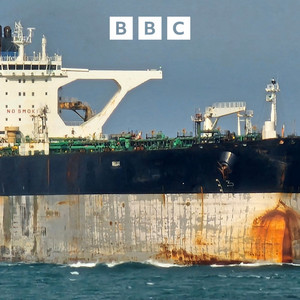
One that the US had been pursuing for weeks since intercepting it off the Venezuelan coast, was boarded in the North Atlantic between Iceland and Britain.
During the chase, the ship, which is reported to be empty of cargo, changed its name and adopted a Russian flag.
Before the tanker was seized, Russian naval support, including a submarine, had been on its way to escort it.
The second vessel, which was carrying oil and sailing under a Cameroonian flag, was seized in the Caribbean.
It's now being escorted to a US port.
A former Russian deputy foreign minister, Andrei Fedorov, told the BBC Moscow would take the US action very seriously.
For Russia.
It's a very important thing because if there will be attack from US, it will be considered as attack on Russia.
And it could lead to very critical or maybe even crisis situation in relations between Russia and US.
The BBC's diplomatic correspondent, Paul Adams, is following developments from Washington DC and gave this update on the seizures.
The first of the two tankers was the Marinara, the vessel previously known as the Bella One.
Now.
This has been the subject of interest to the American authorities since an initial attempt to intercept it near the Caribbean or in the Caribbean last month.
It managed to avoid being captured at that point, headed back out into the North Atlantic, where it has finally been apprehended, about 200 kilometers off the south coast of Iceland.
Despite, it seems, the presence nearby of a Russian submarine which was sent apparently in an effort to escort the this tanker.
This tanker which had only in the last what 10 days or so, re-flagged itself, taken a Russian flag and changed its name.
So that's the Marinara.
The second of the two tankers was the Sofia, seized somewhere. much closer to Venezuela.
I think this brings to fore the number of vessels that the Americans have seized since early December, vessels which they say are part of a shadow fleet involved in the transportation of Venezuelan oil in defiance of American not international, but American sanctions.
You know, despite the capture of President Maduro and taking him to New York the other day, this effort to interdict and control Venezuela's oil exports continues, with President Trump, of course, saying overnight that he would be making sure that the proceeds from Venezuelan oil would go to benefit the American and Venezuelan people and would be controlled by him.
Why are the Americans so determined to stop this tanker, though, Paul?
It is an interesting question, Matthew.
I mean, is this just a rusting, empty part of the shadow fleet that has been involved in the transportation of Venezuelan oil, or is there something else?
Now, interestingly...
The Bella One, as it was then known, was initially sanctioned by the U.S.
Treasury Department during the Biden administration for the alleged links of its owner to the Iranian Revolutionary Guard.
And so it was regarded as having that connection in addition to any Venezuelan connection.
So whether or not there is an Iranian angle to this remains to be seen.
But it is interesting that the Americans have devoted considerable resources to tracking and intercepting it.
And it seems the Russians were prepared to devote resources to trying to protect it, even if those efforts came to nothing in the end.
So that is a lot of interest and a lot of resources being devoted to a single member of the shadow fleet.
Paul Adams speaking to Matthew Amraliwala.
Well, only hours before he was seized by the US military, the Venezuelan president, Nicolas Maduro, had praised his Chinese counterpart, Xi Jinping, as an older brother.
China has invested heavily in Venezuela and is the leading buyer of Venezuelan crude.
So it's no surprise that the US nighttime raid over the weekend has been denounced by China as a blatant breach of international law, even as some within the country are calling for a similar operation in Taiwan, long regarded by China as a breakaway province.
Beijing also condemned President Trump after he said the interim government in Venezuela would, in his words, turn over tens of millions of barrels of oil to him.
Mr Trump says the oil will be sold to benefit both Americans and Venezuelans, but he will control the money raised.
Mao Ning is a spokeswoman for the Chinese Foreign Ministry.
The United States has brazenly resorted to the use of force against Venezuela and demanded that America first be applied when Venezuela disposes of its own oil resources.
This is a typical act of bullying, a serious violation of international law and a grave infringement on Venezuela's sovereignty.
So strong words from Beijing.
Our China correspondent is Stephen McDonnell.
Yeah, absolutely.
And you might expect that, of course.
I mean, there's China, the number one buyer of Venezuelan oil.
And then there are these reports that the Trump administration has been leaning on the interim leader in Venezuela to basically stop oil sales to China in favour of the US.
What's more, she was asked today the spokesperson Mao Ning from the foreign ministry that we just heard from.
She was asked about the more general push from the Trump administration for Venezuela to cut off all economic relations with Russia, Iran and Cuba, as well as China.
So Yeah to China.
This is, of course, a violation of international law, and the Chinese government would say the Venezuelan government can sell its goods to whoever it wants to.
I mean, who is Donald Trump to come along and start demanding this and demanding that?
How big a blow is this to China?
How easy will it be for China to replace the oil it's no longer getting from Venezuela?
And how much loss of influence is it seeing in Latin America?
I mean, I think for China it's not so much the short-term hit of this oil as much as a sort of more longer-term consideration.
So they'd be thinking well, all these years we've been trying to build up links with these Latin American countries.
Along comes Donald Trump now, and he's sort of threatening not only Venezuela but other countries as well, saying that this is our sphere of influence, we'll do what we like basically, around here.
Now for china, the two ways they've been looking at it is one they're thinking well, that's potentially problematic for us in terms of our dealings with latin america.
It also though, does present itself with a bit of an opportunity because, of course, beijing can then say well, what about asia?
This is our sphere of influence.
You can stick your nose out of dealings with Taiwan, the South China Sea Japan, what have you?
Because we'll do whatever we want to do here.
And Russia might say the same thing in terms of its invasion of Ukraine.
So in some ways, these words from Donald Trump, and actions for that matter, have been a bit of a blessing for these other countries.
Stephen McDonnell.
Buoyed by the success of the US military operation in Venezuela, President Trump is now contemplating something that would have been unthinkable just a few years ago taking over Greenland, a semi-autonomous area of Denmark.
This could include the US using its military, potentially against a fellow NATO member.
This despite European leaders hours earlier issuing a joint statement rallying behind Denmark.
But Mr. Trump maintains that the vast Arctic island is vital for U.S. security.
Denmark's foreign minister, Lars Laker Rasmussen, said that, while the security of the Arctic region was important, the US concerns were exaggerated.
The image that's being drawn that there are Russian and Chinese ships right inside Nuukfjord and massive Chinese investments.
It is not a totally correct picture, to express it very, very diplomatically.
And therefore we think it makes sense to try and have a meeting with our American counterparts in order to solve some of the misunderstandings that might be there.
Our correspondent in Washington, David Willis, told us more about what the White House is discussing.
The White House says that Mr Trump and his advisers are considering what it calls a range of options in that regard, including the possible use of military force.
But Wall Street Journal newspaper here says that the Secretary of State, Marco Rubio, informed lawmakers on Capitol Hill that the Trump administration would much rather buy Greenland than invade it.
Donald Trump sees Greenland as a potential staging post for seeing off adversaries such as Russia and also as a potential source of natural resources, rare earth minerals, which are thought to lie beneath the Arctic ice caps of Greenland, minerals that which are necessary for high-tech development and production of items such as batteries, cell phones and so on.
David Willis.
So what can the Europeans do in response to Mr Trump's threatened takeover of Greenland?
Our Europe editor is Katja Adler.
At the beginning.
So if we look back to the first time in office, a lot of European leaders, behind closed doors, laughed at the idea.
They really did.
But after Donald Trump's controversial action in Venezuela at the weekend, nobody is laughing anymore.
The prime minister of Denmark says that Donald Trump's threats to take Greenland unilaterally have to be taken seriously.
She says, if the US does go ahead with that, which Donald Trump says he's absolutely determined to do that, she said, would spell the end of the defence alliance NATO.
Now, we know that Donald Trump is not a huge fan of the defence alliance.
He's spoken many times about his dislike of Europe's reliance on the United States for defence and security, and he's got promises from European leaders to spend more on their own defence alliance.
But for the Europeans, they do rely on NATO.
They've relied on NATO and its bigger member, the United States, for their security since the end of the Second World War.
So, whereas an end to that alliance may not upset the US president, it would pose a big problem for the Europeans.
The thing is, what can they do?
Well, we had a joint communique issued on Tuesday by six major European powers.
The only ones who could decide the future of Greenland would be Greenland itself and Denmark.
But Donald Trump isn't listening.
Denmark and Greenland have tried repeatedly to get a meeting with Marco Rubio, the US Secretary of State, throughout last year.
They've tried again.
But Donald Trump seems absolutely intent.
And the thing is, If we have a look at how European leaders have dealt with Donald Trump since his re-election into office, they tend to try to manage him rather than confront him.
They don't want to risk his ire.
And right now, they really, really need his buy-in over Ukraine because we had a very big meeting.
I was there in Paris on Tuesday talking about future security guarantees for Ukraine to ensure its sovereignty after aggression with Russia ends.
And also Europeans are divided.
That statement backing Denmark was only signed by six European leaders.
So clearly divisions there.
Yeah, it was signed by six leaders.
I mean, they are major European powers and were supported by several more countries who sort of expressed their support for that communique online.
However, absolutely.
This communique was issued on the sidelines of that Ukraine meeting at which there were so many European leaders present.
But as you say, only six signed that communique.
And that goes back to what I was saying about how different European countries are dealing with Donald Trump.
Often, if you look particularly at the UK or Italy, safeguarding what they believe are special bilateral relations with Donald Trump.
And despite promising to invest in their own defences, they do still heavily rely on Washington for air capabilities, for example, command and control for intelligence.
And Washington knows this full well.
Our Europe editor Katja Adler.
And for more on this story.
You can go onto YouTube search for BBC News.
Click on the logo, then choose Podcasts and Global News Podcast.
There's a new story available every weekday.
Cancer is mostly seen as a disease of old age, but in recent years that picture has been changing.
Take bowel cancer, for example.
Data shows it's increasing among people under the age of 50, yet scientists are unclear as to why this is.
Holly was diagnosed with stage 3 bowel cancer when she was 23.
It is really unfair and there are some days where I'm screaming and crying because it all feels really unfair and I think oh, why me?
And then other days you just get on with it.
Well, now researchers are hoping that tens of thousands of preserved bowel cancer samples, some of which date back to the 1960s, could help to unlock the mystery of why the disease is rising in the young around the world.
One of the scientists taking part is Professor Trevor Graham from the Institute of Cancer Research.
He spoke to my colleague Justin Webb.
The number of cases of bowel cancer in young people that's defined by people under the age of 50 has more than doubled in the last few decades, and we don't know the reasons why.
It is a worldwide thing, so it's seen in countries around the world, but the rate of increase differs between countries.
So in the UK, the rate's roughly doubled in the last couple of decades, whereas in the US, the rate of bowel cancer in young people is even higher than it is.
We want to find out why, of course, and there are lots of possible reasons that could be causing this increase, but whatever the reason is, something's changed over the past few decades.
With my fantastic colleague, Professor Kevin Monaghan at St Mark's Hospital in London.
That's the UK specialist bowel hospital.
We're going to try and find out why.
St.
Mark's is a long running hospital and it has discovered many of the important things about how bowel cancers grow.
And because of this proud history, they've been collecting samples for many, many years of bowel cancer specimens for more than a decade, we think.
And they're stored in the basement of the hospital.
And this wonderful room which we think of as a treasure trove for research really it's.
This room stacked floor to ceiling with boxes, reminds me a little bit of the end of the film Indiana Jones and the Last Crusade.
You know the warehouse.
All those crates stored in there and somewhere in all those boxes in this room, like the crates in the Indiana Jones films.
We think the answer might lie because we can treat the room like a time machine.
It documents what's happened over the past decades from the storing of these samples in this room.
I see.
So you're looking at what the markers are then that seem to be increasing, because it's not clear to me exactly how previous cases of bowel cancer lead to you then working out what's going on now.
Yes, exactly.
So whatever is causing this increase in bowel cancer in young people, that thing itself must have increased over the past decades.
And so what we need is a time machine.
You know, this is how we think of it to be able to go back into those past decades and ask well, what was rare in the past but is common now?
And so that's what we can do.
We can take samples from this fantastic archive and Professor Trevor Graham.
Still to come in this podcast...
Archaeologists uncover a rare find a near-complete Iron Age war trumpet that may be linked to an ancient British tribe led by the warrior queen Boudicca.
Since Israel's war in Gaza began in October 2023, concerns have grown over the treatment of Palestinians in the occupied West Bank.
But never before has a United Nations rights chief described the conditions there as an apartheid system.
Now a new UN report points to the asphyxiating impact of Israel's laws, policies and practices on the daily lives of Palestinians living in the occupied territory, saying decades-long discrimination and segregation is intensifying.
Shaima Khalil reports from Jerusalem.
This is the first time a UN rights chief has used the term apartheid to describe the treatment of Palestinians in the occupied West Bank.
Volker Turk said there was a systematic asphyxiation of the rights of Palestinians, whether in accessing water education, going to hospital, visiting family or harvesting olives.
He added that every aspect of life for Palestinians in the occupied West Bank was controlled and curtailed by what he described as Israel's discriminatory laws, policies and practices.
This latest UN report said Israel treats settlers and Palestinians under two distinct bodies of laws and policies.
It added that, since the Gaza war began following the Hamas-led attack on 7 October 2023, The Israeli authorities had further expanded the use of unlawful force, arbitrary detention and torture.
Mr Turk called on Israel to repeal all laws, policies and practices that perpetuate systemic discrimination against Palestinians.
The report also says that Palestinians continue to be subjected to large-scale confiscation of land.
The UN said settlement expansion in the occupied West Bank had reached its highest level since 2017.
The most recent decision by Israel to approve the recognition of 19 new settlements has brought the total number of settlement approvals over the past three years to 69.
Shaima Khalil.
While many Christians celebrate Christmas on December 25th, millions of people around the world observe it on January 7th.
Coptic and Orthodox Christian communities in Africa, Europe and the Middle East mark the birth of Jesus Christ nearly two weeks after most of the Western world.
It's traditionally a time when families gather to share a feast and celebrate the end of the fast.
For some, however, the holiday is far from joyful.
We've been hearing from Alganesh Gibrigziabir, an Ethiopian from Tigray who fled from one war to another in Sudan.
When war broke out in November 2020, I fled my hometown of Humera to Sudan.
After staying in Hamdite refugee camp for about three months, I moved to another camp, Tenerba.
We're surviving as best we can, but life is extremely hard.
The situation is very harsh.
Refugee life has been reduced to almost nothing.
Because it is the birthday of our Lord and Savior, Jesus Christ.
We give thanks simply for bringing us this far.
Some of us are still alive, even though we are facing very difficult conditions, and we're grateful to have reached this holiday.
When I was home, I used to celebrate the holiday festivity with everyone.
We would slaughter a chicken, a goat or a sheep and share a meal filled with love and abundance.
Now we no longer have meat.
Surviving on split chickpeas and millet makes the suffering very bitter.
The war in Sudan has affected us deeply.
We fled the war in our own country, leaving behind fertile land. and came here.
But now war has broken out in the country that gave us refuge.
We worry, asking ourselves, where can we go now?
When the one country we thought we had has also fallen into war, what can I say?
It is a very painful feeling.
My wish is for peace to prevail in my country, so that I can return home, live peacefully with my people, my brothers, my neighbors, and celebrate the holiday.
In peace.
Ethiopian refugee Agnes Gibrisiabe talking about her hopes of returning home.
As protests continue across Iran.
A human rights group says at least 36 people have been killed during the past 10 days of demonstrations.
The human rights activist news agency says two of them were affiliated with the security forces.
The unrest was sparked by an economic crisis and has now spread to most of Iran's provinces.
Meanwhile officials say a man accused of spying for Israel has been executed.
Kazra Najee of the BBC Persian service told me more about him.
According to Iranian officials, his name is Ali Ardestani.
The Iranian authorities are saying that he was a key Mossad agent and that he was passing on sensitive information to Israelis and photographing particular places and and gathering information about sensitive subjects in return for a million dollar reward, according to the Iranian authorities in cryptocurrency, and also rewarded with a British visa.
We don't know anything more than that.
They haven't, by the way, connected this to the present order. unrest in Iran.
They haven't.
They haven't.
But nonetheless, the message is clear.
And this man is probably the 12th or 13th person who's been executed vis-a-vis Mossad and Israel on alleged spying for Israel in the past six months.
So tell us more about these protests, which have been going on for 10 days and which seem, if anything, to be intensifying and are a big challenge to the Iranian rulers' grip on power.
That's true.
We are definitely getting the picture of the spate of unrest expanding rather than dying down.
Today.
So far we've got reports of unrest from several cities, from the very top of Iran to the bottom of Iran, from the west to the middle of Iran.
And some of them are violent.
Violence by who?
Between the demonstrators and the security forces.
An interesting thing in this expansion of this unrest in Iran is reaching smaller villages.
And this is what we witnessed during the 1979 revolution, that it had got to the level of villages.
And today we're getting signs of that.
So, yeah, it is a deepening.
Kaz Ranaji.
It's a rare discovery that has excited archaeologists here in England.
They've unearthed an Iron Age battle trumpet in the eastern county of Norfolk.
It's the most complete battle trumpet or carnix ever found in Europe.
It's believed that it was used by Celtic tribes across the continent, including the Ikenai tribe, which was led by Queen Boudica in her failed uprising in Britain against the Romans nearly 2000 years ago.
David Slitter reports.
The sound of a carnix, or rather a reconstruction of this animal-headed battle.
Trumpet used its thought either in rituals or to terrify enemies.
Remains of two others have been found in the UK over the years, but this metre and a half metal war horn with long flappy ears is the most complete.
Discovered at an undisclosed location in Norfolk.
The hoard includes two trumpets and, even rarer, a boar's head, battle standard buried in the homeland of the Ikenai tribe.
And while it's difficult to date accurately, it's thought to be from the first century AD, the time of the Ikenai revolt against the Romans led by their warrior, queen Boudica.
Sounds beautiful.
That report was by David Slito.
And that's all from us for now, but there will be a new edition of the Global News Podcast later.
If you want to comment on this podcast, you can send us an email.
The address is globalpodcast at bbc.co.uk.
This edition was mixed by Ben Andrews.
The producers were Muzaffar Shakir and Ariane Kochi.
The editor is Karen Martin.
I'm Janet Jalil.
Until next time, goodbye.