NPR.
This is The Indicator from Planet Money.
I'm Waylon Wong.
And I'm Stephen Basaha.
And this is one of my favorite sounds.
Chugga, chugga, chugga, chugga, choo, choo.
That sounds specifically Waylon.
That sounds...
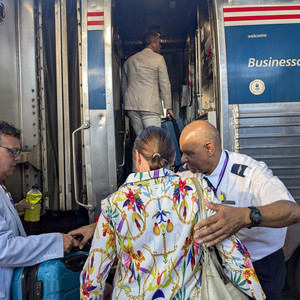
A specific train sound is the new Amtrak line between New Orleans and Mobile, Alabama.
I got to be on that first train ride this summer and looking out the window at the sparkling Gulf water, the marshlands, I couldn't stop thinking about this nagging question so many Americans have.
Why can't we have more trains like this?
In other words, why can't the U.S. be like Europe?
And it's not just Europe, but also countries like Japan and India.
They all have extensive passenger train systems to get from city to city.
On today's show, why the U.S. chose not to have the same.
And we learn why U.S. railroads could still be worth bragging about.
Fisher Investments is a fiduciary and I think one of the very important roles we have here as a fiduciary is to help expand people's thinking about what this money is needed to do for them.
Even a trendy thing that everyone knows isn't a great idea, but management just wants us to give it a try for a bit can change the world of work.
So, whether it's a last-minute policy change or adding a new company holiday, ADP designs forward-thinking solutions to help businesses take on the next anything.
ADP.
Always designing for people.
Our conductor into the world of railroads today is Alan Zaremsky.
He teaches classes on railroad engineering at the University of Delaware.
It sounds like you're going to be asking me the classical questions of how come the US railroad system is not as good as Europe, which is
Sort of the classical misunderstanding of what's going on.
Misunderstanding?
Oh, I look forward to being corrected.
I get that question at the start of every one of my classes.
OK.
So imagine I'm that young undergrad sticking his hand up, being like why can't we have these nice passenger trains like Europe?
Let's start off with the fact that the United States has the best freight railroad in the world in the world.
Best freight railroad in the world.
That's great news if you're a cargo container full of presents for good little boys and girls.
Or coal for all the bad ones.
Oh, yes.
The US has more railroad tracks than any other country, including China, which has extensive rail systems.
But those tracks are almost exclusively used to transport goods, not people.
Why do we have so much freight train traffic and business in the U.S.?
?
Okay, now we're getting into the underlying basis of your question.
Okay, the United States, for a variety of reasons, has chosen to put its emphasis on freight transportation.
Europe has put its emphasis on passenger transportation.
So this was a choice.
And one reason for that choice comes down to density.
Europe, by comparison, is packed in with lots of cities not too far apart.
The U.S. is vast and spread out.
A coast-to-coast train ride would just take forever.
New York to Los Angeles is 3,000 miles, even if you're going at 200 miles an hour.
Which our trains are not.
But even if you did have built an investor system, you're still talking about a day and a half to two days.
Versus, you know, six hours on a flight.
Yeah, so you could have a multi-day train ride between LA and New York, or you could have freight trains.
Or maybe we should call them money trains.
Freight railroads are extremely profitable.
And in fact, if you bought railroad stock, well, take Warren Buffett.
Warren Buffett bought the building to northern Santa Fe.
Now, Warren Buffett is no fool.
The U.S. freight train industry as a whole is worth about $80 billion.
That's nowhere near as big as the US banking industry, but it is around the size of the US baking industry.
The baking industry?
How many loaves of sourdough can you fit on one freight train?
Anyway.
These railroads are also owned by publicly traded companies and it makes sense these businesses would pick the more profitable option.
But you know, couldn't they just share the railroad's passenger and freight train's kumbaya taking turns?
The answer is yes, we can, but there's an inherent conflict.
Okay, so not much kumbaya.
Like, take that Amtrak line between Mobile and New Orleans.
Passenger trains stopped running between those cities because Hurricane Katrina damaged the tracks 20 years ago.
And it's taken until this summer to come back.
That's because during those past two decades, Amtrak spent a lot of time fighting and negotiating with railroad owners who said it would hurt their freight business.
You can't run as many freight trains as you can, which means railroads are losing money.
You were telling me, though, that these trains Freight trains are so profitable.
And yeah, they might lose some money if a passenger train is sharing the tracks.
But is it really that much money that they're losing when they're making so much money like you're saying?
Okay, now you're getting into a classical socialist versus capitalist argument.
Oh, I don't think I'm making a socialist argument here.
Yeah, what the railroads would say is it's our duty to our stockholders to maximize our profits.
What you're saying is that there's a societal benefit by you allowing throughout the passenger trains.
It has some value.
And how do you reconcile that?
Now it is worth mentioning that pretty much every version of transportation in the US is subsidized, from cars to flying.
Yeah, and you don't hear many people tossing the socialism label at interstates.
The U.S. and state and local governments all spent just over $300 billion on highways in 2022 alone.
And when it comes to trains, there is some sharing of the tracks.
Pretty much every Amtrak train is riding on private railroads.
And if you're one of those private railroad companies, one or two passenger trains on the line each day isn't that big of a deal.
But if you want to run a true passenger rail system okay, like they do in Europe, which means you want to run a couple of trains an hour.
You want a train running every half hour, then now you're not talking about two trains a day.
Now you're talking about 20 to 30 trains a day.
And all of a sudden you're talking about cutting the freight capacity, maybe in half.
Okay, whole different option.
Why not just build new railroads?
Leave the freight trains alone on their tracks.
And while we're at it, let's make them high-speed rails too.
California has been trying to do that for nearly 20 years to connect San Francisco and L.A.
But it's been bogged down with political issues like where the train should and shouldn't cut through and stop.
Allen says there's also another serious challenge here.
One of the problems with California high-speed rail is is that it's turned out to be much more expensive than anybody expected it to be.
Yeah, the California project was forecast in 2008 to cost $33 billion.
Last year, it was estimated to cost nearly four times more, according to the Fresno Bee.
So, summing all that up, it's a lot of reasons.
Passenger trains just aren't as common in the US compared with Europe or Asia.
US cities are far apart.
Passenger rail is just expensive and it would just slow down the money-making freight trains.
When you tell that young undergraduate with their hand up with the Europe versus US question about passenger train and you give them all this, do they lower their hand and say Thank you so much, Professor.
My eyes have been opened.
I understand.
They lower it and say, we still need passenger trains.
We understand it's not a simple issue.
I'm not saying we don't need the passenger trains.
In fact, Alan would like more passenger trains.
He just doesn't agree with the simple idea that Europe has great trains, while the US has a lousy railroad system.
Where does that leave us?
The corridor approach. the corridor approach.
A train corridor is a simple stretch of railroad connecting a few large metros, ideally not too far from each other.
We actually have a very successful passenger rail system in the Northeast Corridor Washington, New York to Boston.
If you want to travel between Washington, New York and Boston, you travel.
The majority of people still travel by train.
It's an efficient, effective system.
More than three quarters of a million people ride part of the Northeast Corridor every day.
And the private company Brightline is building a corridor between Las Vegas and Southern California.
The company already launched a South Florida line back in 2018.
It's just not exactly profitable, at least not yet.
But Allen says passenger trains are almost never profitable, not even in Europe.
Those trains are supported by taxpayer dollars.
So if the U.S. really does want a big passenger train network, it has to be willing to pay for it.
This episode was produced by Angel Carreras with engineering by Sina Lafredo.
It was fact-checked by Sierra Juarez.
Kate Kincannon is our show's editor, and The Indicator is a production of NPR.
This message comes from Mint Mobile.
Starting at $15 a month, make the switch at mintmobile.com slash switch.
$45 upfront payment for three months.
Five gigabyte plan equivalent to $15 a month.
Taxes and fees extra.
First three months only.
See terms.
This message comes from BetterHelp.
The holidays are a time of traditions, like making your grandmother's pudding recipe or watching that movie you've seen a thousand times.
This message comes from Capital One.
Banking with Capital One helps you keep more money in your wallet with no fees or minimums on checking accounts.
What's in your wallet?
Terms apply.
See CapitalOne.com bank for details.
Capital One N.A., member FDIC.