This BBC podcast is supported by ads outside the UK.
If journalism is the first draft of history, what happens if that draft is flawed?
In 1999, four Russian apartment buildings were bombed.
Hundreds killed, but even now we still don't know for sure who did it.
It's a mystery that sparked chilling theories.
I'm Helena Merriman and in a new BBC series I'm talking to the reporters who first covered this story.
What did they miss the first time?
The History Bureau, Putin and the apartment bombs.
Listen on BBC.com or wherever you get your podcasts.
Is mining about to go under the waves?
We are really trying to invent a different way of deep sea mining.
You're stirring up sediments whenever you dredge to get this material, and that could be a threat to marine life and ultimately, human health.
Yep, saving the planet or is it ruining the ocean?
This is World Business Report from the BBC World Service.
I'm Ed Butler, and today we're going in search of those multi-billion dollar treasures yet to be mined on the ocean floor.
Using robots perhaps, but at what price to the planet?
We're also hearing from the boss of coffee retailer Starbucks, who wants robots to help serve his customers.
And is the Latino music industry booming amidst Donald Trump's immigration crackdown?
First of all, though, President Trump says tonight that India has agreed to stop buying Russian oil.
India hasn't formally confirmed that, but this is all a precondition, it seems, of a long-awaited trade deal with the United States.
Washington has, for its part, said it will lower tariffs on Indian goods from 25% to 18%.
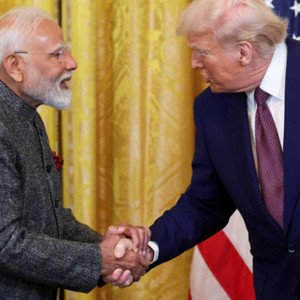
Mr Trump announced the agreement after a phone call with India's Prime Minister, Narendra Modi.
Lotz remains very uncertain, though, about this deal.
Jyoti Malhotra is editor-in-chief of the Tribune in India.
She's told me more about what we know so far.
What's been announced is that both the Indian Prime Minister, Prime Minister Narendra Modi, has tweeted to say that there is a deal between India and the US, which means that the Americans have promised to reduce tariffs from 25 percent to 18 percent, which is now amongst the lowest in the world.
Well, you know, as far as the Americans are concerned, of course.
And the US president has also tweeted to say that he's spoken with his good friend, Prime Minister Modi, and that the Americans will reduce tariffs to 18.
And he's also said, very interestingly, that my good friend, the prime minister, has promised to stop buying Russian oil and that he will buy more and more goods from the US, And perhaps oil also from Venezuela.
What do you think?
Has India promised not to buy any more Russian oil?
Well, you know, I think it's a bit more complicated than that, because oil purchases, if you look at the data, have significantly come down.
They're almost down to zero.
I think they're two or three percent.
But that happened a while ago.
So probably the Americans were waiting to see whether the Indians would deliver on their word or not.
Before tariffs kicked in back in the day, you know before Maduro was taken and you know many months even prior to that.
India has been buying oil from Venezuela for many years.
So India's oil factories, if you like, use the kind of oil that Venezuela produces.
Actually, they do not use the kind of oil Russia produces.
So what India does with Russian oil is that you buy the Russian oil because you're getting it at this huge discount.
You refine it in your own refineries and then you sell it back to Europe or anywhere else.
And that's how India has been making this money over the last few years, you know, and has in the bargain, stabilising its own economy hugely.
Reducing tariffs on US goods to zero, according to President Trump.
I think that deal is all right.
I think the Indian economy will be able to tolerate that, because in any case Indian tariffs are quite high.
And if you're reducing import tariffs on US goods to zero, I think that's fine, because there isn't that much.
I think the farmer...
Stuff was quite a sticking point.
And guess what?
There was chicken's legs.
Evidently, Americans like to export chicken legs all over the world.
Then there was motorcycles, you know, the high-end bikes from the U.S.
So I think the Indian economy...
You know, we are such a large market that you are able to absorb all of that.
I think that's not so much the sticking point.
The problem was that India did not want to reduce subsidies on its own agriculture.
And I will have to see, you know, what fine point on that is.
Tell me, though, how much of a game changer could this be for India?
It is huge, Ed.
It's definitely very big, especially since it comes in the wake of the big trade deal between India and the European Union which, as you know, just happened a few days ago a week ago actually.
So this has been in the offing for a while.
And India's exposure to the American market is enormous.
So these tariffs that were slapped in India, first 18, then 25 and then 50 percent.
Now, if this does come back to 18 and then zero on some counts, it's a very, very big deal.
So that's the first.
It's huge for the Indian exporter.
And, second of all, Prime Minister Modi is going to be able to say to the parliament and to the people that look, this is what I pulled off.
First, I did this with the Europeans and now I'm doing it with the Americans.
Thoughts of Jyoti Malhotra in Delhi.
Peter Jankowskis is vice president of research analysis at Arbor Financial Services in Chicago.
Peter, hi.
Does this feel like the Trump administration maybe is gradually winding back to bilateral deals, now winding down its global tariff posture?
Indeed, they are certainly, from the beginning, have been focused on striking these individual country deals.
It also says you know, some of the efforts to use tariffs to cut back on oil consumption, or rather oil sales by Russia, could be having some effect.
It's really hard to sort that out and see how effective they've been.
But there certainly is a suggestion that there was a connection there.
Peter Jankowskis, thanks.
We're going to speak to you a bit more about some of the other news in the markets, but let's move to another big story today, which has been Japan saying that it has successfully retrieved rare earth sediment from nearly 6000 metres below the ocean's surface.
This in what it's calling a world first.
The sample was collected near the remote Pacific island of Minimitorishima, which is where the seabed is thought to hold large deposits of metals used in electric vehicles and defence technology.
The move is part of Japan's push to reduce its reliance on China, which dominates the global supply of rare earths.
Well, this is also part of a wider push by other nations to further exploit mineral deposits on the ocean floor using the latest tech.
A couple of years ago my colleague Michel Fleury was in Canada seeing one of the robots they use there to retrieve the sediment in action.
This robot was designed to collect rare metals from the deep ocean, like nickel and cobalt, without disturbing undersea life.
A camera on the machine monitors its advance as it hovers over the harbour floor a bit like a sea rumba.
Using artificial intelligence, it's able to recognise the valuable metals, while leaving important marine ecosystems intact.
So if this were a real mission, this would be the robot coming back to the surface and then here on the boat, they're ready with a crane, ready to pick it up and bring it back on board.
What this project shows is how the technology is advancing in a way that makes deep sea mining seem much more plausible.
Michel Fleury there.
Well, the company behind that trial that she was engaging in is Impossible Metals.
Its CEO is Oliver Gunasekara.
Hi, Oliver.
Thank you for joining us on World Business Report.
How is this new robotic technology changing things then?
For this, the whole project of deep sea mining.
Well, thank you for inviting me.
But basically, I think by using modern robots and AI, we can both extract the minerals that we need, whilst also preserving and protecting the marine habitat.
Right.
We can protect the marine habitat because we are hearing, aren't we, all kinds of environmental criticisms destruction of habitat, the risk of sediment plumes, toxic pollution, noise and light pollution, disruption of carbon sequestration.
All of this could happen for plants under the sea.
And the fear is we just don't know its long term impact.
Well, we designed our collection system taking into account all of those concerns, because those concerns come from the legacy technology, the dredger and riser system that was really tested in the 1970s.
And we're really the first company to build a brand new architecture using modern technology and test it in the deep ocean.
Where are you seeing the richest opportunities to mine right now?
Well, the area of the ocean between Hawaii and Mexico, it's called the Claritin-Clipperton zone.
It's four and a half million square kilometers.
It's estimated to have something like 20 trillion worth of critical metals nickel cobalt, copper and manganese, as well as some rare earth elements.
Three or four thousand metres deep though, right?
I mean, it's a long way down.
How easy is it to get the stuff out there?
It's not easy.
And it's actually even deeper, four to six kilometers or three to four miles.
So very, very deep.
And so it's not easy.
But we have been building underwater robots for about 30 years.
They're used quite extensively in oil and gas and now also military drones.
And so we, as a company, were able to reuse a lot of that basic technology and then supplement it with our own unique capabilities, including hovering drones, arms and AI.
We've talked about the regulatory concerns put forward by environmentalists.
They've also been put forward by many governments.
Do you sense there is a mood shift now that the regulatory environment is swinging in your favour?
Because you're talking there about international waters.
We are.
And I think we have to remember that these resources are also found in domestic waters as well as international.
And we now see, for instance, the Cook Islands have large quantities of these minerals in their own waters, as does the US, around American smear and elsewhere.
And I think the fact that President Trump issued an executive order last April to talking about something like 100000 new American jobs could be created over the next decade and really talking about deregulating, accelerating funding and mapping we see that as a really positive indictment for the industry.
How soon till we see large-scale mining at five kilometres down under the waves?
We're working on our technology to be ready around end of 28, early 2029.
We need to scale up our technology, but we feel pretty confident that we could be mining in that timeframe.
Oliver Gunasekara of Impossible Metals, thank you very much indeed.
If journalism is the first draft of history, what happens if that draft is flawed?
In 1999, four Russian apartment buildings were bombed, hundreds killed.
But even now we still don't know for sure who did it.
It's a mystery that sparked chilling theories.
I'm Helena Merriman and in a new BBC series I'm talking to the reporters who first covered this story.
What did they miss the first time?
The History Bureau, Putin and the apartment bombs.
Listen on BBC.com or wherever you get your podcasts.
You're with World Business Report from the BBC World Service.
Now the coffee retailer Starbucks is betting that artificial intelligence can speed up orders at its outlets, while allowing staff to have a better relationship with customers.
One year into CEO Brian Nichols' efforts at turning the company around, sales are starting to rise, although profits, it seems, are still taking a bit longer to catch up.
He's been sitting down with the BBC's North America business correspondent, Michel Fleury, to explain how he hopes AI will improve your morning coffee.
Technology is both a behind the scenes tool, and then it's also a way for us to make the experience have less friction.
And behind the scenes is our SmartQ technology, right?
This is organizing orders and production time for the drive-through mobile order cafe so that we can hit those timelines that we want to hit for our customers.
Then there are other things with like AI, where we're getting smarter forecasting, smarter supply chain management, smarter scheduling.
And then there are other things where it's like we're piloting this right now where, when you pull up in the drive-thru, we still want you to have a person-to-person connection, but the order is actually being inputted by AI.
So, even though you're talking to a person, they're not having to now actually input the order, because it's actually just going straight into our system, which then queues up the order because they know there's three cars in front of you.
This is the time to start pulling the shot.
This is the time to start making the egg bites.
And then, when you go all the way down to the app, You're going to be able to hold up your phone and say you know what?
I've got an appointment at 9 o'clock.
It's at this location.
Find me the nearest Starbucks.
I want my, in my case, vanilla protein latte ready at 845.
Give me the directions.
And it'll just load the order in, give you the directions and when you show up, your coffee's ready to go.
So it is really a powerful tool that can make our baristas spend more time on the craft and the connection, or give them more time to do that.
And at the same time, it can give the customer access in ways they've never had access before.
I was reading about one of the technologies you introduced, Green Dot, which is a real-time assistant for baristas.
I mean, does that help empower the baristas?
Absolutely.
Or is it helping them sort of enforce both the speed but also the kind of continuity that people expect, the standards that people expect from startups?
Yeah, absolutely.
It does all of those things because now it can also help solve problems.
If you have somebody call off, what's the right way to deploy for the day?
It also can help them if they're having to troubleshoot something, solve the problem at hand.
And then also, it has the ability to give them an idea of what their day might look like, based on, You know like, in this case, it snowed.
Right.
So it's going to have a little different travel pattern or visitation pattern than we've had historically.
So it definitely sets them up for success.
And clearly I mean there is this tension about.
You know, you hear understaffing or staffing issues, the pressure that baristas feel to deliver on sort of the connection and the service levels.
This seems to be something you've thought a lot about.
You know when we talk on the operational side.
Absolutely.
How are you sort of addressing that situation?
Yeah look, the biggest thing we've done since I've gotten here is we've put a I think it's 500, 600 million investment into our partner's ability to provide that service experience.
And we want the rosters to be staffed correctly.
We want to give them the guidance so that they're deployed correctly.
And then we're going to give them the tools that make hopefully the job a lot easier to manage.
You know, we've simplified a lot of things, especially the way, the metrics that we ask you to be accountable for.
There used to be this thing called the health pyramid, where there were, like I don't know 100, 200 metrics in here.
We've simplified that down to five things.
And the five things are in our partners' control.
It's very visible for them.
They'll be rewarded for it.
What are the five things?
So basically it's going to be staffing correctly, customer experience throughput and in stock being in stock on items.
So, you know, that right there just simplifies what you need to be doing.
Brian Nicol there of Starbucks speaking to the BBC's Michelle Fleury.
Well, Peter Jankowskis of Arbor Financial Services is still with us.
Peter, a quick look, if we may, at something of a major developing story today in the US.
In the last hour or so, Elon Musk's SpaceX has confirmed it's merging with another Musk-owned company, XAI.
What's going on here?
Well, I think Mr Musk is working toward developing a cash stream to help support the AI developments.
He's been talking a lot about building data centers in space, which is a natural tie-in with SpaceX.
But, more importantly, SpaceX has a steady cash flow that comes from all those launch contracts that they have.
Right.
And this is all a prelude to an IPO, we're being led to believe.
Is that right?
That's right.
I've heard some stories or read some stories about that as well.
They're targeting something that would value SpaceX at about 125 trillion, which again is a lot of cash that would be coming into those coffers.
Yeah, a very big IPO.
Disney, now another major company, it's warning.
I mean, it's had pretty good results, hasn't it?
Its quarterly profits fell somewhat, but the theme park sales have hit a record $10 billion.
But at the same time interestingly, the CEO is warning of the risks of fewer foreign visitors coming to the US, perhaps because of the anti-Trump sentiment, perhaps because of visa restrictions and so on.
Yes, that does seem to be a concern, and it's a strong one for Disney.
About 70 of their profits comes from the theme parks and of that 70, about 80 of that is US theme parks.
So anything that raises concerns there can put pressure on the stock.
Peter Jankowskis, for now, thank you very much indeed.
Let's go to Columbiana.
We have many reasons to achieve a pact for life.
The words there of the Colombian President, Gustavo Petro, speaking in Bogota just before boarding a plane to Washington, where he will be meeting the US President, Donald Trump, on Tuesday.
He says he wants to agree a pact for life in the Americas.
But the two men have not been seeing eye to eye recently, with Petro criticising pretty much everything, from US drugs policy in the region to drugs, the White House's stance on trade.
Cocaine flows to the US meanwhile, will no doubt be a major discussion point for the US since, by some estimates, there's been a ninefold production increase in Colombia since 2012.
My colleague Catherine Ellis is in Colombia and she joins us now.
Catherine, give us an idea first, just how lucrative the cocaine industry has become for Colombia, across the board these days.
Well, it's extremely lucrative.
I mean, this is a multi-billion dollar global industry we're talking about, and there are various estimates about how much it's actually worth.
Some put it at about $100 billion.
Colombia produces about 70 of global cocaine, and the US is still the largest market in terms of individual countries.
Now, if you look at the cocaine industry as a chain, you've got the farmer who grows the coca bush.
That's where cocaine actually comes from.
You've got employees that pick the leaves.
You've even got cooks who feed those who pick the leaves.
People refine it, transport it.
And then you've got the sellers who sell it on the streets, for example, in the US.
Now the coca farmers that are actually growing this coca.
They are kind of at the bottom of the chain.
They don't earn that much, but they grow a lot more than legal crops.
And many of them have been trying to join substitution programmes to get away from the violence it causes.
And I've been speaking to one ex-grower in Colombia's Pacific region who's part of one of these programmes.
Coca, more than a solution, was the worst of evils in our territory.
Our fields, they became minefields.
So what did the signing for the voluntary eradication of coca crops mean?
With great anticipation, we pulled up those plants, which had given our families some income.
But there were so many delays from the government.
We had lost hope that this project would continue.
Then, under the government of Gustavo Petro, people have been replacing those illegal crops with cacao.
It is essential that the government invest in and fix the roads near the farms so the product can be transported, so we farmers can make more money, so our families benefit.
The words of one ex-coca grower there.
Well, there are some success stories in these substitution programmes, but it does seem like there are also plenty of failures, doesn't it?
I mean, why?
What's going wrong?
Yeah, there's been a lot of criticisms.
I mean, you've got very heavy bureaucracy involved in these programmes, poor implementation.
And like that lady was just saying, many delays.
I mean, farmers have rooted their coca, promised financial and technical support, and a lot of them didn't get it at all.
Some even went back to coca to survive.
And then you get Petro come into power in 2022 promising to revive these programmes and go further by transforming rural economies.
But without reliable markets, infrastructure opportunities for many farmers, coca actually remains the most viable option.
There are a lot of security concerns as well.
Now, coca cultivation is at record levels.
And I've been speaking to Gloria Miranda.
She's the director of the agency in charge for the substitution of illicit crops.
It's a very difficult context to intervene in and it can be solved simply by removing coca and planting cacao.
What we are trying to do is to replace not only the coca plant itself, but the entire economy surrounding it, including processing, the agro-industry, transportation and logistics.
It's not something that happens overnight, it requires time.
You also need complementary investment in roads, education technology, the Internet, basically everything a state needs to bring well-being to its people.
Gloria Miranda in Colombia there.
I mean, briefly, Catherine, we've got this meeting now between Petro and President Trump.
What are the hopes?
They've not been seeing eye to eye.
Is there much optimism about what we're going to see this week?
I mean, there's a lot of nervousness, but there's a little bit of hope as well.
As you said, there's been kind of a lot of insults over the last year, not only over drugs but over foreign policy as well.
A lot of it is actually still rooted to drugs.
You've had the US bombing alleged drug boats off the Caribbean and Pacific coast and even capturing Nicolas Maduro in Venezuela, alleging he's the head of a drug trafficking cartel.
Petro strongly, strongly condemned this.
And then you've got spats over migration and trade as well, China's influence as well.
So let's see what happens.
But there is a lot of nervousness.
Okay, Catherine Ellis, thank you very much indeed.
Now Bad Bunny, the recording artist, has just become the first one ever to win the Grammy's Album of the Year for exclusively Spanish-language music.
He beat Lady Gaga and Kendrick Lamar to win the night's top prize for his sixth album Debí Tirar Más Fotos, which is a personal and powerful exploration of his native Puerto Rico's musical history.
I've been speaking to Jennifer Velez.
She's a music journalist based in Los Angeles and a former writer and editor with Grammy.com.
Latin music in the US globally has had a presence for a very long time.
I think the Grammys, the Academy voting members, are now catching up with the reality of the world.
And it is great to see.
This was an amazing album dedicated to Puerto Rico, dedicated to the music history how Bad Bunny sees the island.
And I think finally the Recording Academy has been pushing for more voting members, more diversity.
And I think it may be working.
I mean, this is history in the making, but it's also, at the same time, very hard to believe because, as we all know, Bad Bunny is an amazing artist globally and is talented.
What are the numbers for Latin music sales in the US now?
Well, the Recording Industry Association of America, the RIAA, in April shared that the total revenues generated by Latin music in the US reached a record of 14 billion on a retail basis in 2024 or so.
I mean, the numbers speak for themselves.
It crosses barriers, language, culturally, and I don't think people need to know a language to feel the rhythm, to understand where an artist is coming from.
So I
Money talks.
These are the numbers.
And so I think finally people are paying attention.
Money talks and bunny talks, doesn't he?
He's not afraid to get political, along with many other artists making his feelings known about the Trump administration's immigration crackdown.
I'm wondering whether that plays well to his audience as well right now.
You know, Bad Bunny did not need to go political.
We know that he comes from Puerto Rico.
The island has its own struggles with the US, but he understands that this is a moment to represent all of his fans, who themselves might be undocumented.
They themselves might have a sister, a mom, a brother.
And it meant so much for fans and people watching to be dehumanize this moment where people are being taken, people are being killed.
So he gave a beautiful speech when he won Best Música Urbana Album, really touching on that.
And, of course, talked about Puerto Rico when he won for Best Album of the Year and told his audience and people on the island to not stop dreaming.
Jennifer Velez and, of course, Bad Bunny will be showcasing his music at next Sunday's Super Bowl.
That's it for today's World Business Report.
We'll see you soon.
If journalism is the first draft of history, what happens if that draft is flawed?
In 1999, four Russian apartment buildings were bombed, hundreds killed.
But even now, we still don't know for sure who did it.
It's a mystery that sparked chilling theories.
I'm Helena Merriman and in a new BBC series I'm talking to the reporters who first covered this story.
What did they miss the first time?
The History Bureau, Putin and the apartment bombs.
Listen on BBC.com or wherever you get your podcasts.