NPR. This is the indicator from Planet Money.
I'm Darian Woods, here with reporter Alan Henich.
Alan, welcome to the show.
Thank you, Darian. I'm very excited to be here.
You've brought a story, but also something in a bag.
Tell me what you have.
Yep. I brought you this bag of fresh apples.
Well, thank you very much.
Did you just go apple picking?
You could say that.
I was just in the orchards of Appalachia.
They only make up a small percentage of the national market, but they had a ton of leftovers this year.
Right. West Virginia alone has around 25 million pounds of apples of nowhere to go.
That's around half of their usual harvest.
Yep. 700 truckloads.
Do we have a truck full of excess apples outside?
I do not, unfortunately.
But the USDA is planning to spend 120 million dollars on these apples, and many, many more across the country.
So for the second consecutive year, this is the largest government purchase of apple products in American history.
And so our question, then, is why is this happening?
Will it keep happening?
And in the long run, will small farmers need to grow fewer apples?
You ready for a road trip, Darian?
Yes. Because we're going to be driving all around Appalachia, visiting orchards and growers.
We'll compare this year to past years, east coast to west coast.
Apples to apples after the break.
This message comes from WISE, the app for doing things in other currencies.
Send, spend, or receive money internationally and always get the real -time mid -market exchange rate with no hidden fees.
Download the WISE app today or visit WISE .com, tease and seize apply.
This message comes from Indiana University.
Indiana University drives discovery, innovation, and creative endeavors to solve some of society's greatest challenges.
Groundbreaking investments in neuroscience, climate change, Alzheimer's research, and cybersecurity mean IU sets new standards to move the world forward, unlocking cures and solutions that lead to a better future for all.
More at IU .edu slash forward.
When voters talk during an election season, we listen.
We ask questions, we follow up, and we bring you along to hear what we learned.
Get closer to the issues and the people and your vote at the NPR Elections Hub.
Visit NPR .org slash elections.
And so, Ellen, for the last two years you've visited Virginia and West Virginia to report on Appalachia's apple economy.
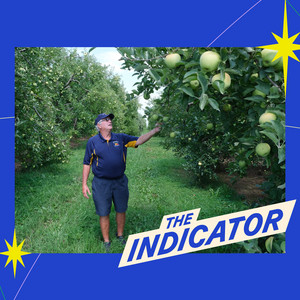
That's right. In Central Virginia, one of the growers I met was John Bruguire.
He's a seventh generation apple grower at Dickey Brothers Orchards.
We're right here at the base of the Priest Mountain right here.
Right above at the peak, you're looking at George Washington National Forest.
The only thing you can hear are crickets and birds.
John's family started planting trees here almost 200 years ago.
We do have paintings that shows orchard being planted here as early as 1830.
I'm fortunate that this property has been in my family since 1752, one of the three granted by King George II of England.
Unfortunately, the rural part of Virginia where we're from, we have excess supply of tree fruit and just simply not enough demand.
In a typical year, around 3 % of American apples go unsold.
That's around 350 million pounds left to rot.
But if you zoom into John's neighboring state, West Virginia, around 50 % of their harvest was sitting on the trees without buyers.
And that's because the processing companies that normally buy these apples and turn them into applesauce and apple juice have lots of apples left over from last year.
These apples can be stored up to a year in what's called controlled atmosphere storage.
These are like giant refrigerators without oxygen.
Because they've become abundant and cheap, they've been buying while the buying's good.
Exactly. To learn more about what's happening in the apple industry beyond Appalachia, we spoke with Carina Gallardo.
She's a professor of economics at Washington State University.
Washington produces the most apples in the country by far.
The profits that have been realized by the apple growers in the last 20 years have been consistently decreasing.
And especially this past year's rise as the volume of production increases.
Moreover, the domestic consumption in the United States has stayed stagnant.
So as apple yields go up with stagnant consumption, the price of apples has been going down.
In particular, what's called the farm gate price, which is what growers receive.
Over the past year, this farm gate price has dropped more than 50 percent on some varieties of apples.
But the price people actually pay at the supermarket has dropped a lot less at only 13 percent.
So companies that are large size and financially stable are perhaps able to face this challenge with economies of scale and more efficient production systems.
But the small grower is not able to face that.
This is exactly the issue that John is facing now.
Because the market sets the price and as his input costs like fertilizer and labor continue to rise, he can't sell all his apples for a profit anymore.
This is why more and more family businesses are selling land, consolidating or being absorbed by investment corporations.
But all is not lost.
The federal government is stepping in to help create a market for these apples, at least in the short term.
It's doing it through the farm bill, more specifically with something called section 32.
Right. And there are section 32 purchases every year for commodities like potatoes, fish, meat, whatever happens to be in surplus.
The idea is to purchase a surplus, keep the growers in business and then donate the produce to people in need.
Seems like a win -win -win.
It is, at least in the short term.
And it takes a big effort on behalf of the USDA, food banks and organizations like Farmlink to help transport these apples to hunger fighting charities across the country.
But over the past two years, section 32 purchases for apples have topped more than $100 million, which is the most money the government has ever spent on apples.
It's an indicator of how desperate growers are to find a market.
In West Virginia, around half the harvest has been sold to the government and donated close by.
And some has gone as far as the Navajo Nation.
That's pretty far. Yeah, but I spoke to growers in states like Pennsylvania and Virginia who weren't even aware that it was possible to sell directly to the USDA.
And even if they wanted to, they would have had to undergo a complicated vendor certification process.
And that's why most of the apples the government bought last year were from big commercial distributors and brokers, essentially middlemen who already had this vendor certification.
So, Alan, was John able to sell any of his apples to the government?
Well, he's not exactly sure.
I may sell to the distributor who got the grant money to do that.
But I haven't received one directly.
Since farmers like John aren't selling directly to the USDA, they're not receiving the best price.
In any case, John doesn't want to depend on the government to get by.
As an entrepreneur, I think it's a bad business plan to rely on any government, state or local, or federal.
It might be a short -term fix, but there's no incentive for innovation or change.
Even if someone from USDA came to your doorstep and said, John, I'm willing to buy all your extra fruit, do you think you would take it or no?
If they're going to spend it, you might as well take advantage of it.
And to say that I wouldn't, I would be fooling myself.
But like I said, I don't think it's a good business plan to rely on that.
And it might not happen next year.
This attitude of self -sufficiency goes hand in hand with avoiding what economists call moral hazard.
This is when an economic actor like an apple grower lacks the incentive to guard against risk because they're protected by insurance.
The worry is that they won't adapt to a changing market.
But to be honest, Arian, that's not what I've seen personally.
Pretty much every grower I spoke to is adapting in one way or another to avoid dependency.
All the growers that I know of my area every year, that's the discussion everybody pushes up acreage.
And for John, that means cutting down his orchards from 100 acres to less than 40.
That was orchard not long ago.
And all those hills that you see on the left, they're all orchard, but we're cutting them for hay and utilizing them in some way to feed the animals.
John is diversifying his land use to become more resilient.
When people come into the fall, you've got cider, you've got sweet potatoes, you've got apples, peaches, pears, plums, nectarines.
All the fall products that most people want will happen.
This is like a supermarket.
I mean, you've got everything.
You really have everything.
When you add the color of the sunflowers, that just adds a little punch.
The sunflowers are there as a backdrop for weddings and events.
Again, another way John is making new use of the space.
They actually rotate from east to west as the sun moves.
And you can imagine a bride standing in front of that, in the foreground, taking pictures for her wedding.
I should get married here.
Seriously. You're welcome to.
I actually should. We went from tobacco in the 1700s.
We went to apples in the 1800s and stayed into the 1900s.
Now we're in the 2000s and who knows what the future may hold.
Okay, so it sounds like you've got a new wedding plans.
Yeah, who knows? Thank you Alan Henich for bringing us this story.
Yeah, absolutely. Thank you again for having me.
This episode was produced by Julia Richie with engineering by Maggie Luther.
It was fact checked by Corey Bridges.
Kate Kannan is our editor and the indicator is a production of NPR.
Who's claiming power this election?
What's happening in battleground states?
And why do we still have the electoral college?
All this month, the Through Line podcast is asking big questions about our democracy and going back in time to answer them.
Listen now to the Through Line podcast from NPR.
This election season you can expect to hear a lot of news, some of it meaningful, much of it not.
Give the Up First podcast 15 minutes, sometimes a little less, and we'll help you sort it out.
What's going on around the world and at home?
Three stories, 15 minutes Up First every day.
Listen every morning wherever you get your podcasts.
It's a high stakes election year so it's not enough to just follow along.
You need to understand what's happening so you are fully informed come November.
Every weekday on the NPR Politics podcast our political reporters break down important stories and backstories from the campaign trail.
So you understand why it matters to you.
Listen to the NPR Politics podcast wherever you get your podcasts.