this is Planet Money from NPR.
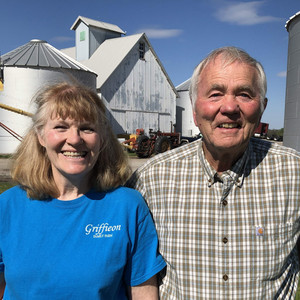
Every time I've called up Lavon and Craig Griffin they've been busy with grandparent chores.
Well, we have two babies today.
A two -year -old and a one -year -old.
Oh my gosh! Are you guys Iowa's best grandparents?
I don't think so. The tiredest ones probably.
A little over a week ago on May 5th Lavon and Craig were babysitting two of their six granddaughters.
My garden's right by our chicken pen, and I just park the girls in their stroller, and they will watch chickens for an hour while I garden.
It's pretty repetitious, but they watch them.
Lavon and Craig are farmers.
Craig is the fifth generation to live on this family farm.
It's pretty big, 1 ,100 -plus acres just north of Des Moines in Iowa.
And in addition to raising chickens, they have pigs and sheep and turkeys and also something called limousine cattle.
It's a French breed of cattle.
They come from France.
And they're very lean.
They have expensive tastes.
I bet. They taste expensive.
But livestock farming is not what brings home the bacon, if you will.
Yeah. The majority of our income comes from corn and soybeans.
Levon and Craig sell their corn and soybeans to a food processor.
That processor exports to international buyers.
So, like many in the farming industry, Craig and LaVon have helped court those international trade deals.
Over the years, they've hosted many interested parties at their picturesque farm, which is conveniently located near an airport.
We've had a lot of people come to our farm from China and Japan.
I've had the mayor of Beijing here.
I've had the secretary of agriculture from Mexico.
No. All this courting of international buyers in general has paid off.
Iowa exports billions of dollars in soybeans and other crops every year.
But then, of course in April, President Trump announced a whole truckload of tariffs.
And some countries retaliated.
For a little over a month, any of Levant and Craig's soybeans headed for China were subject to a retaliatory tariff of 135%.
percent. Wheat, corn, pork, dairy, cotton—those were also hit.
That has meant less demand for Levon and Craig's grains and that really drove down the price per bushel that they can earn.
Ever since President Trump got elected it's kind of been up and down, more down than up.
Craig tracks the fluctuating prices of their crops using a service called Harvest Profit.
It sends them alerts with the up -to -date changes in the price of each crop direct from the commodity markets in Chicago.
It comes into my phone three or four times a day.
So yeah, I'm checking them every day.
Some days I don't even want to look at them, but that, you know.
But on this day in early May, when we spoke with him, Craig was willing for us to face the markets.
He showed us the day's prices.
Okay, Maycorn's down 13 .75 cents.
How is that? Is that good?
Is that bad? Uh, that's probably about break -even.
You'd like to make a little money to live on.
Soybeans were down too.
Basically neither crop would net a profit if they sold their harvest on that day, but they do have a way to wait out the market's volatility, at least for a little while.
It's not like we dump all our grain the minute it comes out of the field.
Yeah we try to hit the highs or you know when the market goes up, and try to stay away from the lows.
When the price gets too low they have these big storage bins.
They're like two stories high and they store thousands of bushels of corn or soybeans or whatever with some air blowing in to keep the crops fresh and dry.
How long can you store grain comfortably without it being like if the price is just down down down And how long can it stay for?
I usually don't keep it over a year.
Grain does get old, you know.
When it sets, it's just like your Wheaties.
Yeah, after it's been around so long, you don't want it.
You don't want to crack in that box yet.
They don't taste quite as good as they used to.
So will prices rise before Lavon and Craig's grains go bad?
Earlier this week, they did get some good news.
the U .S. and China agreed to a 90 day pause in the trade war.
But American farmers are still facing a kind of existential uncertainty.
And they remember what happened last time.
Hello and welcome to Planet Money.
I'm Amanda Orantic.
And I'm Jeff Guo. The U .S. exports billions of dollars' worth of agricultural products every year.
We're one of the world's largest ag exporters.
But now our exports are caught up in a trade war with China and they don't want to buy lots of our things including our Soybeans and pork and corn today on the show we go away way back to 2018 To the last time US farmers were collateral damage in a trade war We go back to see how the government stepped in to keep American farms from going bankrupt what this might tell us about this moment and What might happen next?
As U .S. trade with China exploded, American manufacturing shriveled and workers struggled.
They saw their communities decline and then the world changed very rapidly around them.
Well they kind of aged in place.
Data doesn't speak in words but that's a very dramatic story.
In a recent Planet Money bonus episode, we hear from the economist who helped tell that story and change the way economics thinks about the costs of free trade.
To hear it sign up for NPR plus.
Just go to plus dot NPR dot org Before we get to the 2018 trade war, we need to spend a little bit of time in the 1980s at that time American farms were in crisis one of the reasons they were too good at Farming too efficient in the United States.
We're producing a lot of output." This is Rob Johanson, he's the former chief economist for the Department of Agriculture aka the USDA.
He says there are a lot of innovations coming out in the lead -up to the 80s that are helping farmers produce more food on the same amount of land.
The use of fertilizers is more targeted, the use of crop protectants is more targeted, and the crop varieties themselves are getting better.
So over time agriculture is becoming more productive.
At that time farmers were growing more agricultural commodities like soybeans and corn and wheat than Americans were buying and also more than the rest of the world was buying.
And farmers were maybe thinking wouldn't it be great if we could get someone to buy all of these extra soybeans?
Yeah. Meanwhile the US was in fact busy courting a quite large trade partner China.
The two countries had stopped trading with each other during the Cold War and in 1979 the US and China officially opened their borders to each other again.
So over the 1980s and 90s, trade expanded by a lot.
China, they were great at making textiles and knitwear, so I'm guessing with a fair amount of certainty that they were sending us leg warmers and some neon green sweatshirts.
Thank you so much China, loved it.
This is what's great about trade.
Each country doing what it's good at.
And we are apparently really, really good at growing soybeans.
And by the early 2000s, China starts buying a lot of our extra soybeans.
They're the number one country in pork production, for example, so they need a lot of our soybeans to feed their swine herds.
And so we are exporting more and more of our soybeans to China for that reason.
The post -Cold War era is this booming time for globalization.
There is more international trade, there's more investment, there are more ties between the U .S. and Chinese economies.
And by 2015, the relationship hits a major milestone.
For the first time ever, China becomes the U .S.'s biggest trade partner.
Canada and Mexico, they fall to second and third place.
But as with all trade relations, there are issues, squabbles, disputes.
And the U .S. increasingly claims that some countries, especially China, are not playing fair, that they have been stealing intellectual property, that there have been hacks that put U .S. national security at risk and that their government is subsidizing industries unfairly.
The U .S. felt like a number of countries were over -subsidizing their steel and aluminum production, and so the United States put tariffs on those products.
So at the start of 2018, during President Trump's first administration, he opts not to arbitrate these disputes the normal way, by going to the World Trade Organization.
Instead, Trump uses his favorite tool.
tariffs. He puts tariffs on a bunch of Chinese products including flat screen TVs, medical devices, and batteries.
The idea is that the tariffs will make these Chinese products more expensive so Americans will buy less of them.
China is like, oh you're gonna tariff us?
Well then we are going to retaliate.
We are going to hit you where it hurts.
Those farm goods you send us?
We are basically going to tariff them to the max, like on your sorghum, which is this ancient grain.
You usually use it to feed animals, and China did this because they knew they could source affordable sorghum from other countries.
Rob says there's one story that shows just how quickly the tremors of the 2018 trade war were felt around the world, days after China announces the retaliatory tariffs.
There were ships loaded with sorghum from the U .S. that were headed to China for offloading for their market.
One of these was a cargo ship named the RB Eden.
It was heading from Corpus Christi to Shanghai and while on route it gets wind of some news, it's a ship so I assume all news comes via wind, China has imposed what was kind of a retaliatory tariff on sorghum at 179%.
Yowza! That is a lot.
Yeah and presumably now the buyer in China does not want to pay the extra fee.
Offloading them in China would have meant facing very high tariffs on those imports.
So the ship is like, okay we can't unload in China, and we're already more than halfway to Shanghai so we're gonna do a UE.
We're gonna head around the bottom of Africa and, I don't know, towards Spain?
They are just trying to find some port where some buyer will take this grain off of their hands.
Of course, the buyer knows that you need to offload it, you know, quickly.
Yeah, you don't want to just like float around for weeks or months on end.
Exactly. Exactly. And it is clear to Rob and the others at the USDA that this is not just going to be a problem for sorghum.
China is likely going to put more retaliatory tariffs on all sorts of other U .S. crops and livestock.
That's when we really first started putting a lot of emphasis into like what do we do about this if if we know this is going to happen.
and we know that all of a sudden, not just sorghum, but a lot of other egg products are gonna be affected, cotton, corn, dairy, hogs, soybeans, wheat, and then a number of specialty products that we sold to China, like almonds and cherries.
All of these delicious items from American farms. No one in China will wanna buy those products with the added tariffs tacked on top of them.
Now, American farmers on those American farms, they are, of course, getting a little worried as they follow everything that is happening.
Yeah, for me it was hearing it on the farm news.
This is Aaron Laymon, farmer and president of the Iowa Farmers Union.
He was like, surely we're not starting a trade war, aren't we?
To be honest, I think like a lot of farmers, we were thinking, okay, this might be posturing.
This might be some saber rattling.
And then when did it become apparent and that it wasn't what you thought it was going to be.
Well, I think it escalated and escalated and escalated.
Meaning that China was buying less and less and less from US farmers.
And so the prices of two of Aaron's main crops, soybeans and corn, they were dropping.
So farmers at that point are scrambling to try to find ways to tighten their belts.
Aaron put off upgrading his tractor.
He also put off making improvements to his planter and combine.
His household income went down.
For farmers like me, you know, I'm the fifth generation on our farm, and the age of the average farmer in Iowa is 57 years old, and it's only getting older.
So the need to bring the next generation of farmers back to the land is extremely important.
Well you're not going to do that in a time of crisis.
Erin has two kids. At the time, they were both in college.
He wasn't sure if they'd come back to work on the farm.
And it is a lot harder to convince your kids to come back when crops are selling for a fraction of what they used to sell for.
It just doesn't seem like a viable job.
Now remember, a lot of farmers had worked for years to develop trade relations with buyers in other countries.
But this 2018 trade war was putting all of that in jeopardy.
And as the trade war was escalating, Aaron says the farmers were starting to get really worried because even though this fight wasn't initially about agriculture, China had targeted them.
The farmers, they were collateral damage.
So it's no fault of their own when they have built up these trade relationships for years and years and years and then a flip is switched and all of a sudden all that work gets yanked.
Now, the first Trump administration was watching all of this happen, and it looked like China was being strategic with going after farms, hitting the states where a lot of Trump voters live.
And the Trump administration could see that the farmers were in trouble, and they didn't want a bunch of their voters going bankrupt as a result of their trade war.
So there was talk about, OK, is there a way to help farmers who are impacted?
So that's when we started hearing about possible trade payments.
Trade payments, sometimes called trade aid, which rhymes.
Sometimes called trade mitigation payments.
That one doesn't rhyme.
Anyway in April of 2018 right after China retaliated against the U .S. Trump instructed the Secretary of Agriculture to come up with a plan.
It came from the administration from the And the plan was to use the Commodity Credit Corporation.
The Commodity Credit Corporation.
Basically this fund was created way back in the 1930s under Franklin Delano Roosevelt during the Depression and the Dust Bowl years when drought was devastating the Midwest. FDR was famous for his fireside chats, where he would ask fellow Americans to pull up a chair and listen to him on the radio.
My friends, I have been on a journey of husbandry.
FDR had journeyed to the Midwest to look at the country's farms. I saw drought devastation in nine states.
I talked with families who had lost their wheat crop, lost their corn crop, lost their livestock.
FDR saw the cracked, blistered earth, the grasshoppers, the starving animals.
it was clear that American farms were in the middle of an environmental and economic disaster.
And farms were going bankrupt.
The president thought that the markets for grain and livestock were vulnerable to these natural or man -made threats, and so leaving food up to the free market might mean people wouldn't have enough to eat.
So, FDR set up this government -run fund to, quote, stabilize, support, and protect farm income and prices, the Commodity Credit Corporation, the CCC, and the funds would be distributed largely at the discretion of the Secretary of Agriculture.
Coming up after the break, we fast forward to 2018, when the trade war hits American farms and the government steps in to try and save them using the CCC.
So, remember in April 2018 when that cargo ship had to do a UI while it was on its way to China?
That was when it became clear that the 2018 trade war was going to be a disaster for U .S. farmers.
Once President Trump decides that the government needs to step in, he turns to the USDA.
And he's like, we are going to need a program to keep farms from going bankrupt.
Rob Johansson was at the USDA at the time, and he remembers all of this pressure coming The president was very interested in making sure that U .S. farmers knew that we were going to have their backs when it came to this tariff situation.
He and his team jump in to try to figure out what to do.
They are going to need money.
They need to move fast. It would be kind of helpful to not have to go to Congress for this.
Then, they remember that they've got that special pot of money, the Commodity Credit Corporation, that sweet, sweet CCC cash that's available to them.
Now, using the CCC to try to save hundreds of thousands of farmers being hit with trade damage was a bit unusual.
The fund had mostly been used to help farmers after a hurricane, or they gave out loans, or they paid for trade missions from the fund.
I would say that the one difference was that this was a much larger program that we inced in the past. It had never been used at that level before, for an ad hoc type of program to deal with an unforeseen situation.
Basically, they were going to need to pull a lot more money out of that fund than usual to reimburse the farmers.
But this, this was an emergency and they quickly decide that the CCC money is their best option.
Rob and his team have to figure out how to best distribute the money.
And it's a pretty chaotic moment.
There are trade disputes going on with several different countries.
But there are some findable outables, like roughly how many farmers are going to be impacted.
We'll compare two things.
What is our estimate of damages?
That's one number. How much money do we have is another number.
What they had was about 12 billion dollars in the CCC to work with.
But they don't want to spend all of that at once.
And who knows how long these trade wars are gonna go on for?
This is during a dynamic period in which the US government is engaged with negotiations with these other countries and this program may not be needed in eight months.
Right, like what if the USDA gives out a bunch of taxpayer money, the trade war ends, and the farmers didn't actually need all that money after all.
So Rob and his team at the USDA make some detailed calculations, Which crops are affected by how much how much money do we have who is eligible and they come up with a formula?
And they use it to launch a program that gets a fun name the market Facilitation program and farmers apply for funds at their local USDA office.
They have to be thoughtful about it They don't want to send out too much taxpayer money If the trade war suddenly gets resolved and they don't want to mess up the agricultural markets by accidentally incentivizing farmers to grow, say, soybeans instead of cotton, just to collect a check.
In total, they paid out 23 billion dollars to farmers.
And finally, in January 2020, the US and China strike a deal.
It's known as the phase -one trade deal.
There is a lot in it, including reducing tariffs and a commitment from China to buy more stuff.
And for Robin the Farmers, this includes promises from China to buy more from American farms. So what does that mean?
That means that they're gonna be buying over those two years about, you know, $80 billion worth of ag products.
Ag products like corn and pork and soybeans.
And with that, the trade war ends with a deal.
But the US did not come out of this trade war with a win.
China never actually met its purchasing promises in part because of the pandemic, and also because maybe the goals were not that realistic.
Plus, a lot of the issues that launched the trade war, those worries over intellectual property theft and fair competition and fair trade, many of those have still not been resolved.
So, what did people think of the market facilitation program, the program that sent checks to farmers?
Well, some government watchdogs and politicians and farmers have criticized the program, some felt that there wasn't enough transparency, or that the decision to distribute this much money should have been left to Congress.
Another complaint, that the money wasn't distributed fairly.
There were complaints that red states got more and that some companies like a giant meat packing company for example got money that was supposed to go to farmers.
There has been a fair amount of Monday morning quarterbacking going on about how well we did.
Did we make the program too generous in some respects Were we deficient in other areas?
It's all easier to look at in the past when you have four years of historical perspective and I think it's wise for people to do that now.
Rob was a pretty good sport about all of the criticism.
You know there are lessons we can all learn from, do better next time.
And overall, he thought the program was a success.
In the end, hundreds of farms did go bankrupt.
Small to medium farms were hit the hardest. but it would have been way worse without the emergency CCC funds.
So how did some of the farmers feel about it?
We asked LaVaughn and Craig, doting grandparents and owners of an 1 ,100 -plus acre farm, what they thought about the program.
We did get a government payment, but the payment we got was something like $20 an acre.
So basically the government bailout helped you break even.
Well... Not even. Not even, even.
It didn't pencil out.
It would just look, it just looked good.
It was a big selling point.
Good campaign message.
Well, we helped bail the farmer out, you know.
Well, they didn't. They - Sent a band -aid.
It's a band -aid. Yeah, the band -aid did not fix everything.
And also, something fundamental had been lost. There has been lasting damage now to the trade relationships that had been years in the making.
During the trade war, China started buying more and more soybeans from Brazil and Argentina and Uruguay.
And when the 2018 -2019 trade war ended, that buying kept going.
China now buys the bulk of their soybeans from South America.
And some of the deals between American farmers and Chinese buyers never came back.
Well, in the last 30, 40 years, we've built up relationships with China, Mexico, Canada, and talked them into buying our product.
And in 10 minutes, Trump with his tariffs, all that's out the door.
And so, you know, well, those relationships come back when the tariffs situation isn't quite so violent?
Volatile, that's what I wanted to say." Now this time around, in the 2025 trade war, the retaliatory tariffs have been much less targeted.
So many industries are taking a hit, from farming to manufacturing to energy.
And if things get really bad, it wouldn't be possible to effectively bail them all out.
But bailout or not, trade wars have a way of permanently changing your economy, sometimes causing irreparable damage.
Right now, President Trump and trade representatives from China have somewhat deescalated the situation.
Those 135 % retaliatory tariffs on soybeans are paused for now, but U .S. soybeans do still face a retaliatory tariff of about 10 % to 20%.
And this is really just a 90 day truce, not an actual trade deal.
So, depending on the details, it is still not clear if farmers, or any group, will want or need a bailout in the future.
Today's episode was produced by Sylvie Douglas and was edited by Jess Jang.
It was engineered by Robert Rodriguez and fact -checked by Sarah Juarez.
Alex Goldmark is our executive producer.
Also a special thanks to Benga Adjalori, Grant Gerlach and Joanna Broder.
I'm Jeff Guo. And I'm Amanda Arancic.
This is NPR. Thanks for listening.