Excellent.
Nice.
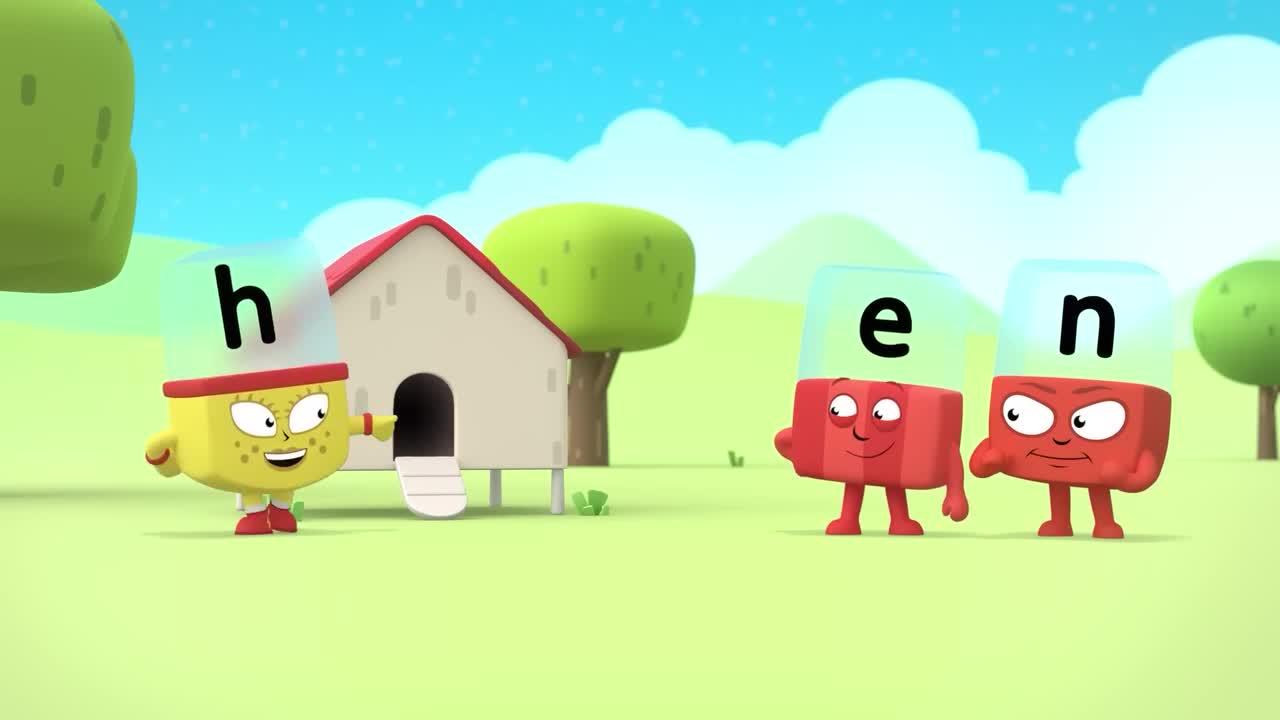
We have our hen house, but something's missing.
Eh?
Hen.
Hello?
Hello?
Nope.
No hen.
Try again.
Hen.
Hen.
Hen.
Hang on.
Three hens?
That was not expected.
Come to me, hen.
What playful hens.
Hen.
Hi, hens.
Every one of us has a hen.
Perhaps give them names.
Nice.
Now, what name shall I choose?
Nicky.
No.
Noodle.
No.
Perhaps try... Pen.
Pen.
Huh?
This P is big.
That's called a capital letter.
You can make capitals, too, if you concentrate.
Capital C.
What can his capital P do?
Pen.
A name badge.
It says Pen.
Pen is the name of my hen.
Pen.
J shape.
J, think of having your capital letter.
Jumping jelly beans.
J.
Hooray!
Jolly good!
How about a name for your hen, E?
Excellent idea.
I was having a lovely doze when all this clucking zapped me awake.
Ever wanted to see your capital letter Z?
Zany, you have to concentrate extra hard.
My own capital letter.
Zen!
Your name is Zen, Hen.
Now we know the names of all three hens.
Hi, Jenna Hens.
Ever so pleased to meet you, Zen.
No need to be shy, Pen.
Now you all have names.
You can't have a name without a capital letter.
Isn't that right?
Calm the ram.
Pat, the cat.
Zak, the yak.
Nice, but there's someone else who needs a name.
Ben!
The pen's name is Ben.
Oh, oh, oh.
Just right for a jolly walk.
Oh, oh.
Super.
All set.
Gosh.
A sign with letters on it.
Jumping Jellybeans, I can see a J. Oh, oh, oh.
Yes, that is your letter O. And there's mine, G. But what does the sign say?
J-O-G.
Jog.
Goodness.
J-O-G.
Jog!
We read it.
It says jog.
But jog where?
Let's get jogging!
Jiggly jellyfish, I'm jogging!
That was great fun!
I'm going to jog again!
Good spot, O. That's your letter again.
And the others are... H, P... Hello?
I was just passing.
Hey, what does this sign say?
H, O, P, hop.
H, O, P, hop.
It says, hop!
Hop where?
Ha-ha!
We have to hop across!
Here goes!
Hop!
Hop!
Hop!
Hop!
Hop!
Hop!
Hop!
Hop!
Hop!
Hop!
Hop!
Go!
Go!
Go!
Go!
Go!
Got it!
Let's keep hopping!
Goodness.
An unusually huge sign.
What does it say?
Up.
Up.
I just popped in.
We've read it!
It says up!
Up where?
The only way over is up!
Up, up, up!
Mayor!
No way!
Incredible!
It must be important because I can see my letter.
But what does it say?
G-e-t.
Get.
I-n.
In.
Get in.
G-e-t.
Get.
Get in!
We read it!
It says get in!
Get in what?
You'll see in a second!
You're all simply sensational!
You've done so well reading my signs!
Good process!
You've made a great game!
Nice!
See you back at the start!
Get in!
Get in!
Excellent!
Super successful signs!
Wonderful!
Nice!
Wait!
No teapot!
Impressive!
Good morning!
Good morning, G!
And a good morning to you, Magic Seedling!
I wonder what you're going to grow into?
Josh!
Goodness!
A great maze!
Wow!
But how do we get out?
Nope, not that way.
That's my capital letter.
I need to go that way.
Not again.
Let's go back in.
You're right.
There is another letter.
Goodness.
This looks like a tricky word.
I wonder what it says.
Oh, no.
Oh, no.
The sign says no, so that's not the way to go.
So, no is not just a tricky word.
It's a helpful one, too.
It says... Oh, no.
And no means not that way.
Gosh, another sign.
Oh, no.
G. O. Go.
G. O. Go.
Great, O. You made the special sound again.
Go is another helpful word.
It means go that way.
Mm.
O. No.
G. O. Go.
Go.
Terrific!
My treasured teapot!
Tea!
I was turning back to get my teapot when I got trapped in here.
We'll help you get out.
Oh!
Guys, look!
It says go.
But what's the next word?
T-oo-too.
T-oo-too.
A new word!
The sign says, go to, and then a star.
Go to a star.
A star!
Now what do we do?
Goodness!
Go to a red bird.
I must say, G, I'm incredibly lost.
We've got to find a red bird eye.
Nailed it.
Eh?
Great work.
Go... What does that word say?
I-N.
In.
I-N.
In.
Go in.
Go in.
Great.
We went in and got out.
What a great magic maze.
Time for some tea.
Tuck in.
Nice one.
Impressive.
Jay, which is the way out?
Gosh.
W. W. W. W. W.
We're coming, W. Back in no time.
Now that we can read the signs.
It's Ben the Pen.
Amazing.
Brilliant.
Oh, excellent.
Brilliant.
Wonderful.
Huh?
I... That's me.
I... Still me.
I... I am... Ben, the card.
Who am I?
I am I. I am I. I am the best.
I'll tell you why.
I'm simply better than the rest.
And if you haven't heard, you can take my word.
I am incredible.
I am I. I am fun.
As you can see, I am fun.
It's fun being me.
I am fit.
Fit?
I run a lot.
I am fit.
I can jog on the spot.
I am fab.
Fabulous me.
I am fab.
I'm sure you agree.
I am a hit.
Hit!
I will go far.
I am a hit.
I am a superstar.
I am fun.
I am fit.
I am fab.
I am a hit.
You'd better believe it because I am I. I am the best.
I'll tell you why.
I'm simply better than the rest.
I do it on my own.
Just me alone.
I don't need anyone.
I am... big.
Big?
How can that be?
I am big.
I'm as tall as a tree.
I am... red.
Why am I red?
I am red.
From my toes to my head.
I am a... cat.
Meow.
I am a cat.
Just look at me now.
In a wig.
In a wig.
I am a cat in a wig.
And I'm red and I'm big.
I am a big red cat in a wig.
Excellent.
I am a big red cat in a wig.
I am a big red cat in a wig.
Yes!
I love it!
More, Ben, more!
I am a... Dog!
I am a dog, I am a...
I am a hen.
I am a... Log.
I am a log.
I am a... Pen.
I am a pen.
A pen?
A pen.
Like Ben.
Ben.
Is.
And Ben is... Fab!
What a fabulous pen!
I am I, and Ben's a dream.
I'll tell you why.
We make a really funny team.
I know I can depend on my new pen friend.
We are incredible.
I am incredible.
Ben is incredible.
Ever so pleased to meet you, Parrot!
My Smoothie Shack is open!
Every kind of smoothie for everyone!
Hello, everyone!
What kind of smoothies would you like?
An impressive smoothie, please!
A colourful one!
A nice one, please?
Easy.
Huh?
Empty?
Ever so sorry.
I forgot to get fruit.
No way.
Who can help me find some fruit?
I. It's a capital I. Just like my name.
What does that word say?
Can.
Can.
I can.
Does that mean you can help?
I can.
Excellent start, but we need more fruit.
Who else can help, Parrot?
Excellent.
I can read, Can.
That new word's got my letter, but it looks a bit tricky.
What does that word say?
E!
He!
E. He.
Hey, you've made a special sound, E. The parrot is saying, he can.
He can help.
Do you have any, Froot-O?
Oh, oh, oh!
Oranges!
Ooh!
Thanks ever so much, but I still need extra fruit.
Who else can help?
Super sandwich.
Hello.
I can read can and there's my letter again.
But I wonder what that tricky word says.
The parrot's saying she can.
Can you help us?
Do you have any fruit?
Strawberries.
But I still need more fruit.
Who else can help?
Epic!
Except that's more fruit than I can carry.
Who else can help?
Well, maybe I can.
I can read can, but what's the first word?
E. We.
E. We.
We can.
That's us, W. But I'm not sure we can carry all this fruit.
If you can't, maybe...
Now I've everything I need to make excellent smoothies.
But who can drink them all?
We can!
How odd!
Good day!
Uh-oh!
Om-nom!
Om-nom!
Gosh, how odd!
Oh!
Gah!
Oh!
Ah!
Ogg?
Ogg?
What's an ogg?
Uh-oh.
Oggog!
Oggogogogogogogogogogogogogogogogogogogogogogogogogogogogogogogogogogogogogogogogogogogogogogogogogogogogogogogogogogogogogogogogogogogogogogogogogogogogogogogogogogogogogogogogogogogogogogogogogogogogogogogogogogogogogogogogogogogogogogogogogogogogogogogogogogogogogogogogogogogogogogogogogogogogogogogogogogogogogogogogogogogogogogogogogogogogogogogogogogogogogogogogogogogogogogogogogogogogogogogogogogog Og-Og!
Og!
Yes?
Og-Og-Og-Og-Og-Og!
And Og ran off with your magnifying glass?
Yikes!
Y-O-G!
Yog!
Yog!
Yog-Yog-Yog!
Yippee!
A Yog!
Yog?
Zog, zog, zog.
Oh, oh, oh, oh, oh.
The yog needs a zog.
Yog.
What is that?
A yog.
A yog.
Yes, a yog.
A yog.
How odd.
Zog, zog, zog.
And it needs a zog.
A zog.
Yes, a zog.
A zog.
How odd.
Zog!
Zog!
Zog!
Zog!
Zog!
Zog!
Zog!
Zog!
Zog!
Zog!
Zog!
Zog!
Zog!
Zog!
Zog!
Zog!
Zog!
Zog!
Zog!
Zog!
What is that?
A yog on a zog.
A yog on a zog.
Yes, a yog on a zog.
A yog on a zog.
How odd.
Zogs, zogs, zogs.
And they need a zogs.
A zogs.
Yes, a zogs.
A zogs.
How odd.
Zogs.
Zogs.
Zogs, zogs, zogs.
Zog, zog, zog.
Yog, yog, yog.
Vox, vox, vox!
Exciting news!
The yog and the zog and the zox need a vox.
What is that?
A yog and a zog and a zox.
A yog and a zog and a zox?
Yes, a yog and a zog and a zox.
A yog and a zog and a zox, how odd.
Vox, vox, vox.
And they need a vox.
A vox.
Yes, a vox.
A vox.
How very odd.
Vox.
Vox.
But that's a box.
Vox, vox, vox.
Zox, zox, zox.
Zog, zog, zog.
Yog, yog, yog.
Og.
Yog!
Yog!
Yog!
Yog!
Yog!
Yog!
Yog!
Yog!
Yog!
Yog!
Yog!
Yog!
Yog!
Yog!
Yog!
Yog!
Yog!
Yog!
Yog!
How odd!
Mm, mm, mm, mm.
Quack!
Quack!
Quack!
Quack!
Woop woop woop.
Mom, mom, mom, mom, mom, mom, mom, mom, mom.
What fun!
That was fabulous!
Funny?
Are you two okay?
Fantastic!
An alien!
I'm F.
What's your name?
Fred.
This is Fred.
He's my new friend.
Cup of tea, Mr. Fred.
Where are you from, Fred?
Uh, what?
I think he wants to go home.
But he's trapped.
I could fly Fred home.
It'll be fun.
Forward to the furthest frontiers of space.
They're too heavy.
Feeling...
Oh, gosh.
I've failed.
But I'm not finished.
Fear not, Fred.
We'll find a way to get you home.
F-O-G.
Fog.
Where are you, Fred?
Ah.
Found you.
You're not Fred.
No.
But you could do a favour for me.
Fantastic, Fred.
There you two are.
We saw you were having trouble, so we brought the troops.
Fellow Alpha Blocks, we must find a way to help our friend Fred fly home.
Now follow me!
Fun!
This is fun!
We're flying!
Not high enough!
I can help!
Finn!
Finn!
A fish fin can't help us fly.
Fantastic!
Five, four, three, two, one.
Blast off!
Mommy!
Fred!