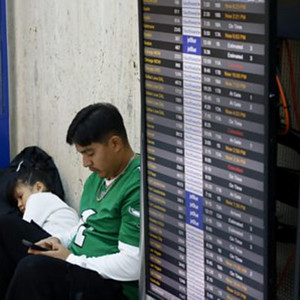
like chaos in the US as the government shutdown leads to cancelled flights at dozens of airports.
We're not getting paid because the political games, it's almost like we feel betrayed.
I don't trust any airports.
I will never travel again.
If I travel again, I will drive.
Welcome to World Business Report from the BBC World Service.
I'm Sam Fenwick.
Hundreds of flights delayed and thousands cancelled.
It's the fifth day of travel turmoil in America.
Air traffic controllers are angry they've not been paid.
Travellers feel stranded.
Coming up, we'll look at the mounting costs for the industry.
And could a two-year disruption to global shipping finally be coming to an end?
The Houthis say they'll pause their attacks in the Red Sea.
So travellers in the US are being told to brace for even more delays and cancellations this week.
The government shutdown means thousands of federal workers, including air traffic controllers, haven't been paid.
Many of them are off work or too stressed to safely manage the system.
Let's hear from Jack Chris, an air traffic controller from the US state of Maryland.
It's been quite difficult.
It's been a state of anomie.
There's nothing really normal that's going on right now.
It provides us a bit of anxiety because we're working already up under a lot of stress because of how perfectly you have to operate as an air traffic controller.
There's zero margin for error.
And then when you add that stress, mounted with the financial stress of not knowing when you get paid, listen you know.
Everybody that goes to work goes to work for a reason.
Not because we like it, although I like airplanes.
We go to work because we want to get paid and we got bills and obligations and children.
And so the fact that we're not getting paid because the political games is, it's almost like we feel unrepresented or underrepresented.
We kind of feel betrayed by our own government.
It's just it's not a good feeling.
It's un-American.
It just doesn't feel like there's something that America should be allowing to occur.
Well, because of these levels of stress there, talked about by Jack Criss, the Federal Aviation Administration, the US government agency responsible for aviation safety, including air traffic control, has ordered cuts to flights at 40 major airports.
Since Friday, airlines have already cancelled nearly 8000 flights, including more than 2300 yesterday and around 1000 more on Tuesday morning.
These passengers at Atlanta Airport have been caught up in the delays and the cancellations.
First it was delayed and then it got cancelled.
Completely.
So now I have to wait a whole other day.
They're only sending out one flight a day.
So I'm trying to keep my hopes up, really.
I'm tired.
I will never travel again.
If I travel again, it'll be I will drive.
Because I don't trust any airports.
I don't trust any of this stuff anymore.
I have totally lost faith in whatever it is, the system.
It has to be the shutdown.
What else could it be?
This has never happened to me before.
I've traveled before.
I've never had this kind of problem.
And, like I said for people, my age 73 years old and I'm sitting out in the cold in a wheelchair waiting.
We're flying internationally today and our flight just had an hour between, and that flight has had delays this week.
So we ended up moving our flight from Jacksonville to Atlanta to early morning, and we're going to spend the day in the Atlanta airport waiting for our six o'clock departure now.
Well, despite that breakthrough vote in the Senate on Monday, it's still very uncertain how quickly airports will return to normal.
Let's talk now to Mike Arnott.
He's from Sirium.
It's an aviation analytics company and he's joining us today from Toronto.
Mike, thanks for being with us.
How serious has this shutdown been for airlines and airports?
Well, it's been a very difficult situation for everyone that's involved in the industry, including the air traffic controller that we heard from and the passengers at the airports that were in the clip.
The airlines in particular are going to be used to these kinds of scenarios several times a year.
They'll be hit with weather delays.
We've seen some IT outages.
We've seen what happened at London Heathrow.
And that is sort of part and parcel of the airline industry.
So those folks will be working as hard as they can to get the engine spooled up, as they say, to get back to normalcy as soon as the government shut down.
I suppose they can be on standby to act very quickly when the government shutdown ends.
But at the moment, it's not ended.
It's still going on.
Well, and indeed the difference here between you know a weather event which has caused delays and cancellations, or an IT outage, is that This has been foreseen for some time, that there would be a reduction in flying.
So you know, the airlines knew in early October or late September that there was a possibility of a reduction imposed by the FAA.
So they will have had some time to prepare, to put planes in sort of the most optimal places that they could last Thursday.
That doesn't mean that everything will return in a moment's notice when the government orders, But when it does reopen it will take a couple of days.
And based on the data that we have at Serium from past incidences, it will probably take two to three, four days to reopen, to return to some sort of normalcy, but it will come relatively quickly.
And the passengers?
Yeah, I want to ask you about the passenger confidence, because we heard there in that clip that you know one woman would rather get in the car than be subjected to having to sit and wait for a plane.
How bad is this for passenger confidence and then booking again, rebooking those flights?
Well, we've got in the United States the most important holiday of the year, which is Thanksgiving, and that's coming up in a couple of weeks.
This Thanksgiving Serum.
Data shows that bookings for this year, compared to last year, were up about 2 year over year.
But in the last week or so, the bookings have fallen.
And so the pace of bookings has slowed by about half.
So there's definitely consumers that are reacting with their pocketbooks.
And how might airlines then maybe try and coax them back?
Can they give them incentives to try and make them book?
Well, it's so price sensitive in the airline industry that I suspect that the passengers that are frustrated now, within a couple of weeks, will be quite happy to get on a plane to visit family and friends, or what have you for the December holiday period?
The airlines have a lot of tools in their tool bag, including lowering fares, including using points and miles, availability.
Generally though, in the United States market, the planes are pretty full at the holiday period, and certainly at Thanksgiving.
So I don't think the airlines are going to worry too much.
And I don't think passengers, you know, passengers, we all sort of have a very short memory.
The minute that our flight is cancelled or delayed and we have a bad experience, we're back online booking another flight a couple of weeks later, seeking some sun.
Just briefly before you go.
Do you think customers are sympathetic to the air traffic controllers not turning up for work?
I don't doubt that the American traveling public is frustrated by this situation and is very sympathetic for the controllers.
And I think it's a testament, getting back to the data, that on time performance, which is sort of the standard measure of operating efficiency in the airline industry, has been relatively stable since the shutdown began, only with a couple of days where planes and connections would have been missed and there would have been a lot of delays.
So it's a testament to the work of those air traffic controllers that really the planes have been leaving generally on time or even above average.
So that's great.
Thank you very much.
Mike Arnott there from Syrian.
He's an aviation analyst.
Let's talk to Fiona St.
Cotter now.
She's a senior market analyst at Citi Index.
Are we seeing any effect on stock prices of some of these major airlines because of this prolonged shutdown?
Fiona.
Yes, we are, actually.
As this week kicked off, we've seen today.
We've seen that these ongoing concerns of flight cancellations have pulled aviation firms lower.
American Airlines, that's down around 5% this week.
Delta Airlines, they're also down around 2% this week.
And this lower share price is just a reflection of concerns of basically what this is going to cost the aviation firms in terms of financial and operational burdens that is going to come as a result of these ongoing cancellations.
Fiona Sincotta, please stay with us.
We will come and talk to you again in just a moment time.
But let's move on now, because a woman who ran a multi-billion dollar fake investment scheme in China and then escaped on a moped and eventually ended up in London in the UK, has been jailed for more than 11 years in what's now been called the biggest money laundering case ever tried in the UK.
On Monday, Qian Jimin was convicted of trying to launder more than 60,000 Bitcoin.
That's now worth around six and a half billion dollars.
Here's the moment police in London caught up with her.
Hello, madam.
Appreciate you're in bed.
I've just got to record down your name, if that is all right.
So what's your first name, please?
Detective Constable Joe Ryan was on the raid.
The whole house, a very large house, fairly messy.
And there was cash almost everywhere.
Thousands of pounds, bundles of £20,000 here.
More than 100,000 people across China invested, many of them losing their life savings.
A man we're calling Mr Yu, who spoke to the BBC on condition of anonymity, took out loans and invested everything into the company, which claimed to be developing health products themselves, as well as mining crypto.
And for a while, Mr. Yu was getting daily returns.
But then in 2017, all of that stopped.
We were just too weak to resist.
They just pumped up our dreams until we lost all self-control, all critical judgment.
Many families have been broken up.
People have been left without money to pay for medical treatments.
All this has really happened.
It's still unclear whether people like Mr. Yu will ever see any of their money again.
Here's the BBC's Nick Johnson.
He was in court on Monday.
Well, we heard in court from the judge.
He said that the Bitcoin that was fortunately gained by Tian has gained so much that there should be more than enough to recompense people in China.
But that will be a decision for the Chinese authorities.
And certainly the Home Office here in the UK won't be drawn yet on how the Bitcoin seized is going to be used, used and what's going to happen to it.
But it is a significant amount of money.
And the judge today talked about how sophisticated Qian was in terms of her offending.
So that was the BBC's Nick Johnson, and he was in court on Tuesday, not Monday.
Let's talk to Fiona Sincotta again about this.
Conviction of this size Fiona.
Does it have any effect?
Do you think, on the confidence of Bitcoin and the wider crypto market?
I think it's never a good look to have this level of problems within the crypto market and can erode confidence.
I think if a scam is large enough, then it can in fact impact the price.
But I think the crypto market has matured quite a lot over the past decade, which does mean that it takes a lot more to rock the boat and actually have an impact on the price.
But I think, If we're looking for some sort of silver lining here, maybe these scams can actually help to drive regulation, which is always a good thing.
I was going to ask you is regulation keeping pace with the scale and sophistication of crypto-related fraud?
Well, I mean, it's definitely not easy, but I would say that it is improving.
The crypto market, it really does evolve faster than traditional financial systems.
And scammers are looking really to exploit gaps between innovation and oversight.
We have regulators such as the FCA, the SEC and EU's sort of meeker framework.
They are tightening rules on transparency and advertising, consumer protection.
But, you know, this is a decentralisation that we're talking about here.
Yeah, borderless transactions, anonymous wallets, and that does make enforcement very difficult.
Okay, thank you, Fiona, for explaining that.
This is World Business Report from the BBC World Service with me, Sam Fenwick.
The climate talks in Brazil have entered day two and much of the focus is on how the energy transition will be funded.
South Africa is pushing for climate finance that better reflects African priorities.
The continent has some of the world's best solar resources, but gets only a small share of the clean energy investment.
And South Africa wants to change that.
It's opening up power generation to private companies and expanding wind and solar resources, But it says the current funding pledges fall far too short of what's truly needed for a just transition.
South Africa's environment minister is Dr Dion George, and he's attending the summit in Belem.
And he told me how he's trying to find the right way to finance the green transition.
If we're going to transition in a just energy transition and leave nobody behind, we need to make sure that we can finance the transition.
I think that that's the issue.
So south africa has got that issue in terms of the funding and we do have the just energy transition and it's a plan, the investment program behind it, and we have had quite a lot of financing from concessional financing and we initially had some grant funding, etc.
But um, further up in africa there's a battle on because, you know, the price of capital is very high.
So what we have done, not only here, but also in our G20 stream, as we've been speaking about the cost of capital,
But more specifically, when we were at Baku last year, there was the Baku to Belem roadmap and that roadmap was to get to 13 trillion in the finances.
That would be scaled up over time.
Now the big thing for us is well, we are saying to the developed economy countries do as you say you will do.
Because if there has been this promise and commitment under the paris agreement then to deliver on this finance, then they must do that, and if they don't, or not capable of doing it, then they need to say so.
Because it is so that there have been some european countries in particular have said well, the fact is that they need to spend a lot more money on security.
And also, I mean, we know, if we look at the electricity in the European countries, they are sort of less ambitious in wanting to assist other countries with financing for climate because they have their own priorities.
You say that, but the European Commission's Global Gateway Initiative has pledged 150 billion euros by 2027, 554 million of that for green energy.
Yes, absolutely.
And I mean, that's a very good number.
But the fact of the matter is, is that there is more that is required.
Now, it is so that, of course, you must work with what you have.
And of course, there must be the implementation of the project.
And I think that has also been an issue.
So, for example, there have been instances where money is in fact available, but it's not translating into activity on the ground.
So if there is finance available, then how does that turn into the actual project that needs to be delivered?
Specifically in South Africa, for example, we have a difficulty in building the transmission lines.
Lots of opportunities for building the new greener energy sources, but then transmitting it is a problem.
If you look at what's going on in South Africa though, you have had rolling power blackouts for many years.
And that's actually suppressed growth, hasn't it?
Because confidence in your own state power company is very low.
So you can perhaps understand why private companies in particular might not want to invest.
Yes, absolutely.
I think the crucial problem there in South Africa is that we have ESCOM, which is a monopoly.
It is not working efficiently.
Obviously, it relies on coal, which is an enormously big problem also.
I mean, as the environment minister, I'm responsible for holding them to account for the emissions, but they are exceeding them and action does need to be taken.
Also, another thing that ESCOM has done is that they get in the way of the green energy development.
So, for example, they are holding back on accelerating private-public partnerships, for example, controlling the grid, for example.
So that's the problem.
It is so that we could have gone much faster, but of course we have to work with what we have.
It seems strange that a government minister would be blaming a state-owned company for holding investment back.
I am the authority that is responsible for oversight over the emissions of ESCOM, for example.
The Minister of Electricity and Energy is responsible for the entity of ESCOM and it is not properly under control.
That is an unfortunate fact.
So I think the reality that we need to face is that ESCOM has made some progress in adding more energy to the grid, finalizing the power stations that have been going on forever.
But they are still very much inefficient and very much not progressing as fast as they should be.
What has been a positive development is that there was an appeal on the new nuclear power station for Cape Town that had been over a decade in the making.
I have actually dismissed the appeal on that.
So they can proceed on the nuclear energy, which is in our energy mix as well.
So we're not short on policy in South Africa.
We've got the energy mix.
We've got the integrated resource planning of how we're going to get to that.
But the crucial thing is that there is that view that we have got coal and that we should actually burn that coal.
You say you've got the policies and you've got a plan for where you want to be, but you haven't got the money.
And at the moment, coal makes up 80% of your energy generation.
Now, I know that you have got plans to increase green energy, but it's from a very low base.
I doubling from 1% is very small.
It is very small indeed.
It is not enough.
And I think that therein lies the complexity is that there is a view amongst some in South Africa, also in the government, that what we need to do is that we need to burn our coal and that we must not accelerate our transition.
Now, that is one view.
There is, of course, then the other view, which is my view and the view of the Minister of Energy and Electricity, that we need to speed up.
You can have the ambition, but you have to be able to do it.
That was Dr. Dion George there, South Africa's Environment Minister.
Fiona Sincotta, Dr. George there saying not short on policy, but possibly short on cash.
How can investors go in and invest in there?
How can South Africa make themselves more attractive to private investors?
Yeah, it's a tough one because I think here we've got sort of the idea of perceived risk and it is considered to be riskier.
You've got obviously, currency volatility, debt burden, potential political instability and that sort of drives up borrowing costs and does deter private capital from going forward.
I think other things would be sort of the idea of the infrastructure as well.
Sort of that lack of modernization can make sort of large scale renewable integration expensive.
So it's a very difficult one to address, because more investment is needed in order to be able to help resolve these problems.
But I think you know a good place to start is obviously consistent energy policies and you know strong regulatory framework to encourage longer term investing.
Organisations like the European Commission or other countries pull back funding for this kind of thing.
Does that make it less likely that private investors will come in as well?
Yes, because I think it just removes that idea of legitimacy, the idea of security, that sense that if there are bigger players doing it, then then maybe it does feel a little bit safer for private capital.
So I think that would be a negative all round.
Let's just quickly talk about job numbers, because in the UK unemployment rose to 5 in the three months to September.
Also concerns over the US jobs market as well, because of tariffs starting to weigh on business activity.
Do we see other economies where job numbers are a worry?
It's interesting because I think the US and the UK are seeing weaker job markets than other economies.
If we're looking for sort of another economy where unemployment has been, or is, relatively high, as Canada, which has been a key factor for the Bank of Canada, cutting interest rates.
But interestingly, if we look at Europe and Australia, we're still seeing low levels of unemployment there.
Europe's still at 6.3%, which is a historically low level.
And Australia.
We've got data this week from that.
It's expected to come in at only 44, so down from where it was previously.
Thank you very much.
Fiona Sincotta there from City Index.
It's an investment firm in the city of London.
Now we're going to finish today with Yemen's Houthis, who say that they may pause attacks on commercial ships in the Red Sea following the ceasefire in Gaza.
Now, the move could ease more than two years of disruption to global shipping.
In a letter posted online, the Houthis say that they've stopped for now, but warn that they'll resume strikes if fighting in Gaza restarts.
So how safe is it now for ships to sail through the Red Sea?
Let's have a chat with Peter Sand.
He's the chief analyst at the Ocean Intelligence Foundation. platform, Sunita.
I've not said that right, have I?
It's Sunetta.
Is that right, Peter?
Thank you for joining us.
That will do.
So how credible then, do you think this announcement is by the Houthi military on these attacks on shipping?
Well, from what we know now, details are sketchy and a large scale return of container ships to the area cannot be based on details that are unknown to this extent.
So the word from the Houthi militia will not bring safety to cruise ships and cargo just per se.
So more is needed to ensure safe passages once again are possible.
Are shipping companies going through the Red Sea or have they still stopped?
Yeah, we have seen throughout the year that fewer and fewer container ships have passed through the area.
But most recently, we have seen a couple from the French carrier CMA, CGM passing through it.
And they have also been under the protection of French Navy.
So it's not like shipping has completely stopped transiting the area.
But in container ships it's like one out of 10 going through, with the rest of them going around the Cape of Good Hope.
Yeah, I think some Greek ships have been going through the route as well, haven't they?
As well as those friendships.
Yeah, definitely.
We've seen an uptick in tankers going through the area in the past couple of months.
But on the overall perspective it is still a large scale disruption to global shipping and maritime supply chains.
So what might need to happen for shipping companies to feel more confident, to then start to reroute ships back through the Red Sea?
Well, it's a part of a bigger regional security agenda.
The Houthi rebels is not acting completely in isolation.
They are part of the bigger picture, connecting Iran with Gaza and Israel to the Houthi rebels.
So it's a vicious cycle.
But the current on the ceasefire – well, it is a ceasefire to some extent.
It's going in the right direction.
Details like this coming out also from the Houthi rebels.
It's better than not having it.
So I think now more than ever, we're going into the right direction.
But I think still more needs to be done before we actually see transits back at the level we had latest in 2023.
As you said, it's a story that we've been talking about all year.
How damaging and how costly have these attacks been on shipping and world trade?
Yeah, it's literally a double-edged sword, right?
Because ship owners and operators have actually made a little bit of a win for profits out of rising freight rates because of this disruption.
Shippers on the opposite side of the table have paid up for not only having more cargo at sea for a longer period of time, but also massive disruptions, as these global shipping networks were reset two years ago.
And in the event that we will see shipping returning, there will also be up to two, four months, something like that, with disruptions.
Peter San, thank you very much for joining us today on the programme.
Thank you to you for listening.
The producer today was Victoria Holland.
I'm Sam Fenwick.
We'll see you again same time tomorrow.