Get the unmissable news stories of the day.
This is the Beijing Hour. Examining the events that impact and shape China and the rest of the world.
This is the Beijing Hour. One hour of news and information brought to you every weekday.
Now here's your host. Shane Bigham with you on this Monday, August 11th, 2025.
You're listening to the Beijing Hour, coming to you live from the Chinese capital.
On today's program, Qatari broadcaster Al Jazeera blames Israel for the deaths of five of its staff members in Gaza.
The UN Security Council has convened an emergency session to talk about Israel's planned takeover of Gaza City.
Extreme weather across China continues to cause problems, including torrential rains and scorching heat.
In business, China's consumer prices are showing relative stability.
In sports, results from the first weekend of the World Games in Chengdu.
In culture and entertainment, a film about the Nanjing Massacre will soon open for global audiences.
Now checking the day's top stories. Qatari broadcaster Al Jazeera says the Israeli military has killed five of its staff who were covering the war in Gaza.
An attack killed correspondent Anas Al-Sharif and four other media workers in their tent near the Al-Shifa hospital in Gaza City.
28-year-old Al-Sharif was one of the channel's most recognizable faces. working on the ground in Gaza, providing daily reports.
The Committee to Protect Journalists and a UN expert had previously warned that al-Sharif's life was in danger due to the nature of his work.
The Israeli military is confirmed carrying out the attack, calling al-Sharif a terrorist who posed as a journalist.
Al Jazeera strongly condemned the assassination, calling it a desperate attempt to silence voices, exposing the truth in Gaza.
It's called for decisive measures to halt the ongoing genocide and end the targeted killing of journalists.
The media also said the Israeli military has killed over 200 media workers during the conflict, urging decisive measures to halt the ongoing genocide and end the targeted killing of journalists.
Hamas has accused Israeli Prime Minister Benjamin Netanyahu of telling a series of lies to cover up a genocide in Gaza.
Israel's bombardment of Gaza continues, with no signs of the humanitarian crisis easing.
Rami Al-Maghari reports. The latest situation in Gaza is continuing bombardments and explosion of homes in the eastern parts of Gaza City, mainly Al-Zaltun and Tufa neighborhoods.
Evacuation orders have been sent to families over there before ahead of the detonation of those homes.
This is a part of what is seemingly Israeli plans for taking over the Gaza Strip before they take serious actions amidst reports suggesting that Israel is preparing hundreds of thousands, a few hundred thousand Israeli soldiers to take the action that has been widely reported recently.
Other strikes and bombardments hit the southern parts of the Gaza Strip including Khan Younes city, where a number of targets have been hit so far since the early morning, causing the death of at least 11 Palestinians over there.
In terms of the food supplies that have entered the territory over the past few days of the past week, Still the number, the quantities of goods and commodities are not that much and prices of these goods are very high and beyond the capacities of majority of the purchase power of the majority of the population here in the Gaza Strip.
It's true that there are some goods in the local market now entered through via the crossings and these are private sector goods, commercial goods and commodities but still the situation is still difficult because of the fact that the majority of the population are impoverished ones and they are bearing the brunt of a very intensive Israeli war in actions, particularly displacement that For example, here in Gaza City, in every single corner of Gaza City, you might come across tents, sheltered tents, in which there are hundreds or tens of families displaced here.
That was Rami Almagari reporting. Prime Minister Anthony Albanese says Australia will recognize a Palestinian state at the United Nations General Assembly next month.
He said the cabinet endorses the decision as part of a global effort building momentum for a two-state solution.
Albanese said it'll be based on commitments from the Palestinian Authority, which includes a condition that Hamas will have no involvement in any future state.
He stressed permanent Israeli and Palestinian statehood for lasting peace.
Meanwhile, New Zealand's government said it'll make its decision on a Palestinian state next month.
German Chancellor Friedrich Merz says Berlin's decision to halt arms exports to Israel comes in response to Israeli plans to expand its operations in Gaza.
Merz says Germany will help diplomatically, but it'll not fuel a conflict that's now being pursued exclusively by military means.
Germany's being Israel's second largest weapons supplier after the U.S., with its military equipment making up 30% of Israel's major arms imports from 2019 to 2023.
Berlin also increased its arms exports to Israel tenfold in the months after the October 2023 attack.
Meanwhile, a recent poll by Forza Institute shows 54% of German respondents support the recognition of a Palestinian state.
They're also calling on the government to completely stop supplying arms to Israel.
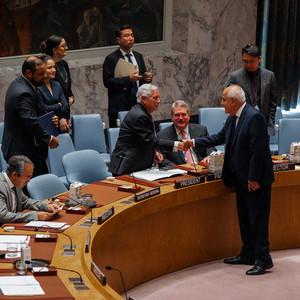
The UN Security Council has convened an emergency session addressing Israel's planned takeover of Gaza City.
There's mounting concerns that the plan will endanger the hostages while worsening the already catastrophic humanitarian situation.
Miroslav Yenka is the UN Assistant Secretary General for Europe, Central Asia and the Americas.
He warned that Israel's decision will likely trigger another calamity in Gaza, causing further forced displacements, killings and destruction.
The Israeli military currently controls around 75% of Gaza, but about 2 million of the enclave's citizens are located in the areas not under the control of the Israel Defense Forces.
The UN has warned of possible catastrophic consequences for civilians in the event of a complete military takeover and forced displacement in a region already suffering from a devastating humanitarian crisis.
Coming up, monastic life in Shizong is blending tradition with the modern world.
A 3,046-kilometer greenbelt now circles the Taklamakan Desert, a leafy wall standing between sand and sky.
Once barren lands are coming alive with trees, birds, and hope, each kilometer is a victory against erosion, dust storms, and desertification.
Nature bounces back when we give us At eight minutes past the hour, in the highland region of Shizhong in southwest China, ancient spiritual traditions are not just preserved, they're thriving in harmony with the modern world.
Thanks to national support and thoughtful development, one of the most sacred sites in Tibetan Buddhism is embracing the change of the times while honoring its past at the same time.
From daily rituals to state-of-the-art infrastructure, monastic life there is moving into a new chapter.
Gong Ming visited the site to find out more.
Founded in the mid-15th century, Tashu Hongpo is one of the six great Galupa monasteries and a historic seat of the Panchen Lamas.
It stands as a cornerstone of Tibetan religion, culture, and knowledge.
Inside the esoteric college, a clear bell signals the start of scripture recitation.
Rows of monks enter the hall, their chants reverberating through centuries-old walls.
Later, in the monastery's debate courtyard, monks engage in lively debates, exchanging sharp logic and gestures.
While its traditions remain, modern comforts have found their way into monastic life.
Inside one monk's quarters, the kitchen is fully equipped with modern appliances.
Yet in the corner, an old relic still tells the story of how life here has changed over time.
We used to cook noodles using this clay stove with charcoal underneath.
Now we just use this stove here. In his own room, bright and open, one centerpiece stands out, a full electric tea set.
As he welcomes us and a friend to sit, he begins preparing tea. showing his collection of assorted tea leaves and sharing his deep passion for tea culture.
Back in 2010, I went to a tea house with some friends, and that's when I really got into brewing tea.
Life in the dorms is a lot easier now before we had to boil water outside.
After we got running water and electricity, I bought this electric tea brewing set in 2011.
When asked where he learned about tea culture, he put out his phone and showed us some online creators he follows.
He even records and shares his own tea-making videos from time to time.
Nowadays, our living standards are much better.
Besides studying Buddhist teachings, we also learn modern subjects like foreign languages, technology, and the Internet.
Right next to the monastery gates stands Tasho Hongpo Tibetan Medical Hospital, a vital institution with over 370 years of history.
Once a modest clinic, it has undergone significant upgrades in recent years.
These improvements have transformed the hospital into a modern facility serving both monks and the local community. with limited equipment.
But with policy support, the hospital has expanded its facilities and added many modern, advanced medical devices.
Nowadays, monks only pay a small fee for CT scans.
But for most treatments, medications, routine checkups, even their annual physicals, they get free care through the National Health Insurance.
Over the past decade, Taisho Honpo Monastery has steadily modernized while preserving its heritage.
New drainage and fire safety systems, including sprinklers and alarms in every main hall, have greatly improved the security.
The spacious, well-maintained entrance plaza now welcomes a steady stream of worshippers and visitors from across the globe, all drawn to the monastery's enduring spirit as it embraces the future.
Tradition doesn't stand still, it evolves with the time.
And right here at the historical Taisho Hongpo Monastery, you can see that in action.
While the core beliefs of Tibetan Buddhism remain deeply rooted, daily life is modernizing, people's livelihoods are improving, and the region's rich cultural heritage continues to thrive alongside progress.
That was Gong Ming in Shizhong. China's put environmental protection at the forefront of its national development strategy, with combating desertification a key focus of the efforts.
Lucy Ray traveled to Inner Mongolia Autonomous Region in the north of the country to explore how innovations are transforming once barren landscapes into thriving ecosystems.
Send is much like its opposite, water. You can see it, you can feel it, but you can't always control it.
Fighting it takes both grit and flexibility.
In the Kubuqi Desert, China is trying something bold, planting solar panels to heal the land.
In many places, solar panels are about cutting carbon.
But here in Inner Mongolia, it's also about cutting wind, keeping the soil, and giving the land a second chance to breathe again.
Inside the solar fields, life is quietly returning.
The poles stabilize the shifting sand, and the panels above cast shade, slowing evaporation, giving scarce moisture a better chance to linger.
This is part of a 400-kilometer-long, 5-kilometer-wide ecological barrier built to shield the Yellow River from the encroaching Kubuji Desert.
The goal is to achieve an installed capacity of 100 million kilowatts.
It will also help treat 200,000 hectares of sandy land.
In the middle of the desert and under this solar panel, you can feel it, this quiet and stubborn kind of hope.
But desert control comes with trade-offs.
The risk? Ecology for ecology's sake. That's where the electricity helps.
It's not just green power, it's also economic fuel.
Dalat banner alone generated 360 million kilowatt hours in just the first half of this year.
That's the carbon equivalent of cutting over 2 million tons of emissions.
Tackling desertification isn't just about sunlight and technology.
It's also about water. Underground water is precious, which makes it tricky to use for large-scale restoration.
So the question is, how do you heal the desert without draining the land dry?
China's fight against desertification spans decades.
On the road to the Mu'a's desert, traces of early efforts remain. checkerboard windbreaks and green patches sprouted from earlier area seeding.
These efforts have earned China one of the UN's highest environmental honors in 2017.
The checkerboard method has since spread to African countries battling severe desertification.
But the exploration continues in China. Instead of irrigation, researchers are placing a new biodegradable hydrogel into the soil.
It's designed to retain moisture, allowing plants to survive on rainfall alone.
Our innovation handles greening and sand control in one go, way more efficient than old-school methods.
It cuts labor, time, and costs significantly.
Each planted seedling may seem insignificant against the vast desert, But researchers are testing more than just survival.
They're testing sustainability. Some species endure the climate but damage the ecosystem.
Take something like tumbleweed, for example.
It's a U.S. import. Once it dies, it creates barriers.
If planted near cities, it can worsen dust storms and disrupt daily life.
Other species offer more promise. Shrubs like white pea shrub adapt well and double as livestock feed.
A newly introduced reed, space-bred arundel, may help restore soil and be used for biofuel.
The hydrogen method is now being scaled up.
Demand is rising, especially from desert-prone countries in the Middle East.
We've signed a $300 million deal with the United Arab Emirates and are partnering with the Royal Nature Reserve in Saudi Arabia.
Our product is non-toxic and biodegradable.
We believe it can accelerate restoration and become part of the global solution.
The road out of the desert is hard, just like the path to stop it from spreading.
But for China, the will to restore the land runs deep.
Across China's arid and degraded land, green is returning, step by step, year after year.
The work continues, fueled by the determination to find solutions that can withstand time and climate.
That was Lu Sere in northern China. China will host the Shanghai Cooperation Organization Summit later this month.
Leaders from dozens of countries and international organizations will attend the summit and related events.
Amid the global buzz of Sanlitun in Beijing, one Indian restaurant offers a distinct escape from the bustle of city life.
Its founder and head chef arrived in China years ago.
Liu Jiaxin went to discover his tale through a flavorful experience.
Stepping into Dastan in the heart of Beijing feels like a sensory passport of India.
The intoxicating aroma of spices, the warmth, the colors.
But behind all this is an extraordinary journey of one man.
Today we're going to join Chef Rabiul Baksh for an exciting bite of India.
My name is Sheikh Rabiul Baksh. I'm the founder and head chef of Dastan Indian Cuisine Group.
We have total four Indian restaurants in Beijing.
So I started my culinary journey in a small hometown.
It's located in Kolkata, eastern India. From gaining invaluable experience in hotels across China, including the Hyatt Regency, one of the most famous five-star hotels, Ravi dared to bet on himself.
In 2021, he founded Dustin, meaning starring.
The bright spices bring life to the kitchen of black and white.
In just a few minutes, an authentic chicken curry is ready.
Hello. Hello, Ravi. Namaste. Welcome to Dastan.
Thank you so much. The dish Ravi personally prepared is one of the most famous in India.
Old Delhi style butter chicken. We call it like Puranidilli wali makhani.
It's like slow cooked chicken, which is cooked in the tandoori oven.
And the gravy base was like tomato and cashew nut base is gravy.
So it's a bit of like sweet and sour and bit of like spicy even.
And you can put it on. It was absolutely delicious combined with garlic naan.
So beyond curry, what else can we see in Indian foods?
This is a very interesting question. You know, for the local people, they thought Indian cuisine means like only curry.
But this is not true, honestly. One of our most famous street snacks we call pani puri.
No Indian snack is more well-known than pani puri.
People are fascinated by the combination of flavors that these crispy little shells bring forward.
Ravi puts mashed potato inside them. Two flavored waters, spicy and sweet.
One big bite brings a full, refreshing taste.
Instead of curry, we have also kebab. It's one of the most popular Indian barbecue, you can say.
We cooked in the tandoor even. We have like something different called biryani, which is like slow cooked rice, slow cooked Indian rice.
Ravi pours his heart into every dish. In only four years, he opened four restaurants in Beijing, each with different positioning and innovative flavors.
While admiring his entrepreneurial journey, I am also curious about how he came to truly appreciate Chinese food.
I can proudly say one of my favorite Chinese dishes is like, like shredded potato.
Yes. Why? You know, these dishes always give me a kick.
I don't know, you know, for these dishes with the white rice, I can eat a lot.
I think most of foreigners also, they love it.
Give ordinary dishes new life. That's the charm of cross-culture adventure, isn't it?
Ravi says his tale of chasing and catching the Chinese dream is to turn destiny into a beloved bridge between cultures.
That was Leo Jashin reporting. Today, we continue our special program revisiting China's pivotal battles and heroic stories during the War of Resistance against Japanese aggression.
In this episode, we go back to 1940, when the war entered its most difficult phase.
In Yongchuan, Shanxi Province, the main eastern battlefield behind enemy lines, the Eighth Route Army launched a large-scale operation known as the Hundred Regiment Campaign.
85 years later, Xu Shiqi returned to this once war-torn land to uncover the story of a national struggle and to hear the echoes that history has left behind.
85 years ago, the 8th Route Army launched an unprecedented behind-the-lines operation on this very land, the 100th Regiment Campaign.
The battle became a monumental chapter in the history of the Chinese people's war of resistance against Japanese aggression.
This scene depicts General Peng Dehuai and General Zuo Quan listening to a battle briefing from Wang Zhengzhu, the chief of operations department.
At the time, Wang reported that over 105 regiments had joined the campaign.
Peng Dehuai immediately decided whether it's 100 or 105, let's call it the 100 Regiment Campaign.
At 8pm on August 20, 1940, the 8th Route Army launched the 100 Regiment Campaign.
The campaign was divided into three phases.
The first phase lasted until September 10th, with the primary objective being the capture and control of the Zhengding-Taiyuan Railway.
The Zhengding-Taiyuan Railway connected two major lines, the Pinghan Railway and Tongpu Railway.
Once served, it would not only cripple Japanese supply lines in Shanxi, but also allow the Eighth Route Army to link its bases in the Taihang Mountains and the Jinchaji border area.
Yangquan became the main battlefield during this stage, with intense fighting breaking out in Mohetan, Nanziguan Pass and Shina Mountain.
In mid-September, the campaign entered its second phase.
The Japanese army mobilized tens of thousands of troops in an attempt to retake the railway.
In response, the Eighth Route Army swiftly adapted its strategy, switching to mobile operations that combined guerrilla warfare and ambush tactics.
Between late September and early October alone, The Eighth Route Army launched over 800 skirmishes, inflicting more than 12,000 casualties on Japanese and puppet troops.
The enemy's main forces were bogged down in some mountain ranges in north China, significantly weakening their ability to launch further sweeping operations.
From late October, the campaign entered its third phase.
The Eighth Route Army took the initiative.
Relying on the Taihang Mountains, Taiyue Mountains and the central Hebei Plains, they launched mobile guerrilla strikes and localized counterattacks across key base areas.
This phase levered a severe blow to Japanese suppression efforts and further expanded the strategic gains of the campaign.
The Henry Regiment campaign lasted for over five months and effectively consolidated and sustained the anti-Japanese base areas in North China.
The CPC let backstage battlefield become the main front of the Chinese people's war of resistance against Japanese aggression, fully demonstrating the role of Communist Party of China as a pillar of strength.
Its impact extended far beyond Chinese borders and is recognized as a significant chapter in the global war against fascism.
Eighty years ago, it was right here the Eighth Route Army set out.
The Hangzhou Regiment campaign wasn't just about sabotage.
It was a people's war, a remarkable chapter written into nations' memory.
Standing here today at the memorial, what we remember is the spirit, the strength to break through blockades and keep moving forward.
That was Xu Shiqi in Yongcheng, North China.
Coming up, extreme weather is causing a wide range of problems across China.
United in purpose during World War II, the Chinese military and people stood as one, fearlessly resisting Japanese fascism.
China's unwavering whole-nation effort forged the pivotal Eastern Front.
Through fierce battles, immense sacrifices, heroic endurance, and decisive support to the allies on the European and Pacific battlefields, China has helped secure liberation, the final victory, and the lasting legacy for global peace and human progress.
Resolve and Resilience, the main eastern battlefield of World War II, only on CGTN.
26 past the hour. Extreme weather events continue to affect many parts of the world, alternating between high heat and intense rainfall.
Recovery efforts are now underway in Yuzhong County of northwest China after heavy rains caused much damage.
The central government has sent 10,000 emergency relief items to support the affected communities.
Local authorities say all damaged roads have now been repaired and reopened after torrential rains on Thursday evening triggered flash floods and mudslides.
Earlier, we spoke with You Yang in Yuzhong County.
I'm at a canteen of one of the major resettlement sites in Yuzhong County, northwest of China's Gansu Province.
And earlier, heavy rainfall triggered a mountain torrent in this area, leaving 15 dead and 28 missing.
Actually, nearly 10,000 people in Yuzhong have been safely relocated, and over 400 people among those who were trapped have been rescued.
Well, this resettlement site in a high school in Yuzhong County has received more than 170 people from Malian Village in Mapo Town.
It's actually one of the hardest hit areas.
Well, actually, this resettlement site has received over 170, then 177 people, and most of them from the most hardest hit areas called Malian Village.
And currently, it's actually the launch time.
And let's take a look at how they're enjoying their launch here.
How do you feel about your lunch? He says it's very good.
And he said actually they're providing very rich meals, especially for breakfast, lunch, and of course their lives here are very safe and they can enjoy all their food here.
So actually, currently about 14 resettlement sites like this have been set up to receive the affected people, and those places include hotels, schools and the village committees and as of monday all affected areas in yuzhong county have had electricity and more than 2 700 rescue personnel have been dispatched by local authorities and local authorities say they will keep monitoring the development of situation especially for the emergency response continues that was yo young reporting from gansu province China has renewed a yellow alert for rainstorms, the second level in the country's four-tier system.
Heavy rains are forecast to hit parts of Sichuan, Hubei, Anhui, Guizhou and Jiangsu provinces and the city of Chongqing until Tuesday morning.
Authorities have already initiated a flood emergency response for Sichuan and Guizhou in the southwest.
A geological disaster prevention response is also in place for neighboring Hubei and Chongqing.
At 29 past the hour, checking the forecast ahead of the break in Beijing's down to 24 degrees this evening.
Moderate rainfall in 31 on Tuesday. Nanchang's 30 overnight, then thundershowers in 36.
Chongqing will get torrential rains in 24 this evening, as followed by sunny conditions in 34.
Anhui has heavy rainfall in the forecast, 22 degrees overnight, then overcast in 29 degrees.
Elsewhere in Asia, Islamabad's down to 27, followed by a light rainfall and 34 on Tuesday.
The NTN's 24 overnight, then some rain and 32.
Phnom Penh's 25 this evening, then heavy rainfall and 32 degrees.
In Africa, Nairobi's getting a light rain and 20 on Tuesday.
Kampala's down to 19, followed by a light rain and 26 degrees Celsius.
It's time for a short break. So far this hour, Qatari broadcaster Al Jazeera blames Israel for the deaths of five of its staff members in Gaza.
The UN Security Council has convened an emergency session to talk about Israel's planned takeover of Gaza City.
Extreme weather across China continues to cause problems, including torrential rains and scorching heat.
Shane Begum with you. Stay with us here on The Beijing Hour.
Listen up. Can you hear the heartbeat of our world?
It's vibrant and pulsating with the essence of life itself.
From the stem of trees to the gurgle of rivers.
From the silent strength of mountains to the icy whispers of glaciers.
Even the solid ground beneath our feet right there, in the midst of all, beats the heart of humanity.
What if those other heartbeats were to stop?
Would ours keep on ticking? Ever wondered what's actually going on in Africa through the perspective of an African?
How are things really going between China and Africa?
What's the narrative of this relationship?
Well, get a perspective with China Africa Talk.
Hear from African diplomats, entrepreneurs, academics, Chinese natives and more.
Get on our wavelength every week to find out what's real with China Africa Talk.
Find us on your favorite podcast. We'll see you there.
Examining the events that impact and shape China and the rest of the world.
This is the Beijing Hour, one hour of news and information brought to you every weekday.
Now here's your host. Shane Bigum with you on this Monday.
Still to come, in business, China's consumer prices are showing relative stability.
In sports, results from the first weekend of the World Games in Chengdu.
In culture and entertainment, a film about the Nanjing Massacre will soon open for global audiences.
To contact us, you can email radio at cgtn.com or follow our ex-account at cgtnradio.
First, though, checking the day's headlines.
China Coast Guard says it's expelled Philippine Coast Guard and public service vessels from territorial waters around the island of Huangyandao.
A spokesperson said the Philippine vessel intruded the area in the South China Sea despite China's repeated warnings, using the pretext of supplying fishing boats.
The Chinese official said the CCG took legitimate measures, including tracking, monitoring and blocking.
The spokesperson stressed that Huang Yandao's Chinese territory and the Coast Guard will safeguard national territorial sovereignty and maritime rights and interests.
U.S. President J.D. Vance says Washington's done funding the Ukraine conflict and wants to bring a peaceful settlement.
He said the United States doesn't have a problem if Europe wants to step up support for Ukraine and buy weapons from American producers.
The European Union's top diplomat said any agreement between the U.S. and Russia must include Ukraine and the EU.
U.S. President Donald Trump and Russian President Vladimir Putin are set to meet in Alaska on Friday.
Qatari broadcaster Al Jazeera says the Israeli army has killed five of its staff members in Gaza.
Palestinian civil defense sources say the Israeli army targeted the journalist's tent in a hospital in Gaza City.
The Israeli military confirmed carrying out the attack that struck Al Jazeera reporter Anas al-Sharif before calling him a terrorist who posed as a journalist.
Al Jazeera has condemned the assassination, describing it as a desperate attempt to silence voices exposing the truth in Gaza.
It says the Israeli military has killed over 200 media workers during the conflict, urging decisive measures to halt the ongoing genocide and end the targeted killing of journalists.
UN Security Councils convened an emergency session addressing Israel's planned takeover of Gaza City.
There's mounting concern that the plan will endanger the hostages while worsening the already catastrophic humanitarian situation.
The Israeli military currently controls around 75% of Gaza.
But around 2 million of the enclave's citizens are located in the areas not under the control of the Israel Defense Forces.
Futsong is China's permanent representative to the UN.
He expressed concern over Israel's Gaza City takeover plan.
China firmly opposes any attempt to occupy Gaza.
Recently, the Israeli Security Cabinet approved the plan to take over Gaza.
China has expressed serious concerns over this and urges Israel to stop the dangerous move immediately.
Gaza belongs to the Palestinian people and is an inalienable part of the Palestinian territory.
Any act that changes the population and territorial structure of Gaza must be resolutely resisted.
Israel must fulfill the international humanitarian law obligations of the occupying power, open all crossings, lift restrictions on the access of supplies, ensure the large-scale, rapid and safe entry of humanitarian supplies into Gaza and support the United Nations in conducting rescue operations in a manner that conforms to humanitarian principles.
Amir Slavyanka is the UN Assistant Secretary General for Europe, Central Asia and the Americas.
He warned that Israel's decision will likely trigger another calamity in Gaza, causing further forced displacements, killings and destruction.
You're listening to the Beijing Hour. Coming up in business, China's consumer prices are showing relative stability.
80 years after the guns fell silent. echoes of China's fight against fascism still resonate?
What can a yellowed newspaper reveal about China's first end in World War II?
What does a blood-soaked vest tell us about a soldier's final battle?
And what does an old record sing about the power of unity on the Eastern Front?
The Unyielding East, China's World War II Relics, brings you the forgotten objects and the unforgettable stories of a nation that stood its ground.
Discover China's role in the global fight against fascism and the people whose sacrifices helped secure final victory.
Listen to The Unyielding East, China's World War II Relics, wherever you get your podcasts.
We're at 36 minutes past the hour. Turning to business now, and here's Wang Zihang.
Thank you, Shane. Stock markets on the Chinese mainland closed higher on Monday.
The Shanghai composite was up over 0.3%.
The Shenzhen component gained nearly 1.5%.
Home appliance and energy shares let the gainers.
Elsewhere in China, the Hong Kong stock market closed higher as well, with the Hang Seng index up nearly 0.2%.
Meanwhile, the Nikkei index in nearby Japan gained almost 1.9%.
Official data shows China's consumer price index edged up 0.4% in July compared with the previous month.
It rebounded from June's 0.1% decline and surpassed the average seasonal pace of a third of a percent.
On an annual basis, the CPI data held steady.
The core measure that excludes food and energy climbed 0.8%, maintaining its upward momentum for three consecutive months.
According to the National Bureau of Statistics, these positive trends were primarily due to rising service and industrial consumer good prices.
The MBS also highlighted the impact of policy measures in boosting demand.
Meantime, the producer price index, which measures costs for goods at the factory level, dipped 0.2% in July from the previous month.
It showed improvement from June's 0.4% drop, marking the first monthly narrowing of the decline since March.
The MBS says the better PPI figures reflected multiple factors, including optimized market competition, continued industrial shifts, and unleashed domestic demand potential.
For more, Lily Liu spoke with Liu Zhijun, a senior fellow from Yanming University of China.
So what are the key drivers behind the rising consumer pricing index?
And is it primarily due to seasonal factors like summer tourism?
Or are there signs of broader consumption recovery that's supported by income growth or consumer confidence?
Actually, all factors, as you mentioned already, that some signal reading are also the main drivers to stimulate the figures in July.
But I have to say, frankly, all the figures from CPI, we can see something very special.
First, the special is that there's no big surprising, no big improvement.
And secondly, there is no big shock. Also, because we are facing so many challenges and uncertainties, but still the figures and the economic development still very well, very healthy, that is 0.4% compared.
So if in this case we can see a tendency for China that we are still facing some pressure, of course we have some good opportunities to increase and to improve our management. and also our economic conditions, but still we are facing some more uncertainties and seasonal problems also we are facing.
For instance, July is okay. It's good for tourists, for student vacation, We know July is the season for new graduates.
We have more than 12 million new graduates looking for employment and new jobs.
So this is really big challenges. So in this way, we can see that all the policies concerned that they have to be centralized in order to get the unified market and the unified efforts and the unified policy to support the strength of our development.
But in the long run or in the short run, we will have to pay great attention that There was senior research fellow Liu Juqin at Renmin University of China on China's latest CPI and PPI figures.
China's trade facilitation efforts have helped stabilize the country's trade volume while improving the quality of foreign trade.
Fujian Pilot Free Trade Zone on the southeastern coast has launched a smart service platform that incorporates regional comprehensive economic partnership tariff policies.
Through its AI-powered algorithm, The platform enables enterprises to obtain customized tariff solutions with one-click analysis, while facilitating instant approval and issuance of certificates of origin.
Enterprises in Fujian Province have independently issued origin declarations for exports worth over 2.4 billion yuan, or around US$334 million this year, ranking first nationwide.
This has provided strong support for businesses expanding into RCEP markets.
In Qingdao, Shandong Province, customs authorities are actively promoting new rail-sea intermodal regulations.
Companies will be able to complete customs clearance and inspection at inland ports before sending goods by rail to seaports for direct loading.
This eliminates container transfers and duplicate declarations.
Since January, Qingdao Port has handled over 1.7 million standard containers of intermodal cargo, up 13% on a yearly basis.
A major underwater cable now links the island of Crete to mainland Greece, bringing cleaner energy and fewer blackouts.
The Ariadne interconnection backed by China's state grid is helping the EU hit its climate goals.
Evangelos Sipsis has the story. It's one of the deepest power cables in the world, running 335 kilometers through the Aegean Sea and diving over 1,000 meters deep.
The Ariadne interconnection now connects Heraklion in Crete to Athens, carrying up to 1 gigawatt of high-voltage direct current.
The goal, replace Crete's old oil burning plants with clean, stable power from the mainland.
Officials say the switch will cut off over 400,000 tons of CO2 emissions each year and save millions in fuel costs.
It's a very important job. This is a historic project.
It protects our environment, supports tourism and brings real energy security to Crete, something we have waited decades for.
Funded by Greece's IPTO and 20% owned by China State Grid, the $1.1 billion project is already live and in trial mode, expected to begin full commercial operation this fall.
SIGGRID will keep promoting openness and cooperation and work with partners like IPTO to encourage professional exchange, share expertise and advance common goals such as energy security and lower carbon development.
Each line has already passed full load tests.
Engineers say the system is ready to deliver clean, reliable power year-round, even during Crete's peak tourism season.
This is state-of-the-art HVDC technology.
It's stable, efficient and gives us room to expand renewables on the island.
The project also opens the door for Crete to become an energy exporter, feeding up to 2.5 gigawatts of island-based wind and solar into the mainland grid.
That aligns with the EU's 2030 climate targets, making Crete a critical link in Europe's energy future.
Crete's clean energy potential is enormous.
With this link we can finally tap into it at scale and send it where it is needed.
And as well as having a national impact, there's regional benefits too.
Crete is no longer on the sideline. We're becoming an energy hub for the Mediterranean, supporting both Greece and Europe's clean future.
From geopolitical tensions to global targets, this cable runs deeper than electricity.
It's a quiet current of cooperation, powering the future in one island at a time.
That was Evangelos Tsipsis in Greece. In neighbouring Turkey, industry insiders say the country's signature crops, including apricots, grapes and cherries, are facing the toughest seasonal record this year.
Output is expected to hit historic lows due to severe spring frost, followed by summer heatwaves.
In April, temperatures plunged to minus 17 degrees Celsius in the central and eastern parts of the country, inflicting severe damage.
The Agriculture and Forestry Ministry says it is one of the most severe agricultural frosts in history.
Heat waves compounded below in July, with the temperature soaring to 45 degrees Celsius.
These extreme weather conditions have hit central Anatolia hardest, estimated to supply 85% of the world's dried apricots.
According to industry data, Turkey's dried apricot exports last month totaled around 2,850 metric tons, down over 17% from the same period last year.
Thank you very much. That was Wang Ziheng with Business.
Coming up in sports, we have results from the first weekend of the World Games in Chengdu.
Sideline Story brings you all things sports related.
The hottest topics, latest events, juiciest stories, all with a very personal take.
Subscribe to Sideline Story podcast for heated sports discussions covering events that are happening in China and around the world.
Thank you, Shane. We begin with the World Games in Chengdu.
The trampoline gymnastics competitions concluded on Sunday with China claiming gold in women's synchronized events.
Hu Yicheng and Zhang Xingsheng delivered an almost flawless routine in the final to secure the title.
Japan got silver while Canada settled for bronze.
In martial arts, China's Liu Xiaohui topped the podium in Muay Thai by defeating Thailand's Kulanath Koinak in the women's 48kg division final.
Her compatriot Han Xin claimed the gold in the 60kg category.
Sunday also saw the opening of the Feng Swimming events, which witnessed three world records.
China won the women's surface relay 4x100m with a thrilling comeback.
In an exclusive interview with Zhu Mandan International World Games Association President Jose Pereira talked about Chengdu 2025's legacy in relation to the future of non-Olympic sports.
Looking beyond Chengdu, how do you envision the future of the World Games?
Are there any discussions of potential new sports or new formats or strategies to integrate with the Olympic movement?
Well, in the World Games there are all the federations that are recognized All sports featured in the World Games are governed by federations recognized by the IOC, though they are not yet part of the Olympics.
The inclusion of new sports largely depends on the IOC's recognition process.
However, the World Games remain adaptable, continuously evolving their strategies to stay dynamic and relevant.
We collaborate. with analytics firms to understand youth trends, ensuring the Games align with future demands.
This time the Games achieved a lot of firsts.
The first torch relay, the first time that female athletes outnumbered male athletes, and the first Athletes' Commission election.
Do these innovations represent your reform vision for the World Games?
Yes, definitely. Gender equality is a priority.
Four years ago, we reached an agreement with Chengdu's organizers to ensure equal participation, with 15 more female athletes competing than males.
Another innovation was the torch relay, which engaged communities across Chengdu, allowing residents to share in the excitement.
We also introduced a baby room policy, enabling female athletes with infants to bring their children and receive special support, a groundbreaking initiative that has been widely praised.
That was International World Games Association President Jose Pereira.
In football, Crystal Palace won its first community shield on Sunday, defeating Liverpool 3-2 in a penalty shootout after twice coming from behind in regulation time.
Last season's FA Cup winners forced the match to spot kicks, where goalkeeper Dean Henderson saved shots by Alexis McAllister and Harvey Elliott, while Mohamed Salah sent his effort over the bar.
Liverpool's Alisson Becker denied Aberace Eze and Bourna Sosa hit the crossbar, but Crystal Palace held on to claim the trophy.
Palace manager Oliver Klasner praised his goalkeeper.
We know that Dean is a great goalkeeper.
He saved many, many, or he cleared many chances for us, supported us.
And also there's a lot of work behind it.
For example, the day before the meeting in the hotel with the analyst, with his goalkeeping coach, he went through all the penalty takers from Liverpool and he's well prepared.
And then he has the confidence, I think, that he can save the penalties he showed it.
The Community Shield is often referred to as the curtain raiser for the new season in the Premier League. which gets underway on this weekend.
The Saudi Arabian Football League has secured its latest marquee signing after Davin Nunes completed a move from Liverpool to Al-Hilal on Saturday.
The Uruguayan international cost a reported US$62 million and has signed a three-year contract.
Al-Hilal, Saudi Arabia's most successful team, has been searching for another star signing after releasing Brazil great Neymar in January.
Still in football, Lu Jiayu netted hat-trick as China overpowered Lebanon 8-0 in the final Group E match of the 2026 AFC U-20 Women's Asian Cup qualifiers on Sunday.
The tournament features eight groups with all group winners and the three best runners-up advancing to the tournament finals in Thailand next year.
China had already sealed first place in Group E before kick-off, following earlier wins against Syria and Cambodia.
And finally, Spain's Alex Palu captured his third consecutive IndyCar season title and fourth in five campaigns by finishing third in Sunday's Portland Grand Prix.
Australian Will Power won the race. With four career season titles, Palu ranks third on the all-time IndyCar list behind record 10 won by AJ Foyt and six taken by New Zealand's Scott Dixon.
Thank you very much. That was Yang Guang with sports.
Just ahead in culture and entertainment, a film about the Nanjing Massacre will soon open for global audiences.
The Beijing Hour, your window on China and the rest of the world.
It's 52 past the hour. In culture and entertainment, Dead to Rights, a film about the Nanjing Massacre, has taken China's summer box office by storm with its intricate plots and captivating theme.
The film's box office had surpassed 2.2 billion yuan, over 300 million U.S. dollars, since the premiere on July 25th.
The movie is making its global premiere and igniting discussions worldwide.
Wang Siwen reports. Set in one of the darkest and least known chapters of World War II, the Nanjing Massacre, Dead to Rights tells the true story of Chinese civilians who risked their lives to preserve photographic evidence of Japanese war crimes.
To bring it to the screen, the creative team began with extensive research in 2023, collecting nearly 10 million words of archival materials.
We stayed rooted in historical truth while daring to explore artistically.
We hope this combination allows audiences to feel what we call a departure effect. as if they've walked through a long tunnel of time like survivors from the massacre 88 years ago when they step back into today's world they'll feel a deep sense of gratitude and love for the present some parents brought their children to learn history i hope children can learn the truth of history through as many channels as possible so they will never forget The film held its North American premiere in Washington, D.C. and set to open in theaters across the continent on August 15th, serving as a powerful reminder to reflect on history and to cherish people.
China's ambassador to the United States, Xie Feng, attended the Washington, D.C. premiere.
The film is also generating strong reactions in other international markets.
It was hard to look at some of the scenes.
They were so real. This movie felt so real to me that It was painful at some times, but I think it needed to be said.
From landing the wartime streets to today's global stage, that rise carries the memories of the past, urging audiences everywhere to remember, reflect, and never forget.
That was Wang Suen reporting. Iconic EDM festival Tomorrowland will land in Shanghai on November 22nd with its first ever official China edition.
It will also mark the music festival's first ever indoor show.
Zheng Yue spoke with organizers about how Tomorrowland's magic is being reimagined for Shanghai.
Tomorrowland is moving from the fields of Belgium to an indoor venue in Shanghai.
The world's most iconic EDM music festival dropped the bombshell when it announced its first official China show, scheduled for November 22, 2025.
So we're very excited to bring an immersive experience indoor show designed specifically for Shanghai, specifically for this audience to China.
And this is Tomorrowland's first official indoor show in the world.
The show is called Paper World and will feature the China debuts of internationally renowned DJs.
Today is really for us a milestone. It's a big step for us for the first time organizing an event in China. an indoor event where we will combine all our strengths and all the things that make us unique, from storytelling to set design to music.
This project is a tangible expression of the growing ties between Belgium and China, rooted in mutual respect, creativity and shared vision of the future.
Since its first event in 2005, Tomorrowland has taken the world by storm, with additions in Belgium, the U.S., Brazil, and France.
China has such a diverse and dynamic, evolving musical scene.
Tomorrowland is such a dynamic and world-class IP, and we're just excited to bring the magic of Tomorrowland to China, to Shanghai.
That was Zhang Yue reporting. One of the world's premier classical music events is embarking on an historic expansion beyond the Swiss Alps.
The Verbier Festival is making its Asian debut in Shenzhen next January.
The festival's founder said the strategic move reflects Asia's remarkable ascent as a classical music destination.
The festival began in Switzerland in 1994.
Beijing down to 24 degrees this evening.
Moderate rainfall and 31 in the forecast for Tuesday.
Nanchang's down to 30, then thundershowers in 36.
Chongqing gets torrential rainfall overnight.
The low is 24, sunny and 34 tomorrow. Anhui has heavy rainfall overnight, a low of 22, and that's followed by overcast conditions in 29.
Elsewhere in Asia, Islamabad's down to 27, followed by some rain in 34.
Vientiane's at 24 this evening, then a light rainfall and 32 degrees.
Phnom Penh's at 25 overnight, then a heavy rain and 32 tomorrow.
And finally to Oceania, Port Vila's 22 overnight, a slight rainfall and 27 degrees on Tuesday.
And that's it for this edition of the Beijing Hour.
Making news today, Qatari broadcaster Al Jazeera blames Israel for the deaths of five staffers in Gaza.
And extreme weather across China continues to cause problems, including torrential rains and scorching heat.
On behalf of the staff, this is Shane Biggum in the Chinese capital, hoping you'll join us for the next edition of The Beijing Hour and open a window to the world together.
Find The Beijing Hour at precisely 6 p.m.
Beijing time. We meet you on podcast and on air every weekday.
The Beijing Hour, your window on China and the rest of the world.
He can't live without the Yellow River in his eyes.
The Yellow River is so noble and elegant.
Both my grandpa and dad made a living from the river.
Would you like to move away from the Yellow River?
I don't think I will. I love it so much.
The Yellow River, the second longest river in China, is regarded as a shaping force in the history, economy and culture of northern China.
Today, about 100 million people live within its water basin, making up nearly 9% of the country's population.
How is climate change felt at its headwaters?
And what are the locals doing to cope with it?
What are the descendants of the boatmen doing?
What has kept some people from leaving their home village by the river?
And what has drawn others back? Could the fading fishing community revive in a time of digital transformation?
From 2021 to 2024, our reporters visited the upper, middle and lower reaches of the Yellow River, talked to the herders, farmers, boatmen, fishermen and eco-activists who share a close bond with the river. and present their stories in pictures, podcasts, and videos.
All in our 12-part series, The Yellow River Mosaic, available only on CGTN Radio.