I'm David Marchese.
And I'm Lulu Garcia Navarro.
We're the hosts of the Interview from the New York Times.
David and I have spent our careers interviewing some of the most interesting and influential people in the world.
Which means we know when to ask tough questions and when to just sit back and listen.
And now we've teamed up to have these conversations every week.
We'll try to reveal something about the people shaping our world.
And we'll get some great stories from them too.
It's the Interview from The New York Times.
Just listen wherever you get your podcasts.
From The New York Times, I'm Rachel Abrams. This is The Daily.
Over the past few weeks, some of the most prestigious universities in the country have faced a threat to their very existence from President Trump, who has frozen billions of in federal funds in an attempt to rid higher education of what he calls its woke ideology.
And the question now is, who will cut a deal and who will fight?
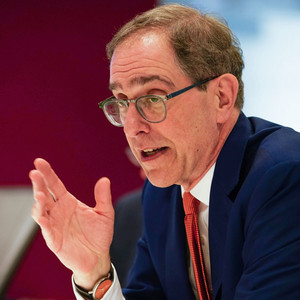
Today, my conversation with the president of Princeton University, Christopher Eisgruber, who has vowed that he will fight.
It's Wednesday April 9.
Hi, I'm Chris Heisperber.
Hi, Rachel Abrams. Thanks for coming here.
Yes, thank you for making the time for us.
You mind if I grab a cup of coffee?
Please no, no. You should definitely caffeinate.
Okay. I'm already caffeinated so I need to do caffeinated.
No good. We like that energy on the daily.
We're a high energy show.
All right. OK, come on back.
Thank you. So President Eisgruber, first of all, Eisgruber, right?
Yeah, feel free to call me Chris, please.
OK, Chris. It's easier than Eisgruber.
Chris, we are talking to you about one week after the administration moved to suspend dozens of grants to Princeton.
And that could be hundreds of millions of dollars potentially.
And this, of course, follows the moves from the administration against other universities.
We've seen it with Columbia.
We've seen it with Harvard. And if this goes the same way that it's gone for other institutions, what we could expect to see in the near future, if you haven't gotten it already, is a list of demands from the Trump administration, changes that they want to see from Princeton.
So we want to talk to you today about how you're feeling about the choices that you have in front of you and what those choices even look like, practically speaking.
But just to start off, I want to start this conversation with you maybe taking us back to the moment when, if you remember, when you realized that Princeton might actually be in trouble.
Well, without trying to be precise right now about the timeline, we began to see precipitous kind of threats to funding streams early on in the new presidential administration.
and that included initially a freeze of research funding to universities.
It included the imposition of severe caps on what are known as facilities and administration recoveries or overhead costs charges.
Those are charges that apply to very real costs of research, and suddenly the government is saying well we're going to take that number down in ways that are going to make it impossible for universities to go forward with the research that they've been doing before.
So that was the point at which I and every other university president realized there was a serious threat to this government -university partnership that has contributed to the strength of the country and to the quality of our research institutions.
Then, a couple of weeks ago, something happened at Columbia that introduced a new and, in my view, very dangerous element to this, which is that the government came in and, without any due process or any apparent investigation, and said basically to Columbia, we're gonna take away a bunch of your grants that support things like medical research and we're not gonna restore them to you unless you do things like admissions reform for how it is you take in undergraduate students and putting certain departments that deal with things like Middle Eastern studies into receivership.
That was whole new territory in terms of what the government was doing because the government was using its tremendous power over research dollars to try to control what a private university was doing in terms of matters that are generally considered part of academic freedom.
That is how you constitute your departments, how you choose your students, and presumably how it is you choose your faculty.
Of course, with Colombia, what the Trump administration said was that its motivation for pulling Colombia's funding was this failure to root out anti -Semitism on campus.
But in your mind, was that the motivation?
Did that ring true to you?
And what did you understand that action by the administration to truly be about with regards to Colombia?
Yeah, Rachel. So let's start with this, right?
Standing against antisemitism is a fundamental responsibility for any university president and for any university.
It's something where universities ought to be working in partnership with the government.
And if the government has concerns about antisemitism or any other form of hate on a college campus, it is legitimate for the government to go in pursuant to the laws that exist prohibiting that Title IX, for example Title VI, Title VI, right, and to come into require the university to take steps.
But that's the right way to proceed.
In that kind of investigation, as in any other kind of investigation, the government should be observing the due process that our law provides.
They should be allowing universities to respond and offer their side of the story.
And then they should be putting in place, if they find that there are violations, appropriate remedies that are tailored to the violations and to the law.
I think the problem with what happened at Columbia was that due process was not observed, the threats were made to funding without any real investigation or without any opportunity for Columbia to respond and then they were done in ways that encroached on these extraordinarily important principles of academic freedom.
From my own standpoint, as I look at Columbia, I would say it's clear there were some serious problems with anti -Semitism on that campus.
I also believe it's clear that Colombia was taking steps that they should be taking in order to address anti -Semitism.
If the government didn't think they were doing enough, that's a perfectly appropriate thing for the government to be involved in.
But again, respecting the norms of due process that are fundamental to our law and fundamental to our country, rather than doing this in some way that just comes in and says, hey, we're taking your funds and now, we want you to make these other kinds of changes.
So basically, you're viewing all of this.
I'm just going to narrate a little bit for us here.
You are seeing what's happening at Columbia.
That's when you decide to write this op -ed in The Atlantic, right?
That's correct. You said that what the Trump administration is doing right now basically amounts to quote, the greatest threat to American universities since the Red Scare of the 1950s.
Every American should be concerned.
Can you tell us a little bit, why did you decide to reup that op -ed And what did you mean by that quote specifically?
So, I decided to write the op -ed because I do think there's a very fundamental threat here right now with two dimensions to it, to America's research universities, that anybody who cares about the strength of this country, our economy, our prosperity, our security, our health should be worried about.
And one of those is the threat to this compact between the government and our universities that has produced research that's made a difference in the life of every American.
The reason I wrote when I did, when the threats were made to Colombia is that there's an even more fundamental threat when the government starts intruding on academic freedom.
And basically says, there are departments at Columbia that seem to be saying things that we don't like, we're gonna use this funding as a mechanism to try to change what it is Colombia is doing in that respect.
That means as we look at efforts to influence what universities are doing, how they teach about Israel and Gaza, how they teach about climate, how they teach about American history, how they teach about diversity.
We are seeing threats of significant intrusion into the freedom of scholars to raise the kinds of ideas that enable change to take place in our society and enable people to pursue truth.
We see another version of this going on as the government goes in and gives an order, for example, to the United States Naval Academy to remove a whole series of books from its library.
There is a pattern here of intrusions in academic freedom of strong universities that should be of concern to every American.
Basically to say this another way, the administration may have said that these actions that they're taking are about anti -Semitism and rooting that out on campus.
But it sounds like what you are saying and your point of view is that this is more about this broader beef the Trump administration has with institutions of higher education, specifically with regards to academic freedom, the things that they are teaching and not teaching.
And that the government, it sounds like, again, correct me if I'm wrong here, but, the government has this enormous leverage, which is research funding.
And that is the cudgel with which they can punish universities for speech, or actions, or conduct, or academics that they do not like.
And so I just sort of wonder, would you agree with that, that this is more about academic freedom than maybe some of the other reasons that we have heard recently.
Yeah. Rachel, I don't want to make this about motive and what the government's motive or intentions are.
What I would say is if this is genuinely about anti -Semitism, there's a right way to go about that.
Right? We should want our universities and our government to be partnering around making sure we have campuses where everybody can flourish.
And for me, that's about all the groups on my campus, it's about our underrepresented minorities, it's about our Jewish students, it's about our Muslim students, and we should all be working together around that, but there are right ways to do that.
The wrong way of doing it does involve using funds as a cudgel to get universities to do things that the government wants.
And when, for example, I'll take one particular demand in the government's letter to Colombia, they asked Colombia to do comprehensive admission reform.
I don't know what that means Rachel, but what I do know is that I can't draw a connection between the stated concern of remedying antisemitism and a suggestion that Colombia should do comprehensive admission reform.
You think these things are disconnected?
I think they're disconnected.
And in any event, I think that it's not appropriate for the government to be using its power as a funder to change the way that Columbia does its research, its teaching, or its admissions.
OK, I hear what you're saying, that academic institutions should be free to decide what to teach, when to teach, how to teach, who to admit, all of that stuff while also maintaining their obligations to have a safe and equitable environment for students.
I hear all of that.
You wrote a little bit about this in the Op -Ed.
To play devil's advocate for a moment, universities have made themselves, over the last few decades, incredibly dependent on government funding and public money.
That has made them vulnerable because it has given the federal government essentially this one enormous donor incredible leverage over universities.
Maybe they haven't dictated up until now what you should teach, but everybody knows the universities are beholden to their donors, and that donors have influence.
That's why people donate buildings.
So I just want to understand, first of all, how reliant Princeton is on federal funding, what it's used for, and whether in retrospect was it a mistake to build an ecosystem of higher education and learning that was so reliant on essentially a single donor?
So let me say a few things about that.
One is just that I think universities have a responsibility no matter where funding is coming from, whether it's from a private donor or from the government to ensure that in taking the funding, they don't accept any strings that are inconsistent and with academic freedom.
And certainly for me as a president, it means that we have to look carefully any time we take a gift, and there are gifts we turn down because we think that they would interfere with academic freedom if we took them.
Second thing you asked is how much funding we take as a research university per year from the federal government, which is, again, gonna be our biggest sponsor.
For us, it's around a ballpark in the neighborhood of $250 million a year on our main campus.
As I say, main campus, because there is also a plasma physics laboratory, which is a Department of Energy national laboratory that we operate for the government.
That's a government laboratory off campus.
And so that gets you up to around 400 to 500 million if you count the laboratory.
Which I just wanna note, in total, that's about 17, 18 % of Princeton's overall operating budget for the year.
So it's not inconsistent with that.
I'll trust your math on that, Rachel, but yes, it's significant.
And it would be higher at many of our peer institutions, Because most of our peers, for example, have medical schools.
And if you have a medical school given the size of its budget and it's dependent on national institutes of health funding, the percentages are going to be higher.
The other question you asked is whether or not it's a mistake to accept that funding given the dependence that it creates.
Rachel, I would say the answer to that is no. This funding has been present in the United States for a period of 70 years at all of our leading research universities, and it has allowed our research universities to be able to conduct research that makes a difference to the world that makes our country stronger and that we could not conduct, even at a place like Princeton with its endowment resources, if we were not accepting funding from the federal government.
And that becomes even more true as you look all the way across the country.
So when you ask about things like, why does the United States win so many more Nobel Prizes than other places.
Why is it that we have the set of discoveries here that over time lead to things like the internet and artificial intelligence or GLP -1s or new immunological cancer treatments?
Those things are happening because of this partnership.
And there could be other models that you could have that would involve less government money flowing to universities.
You would also have less research benefiting the United States if you did that.
I was just thinking about that for a second because why couldn't you just be more dependent on private sector money?
I mean, presumably the private sector would be just as interested in all of the research that you just described.
So couldn't you build a model where there's private sector funding?
What is the pitch for universities to take government funding specifically?
Yes, so when we are creating laboratories or buying equipment or doing other things, paying for faculty, a lot of that funding is coming from what our donors have made possible.
But you need another 250 million dollars a year to be able to do the research that those faculty are doing.
Could you sub in private companies funding that?
I don't think so, right?
Partly because the time horizon on the research that the government funds is in general longer term than what companies are looking at.
Sometimes. They want to return on their investment.
They want to return on their investment.
Okay. That's the way that works.
And I mean, I'll give you a couple of these examples that involve National Science Foundation funding.
Our university has been fortunate in quantum science to host a couple of Nobel celebrations over the last decade, one of them for Duncan Halden and one of them for John Hopfield.
When Duncan accepted this prize, he's an Englishman, he came over to the United States, and there were reporters from England interviewing him at the press conference.
They were interviewing him over zoom.
and they asked this question, well we're proud of you, as an Englishman having won the Nobel Prize.
How come you did it in Princeton, New Jersey rather than back home in England?
And his answer was, I came to the United States because of the National Science Foundation was willing to fund the longterm research that I do, whereas in England, the government funding agencies were looking at things which are much shorter -term application.
If we stop that compact between the government and research universities.
We're not gonna be doing the kind of research anymore that Duncan Halden did.
And that research is either gonna happen someplace else or it's not gonna happen at all.
Given that the federal government contributes so much money to universities, and that your point is that it's a unique relationship that the private sector cannot make up for it.
If you suddenly took away 200 million dollars, there isn't a private company waiting in the wings to fill that shortfall.
And given the fact that the government is now using the leverage that they have to force change on campus, I just want to take some of the government's arguments head on.
And specifically, as we mentioned before, the administration says what we're doing is in service of rooting out anti -Semitism on college campuses, particularly in the wake of the pro -Palestinian protests last year.
And you had mentioned earlier that you think that there is a problem or you have recognized that anti -Semitism is a real problem on college campuses.
You suggested that maybe colleges are not doing enough to route it out and combat it.
And I would like to know specifically, as a college president, as a, I think you mentioned in previous interviews that you yourself are Jewish and you feel a personal relationship to this issue.
I would like to understand and hear more about the specific things that you have seen in the past 18 months that are concerning to you and that have alarmed you.
Yeah, Rachel, so I appreciate the question.
And I should say that, you know, there are two things that are true simultaneously.
One is I see things that alarm me about antisemitism, The second is that many of our colleges are great places to be Jewish, and better places to be Jewish than a lot of other parts of our society.
So I would say that about Princeton, our students, our Jewish students report the highest levels of satisfaction and belonging on our campus.
And we look to support all of our students to make sure that they are having good experiences on this campus.
When you ask what alarms me on campus – Yeah, I'd like to know what specifically you've seen that has bothered you in the last 18 months.
So look, let me give you examples, both from my own campus and off my own campus, right.
So on my own campus, I would say that, both during my time as a student and a faculty member, and then as president, I had never heard an antisemitic remark directed to someone else or to me until last year.
I did hear antisemitic remarks, including a couple that were directed my way over the past year.
In person, somebody actually said something to you?
Somebody sent me something by email, and there was another one that was, you know, left for me as a message, I'll just put it that way.
So, like a physical note.
Yeah. Wow. Right. So, that's unacceptable.
Right. That's unacceptable directed at any student.
You know, those are, in my view, marginal instances on our campus, but there are unacceptable instances.
If I look more broadly at what's going on, these are not things that we've experienced on Princeton's campus, but there are reports of students being physically harassed or targeted on campuses.
There are classes that have been interrupted.
There are students who have trouble getting to their classes.
There were remarks made by people, students, and academics in the wake of the October 7th Hamas terrorist attacks that were utterly unacceptable, right?
So there was one Cornell faculty member, for example, who described the event as exhilarating to him.
It's unacceptable. And I don't see you can say something like that without anti -Semitism being involved.
So those things disturb me and we need to make sure that there are processes on every campus to enable us to address those incidents.
You have to have very clear rules and you have to be willing to enforce them.
I want to bring up another one of the administration's critiques, which is something you hear a ton from the right and have heard it for a while, which is that universities, particularly elite universities like Princeton, Harvard, Yale, the Ivies, they're not representative enough of the broader public, politically.
And of course, that's important because our judges, our lawyers, people that are incredibly influential in shaping society often come out of institutions like yours.
And so this is shaping not just how students think, but it is shaping American culture more broadly.
And that is why it is important to take a strong and aggressive stand.
I'm curious, what do you make of that argument first of all, and how important is it for a university to reflect the broader political ideologies of the country.
Is it a problem that most universities are probably left of center?
So Rachel, there are a lot of different parts to that question you just asked.
Let me start with where I think the truth is in the critique, right?
So, it is important for universities to have vigorous contestation about the truth and to make it possible for people of diverse viewpoints to express their opinions and to flourish on the campus.
So we need to be a place where conservatives feel welcome.
We also need to be a place where conservatives feel they can speak up.
And we need to be a place where, when there are important conservative arguments to be heard and when political viewpoints matter, people are asserting those.
And I do think universities can do better about that.
That is, when we're talking about free speech, we have to talk about the importance of having multiple viewpoints heard. And we should care about that because it's integral to our own mission and what we're trying to do in education.
and research. That's different from saying that universities should reflect the political ideology of the country.
We shouldn't actually, right?
We shouldn't. We shouldn't.
It's not our job to reflect the political ideology of the country, right?
We're not, we're not a Sunday morning talk show that has ideological balance on it.
We need to be open to conservative views.
We need to be a place where conservatives feel they can flourish, but we're supposed to be doing something different than just reflecting what's going on in the country.
We're supposed to be having arguments that get at truth and knowledge.
And that's different from a political debating society.
It's different from what goes on in Congress.
And it's different from what goes on in a lot of journalism or from the political distribution in the country.
There are political divisions about things like climate and vaccines right now.
And there There is no obligation, on the part of the universities, to reflect what is the political division of opinion on those subjects or about, say, capitalism and investing.
I totally hear you, that like, you don't want to platform ideas that you don't believe in such as bad science around climate change, but I'm sure you can understand how conservatives might hear what you just said and think that their viewpoints are not necessarily as welcome as other viewpoints on campus.
Christopher Rufo, I'm sure you're familiar with him, he has been pushing a lot of the the administration is now using, it seems, to make this broadside against higher education.
He's been arguing for years that universities are too, quote, unquote, woke.
That DEI is a problem.
He said something that I'm thinking of as you're talking right now.
He said if conservatives want to protect the American way of life, they must be willing to lay siege to the institutions and reorient them according to their own values.
People like Ruffo, and clearly he's got some powerful people who are listening to him, are thinking that what you just articulated is not enough.
and that is the reason why the administration is taking such an aggressive approach. And so I just wonder like do you need to rethink what you just told me basically?
No, Rachael, I think I need to insist on a distinction that I drew in what I just told you which is that it's really important for conservative views to be welcome on a campus.
But that's different from insisting on ideological balance on a campus.
Our job is to have an honest, fair, truth -seeking process, right?
And an honest, fair, truth -seeking process will produce criticisms of society.
It won't just be a mirror to society.
So that's a difference.
There's a second thing you said in your original question that also connects to what it is that you just asked about Christopher Rufo.
You quoted some accusations that universities indoctrinate.
Universities should never be indoctrinating, right?
And I don't think we are, and I don't think that the opinion data or the other serious studies of what universities do supports that.
We've got to be places where robust arguments take place.
I think what one has to understand is colleges and universities are going to be— I'm going to quote one of my predecessors in my office, Bill Bowen— they're going to be at a slight angle to society.
They operate pursuant to a different set of principles, scholarly disciplines that provide scholarly standards for how you judge arguments that are different from what exists in the rest of society.
So we shouldn't expect them just to be mirrors to what society is.
We'll be right back.
I want to go back to the storytelling for a moment and go back to Columbia, which capitulated pretty quickly to what the administration wanted.
And I want to get your reaction to that, but I also want to read you a quote that you gave, I believe it was to PBS, when Columbia was sort of in the midst of all of this.
You said, once you make concessions once, it's hard not to make them again.
So I'd like to know, did what Columbia did make your job harder as you're now trying to figure out how to deal with the administration?
And are you talking to other University presidents to try to come up with some kind of a united front much in the way that we're seeing some of the law firms that are under fire talking to each other to try to stand up for each other and present a united front.
Yeah, so, you know, let me start with this, right, which is that the circumstances right now that face any university president are really tremendously difficult circumstances and I say that because I don't want to underestimate in any way the difficulty of the choices that my counterpart at Columbia faced.
I believe it's important and essential to stand up for academic freedom, but the threats to an institution that are coming when the government says it's going to deprive that institution of federal funding are severe in a way that present really hard choices.
Presidents are talking to one another about this.
I chair the board for the Association of American Universities.
Board meetings occur regularly.
Now they used to be twice a year.
They're considerably more often at this point as needed.
of every one or two weeks or so.
This is a crisis. You're viewing this as a crisis.
It is a crisis. I mean the funding that is essential to the quality of American research and America's universities is under threat.
That's a crisis for universities and it is a crisis for our country.
We each have our own missions and our own needs, so our responses are not necessarily going to be identical to one another.
But I will say this, I think even when universities have to concede or make concessions, because they may be forced to do that in order to protect people.
I think they need to speak up under those circumstances and recognize the principles at stake, even if they say something like, I really regret this, but I need under these circumstances to make a compromise.
Do you wish you had heard that from Columbia?
I do wish I had heard that from Columbia, right?
I mean, I just think I understand why Columbia might feel that they had to make concessions under their circumstances.
These choices are so hard, right?
You have careers at stake, you have jobs at stake, you have the ability to educate your students at stake.
And you may say, look, I wish I could take a stand on principle, but given what's at stake, I can't.
But then you need to say that, right?
You need to admit, and you need to say to your community and to Americans, hey, there's something really fundamental that has been lost here.
Does this mean that you are considering making concessions to the Trump administration?
I'm not considering any concessions.
Not at all. No, look, we haven't been asked for anything, Rachel.
Right now, all the Trump administration has said to us and all the, actually, the funding agencies have said to us is that the grants are being suspended in general.
There are a small number of cancellations, but in general they've said that they've been suspended pending a period of time during which the administration is determining whether or not the grants are in accordance with law.
So they haven't asked us to do anything.
But you likely will.
If this is anything like the other universities, they're probably going to be sending you some sort of a list. Rachel, I don't know the answer to that question and I won't speculate about it, but I believe it is essential for us to protect academic freedom.
Okay, so let me just ask you specifically, let's just say that tomorrow the Trump administration says we want to put your, I don't know if you have a Middle Eastern Studies Department, but we want to put one of your departments under academic receivership or you don't get your money.
What do you do? We would not do that.
We believe that that would be unlawful and we would contest that in court.
which means potentially losing your funding, of course, from the government as we've discussed.
I mean, I'm just sort of wondering, if you're willing to do battle over some of the demands that one might reasonably expect are coming, have you guys modeled how long you could last financially without the government's support as Princeton as is now?
Rachel, I mean, right now, we are facing a variety of different threats to our funding model.
So just to be clear, because I think this needs to be there for me to answer your question, there's the kind of risk that you just made mentioned, there are the threats to NIH funding or scientific funding more generally, right?
Not specific to us, but across universities.
There are proposals to increase the tax on the endowment and there are adverse economic circumstances.
My understanding looking at stock markets down again rather significantly today.
Yes. Yes. It's probably sank more while we've been talking.
Yeah. So we are modeling various kinds of risks to our enterprise.
What I would say, Rachel is that in moves that we could make to try to raise other revenue or to reallocate priorities to decide we're going to refocus certain kinds of funding on research and give up on some other things that we might be doing.
Those could enable us to deal with short -term losses while we try to overturn decisions that were a threat to our academic freedom.
Wait. Just so I understand.
So you guys are actively considering losing some functionality of the university in order not to capitulate to the government?
That's something that you're looking at?
What we are looking at is how best we can use resources to preserve the core mission of the university.
So, look, I was the chief budgetary officer during the global financial crisis.
That was a 25 % hit to our endowment.
We had to make around a $180 million adjustment at that point to our budget baseline.
We basically said, under those circumstances, and those those numbers, if you do the inflation adjustment on them, are comparable to our total federal research funding on the main campus.
We said we're going to project three things that are critical to what it is we do.
That's our teaching, our research, and our affordability and access to the university.
And we're going to find ways to change other parts of our operation to draw upon other resources to allow for temporary increases to our endowment spend in order to get us through this period.
And, Rachel, we can do that kind of thing again, with temporary being an important word in there.
You can reallocate across purposes.
You can sustain your core for a period of time, but if you're not able to change the basic fundamentals there, I mean, basically our endowment bounced back after the global financial crisis.
At that point, what you're doing is saying, okay, we're gonna have to stop doing some of the things we're gonna do.
We're gonna look at, you know.
Like getting rid of, that's what I was trying to get at.
are you basically looking at different departments or different areas of the university that you would have to cut if this were to go on longer than a year or two?
Well, the first things you look at, so we're already in what we would call a kind of a soft hiring freeze that extends both to our faculty and to our staff hiring.
So, what I would say is, you're pulling your wings a bit on what it is you're doing, you're unable to take up, faculty members are coming to us all the time at places like this with research initiatives.
And some of the most exciting ones are often ones that they may not be able to get government funding for even in a kind of robust federal funding environment.
They're saying if you make an initial investment here, we'll start doing things that are really exciting and then we'll be able to put this onto federal grants once we have proof of concept.
Well, in these circumstances, we're able to do less of that.
And that's where you find yourself pulling back from what it is you've been doing.
Again, just like thinking as a lay person here listening to you, I guess my main burning question is like, are people at Princeton at your level saying, maybe Princeton has to recede from being a leader in scientific research. No. We are not, but there are new initiatives that get harder to do, areas that you want to see universities move into.
That you're not going to be able to do.
That people won't be able to move into.
I just want to point out, it sounds like you are saying, you guys are doing your modeling, you're doing your research, you're looking at your resources, and things will be fine.
You are going to figure out a way to adapt to this environment and continue doing the work that the university is doing without capitulating in the ways that you have perhaps seen from your peers.
And then you can also probably adapt without giving up on research entirely.
There might be new areas you can't go into, but you will remain a research institution on the forefront of research. I guess what I'm saying is, on the one hand I hear you saying it's a crisis.
On the other hand I hear you saying it's going to be fine.
And I'm kind wondering sort of which is it?
I'm not saying it's going to be fine, right?
I just want to be clear about where are our commitments and our priorities, and how are we going to do that, and when I talk to you about what we're doing in the global financial crisis, we were laying off up people into the worst economy that existed in the United States since the Great Depression, that's not things being fine as far as I'm concerned.
Eventually, universities will have to make choices about what they do around affordability and what they do around research if things get bad enough, right?
So our students right now because of our endowment, we have 83 % graduating with zero debt.
At some point, you get to really tough choices about how good does your financial aid program have to be, right, in order to be able to sustain the research that you do.
If you get contraction in what research is going on, you got some universities that go to other places, right, that have to make judgments that we don't have to make about whether they're gonna continue to accept the grants that support their medical schools or compromise on academic freedom, neither of those choices is fine.
There's nothing that's gonna be fine if we don't restore simultaneously a respect for academic freedom without which you cannot be a great research university or this funding.
And I'm just saying our choices are, first of all, we have to protect academic freedom, I do not think we can give up on that.
And the right set of choices for us are ones that say all right, we're gonna reallocate around priorities that mean we're gonna do research and teaching of the highest quality, but not be able to do as much of it as we would otherwise do.
And I don't think that's fine for us, right?
And the choices get harder and harder the more the revenue streams come to bear.
At some point you're going to get to places where even what I described right now is not possible and things are going to get worse.
So things can get very bad.
I'm sure every university president is considering these questions and these considerations that you've outlined.
I sort of wondered, just to zoom out for a second, Do you feel, in the same way that you look at Colombia and you think, I really wish that they had said something about how they don't like this, how they find this sustainable, unproductive, whatever it was, do you feel pressure and an obligation to your fellow presidents, to your fellow universities, to the students at institutes of higher education around the country to really fight back in some way?
I mean, how much of this is about the community that you are in and not just Princeton?
It's absolutely about the community that I am in.
I've felt right since the beginning of my presidency, not just now, but everything we do at one university in the United States depends upon this extraordinary ecosystem of universities that we have. We all depend on one another and the country depends on the network, right?
We educate a tiny fraction of students at Princeton and we depend on other universities partnering with us and we depend on them for the research that gets done.
And I really think we all need to be speaking up right now.
It's important for me to be using my voice and it's why in response to a number of your questions, I've said, hey, I can tell you about what's going on at Princeton, but I don't think this is all about Princeton.
It's about what's happening in the United States.
I think this would be so much stronger if many more of my fellow presidents were speaking up.
You're hoping that they do what you do.
I really want them to do what I do.
President Eisgruber, thank you so much for your time.
Rachel, thank you for the opportunity.
On Tuesday night, the Trump administration announced a new round of funding freezes, this time directed at Cornell and Northwestern universities.
Officials said the moves come amid civil rights investigations into both schools, And they bring the total amount of funding that's been suspended or canceled at universities across the country to more than three billion dollars.
We'll be right back.
This podcast is supported by Betterment.
Don't just imagine a better future start investing in one with Betterment, whether it's saving for today or building wealth for tomorrow.
We help people and small businesses put their money to work.
We automate to make savings simpler.
We optimize to make investing smarter.
We build innovative technology backed by financial experts.
For anyone who's ever said, I think I can do better.
So be invested in better with Betterment get started at betterment .com.
Investing involves risk performance, not guaranteed.
Here's what else you need to know today.
For a fourth day in a row, U .S. stocks ended down on Tuesday as global markets continued to spasm from President Trump's sweeping tariffs.
The S &P 500 dropped another 1 .6%, putting it on the edge of bear market territory.
And... The Supreme Court on Tuesday blocked an order that would have forced the Trump administration to rehire thousands of federal workers.
While the practical consequences were unclear, the order was at least a temporary victory for the Trump administration's efforts to shrink the federal bureaucracy.
Today's episode was produced by Rob Zipsko, Sydney Harper, and Caitlin O 'Keefe.
It was edited by MJ Davis Lynn and Paige Cowett, with research help from Susan Lee.
It contains original music by Dan Powell, Pat McCusker, and Diane Wong, and it was engineered by Alyssa Jayne Moxley.
Our theme music is by Jim Brumberg and Ben Landsberg of Wonderly.
That's it for The Daily.
I'm Rachael Abrams. See you tomorrow.