From The New York Times, I'm Nathalie Kittroweth.
This is The Daily.
In the days since deposing Nicolas Maduro, President Trump has given several justifications for his dramatic action in Venezuela.
Number one, the drugs are pouring into the country, you know that.
Number two, the people are pouring into the country were...
But the thing Trump is most focused on, the thing he keeps pointing to as central to his ambitions We're going to take back the oil that frankly, we should have taken back a long time ago.
...is oil.
We're taking back what was taken from us.
They took our oil industry.
We built that entire oil industry.
Specifically, opening Venezuela's vast oil fields to American companies.
They stole our assets like we were babies.
And the United States said absolutely nothing about it.
So now we're doing everything about it.
Today, my colleague Anatoly Kermeneyev explains the history behind Trump's claim that this is our oil and what it would really take to get it back.
It's Tuesday, January 13th.
Anatoly, we're here today to talk to you about Trump's interest in Venezuelan oil.
And the reason that we are again turning to you is that you famously for some of us former Latin America correspondents spent nearly a decade in Venezuela, covering the country when Maduro first came to power.
And you are a student of and our in-house expert on Venezuelan oil.
So welcome back to the show.
Thanks for having me again, Natalie.
Let's just start with a basic question, which is, why is Trump so focused on Venezuelan oil?
Venezuela is a quintessential petro-state.
It is arguably the first petro-state.
It is a nation that has been built by oil, that defines itself through oil.
And if you are an American president who sees the world through the prism of natural resources— who sees the world through the geopolitics of energy and control of energy resources, then Venezuela is your natural target.
As my colleague Rebecca Elliott wrote, you have a country that is today the world's largest oil producer the United States targeting the country with the world's biggest oil reserves Venezuela.
It is, in a way, a natural relationship, a natural relationship tango, of course, shaped by drama, shaped by cooperation, by competition, by all sorts of conflicts.
But it is a collision of two countries that are in different ways shaped by oil.
Right.
And it's difficult, obviously, to get inside the president's head.
But we do have his public statements on this.
Right.
He's gone out and offered a very explicit justification for some of this, which is he's saying this is going to make the US and Venezuela a lot of money.
Absolutely, yeah.
For us as reporters, one of the most shocking and unexpected elements of this whole drama is just how explicit, how direct, Trump is being about his motives.
The central, the driving aspect of this whole campaign against Venezuelan President Nicolas Maduro is about oil.
This is the crucifix of this entire issue.
And the other thing that he's been saying other than this is about oil we can make money on this is that this is rightfully ours, that the US has a claim to this oil.
So walk me through those statements.
What are he and his allies saying there, really?
Well, this is perhaps the most contentious and complex parts of the story that Trump is saying that the US is reclaiming what's rightfully theirs, what's rightfully America's.
And this sentiment has been echoed by his officials.
You know his top advisor, Stephen Miller, has said, and I'm quoting American sweat, ingenuity and toil created the oil industry in Venezuela.
Its tyrannical expropriation was the largest recorded theft of American wealth and property."
Right.
I remember that post from Miller.
It was quite strident and direct.
Yeah, it's really wild and exaggerated and incendiary, but it does contain the grain of truth.
And to understand where he comes from, you have to go back all the way back to the beginning of Venezuela's oil industry, a century ago.
Okay, take me there.
Tell me that story.
I want to understand where the grain of truth in that statement really is.
When Columbus discovered Venezuela 500 years ago, he thought he'd found an earthly paradise.
Venezuela was a land of mountains, plains and jungles, and with only a handful of Spanish towns and villages.
So, before the oil was discovered, Venezuela was sparsely populated underdeveloped, full of poverty and very little infrastructure.
The first Europeans came to Venezuela seeking gold.
They later found black gold, crude oil.
On December 14th 1922, an oil well being drilled near Lake Maracaibo blew out at the rate of 100000 barrels a day.
Oil was discovered in Venezuela at the very beginning of the 20th century.
And the industry really takes off in the 1920s.
The boom that was propelled a few years later by mass migration of American oil workers.
Foreign oil companies operate the wells.
And those American oil workers.
They started building towns built in the American way, with American grids suburban houses schools baseball, social activities, churches.
And those towns gradually grew into cities and then metropolises, again imitating American way of life.
Oil workers like Juan Ramirez, with their high salaries and many company benefits, have achieved a way of life which is very similar to that of workers in the most advanced countries of Europe and North America.
Local employees which are hired by American oil companies, become the backbone of a new middle class.
The Ramirez family lives in a modern community planned and built by the oil company.
The oil money has been spent on public buildings, skyscrapers, broad avenues, and highways.
The streets became highways, the social clubs became malls, the suburban houses became skyscrapers.
Venezuela's oil capital, Maracaibo in the west, is known here as the Houston of Venezuela.
The hope is that the future holds more jobs, better living standards, better homes.
Venezuela basically answering modernity through the prism of how American oil workers saw the world.
To Venezuela's people, oil is everything.
Wow, it's interesting.
You're saying basically, that the Americans left a huge mark on Venezuela, not just seen in the oil industry itself, but all over the country.
It's funny, what you're saying about the architecture does ring true.
I haven't spent that much time in Caracas, but it's right that it looks more like an American capital than you'd see elsewhere in Latin America.
That's right.
And after the influx of American workers, American capital, the oil production starts to rise rapidly.
And in the 1950s, Venezuela was the world's largest oil exporter.
It is making tremendous amounts of money.
And Venezuela's dictator at the time, Marcos Perez Jimenez.
He uses that oil wealth and pours it into the country's infrastructure.
He starts building massive tunnels, bridges, highways.
Venezuela becomes filled with these massive, grandiose projects that put it way ahead of its peers in Latin America.
It becomes one of the richest countries in the region, arguably one of the richest countries in the world.
And it starts to attract migration from all across the world, from other corners of Latin America, from Asia, from Southern Europe, from Lebanon.
Venezuela becomes this melting pot of cultures, all drawn to the wealth provided by the oil industry.
That is fueling the economy, fueling the country's development and reshaping it as this mecca of modernity at a region that was still extremely poor and backward at the time.
So obviously there is a clear benefit for Venezuelans in all of this.
They're reaping rewards from this boom.
But they're also seeing that there's a bunch of foreign companies right making a lot of money off of selling what is their main natural resource.
So as good as those times may have been, was there any tension there?
There was.
There's a growing number of Venezuelans begun to question the status quo, which gives the bulk of the wealth towards the corporations.
And Venezuela really becomes the driver of a movement that ended up reshaping the world, a movement called resource nationalism.
And what is that?
What's resource nationalism?
It's a concept that states that ultimately, natural resources belongs to the citizens of a state, that the country's national wealth belongs to its people and not to the corporations that are exploiting these resources.
And when is this taking hold?
Just give me a sense of time here.
So in late 50s, a Venezuelan statesman called Juan Pablo Perez Alfonso travels to the Middle East.
He goes to the other oil producing nations and convinces them.
If we bond together, if we stick together, we can assert our sovereignty, we can bring more wealth to our people and we can minimize the influence of corporations in our society.
And this becomes OPEC, which is basically a group of oil nations that together agree on how much oil is produced between them, thereby setting the prices and setting the pace of a global economy.
The idea behind this association, which it sounds like Venezuela is key to helping create, is that these countries are going to agree on how many barrels they want to be in the supply, and that that will affect prices, giving them some control over the revenues they're reaping from this production.
That's right.
And the second crucial pillar of resource nationalism is ownership of resources.
So it starts a chain of legal reforms that assert that what lays on the ground belongs to the states.
This decision is an act of faith in Venezuela and the Venezuelans.
And it culminates in Venezuela in the 1970s when a censor-left, pro-US president at the time, Carlos Andrés Pérez, decides to nationalize Venezuela's oil industry.
And what does the nationalization of Venezuela's oil actually look like?
How does that play out?
So Carlos Andrés Perez chooses a relatively conciliatory path.
This is a Cold War.
Venezuela is deeply allied to the United States.
So he starts talking to the oil companies.
He works out an agreement where the oil companies are compensated and are offered contracts under which we can continue making a lot of money.
And nationalization creates a company called Petróleos de Venezuela, a state-owned company known here universally as PDVSA, which now owns all of Venezuela's oil.
And how do Venezuelans feel about this?
Nationalization becomes the source of national pride.
It becomes one of Venezuela's foundational myths.
It becomes an event that divides Venezuelan history and before and after.
What Venezuelan people assert in control over their wealth, over what they consider their birthright, the oil under the ground?
And this company, Cerevesa, grows and is working together with foreign oil companies.
And it's using some of the revenues to train Venezuelans in the oil industry.
It is using the money to send Venezuelans on scholarship to world's best universities.
And it becomes a fairly effective modern company that is at the cutting edge of technology at the time.
It was a place where Venezuelan middle class, where Venezuela's professional class, had formed itself and becomes the cornerstone of Venezuelan society.
And oil prices are at their peak.
The country is flooded with money, with much of that wealth going into education and alleviation of poverty.
Anatoly, you've described this long tale of history where American oil men came in, worked the fields in Venezuela, got this incredible industry up and running.
And it sounds like Venezuelans really actually gained a lot from the partnership and from the nationalization that came from it.
They got this setup where their national company runs things, where it's working with foreign companies and it's fueling pretty remarkable development.
That's right.
It was a blessing.
But it was also a curse.
Venezuela became addicted to oil.
Its economy became extremely dependent on oil.
And then in the 80s, the global economy changed and the oil prices started to go down.
The price of a barrel dropped from $40 to $10.
Wow, that's pretty massive if you're depending on this.
It's a massive decline, Natalie.
And the cracks begin to appear in Venezuela's economic model.
Venezuela goes from a period of abundance, where the state lavished money on a welfare state, to a period of scarcity, where money scars, where public spending scars, corruption scandals grow and people become increasingly disillusioned and angry with the system.
So what does the Venezuelan government do?
How do they respond to this crisis?
The government's solution to this anger is more oil.
They turned to a remote region of the country called the Orinoco Oil Belt, which contains the world's largest oil reserves.
But these reserves are locked in sludgy tar.
That is extremely difficult to process and it requires cutting-edge technology to make it sellable, which Venezuela does not have at the time, but American corporations do.
So the Venezuelan government turns to foreign investors, turns to foreign multinationals to help them unlock the wealth hidden in this remote region.
And they call this process apertura petrolera, the oil opening.
It is, Natalie, one of the most ambitious oil investments programs in the world at the time.
And Perevesa, the state oil company that has been at the heart of the Venezuelan economy, the heart of its public life, takes the backseat and allows foreign companies to take the lead on the development of these reserves and take the lead on monetizing the profits from these reserves.
And does it work?
Does that arrangement actually yield anything?
The oil starts to flow, production starts to increase rapidly and reaches more than 3 million barrels, from about 15 million by 1998.
But the economic stability never comes back.
People feel that the oil industry no longer serves the national interests.
And people start to look for solutions elsewhere.
And it fuels the rise of one of the most important politicians in modern Latin American history.
Viva Venezuela!
An army officer called Hugo Chavez.
We'll be right back.
Okay, let's talk about who Hugo Chavez is and what his role is in this moment.
So Hugo Chavez grew up in a poor family in Venezuelan savanna.
And like many working class children in Venezuela, he saw his chance to succeed in life in the armed forces.
He joins a military academy and rises rapidly further ranks using his sharp intellect and charisma.
At the same time, he becomes influenced by nationalist and socialist ideas floating around during the Cold War.
And in 1998, he launches a political campaign that takes the country by storm, capturing support from all segments of Venezuelan society.
And what's his message in this campaign?
His message is, Venezuelan oil belongs to Venezuelan people.
And he rallies against PDVSA, the state oil company that he sees has become basically a fiefdom of Western interests, a fiefdom of Venezuelan elites that have lost touch with the people, that are servant by our own interests, that have turned PDVSA into a little country club for the rich and the privileged.
And Chavez wins 56% of a popular vote.
Many Venezuelans rejoice when he becomes president in 1999.
And after he wins, how does he make good on those campaign promises?
So his first big project is redistribution of Venezuela's wealth.
And that means restructuring completely the way PDVSA works, the cash cow of the economy.
And this sends Chávez on a crash course against the company's management, the high priests of the Venezuelan oil industry, the Western-educated technocrats that have been running the Venezuelan oil industry for decades.
That PDVSA elite has crossed the line.
In 2002, Chavez goes on national television, pretends to be a soccer referee, blows the whistle and fires Bedevesa's senior executives.
Offside!
Offside!
He says, you are offside.
When Chavez replaced the oil company's top executives with political appointees, some of whom were radical Marxists, there was a management revolt.
And this fuels nationwide protest that rocked the country throughout 2002.
This is a crucial moment in Venezuela's history because many of the country's middle class realize that this is a power grab.
These people who have for generations seen PDVSA as a model of national development, they see it being taken apart for a political project without any consideration for accountability or democratic norms.
And the year culminates with a massive oil strike.
Pedophilic workers paralyze the country.
Exports stop.
The country runs out of gasoline.
The country is in chaos.
And tens of thousands of workers, including most of the company's skilled workforce, walk out of their jobs, basically paralyzing the Venezuelan economy.
And how does Chavez respond?
He fires thousands of Venezuelan workers, primarily managers and skilled workers, people that supported the strike, but also people that made the company tick, people that made it competitive and efficient.
And he turns the company into just another tool of his political populist campaign.
And all of a sudden, this company, but it's known for its technological expertise and efficiency, starts thriving, opening supermarkets, providing daycare, hosting theater performances.
Well, like theater sponsored by PDVSA, like sponsored by your state oil company?
It's hard to think of a cultural or social activity or a product that you buy that has not been sponsored or sold by PDVSA at the time.
It literally just becomes the provider of social services and welfare in the country.
And corruption also increases.
Many of government insiders, many people close to Chavez, become big oil industry contractors, providing PDVSA with services and goods that are overpriced in return for political loyalty.
So this state-owned company that was such a source of national pride, this crown jewel, has now been gutted basically, of the expertise and the technical know-how that made it work, that made it so functional for so long.
That's right.
It's revenue's fall and production begins to decline.
And Chavez needs to look for other sources of revenue.
It needs to look for other sources of wealth that fund his populist projects.
So in 2007, he launches another wave of nationalizations.
He takes aim at the oil opening, the apertura.
Remember those international oil companies that have spent billions to refine the tarry crude locked in Orinoco oil belt.
The Chavez government has told its foreign partners that they must agree by May 1st to give Petrovesa a 60 stake in those joint ventures or see them nationalized altogether.
Well, Chavez decides that these projects now belong to the state.
He forces the companies to give up control of these projects and give state majority share.
We will never give this, our wealth, our nation, to the United States Empire, even if the Venezuelan oligarchs scream or if the United States and its multinational companies attacks us.
And two major oil companies, companies that became ExxonMobil and ConocoPhillips, refuse.
ExxonMobil wants to be compensated for the investments it lost when Chavez nationalized the country's oil venture.
They leave Venezuela and start a series of legal processes that end up awarding them billions of dollars in damages that these companies continue to claim have been stolen from them by the Chavez government.
So, unlike the first wave of nationalization in the 1970s, which you said led to a relatively functional partnership between the Venezuelan government and foreign oil companies, this wave is a lot more contentious.
And I wonder is this what Trump and his aides are referring to when they talk about Venezuela stealing from American oil companies?
Like, is this the moment that they're referring to?
We don't know, but it is the moment when Venezuela came closest of defrauding American companies, came closest to taking away the money that American companies have claimed is rightfully theirs.
But there was an exception Chevron, an oil company that decided to accept much less profitable terms, knowing that in the long term they stand to win.
The country had the biggest oil reserves in the world.
So even if there was a small chance that those reserves would fall into companies' hands, it would create a massive amount of wealth for the corporation and its shareholders.
Okay, so at this point, PDVSA is a shell of its former self.
The American companies are all gone, except for Chevron.
And Venezuela is now sitting on this massive oil reserve without really the capacity to realize the potential.
The infrastructure, the institutions, they just don't really exist anymore.
That's right.
And when Chavez dies in 2014, the rickety populist economic system that he has built falls apart like a house of cards.
All prices fall and with it the Venezuelan economy.
Starting in 2014, it enters a prolonged period of economic decline, of collapse that ended up being the biggest economic crisis in modern history outside a war zone.
After 17 years of socialist rule Venezuela, one of the world's largest oil producers, has the world's highest inflation rate.
With basic necessities scarce and inflation skyrocketing.
Some reports suggest it could go as high as 700.
And that crisis spreads to the oil industry.
It becomes a shell of itself.
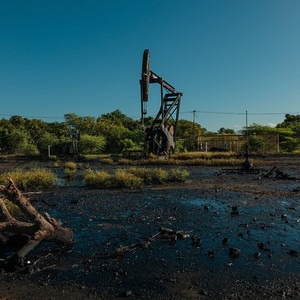
Wells dry up, investments dry up and people are scrambling around oil fields, taking apart the infrastructure, taking apart the pipelines, the fences, the equipment for scrap.
Venezuela's wanted oil fields become a scene out of a dystopian movie.
It's kind of wild to imagine, when you just think about, how much money and time and effort went into building all of that stuff, to have it basically be torn apart and sold for parts.
I mean, things had to have been really bad at that point.
People are struggling to survive, Natalie.
The people of Venezuela are suffering from violence, a world record of daily murders and random kidnappings.
Malnutrition rises massively.
Many people are skipping the meal.
I'm very annoyed.
Only God knows what we're going through.
Because in truth, no one is helping us.
The situation is so severe.
The New York Times reports it's even making it hard for doctors to keep newborn babies alive.
Millions of people emigrate from a country.
It is difficult to imagine the scale of collapse that the country has experienced, losing more than three quarters of its economic activity, without a war, without social unrest, without a major natural catastrophe, all caused by the populist policies instituted by Hugo Chavez and continued by his successor, Nicolas Maduro.
And this is a huge blow obviously, for a movement that has made its name, selling itself as a leftist movement that cares about the people, that is working to prevent this kind of poverty from making people suffer.
So what's the response?
So initially the government tries to just chug along, repressing protests and doubling down on the failed policies that have brought the country to its economic knees.
But then President Trump starts his first term and he launches a campaign to depose Mr. Maduro.
And his biggest blow was sanctioning the Venezuelan oil industry, basically making it illegal for Venezuela to sell its oil to the West.
This paralyzes Venezuelan oil experts and paralyzes economic activity, deepening the crisis.
And it forces Maduro to change tack.
He entrusts one of his top lieutenants, Dast Rodriguez, to fix the economy.
Now the leader of Venezuela. now the leader of Venezuela.
And she embarks on a long campaign to steady the economy.
And the pillar of her campaign is to change the oil industry.
And she does it by launching stealth privatization.
On paper.
The oil continues to belong to Venezuelan people and the state has the dominant role in Venezuelan oil projects.
But in practice, under the secret contract signed by Delsi, Foreign companies gain control of the New Zealand oil fields.
They get to make all the decisions about them and they're given a bigger share of these projects' profits.
Investment picks up, and so does the oil production.
And by the end of 2025, the country is producing 12 million barrels per day, a fraction of where it was before Chavez took power, but a significant improvement to where the country was just a few years ago.
OK, so at present, you're saying things are certainly not as dire as they were.
But in general, the story that you've told overall paints a picture of extreme decay in this industry, in the infrastructure around it, an industry that is very difficult to just start back up overnight when you start to lose it, given how much it takes to make it work.
Trump is now saying, after having captured Maduro, after supporting Delcy, now as the leader, that US companies are going to revive Venezuela's oil industry.
What would it take to actually do that right now?
It would take tens of billions of dollars in investment.
Delta Rodriguez was able to reverse the decline and edge up the production by taking the low-hanging fruits, by fixing things that were easier to fix.
And many oil executives and analysts say that these low-hanging fruits are coming to an end, that for Venezuela to significantly improve its oil production, to take it to a whole other level, would require a massive scale investment that the country has not had for decades.
But there is good news for the oil companies.
And that is that everyone knows where that oil is.
The hard part, the exploration has already been done.
The difficulty is getting it out of the ground.
Remember that most of Venezuela's oil reserves lie in the sludgy area called the Orinoco oil belt.
And the cutting edge multi-billion dollar plants that were used to process them have largely been decayed and disintegrated.
The thing about the oil industry, Natalie, is that you cannot just... turn the spigot back on.
But once something decays, once something falls apart, it often damages the geological receptacle holding the oil.
And it's extremely expensive and time-consuming to repair the infrastructure, to repair the reservoirs and make the oil flow again.
And is doing that actually appealing to American oil executives?
Like, do they actually want this challenge?
That is the main question right now, Natalie just how committed the companies will be to taking another battle in Venezuela, taking another battle in the country that has burned them badly in the past.
So there's still a lot of unknowns, but the cost of sitting on the sidelines is massive.
At stake are literally the world's largest oil reserves.
Just last week, Trump met the executives of some of the biggest Western oil companies to talk about investment in Venezuela.
The plan is for them to spend, meaning our giant oil companies will be spending at least 100 billion of their money, not the government's money.
And the broad takeaway was that, while Trump made big promises touting 100 billion investments in the country, companies themselves showed interest.
For more than a century, Chevron has been a part of Venezuela's past.
We are certainly committed to its present and we very much look forward, as a proud American company, to help it build a better future.
But remain cautious.
We have a very long history in Venezuela.
In fact, we first started in Venezuela back in the 1940s.
We've had our assets seized there twice.
And so you can imagine, to reenter a third time would require some pretty significant changes from what we've historically seen here.
And, very tellingly ExxonMobil, one of the world's largest oil companies and the company that left Venezuela in 2007, said that If we look at the legal and commercial constructs and frameworks in place today in Venezuela today, it's uninvestable.
Venezuela today is uninvestable.
Underline the challenges facing Trump's plans towards the country's oil industry.
Let's get into some of those challenges.
What are the conditions that you think need to be present for these companies to come back and to make the kind of sustained investments that you would need to see for the potential of Venezuela's oil fields to actually be realized?
So first of all, you have to keep in mind that Maduro has been gone for just about a week.
The new leader that has replaced him, Delcy Rodriguez.
She's basically ruling through the guns of American warships, trained on her internal enemies.
The country is filled with armed groups that have been loyal to Maduro.
The country is filled with weapons.
The country is filled with different political factions that oppose Delcy Rodriguez and her policies.
And the risk of unrest and violence is What you're describing.
Anatoly is a situation in which Delcy formally holds power, but she's also contending with these internal rivals, and particularly figures in the political spectrum that have a lot of power, not only over the armed forces in Venezuela, but over armed groups within the country that, if she doesn't control them and if her rivals do, could cause a lot of trouble.
That's right.
She's under pressure to generate wealth, to please the Americans and get the oil flowing.
But at the same time, she's trying to keep at bay the hardliners that are just waiting for her one wrong move in order to pounce and undermine her government.
Okay, so one broad condition for foreign investment, for the oil companies to return to Venezuela, is political stability, which does not seem like a guarantee at all at this point.
What else?
Then come the legal guarantees.
American oil companies have been burned here before.
They have lost billions of dollars of investments and they want to make sure that this will not happen again.
And, of course, for now, President Trump is completely focused on getting Venezuelan oil into the ground and into the United States.
But his term is running out in three years and we don't know who will succeed him, and nor do the oil companies.
And this uncertainty and the scale of required investments is giving them a pause.
Right.
It's interesting the point about Trump leaving office creating some uncertainty there, because essentially what you're saying is these companies they operate on very long timelines.
So not being able to forecast out 5, 10, 15 years in the future, that's a real liability.
It is.
And, of course, the world is going through an electrical revolution where the structure of how we consume energy and the energy we need is changing dramatically.
China is winning itself off the oil by moving towards electric cars and sustainable energy.
And these companies.
When they look at the billions of investments that have to be made, they are thinking will this oil be needed in 10, 15 years time?
Okay, just to enumerate these conditions, because they are many and they feel really monumental.
We're talking about some kind of understanding that there will be political stability inside Venezuela and a consistent desire and ability to collaborate with the United States, as well as a sense that the revolution in clean energy is not going to just totally displace oil in the future right,
So for a moment, if we set aside whether all three or any of those conditions are actually anything that these companies can bet on and just assume for a moment that things work out in their favor and that the investment flows in,
Play out that best case scenario for a minute.
If Venezuela and these oil companies achieve that, what exactly would the US gain?
The US would gain a massive source of oil.
And that means that global oil prices will fall.
And that means that the gasoline prices will fall.
The price that American people pay for pump will fall.
Remember that affordability is now the crucial tenet of American politics.
This is a weight dragging down Republican party in one election after another.
And President Trump's biggest concern right now is bringing these prices down.
And flooding the global oil market with Venezuelan crude is potentially one of the measures that could help them achieve that goal.
And if we're just still living in this hypothetical best case, I have to also imagine that controlling what's assumed to be the world's largest oil reserves would give the US a lot of power geopolitically over our rivals.
I mean, in that case, you really can turn a spigot on and off.
Absolutely.
And this would have massive consequences.
Take, for example, America's relations with Russia, another nuclear power, before whom it's currently negotiating a broad deal focused on the war in Ukraine.
Russia also derives most of its revenues from oil.
And if Trump is able to set global oil prices by turning on and off the spigot of Venezuela's oil bounty, this is going to make it very difficult for Russia to achieve its goals without bowing to America's needs.
China, as we said, is winning itself away from oil, but that process could take decades.
And in the meantime, it is extremely reliant on oil. imports from other countries.
And if Trump can control the source of those impacts again, he can force Beijing to bow to its demands.
I want to just push also on one of the premises of these conversations, which is that Trump and a future US leader would actually be able to control Venezuela's oil.
The U.S. does not have at this point direct control over the Venezuelan government.
And I assume you know, down the line, future Venezuelan leaders may be reluctant honestly, to be viewed as simply puppets of the US government.
And if the US military is not, you know, training those weapons on Venezuela indefinitely, how long can that setup really last?
Is the premise of control actually a fallacy?
For now, Natalie, things seem to be working out in Trump's favor.
Venezuelan interim government has already announced that it's going to embark on a massive legal reform, potentially changing the oil laws, to give foreign companies a greater say in how it's run.
And remember that this government remains deeply dependent on the implicit threats of American force to keep its internal adversaries at bay.
And appears to be more than willing to be doing Trump's bidding.
But Natalie.
History shows that such ambitious grandiose, long-term plans rarely turn out the way they've been envisioned.
There's just so many different facts that have been thrown together at this historical moment.
And the future of the Venezuelan oil industry and, by extension, the future of the Venezuelan people, may look very different from the way Washington sees it now.
Well, Anatoly, thank you.
It's a pleasure to be here, as always.
We'll be right back.
Here's what else you need to know today.
On Monday, officials in Minnesota and Illinois sued the Trump administration over ICE enforcement in their states.
They argued that the mass deployment of immigration agents violated the Constitution and infringed on state sovereignty.
The suits come after a high-profile ICE campaign in Chicago and in the middle of an ongoing and increasingly tense enforcement blitz in Minneapolis.
Federal officials have defended their work in both states, saying it's been necessary given that local officials haven't cooperated with President Trump's immigration crackdown.
And federal investigators examining the fatal shooting of Renee Good are looking into her possible connections to activist groups that have been protesting ICE.
According to people familiar with the matter who spoke with The Times,
They're also reviewing the actions of the federal agent who killed her.
Today's episode was produced by Ricky Nowetzki, Caitlin O'Keefe, Diana Nguyen and Aastha Chaturvedi.
It was edited by Lisa Chow with help from MJ Davis-Lynn.
Fact-checked by Susan Lee.
Contains music by Dan Powell and Marion Lozano.
And was engineered by Alyssa Moxley.
Special thanks to Carlos Prieto and Larissa Anderson.
That's it for The Daily.
I'm Natalie Kitchel.
See you tomorrow.