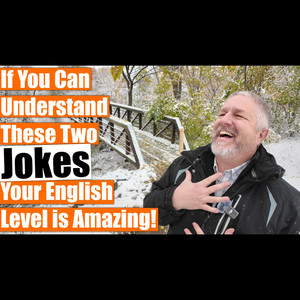
One way that you can test your English understanding is by listening to an English joke and understanding the joke and hopefully, laughing at it.
If you can listen to a joke, if I tell you a joke, and if you understand what I'm saying but you also laugh at the joke because you understand why it is funny, it would mean that your English level is very, very high.
Your English understanding is very, very good.
So in this English lesson I will tell you two different jokes and your job is to try and understand the joke and then your job is hopefully, to laugh at the joke, because you understand it.
Okay, here we go, joke number one.
My uncle told me this joke when I was really, really young and I thought it was hilarious.
For this joke you have to imagine that there's been an accident on the highway and there was a truck and the truck had penguins in it and all the penguins are safe.
They didn't get hurt in the accident, but they're walking around on the highway and there is a police officer there and a man stops with a pickup truck.
And the police officer says to the man, hey, could you do me a favor?
Someone needs to take these penguins to the zoo.
So the police officer and the man.
They put all of the penguins into the back of the pickup truck and the man leaves to bring them to the zoo.
And the police officer stays and handles the rest of the accident and does whatever police officers do.
Well, a week later, The police officer is driving on the same highway and he sees the man in his pickup truck and he still has all the penguins in the back.
And so the police officer puts his lights on and his siren and he pulls over the man in the pickup truck with all the penguins.
And he says, what are you doing?
I told you to take these penguins to the zoo.
And the man says, I did take them to the zoo and it was a lot of fun.
Now I'm taking them to the amusement park.
So hopefully you understand why that joke is funny.
The joke is funny because of course the police officer wanted the man to bring the penguins to the zoo, because that's where animals like that belong.
Especially he wasn't gonna take them back to Antarctica, of course.
He was going to hopefully take them to the zoo and they could go back to wherever they're supposed to be at the zoo.
So the joke is the man took them to the zoo As if they were people, and they went to the zoo and had a good time, and now he's taking them to an amusement park, maybe to ride on the roller coasters and to do other fun things.
So hopefully you understood the joke as a story and hopefully you also understood why the joke was funny.
And here's a challenge for you.
You should memorize that joke and you should tell it to someone else today.
If you go to an English speaking night class or have conversation practice or something like that, try to tell that joke to someone else.
So the joke about penguins.
So this has nothing to do with this lesson, but you might have noticed that winter came early here in Ontario, Canada.
It's only November 10th and we're already having a snowfall.
In fact, last night there was a lot of snow, came down and the power went out and it just felt strange and I was hoping today would be a snow day, but it wasn't.
So that would have been fun, but no, no snow day today, but a beautiful backdrop for a lesson about jokes.
Let's find another spot to stand and I'll tell you another one.
So this next joke is also a joke that my uncle told me when I was a kid.
I had an uncle who, whenever he came over, he usually had a joke to tell, and some of them are not appropriate for an English lesson like this, but some of them were very, very funny.
So here is the next joke.
You need to imagine that there were two men who went fishing.
And so they drove out to the lake and they rented a boat.
They went to a place that had lots of boats to rent and they rented a boat and they put their fishing rods and fishing tackle in the boat and they went out on the lake in order to fish.
And they tried a couple spots.
They tried one spot and they didn't catch anything.
They went to another spot and they didn't catch anything.
And then finally, they found a little spot on the lake where they started catching lots of fish.
And it was amazing.
They were both super happy to be catching so many fish.
They would cast their fishing rod.
Is that how you say it?
They would cast and then they would reel in fish after fish.
And so the one guy says to the other guy, he says, this spot is amazing.
We should come back here next week.
But let's put an X. on the bottom of the boat so we know where this good fishing spot is.
And his other friend says, ah, don't be dumb.
Putting an X on the bottom isn't gonna work.
What if we don't get the same boat?
So this is an example of a joke where you're kind of making fun of people because they're not super smart.
So it's not the greatest joke in the world in my opinion, but obviously putting an X on the bottom of the boat is the first punchline.
The punchline is the funny part of the joke, because if you put an X on the bottom of a boat, it doesn't mean you're gonna be on the same spot on the lake next time.
And then, of course, the second punchline is when the guy says don't be dumb, what if we don't get the same boat?
So there's a joke about fishing for you.
Hopefully you understood the joke and hopefully you understood why the joke is funny and hopefully you can tell this joke to someone else today.
So I don't think I should finish this lesson without telling what's called a dad joke.
A dad joke is a joke that's funny, but it's just funny.
It's like, you're not gonna laugh like crazy when you hear a dad joke.
In fact, you might just groan a little bit.
So here's a dad joke for you.
What did one hat say to the other hat?
The one hat said to the other hat, wait here, I'm going on ahead.
So the reason this joke is funny is because if two people were walking and one person was going to walk faster than the other, they might say hey, I'm going on ahead like A-H-E-A-D all one word.
But if you split that into a space head, a hat goes on ahead.
So the one hat said to the other hat, I'm going on ahead.
So anyways, thank you so much for watching this little English lesson where hopefully, you learned a few jokes.
Hopefully you can tell a few of these jokes to your friends and hopefully you can just use them to improve your English comprehension and to have a fun and enjoyable conversation in the future.
If this is your first time here, don't forget to click that red subscribe button.
Give me a thumbs up, leave a comment below.
And of course, I'll see you next week with another English lesson.