
[Breaking the Input Trap: How to Overcome Your Fear of Speaking English]-[You understand English, but can’t SPEAK it? Here's why]
📋 Summary
Breaking the Cycle: Why You Are Stuck in the Input Trap
For many language learners, there is a frustrating, recurring cycle: years of dedicated study, a solid grasp of grammar, and a vast mental dictionary of memorized words. Yet, when the moment arrives to engage in a real conversation, the result is often the same—you freeze. This paralysis stems from waiting for the "perfect sentence" that never seems to materialize. According to the speaker, the core issue is not a lack of intelligence or ability, but rather a fundamental misunderstanding of how language acquisition works. You aren't "bad at English"; you are simply stuck in the "input trap."
The Fallacy of Passive Learning
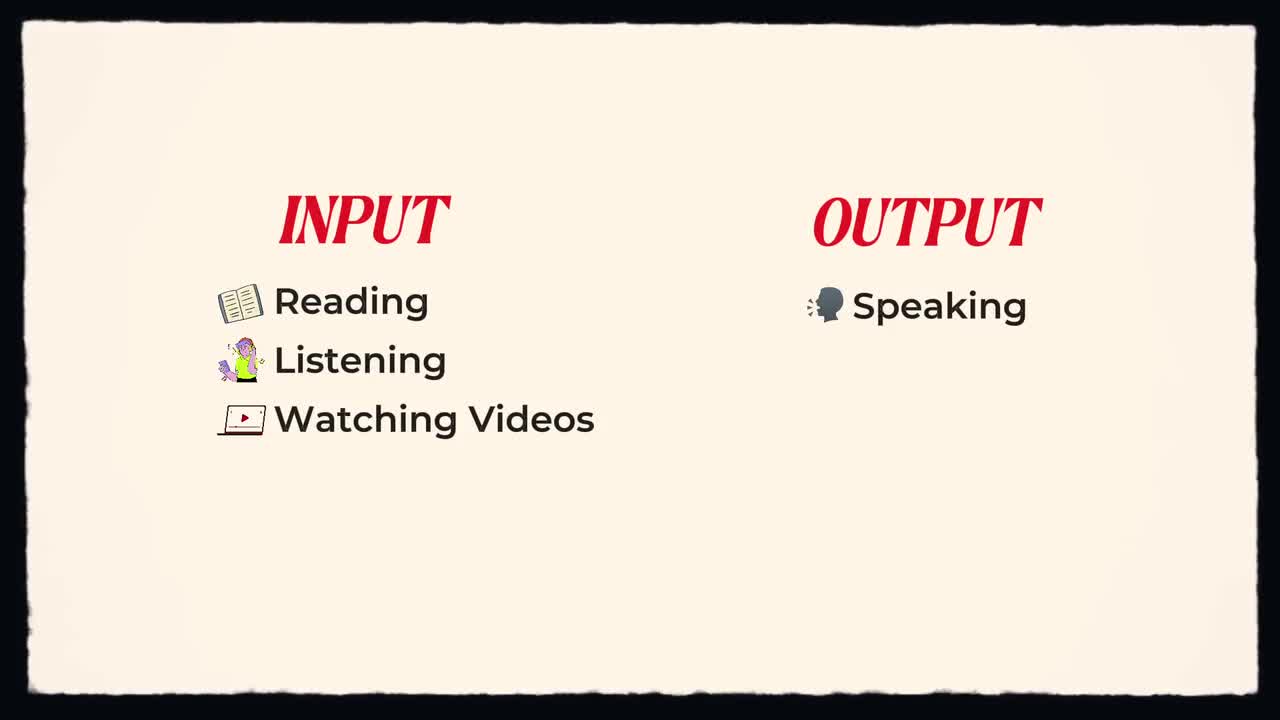
Language learning is often compartmentalized into two distinct categories: input and output. Activities like "reading, listening or watching videos" are categorized as input. While these are necessary components of language acquisition, they are not sufficient on their own. The speaker uses a powerful analogy to illustrate this point: "You are trying to learn to swim by reading a book about water." This highlights the futility of relying solely on passive absorption to develop an active skill. By consuming content without reciprocating through speech, learners create an imbalance where their receptive skills far outpace their productive capabilities.
Reframing the Brain as a Muscle
To move past the fear of speaking, one must treat the brain like a muscle. "Your brain is a muscle, and you can't get strong muscles by watching other people lift weights." This perspective shifts the responsibility from passive observation to active engagement. Just as strength training requires the physical act of lifting, fluency requires the physical act of speaking. The fear of making mistakes often leads learners to seek more study time, but the speaker argues that "you don't need more study time. You need practice." The emphasis must shift from the accumulation of knowledge to the application of knowledge.
From Theory to Action: The Path to Fluency
The final call to action is direct and uncompromising: "Stop studying, and start speaking." The transition from theory to practice is the only way to dismantle the anxiety associated with verbal communication. To facilitate this, structured environments like the POC English Academy offer a solution by providing daily opportunities to speak. Whether through "live lessons" with a teacher or interacting with a "global student community," the goal is to eliminate excuses and force the brain to adapt to real-time communication. By prioritizing output over input, learners can finally break the cycle of freezing during conversations and build the confidence necessary to speak English naturally.
Deep Learning with ListenLeap


