If you're a parent or share a fridge with someone.
Instacart is about to make grocery shopping so much easier.
Because with family carts, you can share a cart with your partner and each add the items you want.
Since between the two of you, odds are you'll both remember everything you need.
And this way, you'll never have to eat milkless cereal again.
So, minimize the stress of the weekly shop with Family Carts.
Download the Instacart app and get delivery in as fast as 30 minutes.
Plus, enjoy $0 delivery fees on your first three orders.
Service fees apply for three orders in 14 days, excludes restaurants.
It needs to be fast and sustainable.
Noom GLP-1 starts at just $149 and ships to your door in seven days.
Take it from Lauren, who lost 22 pounds on Noom.
If I come off of the GLP-1, it's not going to automatically make my weight yo-yo back.
$149 GLP-1s?
Now that's Noom smart.
Get started at Noom.com.
Real Noom user composited to provide their story.
Individual results may vary.
Not all customers will medically qualify for prescription medications.
Compounded medications are not reviewed by the FDA for safety, efficacy or quality.
Life is made up of many gorgeous moments.
Cherish them all, big and small, with Blue Nile, whether it's for yourself or a loved one.
Blue Nile's unrivaled selection of expertly crafted, fine jewelry and statement pieces help make all your moments sparkle.
Blue Nile's experts are on hand to guide you, and their diamond guarantee ensures you get the highest quality at the best price.
Celebrate a life well lived in the most radiant way and save up to 30% at BlueNile.com.
That's BlueNile.com.
Hello, everyone.
This is the 8 Minute English Podcast series on the Learn English Podcast channel.
Did you notice today's video is over 8 minutes long?
Don't be too surprised.
This is a special episode to thank all our loyal viewers of the Learn English Podcast.
I am Nathan, your host, and I am happy to be here today.
Today, let's talk about a really popular topic.
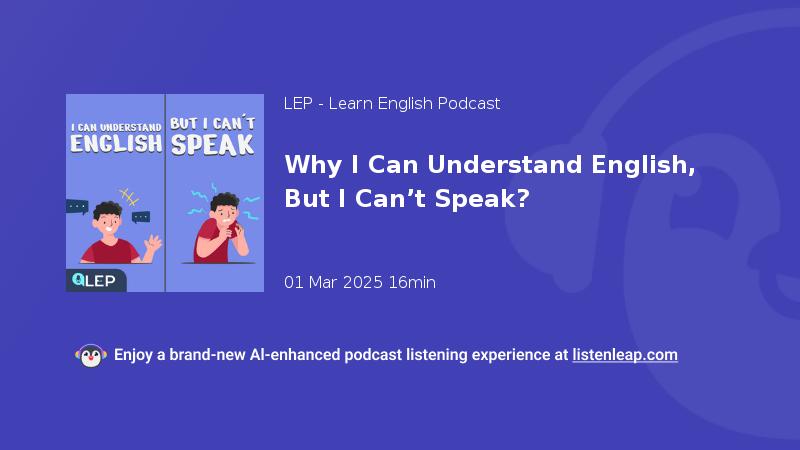
I can understand English, but I can't speak.
Does this sound familiar?
You watch movies, listen to songs or even follow podcasts like this one and you think yes, I understand what they're saying.
I know these words.
Maybe you even know what they mean in your own language.
But then someone asks you a question in English, or you try to speak.
Suddenly, it feels impossible.
Your brain freezes like it hits a pause button.
The words you know, where did they go?
You feel stuck, frustrated, even shy.
Why does this happen?
Understanding English and speaking it are different skills.
Speaking takes more than just knowing the words.
It takes practice, courage, and patience.
So today, we're going to explore this problem and how to move past it.
Make sure to check out our episode PDF, which is filled with tips and useful vocabulary to support your English learning journey.
Now, are you ready?
Let's dive in.
The first reason is you're not speaking enough.
Think about this.
You've probably watched tons of movies, listened to podcasts, or read English subtitles.
But when's the last time you spoke out loud?
Speaking is like a muscle.
If you don't use it, it stays weak.
You might understand every word in a Netflix show, but when it's time to say something yourself, your brain panics.
Second, you're probably afraid of messing up.
Imagine this.
You're in a coffee shop.
You want to order in English.
You know exactly how to say, I'd like a cappuccino, please.
But then, the fear kicks in.
What if they don't understand me?
What if I sound silly?
That fear is like a big wall stopping you from speaking.
And third, you're probably stuck in your first language.
Many learners think in their first language, then translate into English.
This takes time and can make sentences sound unnatural.
For example, in some languages, how old are you might translate as what is your age.
When you translate directly, it can confuse you.
The good news, this isn't forever.
With practice, you'll find your voice.
I'll talk about this in the next part of the podcast.
First, and most importantly, speak, even if it's not perfect.
I know you might be thinking, but what if I say something wrong?
Let me stop you right there.
The goal isn't to speak perfect English.
It's to get your message across.
Just think of babies learning to talk for the first time.
Do they start with perfect grammar?
No.
They say things like, want cookie.
And guess what?
People still understand them.
Why does this work?
Because speaking, even with mistakes, trains your brain to put words together faster.
It helps you build fluency over time.
There's the input hypothesis by a researcher, Stephen Krashen.
It suggests that language learners improve faster by focusing on meaning and communication rather than perfect grammar.
So now, how to do it?
Just start small.
Practice simple sentences like, I like pizza or I went to the park.
Then you can build from there.
The more you speak, the easier it gets.
Next, it's shadowing native speakers.
This is a really fun one.
A lot of people have followed this method and made a lot of progress in their journey.
Here's how it works.
Just listen to a native speaker and immediately repeat what they say, copying their tone, rhythm and pronunciation.
Just think of it like being their echo.
So why does this work?
It's all about muscle memory.
Your mouth and tongue get used to forming the sounds of English.
Plus, you will have the chance to learn how real conversations flow.
Here's a real-life example.
Pick a short clip from your favorite movie or podcast.
Play it, repeat it, and try to sound exactly like the speaker.
Even one minute a day can make a big difference.
Let's move on to another trick.
This is what many people overlook, practice speaking alone.
I get it, you might feel silly talking to yourself, but trust me, it works.
Just start by describing your day.
For example, this morning I had breakfast.
I ate eggs and toast.
Or look around you and name objects.
This is a chair.
It's brown.
Let me explain why this helps.
Speaking alone removes the pressure of speaking to someone else.
You can practice forming sentences at your own pace.
It's like training for a race without an audience.
I have a friend learning English who used to talk to her plants every day.
Hello, plant.
You look happy today.
Sounds funny, right?
But her speaking improved so much because she practiced every day without fear of judgment.
Let's talk about some important words related to this episode's topic.
Speak up is the first phrase.
It means to talk louder or express your thoughts clearly.
If someone says, I can't hear you, they might ask you to speak up.
If you're a parent or share a fridge with someone.
Instacart is about to make grocery shopping so much easier, because with family carts, you can share a cart with your partner and each add the items you want.
Since between the two of you, odds are you'll both remember everything you need.
And this way, you'll never have to eat milkless cereal again.
So, minimize the stress of the weekly shop with family carts.
Download the Instacart app and get delivery in as fast as 30 minutes.
Plus, enjoy $0 delivery fees on your first three orders.
Service fees apply for three orders in 14 days.
Excludes restaurants.
Life is made up of many gorgeous moments.
Cherish them all, big and small, with Blue Nile.
Whether it's for yourself or a loved one, Blue Nile's unrivaled selection of expertly crafted, fine jewelry and statement pieces help make all your moments sparkle.
Blue Nile's experts are on hand to guide you at BlueNilecom.
That's BlueNile.com.
This is helpful when practicing speaking, especially if you're shy.
The second one is get stuck.
When you get stuck, you have difficulty continuing with what you're saying.
This often happens when you forget a word, don't know how to express an idea, or feel anxious.
Let's move on with pick up.
To pick up a language means to learn it naturally by hearing and using it often.
It means you have frequent contact with it through listening, watching or even practicing in real life.
Get the message across is another useful phrase.
This means to communicate your idea clearly, even if it's not perfect.
When you speak, focus on helping the other person understand you instead of worrying about small grammar mistakes.
People care more about your meaning than perfect language.
Finally, we have Step out of your comfort zone.
This means doing something that feels new, challenging, and unfamiliar.
You can feel scary, but trying new things helps you grow and learn.
The more you step out of your comfort zone, the more confident you'll become.
Let's move on with today's topic.
Let's be honest.
Learning individual words is great, but when it's time to speak, do you ever feel stuck?
That's because words only don't flow naturally in real conversations.
Instead, you can focus on learning phrases, chunks of language that people use every day.
For example, instead of memorizing help, learn a complete phrase like, can you help me with this?
Or instead of think, practice saying, what do you think about?
These phrases come up again and again in conversations, so they're much easier to recall when you need them.
Research supports this approach.
Studies from applied linguistics show that learning in chunks boosts fluency because your brain doesn't need to create sentences from scratch.
It's like having ready-made building blocks.
Just practice these phrases in real situations at the store, asking directions or chatting about the weather.
I know speaking English can feel scary, especially with strangers.
But what if you start small?
Speak with people you're comfortable with, like friends, family, or even other learners.
Low pressure situations allow you to focus on building confidence instead of worrying about mistakes.
Remember, fluency doesn't happen overnight.
It's like exercising a muscle.
Start with short, simple exchanges, like ordering coffee or greeting someone, and work your way up.
Apps like HelloTalk, Tandem, or Speaky are also fantastic for finding conversation partners.
They connect you with learners or native speakers who are just as eager to chat.
And the best part?
You're all in the same boat, so there's no judgment.
Here's the key.
The more you practice, the more natural speaking will feel.
Here's another tip to help you speak English better, which lies in listening.
If you want to speak better, first you need to listen better.
Active listening helps you learn sentence structure, expressions, and responses.
Here's what to do.
Watch podcasts, TV shows, or YouTube videos where people speak naturally.
Pause and repeat lines you hear.
Pay attention to intonation, rhythm, and sentence patterns.
For example, notice how someone says...
Really?
That's amazing.
Versus really?
Are you sure?
The tone changes everything.
Researchers believe that imitation trains your brain to think like a native speaker.
When you mimic real conversations, you're rewiring your brain to process English faster and more naturally.
So don't just listen.
Copy what you hear.
Finally, let's talk about fear.
Many understand English but hesitate to speak, afraid of mistakes.
Remember, mistakes show you're learning.
Like children fall before walking, errors help you grow.
People value effort over perfection.
Here's the quote that I love.
Confidence comes not from being perfect, but from trying anyway.
So focus on getting your message across, not perfect grammar.
And now let's review some useful phrases that we listen to.
First, we have take time.
To take time means you need patience to do things.
Learning something important like a language doesn't happen quickly.
It takes time, so don't worry if it takes weeks or months to improve.
Move on is another phrase worth learning.
To move on means to continue to the next topic or step.
When you finish something, it's important to let it go and focus on what's next.
It's a way of saying, let's keep going.
Next, we have work your way up.
This means to improve step by step.
You might start with easy things and then slowly try harder things as you get better.
It's all about making progress at your own pace.
What about in the same boat?
This expression means sharing the same situation or problem as others.
It reminds you that you're not alone and many people face the same challenges.
And lastly, we have pay attention to.
This phrase means to put your focus on something.
When you pay attention, you notice details that help you understand or learn better.
It's a way to remind yourself to be mindful.
And that's the end for today's episode.
What do you feel about today's podcast?
Did it bring you any new discovery or insight?
Feel free to share your thought with us in the comments.
We'd love to hear your opinions.
We hope this episode gave you helpful tips for practicing English.
Remember, it's not about being perfect, but getting better.
Thank you so much for tuning in and see you next time.
Well, with LinkedIn ads, you can know you're reaching the right decision makers.
You can even target buyers by job title, industry, company, seniority, skills.
Wait, did I say job title yet?
Get started today and see how you can avoid the void and reach the right buyers with LinkedIn ads.
We'll even give you a 100 credit on your next campaign.
Get started at linkedincom.
Slash results.
Terms and conditions apply, And keep an eye on your kids' spending with real-time notifications.
Kids learn to earn, save and spend wisely, and parents can rest easy knowing their kids are learning about money with guardrails in place.
Try Greenlight risk-free today at greenlight.com.
Be adventurous in the sun.
Be protected in the sun.
Be confident in the sun.
Be fearless in the sun with Blue Lizard Australian Sunscreen.
As experts in mineral sunscreens for nearly 30 years.
We've earned awards for our high quality products and the trust of healthcare professionals.
Embrace every moment in the sun with your family and blue lizard by your side.
Be fearless in the sun.
Shop blue lizard Australian sunscreen now on amazon.com.