All right, here are genuine seven underrated tips that I feel like everyone does not talk about in the study space community.
And these are tips that actually got me through school and actually got me to achieve a very high grade.
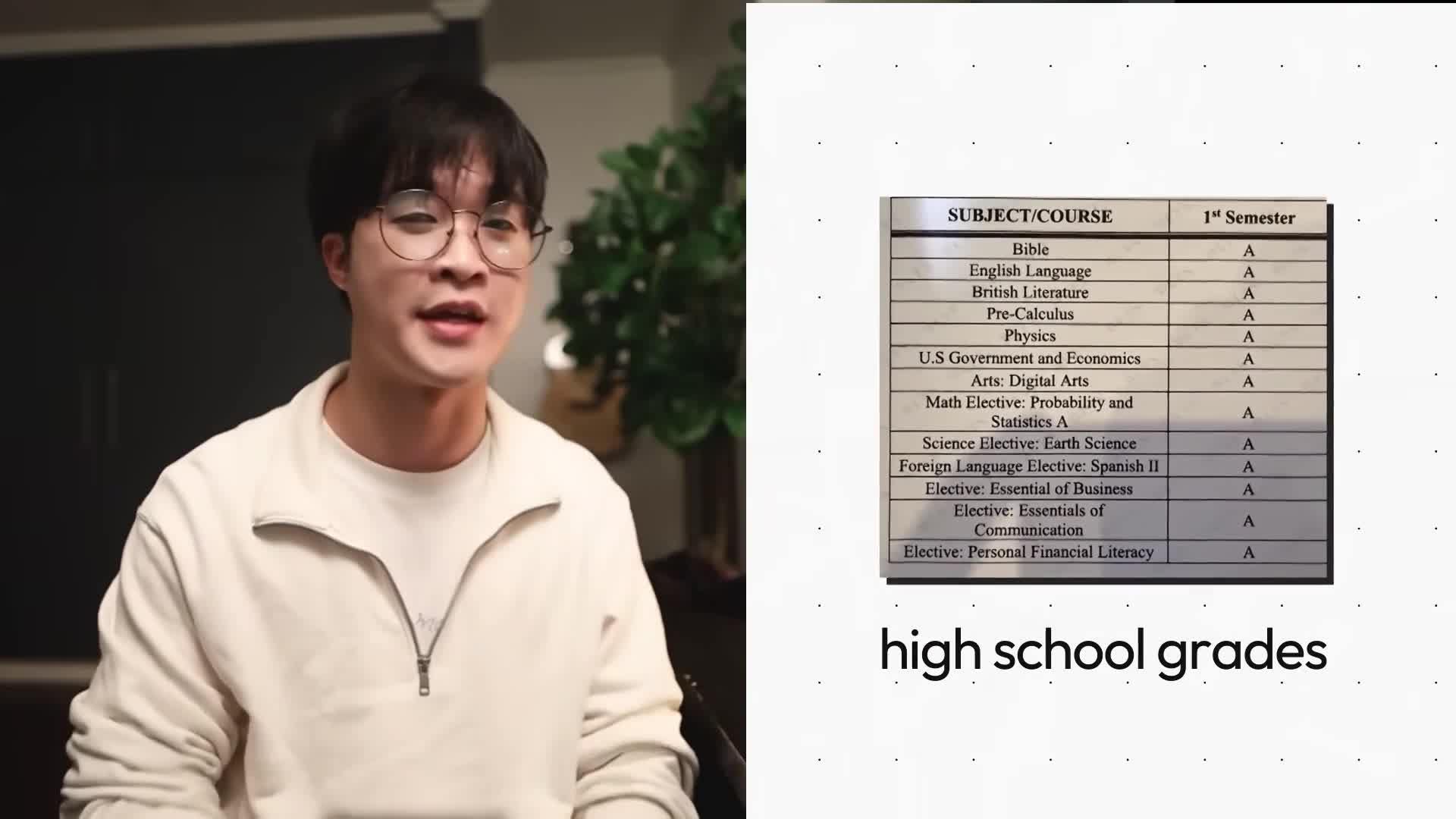
These are my grades for credibility purposes, please.
Guys, every time I show my grades, I don't want it to be a sense of flexing.
I just wanted to show you that these tips actually work, okay?
Like these tips will not be anything if I don't show you the result of why I'm telling you these tips.
So again, these are my grades.
I got a 98% average in high school and these are my grades during university.
So hopefully you guys can learn a thing or two.
Anyway, let's not waste any more time.
Let's get straight into the tips.
The first tip is to study right after waking up.
A lot of people struggle and I see this a lot.
A lot of people tend to struggle studying consistently, mainly because of the variability of our schedules and because we just want to do things in our day.
Like, come on, I'm guilty of that.
And because of the nature of studying is that it's not generally a fun thing for most people, especially after procrastinating the whole day or just, you know, watching Netflix and whatever, and then just opening your book.
Like that's not something easy to do, which leads me to tip number one.
And this is probably by far one of my favorite study hacks.
And it's a very simple study hack.
It's to just simply study right after waking up.
I can't stress how beneficial this routine is because of how primed your mind is to learn information.
Basically, every time you wake up, go straight to studying.
Don't do anything.
Don't open your phone.
Don't take a shower.
Don't eat breakfast.
Just go straight to studying.
Your dopamine levels at its time is usually at its baseline.
And because in order to maintain deep studying or deep effective work, you will have to maintain yourself at that specific dopamine baseline.
So I recommend putting your phone quite literally away from your bed before sleeping and maybe set it to silent mode and set a strict alarm.
And before you sleep, make sure you're already preparing your desk for study.
So, for example, like my desk, I have a bunch of books ready.
I have my laptop ready.
So, you know, my bed is just right over here.
I don't know if you guys can see it's over here.
So literally right after I wake up, I just go straight to my desk and I just start studying.
Our goal is to create as little friction as possible from getting to your bed to your study.
Now for those who are typically groggy in the morning.
A solution for that is to have a glass of water ready or just quickly wash your face or have a quick shower before studying.
Which leads me to tip number two using showers as a resetting tool.
Yes, you like that transition baby, if you find yourself struggling to study after a whole day of procrastinating or just doom scrolling or whatever.
If you want to get straight into setting consistently or instantly, then i highly recommend using showers as a resetting tool.
I noticed that every time I take a quick shower, without any phones, without any music, you know, it just primes me so well for my study session.
And research actually shows this.
So if you shower without any distractions, music or any videos playing in the background, you will be resetting your dopamine levels to baseline.
And bonus point if it is a cold shower, you will be elevating your baseline of dopamine, such that you will have an elevated mood for the next few hours.
I usually do this when I'm tired and when I'm distracted.
And when I'm really tired, I do a cold shower.
That gives me a quick wake up call to get straight into studying.
Tip number three is to revise your studies while commuting.
Commuting takes so much time that we don't even realize.
Like most students actually take 10 hours of our day just to commute.
10 hours.
Imagine 10 hours of just not doing anything.
So during those 10 hours you could be revising something instead.
And imagine how much better you will do by just adding a couple more hours in your week revising your notes or your study material.
And you can do that during your commutes and by commutes i mean whether you're taking the bus or whether you're taking the jeep, that is, if you live in the philippines, whether your parents are driving you or or whether you're just commuting.
In general, if you have the chance, try to take the time to review flashcards and review them.
Trust me, it will be a very efficient thing to do.
Think about it you're already in a car and you're not doing anything, so might as well do something while the time is passing instead of just watching reels or just doing anything else.
Personally, i use a flashcard app.
I have anki on my phone so it syncs with my laptop, and every time i'm commuting i just pull out my phone and i just start reviewing flashcards, although the thing is now i drive, so i can't really review while commuting.
So please guys, i'm not able to study, but you can Live on the legacy for me.
Now, another underrated tip that I have for you guys is to have a paper-like screen protector.
And recently I got myself an iPad Pro and I wanted to get a screen protector for it as soon as possible, because I do write diagrams on it and that's where paper-like comes in.
If you guys don't know, Paperlike is a screen protector for your iPad and essentially it gives that paper-like feel.
Recently they came out with Paperlike 3, with their new butterfly patent, which allows you to apply the screen protector even faster and even easier.
I didn't have to go through the difficult process of, you know, applying a screen protector to any of my gadgets.
Anyway, if you guys are interested then you can head down to the link in the description to check out Paperlike for your new Paperlike screen protector.
Tip number four, end of the day journaling.
Basically journaling at the end of the day.
Now I'm not talking about, you know, like, oh, like, hey guy, do your diary.
Like that's very cliche.
I'm talking about documenting what you've pretty much learned throughout the day and how you've pretty much feel throughout the day, and just general journaling at the end of the day and talking about what you've learned and what transpired throughout the day.
This is very, very, very useful.
And people don't talk about this and I don't know why, but because the thing about this is that it does two things, two very important things.
The first thing is that, by journaling, at the end of the day, it allows you to retrieve information from your brain.
So not only are you doing active retrieval, you are also explaining it in your own words.
So imagine you're writing down whatever you learned in your own words.
That's just layman's technique.
So you're doing two very effective study efficient methods just by journaling at the end of the day, like you've just literally did active recall and layman's technique in one go.
So that's just so useful.
And another utility to journaling at the end of the day is that it allows you to offload any thoughts or emotions, which provides you a great setup for sleep.
You know how some nights you just feel like you can't sleep because you have so many things going on in your head.
This Literally solves that.
Tip number five is to practice writing without AI.
Now, this is not really a tip.
This is more of a reminder, especially to myself, because I also utilize AI sometimes as well when it comes to my work.
But basically try to not outsource your thinking to AI.
When we are outsourcing any sort of cognitive work to AI, you're essentially releasing the need of your brain to think.
And if you continue this habit, this pattern, you will end up relying on AI every time you encounter a small cognitive difficulty, which is a very bad thing.
I want to remind you that when you write or when you encounter a sort of question that requires you to construct answers or something, doing that writing is a skill within itself.
It's a skill that improves every time you do it yourself.
Every time you write yourself, every time you do that thing yourself.
Instead, people outsource that to AI and they just end up not training that part of their brain at all.
And the thing is, every time you come across something that requires you to think you're going to end up scrambling for ChatGPT.
So remember, AI is a tool, not a replacement.
So, instead of it replacing your writing, I want you to use AI more of a supplemental tool, like grammar fixing, plagiarism fixing, you know, general AI tools that don't just replace the whole writing process.
Tip number six is to do an evaluation every end of the week.
The last tip.
I highly recommend this and it's to essentially self-evaluate, because self-awareness is the most useful skill that students should have.
And not just self-awareness in a sense that you're self-aware of yourself, but self-aware of your performance in school.
Have you done your best?
Did you do your best?
How can you optimize your day?
What have you gone wrong?
Not only does this help you perform in the long term because you have maintenance checks, but it also helps cycle your motivation again and again.
So I would highly recommend spending at least an hour or two at the end of the week.
Personally, I do this on Sundays.
I would just sit down in front of my laptop or in front of my iPad.
I would just jot down and evaluate what I've done well in the week, what I didn't do very well and what I could have done better.
And this could be literally in anything else other than studying.
Having a proper evaluation system can actually make you more productive, because you're self-diagnostic.
I don't have it with me, but I do have a journal.
Actually, you know what?
Let me bring my journal real quick.
So speaking of self journaling, I do both.
So I do self diagnostics here and I pretty much do my self journaling after school in my journal.
Of course, I also do it in my iPad and laptop sometimes, but this is pretty much the heart of everything.
So I have some stuff written down here as well.
So yeah, basically, and it's a good way to just track problems in your life.
And because you are tracking and actively evaluating yourself, you are actively tackling problems that you have, rather than just going to the next week blindly.
That tool and that routine is very, very powerful.
All right, bonus tip, bonus tip, bonus tip.
And this is more of a motivator tip.
And I think, you know, crack the code to like stress less motivation, but basically purpose.
Purpose is the best motivator.
I know this is not really a practical tip or an actionable tip, but it is a tip that I believe that people should know.
And basically purpose serves as a great utility source of motivation.
And by purpose I define it as having anything that you do, any little thing that you do, contribute to the bigger picture in the future.
Recently, Alex Hermosy and Tony Robbins had a podcast and essentially Tony Robbins mentioned how purpose is a great pull force that can give you motivation to pull you forward, as opposed to you know the general push motivation which everyone is familiar with.
So you know the grind set, you know going through the hardship mindset and while yes, those are useful and you definitely need to go through hardship, i think as humans, when you know that things that you do have a purpose to a bigger picture.
So i've reached a point in dentistry where i just didn't want to do it anymore, like I'm doing YouTube already.
So why do I have to?
You know, why do I have to continue this?
Like, this is not very interesting.
But I reframed my mind and I thought to myself okay, you know, I'm going to be helping patients in the future.
You know everything I'm learning every medical disease, every drug, every procedure, every technique.
You know someone out there is going to be, you know, in my care and I'm going to be taking care of them.
And just that thought gave me a sense of motivation.
Like it just gave me a sense of purpose.
Practically speaking.
I just wanted to share that with you guys because if you guys feel a bit lost, you know, having that general purpose can be a very great source of motivation.
I hope you guys enjoyed today's video.
If you're watching this.
I don't know if the vlogs are out, because I'm recording this in advance, but if they are, I hope you're enjoying them.
If they aren't, then Seth, what the heck are you doing?
Come on, record the footage already.
Anyway, I hope you guys enjoyed today's video and good luck with your school.
Of course, don't forget to drink your water.
Anyway, I'll see you guys in the next one.
I'm gonna go have dinner because I haven't had dinner and it's already freaking 8 30 p.m.
So yeah, I'm gonna go now.
Goodbye.
Drink your water.
Bye.