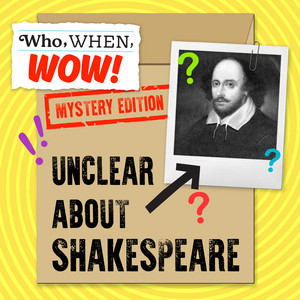
Cheerio!
Remember me?
Your favorite host of a top secret podcast that nobody in the world knows about.
Wink wink.
I'm back today with another mystery, and it's going to take us back in time and across the Atlantic Ocean to jolly old England.
We're going to investigate a rumor that got started 400 years ago.
And yeah, I know, my accent is not great, but I'm going to work on it.
I'm Carly Q, and this is Who, When, Wow Mystery Edition.
Our past is vast and wild.
Many things have brought us to this day.
As history has been compiled, some important details have slipped away.
In our spectacular shared existence.
We consider it our business to recognize a few fogs you.
On the way to work this morning, I saw a beautiful blue feather on the sidewalk.
So I picked it up and put it carefully in my backpack.
What a nice little surprise.
It was going to be a good day, I could tell.
Good morning, Linda.
But when I got to work, I found out that everyone thought I'd been out sick all week long.
Someone said you've been out for a few days.
Were you sick?
What a strange rumor.
I came in every day this week so far.
What are you doing?
I guess when you're down in the basement, people forget about you.
How do they think all those files get put into computer databases?
It doesn't magically happen on its own.
It's not like Lewis or Nibbles are going to do it.
It's me.
All me.
Well, I'm heading down to the basement.
Do you all hear that?
I'm here, and I'm heading to my desk where I work because I
I went down to the basement and sat down with my blue feather.
Peak of health, I might add.
Tell me, oh magical blue feather, why did they think I wasn't here?
But the answer would have to wait.
And here we go.
It was a new mystery.
Time sealed and ready for me to investigate.
Event 1848.
Publishers of... Was the famous William Shakespeare really... Did someone else... Shakespeare?
The William Shakespeare?
The one who wrote famous plays like Romeo and Juliet?
Hamlet?
Macbeth?
Hi, Nibbles.
Nibbles came out from behind the bookshelf in the corner.
Oh, you a big Shakespeare fan, Nibbles?
I powered up my company-issued handheld device.
Never mind. and typed in all the data.
1848 Shakespeare.
Analyzing.
This file refers to the rumors started in the mid-1800s about the true author of several plays attributed to William Shakespeare.
Rumors swirled more than 200 years after Shakespeare... Or whoever.
...wrote those plays, and it caused many people to claim Shakespeare was a fake.
Ooh, a historical rumor.
The real identity of William Shakespeare has been called into question several times in history, including by famous American writers like Mark Twain and the poet Walt Whitman.
Not Whitman.
Yes, Whitman.
If he was a fake, I bet I know who actually did write his plays.
Wanna guess, Nibbles?
That's right!
Aliens!
Some even wondered whether there was a William Shakespeare at all.
Perhaps the whole identity was an invention to mask the true author of Romeo and Juliet.
Are you saying Shakespeare might not have existed?
I think I have a way to find out the truth.
Oh, hey, Carly Q. Did you decide to come in today?
Oh, great.
Not you, too.
What is happening around here?
You tell me.
Well, I'm going to England to investigate one rumor, but it seems that I am the star of one myself, right here at Butthead.
Wait, you're going where?
So I gave Lewis the rundown on what was in the file.
And surprise, he says I'm not sure 400-year-old gossip counts as a historical mystery, but I love me some London.
Count me in.
See you at lunch break.
Splendid.
Cheerio.
Pip-pip and all that.
What's that now?
I'm practicing my English accent, my dear Lewis.
We must always be authentic whenever possible.
Okay, well, keep working on that.
I hunkered down to work with nibbles at my side.
My brain was spinning its wheels.
All I could think about was who really wrote Shakespeare's plays.
And I was obviously not so secretly hoping it was aliens.
Rumor has it, it's lunchtime.
No time for lunch.
I got a mission.
To eat or not to eat, that is the question.
I believe it's to be or not to be.
It's Hamlet, Shakespeare's most famous play.
Or maybe it's someone else's famous play.
We gotta find out.
You know, I'm something of a theater man myself.
Lewis, really?
I was once snowman number four in my school's winter play.
I grabbed Nibbles and H-Dad and Lewis and I ran for the elevator.
Oh, yeah.
And my one line was... On the way, I passed a mirror in the hallway and got an idea.
I took my hat out of my bag and put it on, then stuck the blue feather in the brick.
How dashing and splendid.
I will certainly fit in now.
Off we go, Lewis.
Come then.
Giddy up.
Hello, Odie.
Lovely day, isn't it?
Oh, boy.
Carly, why are you speaking like that?
Lewis, why is she speaking like that?
Because today's mystery is whether Shakespeare really wrote his own plays or whether he even existed.
So we're going back 400 years to England to sleuth around and find out.
And you need an accent to do that?
Well, I want to fit in, don't I?
Do you?
No.
I know a little something about accents.
And yours doesn't sound the way English people talk.
Especially not in 1614.
How about now?
Let me tell you a little something about William Shakespeare.
Oh, that's not really necessary, Odie.
We trust theater professionals to give this sort of feedback.
William Shakespeare was born in this small village, Stratford-upon-Avon, in 1564.
He moved to London, the big city, where he worked in a theater company and began to write plays of his own for the stage.
Yeah, I write my own plays, too.
In 1599, he and his men opened a new theater, the Globe Theater.
Oh, the Globe Theater.
That's not how it's said.
But sadly, it burned down in a fire in 1613.
Oh, no.
I hope they had a good fire.
Oh, yes.
They began rebuilding as soon as possible.
So in 1614, the second Globe Theater is about to open again.
Well, we'll see if it was him or someone else or possibly aliens.
We're planning to find some of his fellow actors in the Globe Theater and ask around to see if anyone actually knows him and has seen him writing his plays.
Okay, quick review of the time travel rules.
No changing anything in the past, but you can, of course, ask all the questions you like.
And your time is limited.
You must be back before the end of the lunch break.
And keep in mind, a story told over and over grows its own legs.
A story has legs, huh?
Not sure I've ever seen that.
Ready, Neville?
Okay.
We're here.
Wow, Louis, look at everyone.
It's a warm June day.
The sun is shining bright.
Whoa, this is amazing.
Look at the women in their long gowns.
I've never seen so many ruffles in my life.
Beautiful.
And look at all the rats.
Ugh, they're scurrying all over the street.
Ew!
Isn't it beautiful?
That's not the word I'd use.
The houses are made of stone, and the roofs are made of straw?
Never seen that before.
Ask H-Dad what that is, Carly.
Okay, let me see.
Tell us what you know about the 1600s and why people have straw on their roofs.
That's called...
Thatch.
It's a medieval style of protecting a house from rain and snow.
The straw is packed tight so water doesn't get through to the inner roof of the house.
House emoji.
Straw emoji.
Look at all these short pants and tall socks.
Those pants are called bridges, and the socks are called hoes.
And they're also wearing linen shirts.
Everyone looks so splendid.
So posh.
Maybe we should ditch the awful accent, Carly.
Nice try, Lewis.
I am trying to fit in.
I glanced around the street.
There was a group of men standing in front of a big building under construction.
Oh, that must be the New Globe Theater.
Come on.
I approached the group and tried to fit in.
And the good news, my fellows, is the roof will be made of tile.
That will prevent another fire the next time we set off a cannon during a battle scene.
Lucky we all escape with our lives.
Oh, hello there, you two.
Hello, fellow actors.
I'm Lewis.
Ah, well, good day to you, fine gentlemen.
I'm Carly.
We're visiting London on this fine day to make inquiries about the playwright William Shakespeare.
What's that about?
I don't understand what you're saying, madam.
She said something about William, that's what I called him.
Where are you from, miss?
I cannot place your accent.
Oh, uh... Give it up.
Just be yourself.
All right, I give up.
I'm actually just visiting from America.
Ah, the New World.
We know some people are traveling there, but we haven't heard of anyone making it back.
What's America like?
Oh, you know, new.
How long did it take you to cross the ocean?
Is it true that it takes six months?
Calm down, everyone.
Our visitors must be tired after such a long journey.
You have no idea.
Here, step inside the Office of the Globe.
Come on, everyone.
We can all talk in there.
Nice and quiet in here.
Oh, oh, I see some mice in the corner there by the bookshelf.
Family resemblance.
They could be my great, great, great, great, great, great, great, great, great, great cousins.
I'll be right back, Carly.
So, Christopher, you work for the Globe Theater.
Indeed.
I'm one of the actors here.
These men all work with me.
We're known as the Lord Chamberlain's men.
Catchy.
And what are you in London for? the globe's grand reopening, perhaps.
That is exactly right.
And I'm here to see if anybody knows of a playwright named William Shakespeare.
What's so funny?
To you also, Lewis?
Do you mean to say you don't know who William Shakespeare is?
He's the reason we're rebuilding this theater, my dear lady.
Sorry.
She's been in America a very long time.
Really, it's just so embarrassing.
But do you actually know him?
Like, he's a real person that you've seen?
Because that's annoying.
You see, there's this rumor.
In America, you see, a rumor is growing.
That the plays are being written by someone else, not by William Shakespeare.
You don't say.
In fact, there's a rumor that there may not even be a William Shakespeare.
So I'm here to ask, is it possible someone else is writing those plays?
This is very unusual.
I mean, how do we even know there's a real William Shakespeare?
Oh, that's easy.
We've seen him.
He writes our plays and even performs with us.
Well, maybe he's been faking the writing this whole time.
I mean, have you ever actually seen him writing his plays?
All right, crowd.
That's a lot of murmuring.
I'm thinking it through.
Just try and relax, okay?
Give him a minute.
There are actors at work.
Come to think of it, I've never seen him write.
Oh, nor have I. None of you have seen him put pen or quill to paper?
William is more of a business type.
Selling tickets, that sort of thing.
But I've never doubted he also had a creative side.
Well, people say that he was from a small village.
Stratford-upon-Avon.
Right, so a country guy from a humble background.
But his plays are filled with such elegant language.
How did he learn to write like that?
He's certainly not from a class of nobles or royalty, but he does seem to know how they all speak.
So it is possible he's a phony, like some fancy lord is writing Shakespeare's plays!
Could it be that a lord is writing William's plays, and Will is just taking credit?
I literally just said that.
You tell me!
I always thought it strange how quickly he made it big in London.
Strange how?
It's like he arrived here from another planet with a drawer full of brilliant scripts.
But if some other person is writing these plays for him, who could it be?
I know!
In fact, I have a theory bear with me that the real authors could be Oh boy, please don't say aliens.
Please don't say aliens.
What's going on here?
A meeting without me, hmm?
William!
Shakespeare!
Saved by the Bard.
Greetings, friends.
I bring good tidings.
I have recently concluded a meeting with the Builder.
Our new roof is almost finished, and the Globe can open as soon as next week.
Awesome!
But who are these fine people?
Good morrow.
I'm William Shakespeare.
Oh, hi.
Hi?
Hmm.
What language is hi?
Ah, they're here from the New World, Will.
America.
Is that right?
How exciting.
I've written a play set in the New World.
The Tempest.
Have you heard of it?
I love The Tempest.
Thank you, kind sir.
Actually, um, Will, these visitors have been asking about you and your writing.
Is that so?
Have you heard of me in America?
What they heard is that you're a fake.
A fake?
Yes.
They questioned if you even existed.
We said William is our friend and fellow artist.
Of course he exists.
We can see that quite clearly.
And they even suggested that, uh, well, that someone else is writing your plays.
Someone else?
Preposterous!
Who do you think sits at my desk all day toiling on page after page, line after line, forging great works in iambic pentameter?
How dare you question my integrity, my art?
We were just asking.
Rumors have a way of getting around, you know.
Carly, I think we're done here, and the lunch break's almost over.
Yep.
I think we caused enough havoc.
Where's Nibbles?
I'm with you.
Cheers!
Ta-ta, Willie Shakes!
Cheerio!
Wow, Shakespeare got really mad.
And he speaks beautifully even when he's upset.
You know, the rumor about Shakespeare's identity didn't start until the 1800s.
I'll tell you, according to all the mice I just chatted with, nobody here and now questions him.
He's a big deal.
But there had to be some fire with all that smoke.
Seems like it was just smoke, Chloe.
All right, here we are.
Get in.
All this talk about smoke really reminds me that we missed lunch.
I could go for some barbecue right now.
Barbecue would be great.
Then pie for dessert.
Uh, yeah, duh.
Always pie for dessert.
How come you two are always thinking about...
Who goes there?
Just kidding, I know who you are.
Find anything interesting?
Forsooth, we met William Shakespeare himself.
Oh my goodness!
What does he look like?
White shirt, britches, more hair than I thought.
And is he the author of the plays?
Seems like it, even though the rumors are pretty convincing.
A story told over and over grows its own legs.
Oh, now i see.
It's like you said, odie a story can seem real simply because it's repeated so often that people will start to believe it.
Maybe i said it, maybe i didn't have a great day, basement companion lewis.
Well, it was back to the grind, back to my desk in the basement sitting and working on entering the files, but it made me think about what shakespeare said, Not so different from what I do every day.
I go to work and I do a good job, but people believed a rumor that I was sick and stayed home all week.
Just because I sit down here quietly finishing my tasks, everyone thought the rumor was true.
I believe Mr. William Shakespeare.
I've learned that rumors can grow like a fire, just catching on people's imaginations until they're out of control.
What are you reading, Lewis?
Hamlet.
It's excellent.
I think I'll start auditioning for plays again.
And noweth I dieth.
Until the morrow, dear listeners, this colloquy doth proclaim thou hast ne'er laid thine ears upon.
That means you never heard this.
Oh, boy, Lewis.
H-DAD initiating end credits mode.
Who Went Wow Mystery Edition is an original Tinkercast production with help from GZM Shows.
Handshake emoji, high five emoji.
For Tinkercast, the executive producers are Guy Raz, Mindy Thomas, and Meredith Halpern-Ranzer.
The shows are written by Aaron Weissman, Susan Mawady-Dirage, and Tom Van Kalking.
The head writer for Tinkercast is Kenny Curtis, and Carly Shiraki is a producing consultant.
Big shout-outs to the rest of the Tinkercast team, including Jed Anderson, Jessica Bode, Rebecca Caban, Natasha Crandall, Lizzie Freilich, Kristen Jang Thuy Mac, Erica Medina, Henry Moskal, Jodi Nussbaum, Ali Paksima, Linda Rothenberg.
Steph Sosa, Tyler Tholl, Joanna Weber, and Anna Zagorski.
Megaphone emoji.
Applause emoji.
The Who Went Wow theme song was composed and performed by The Pop-Ups.
For more information on their three-time Grammy-nominated all-ages music, find them at thepopupscom.
Producers for GZM shows are David Kreisman, Ben Strauss Uh, could you give me another one on that please?
And voice direction is handled by David Kreisman and Amy Cervini.
Our main cast features Carly Shiraki as Carly Q, Brandon Salerno as Louis, Melissa Vanderschiff as Nibbles the Rat, Kenny Curtis as H-Dad and Angel Desai as Odie.
Help support Who Went Wow by becoming a member of the World Organization of Wowzers and discover wows all year long.
Sign up today at tigercast.com slash membership.
You can also subscribe to our YouTube channel at Tinkercastcom.
Slash YouTube for full-length episodes of Who Went Wow, Mystery Edition.
And reach out to us at hello at Tinkercastcom if you have a mystery you'd like Butthead to investigate.
H-Day, powering up.
Who went wow?
Made important inventions.
Who went wow?
Asked all the right questions.
History will never be the same.
Who, When, Why was made by Tinkercast?
Shh, it's starting.
GCN shows Imagination Amplified.