Welcome to Spotlight Advanced.
I'm Bruce Gulland.
And I'm Liz Waid.
Spotlight uses a special English method of broadcasting.
It is easier for people to understand, no matter where in the world they live.
This is a story that Australia's native people tell.
Many years ago, the earth was very different.
There were no mountains or hills.
There was no sea.
Then life came suddenly.
These were the ancestors.
They were spirits in the form of animals, plants, and people.
The ancestors traveled across the earth Because of them, the seas filled with water.
Where they stepped, hills and mountains appeared.
One of these mountains grew in the middle of the desert.
Many of the ancestors lived on this mountain.
The local people were called the Ananu.
They discovered the place and lived by it, too.
Today, they call this special place Uluru.
Today's spotlight is on this special place, Uluru.
What you have just heard is a story about the beginning of the world told by the Anagnou people.
The Anagnou are one of Australia's native people.
They have lived in Australia for almost 65,000 years.
The land is very important to the Anagnou.
It is filled with their history.
They even talk about the land as if it were a person.
They call it my grandmother or my grandfather.
For the Anagnou, the place they live is not just a place.
It is part of who they are.
Uluru is one of the most important places for the Unugnu.
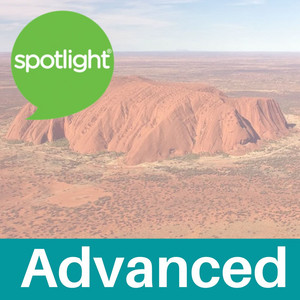
It is a huge sandstone rock in the middle of a flat desert.
From the ground to the top, it is 348 metres high.
And it is 9.4 kilometres around.
There are no other rocks or mountains around it.
It has a dark red color.
But when the sun shines on Uluru, the rock seems to change color.
It is beautiful to see.
It may even seem like magic.
The Anagnu believe Uluru is sacred or holy.
For them, it shows how the world was created.
And it is a part of their beliefs.
But Uluru is not just important to the Anangnu.
In the 1600s, European settlers sailed to Australia.
After a long time, they found Uluru.
They did not know about the Anangnu people, and they did not understand the Anangnu religion.
The Europeans believed Uluru was just another very beautiful place.
Over time, European settlers conquered Australia.
They called Uluru by a different name.
They called it Ayers Rock, and many of them came to the place so that they could see it.
In 1936, people began travelling to Uluru to see it.
They were tourists.
Many of these people wanted to climb the rock.
At this time, Uluru was in a national park.
And climbing it became part of visiting.
Many Australians were very proud of Uluru.
It was one of the most well-known places in their country.
It became one of Australia's national symbols.
It was an example of what made their country beautiful and special.
But watching tourists climb Uluru was painful for the Anangnu.
By Australian law, the Anangnu did not own the land.
But they still believed in their own law.
When tourists came to climb Uluru, they were walking on places special to the Anangnu.
In a way, the tourists were even breaking Anangnu law.
And tourists were destroying part of the rock.
Pamela Taylor is Anangnu.
She told the BBC, Turrets are like insects, like ants.
They climb up and down every day.
Their shoes are scraping away at the rock little by little.
The path is now clear from far away.
It was not supposed to be like that.
For many years, the Onaginu asked people not to climb Uluru.
They put signs at the bottom of the rock to tell tourists why it was important.
But people continued to climb.
Finally, the Unangnu decided that their law should govern Uluru.
It was too important to them.
The Unangnu talked with the Australian government.
They wanted their land back.
In 1985, they received their land. but they agreed to manage the land with the government.
But the Anagnou also wanted to stop people climbing Uluru.
The government did not know what to do.
Many people did not want to stop the climbing on the rock.
And tourism brought in a lot of money.
Some people believed the Anagnou could even benefit.
Maria Bilais is a reporter for Northern Territory News.
She writes that it is difficult to make money in that area.
She says, Creating jobs for the Ananu can only be positive.
It would bring a lot of money to people who need it.
We could address safety issues from the climb and we could employ more guides so that people obey Ananu law.
I can only see a chance to make a lot of money that we should explore.
But the Anagnu believe closing the climb will not drive people away.
They say it will make Uluru more interesting.
They plan to teach people about their culture.
They want to tell tourists stories about Uluru.
Sammy Wilson is the board chairman of the Uluru Katajuta National Park.
He told the conversation.
Visitors do not need to worry that there will be nothing for them with the climb closed.
There is so much else in the culture here.
We have a lot to offer in this country.
There are so many other smaller places that are culturally interesting that we can share.
Instead of feeling disappointed, tourists can experience the place with the anangu.
They can enjoy that they learnt so much about our culture.
And telling people about their culture has done a lot for the Anagnou.
The Anagnou could not close the Uluru climb at first.
But they began telling people about their culture.
And this started to change people's minds.
Tourists began to respect the Anagnou, and they stopped climbing Uluru when asked.
Then in 2017, the Anagnou asked to close Uluru again.
They argued powerfully for their rights.
Many other people joined the Anagnou.
And this time, the national park where Uluru sits agreed.
The decision made some people angry.
But Uluru closed the climb in 2019.
Do you think it was right to close Uluru to climbing?
Or do places like this belong to everyone?
You can leave a comment on our website.
Or email us at radio at radioenglish dot net.
You can also comment on Facebook at Facebook.com slash Spotlight Radio.
The writer of this program was Dan Christman.
The producer was Michio Ozaki.
The voices you heard were from the United Kingdom, the United States, and New Zealand.
All quotes were adapted for this program and voiced by Spotlight.
You can listen to this program again, and read it, on the internet. at www.radioenglish.net.
This program is called, a special rock.
Visit our website to download our free app for Android or Apple devices.
We hope you can join us again for the next Spotlight program.
Goodbye.