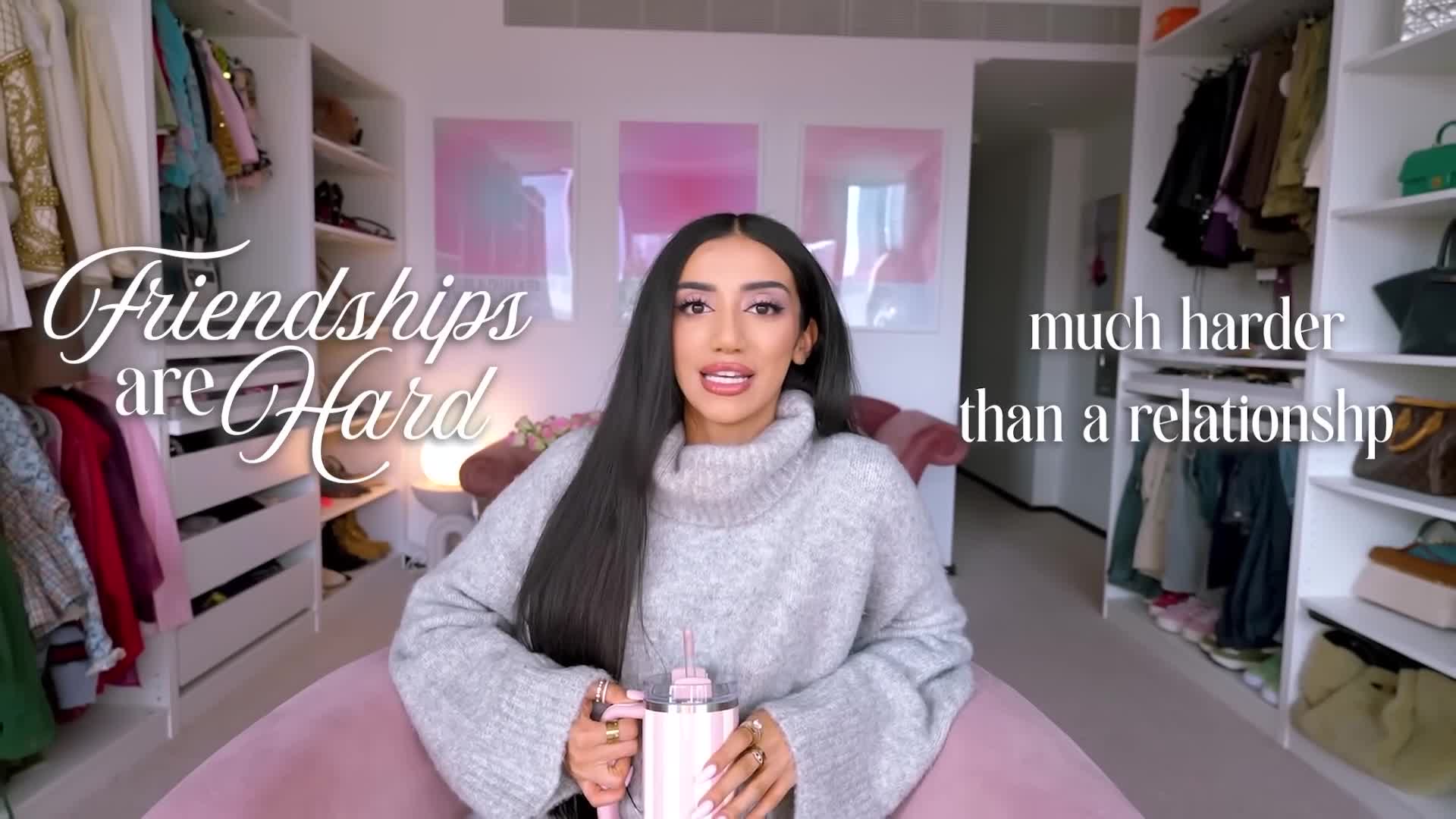
Friendships are hard, much harder than dating, in my opinion, purely for the sole reason that people don't talk about maintaining, making and fixing friendships nearly as much as they talk about dating, especially in the online world.
And then everybody also has so many differing opinions when it comes to friendships.
You know, you have your low maintenance friends, your high maintenance friends.
We have the people that do set friendship standards, the people that don't, and there's such blurry lines in what you should and should not expect in friendship, compared to most people knowing what they want out of a romantic relationship.
That's why I wanted to sit down and make this video today.
I've been meaning to talk about this for so long the ultimate guide to real friendships because I personally have been through it over the last decade of my life.
I've been through so many different types of friendships and friendship breakups.
I do have an entire dedicated video to friendship breakups if you want to learn more about that and how to heal from them.
But this video is more so.
All of the great tips and advice that I wish I could have known sooner, which really would have helped me just find my real aligned true, authentic friends much more easily.
Here is the chapter breakdown for today's video.
If you are confused as to what is going wrong in your friendship life and why you can't quite find your people yet, then keep on watching.
Before we get right into it, quick mention that you and I can twin on our daily jewelry stacks because I teamed up with Abbot Lion to create an amazing edit where you guys can get your hands on all of the waterproof and tarnish-free jewelry I wear every single day.
If you're a silver girlie, no worries, because all of my pieces come in both metals.
We have watches, rings, earrings, necklaces.
It is to die for.
There is a link in the description below so that you can check it out.
And I always have a discount code here, so you guys can get two pieces of jewelry for the price of one.
Pretty good deal if you ask me.
So if you like the way I style myself, just feel free to check it out.
And also a huge thank you to Squarespace who have actually sponsored today's video.
Squarespace is an amazing all-in-one website platform that is designed to help you stand out and succeed online, regardless of your business expertise.
You know, there's always that next step on how you can grow, and Squarespace has got you, no matter where you are on that scale.
Squarespace quite literally takes care of every single step in the business journey, whether it's just starting out and setting up your website, all the way to growing your brand, getting paid, even integrating AI and just staying ahead of the curve.
For example, Squarespace recently launched their latest AI tool.
It's called Blueprint AI, and the way this works is incredible.
Blueprint AI is Squarespace's first ever AI-enhanced website builder.
This allows you to get a fully custom website in just a few steps.
All you have to do is input some basic information about your industry, goals and personality to then generate premium quality content and personalized design recommendations.
Squarespace also offers a complete library of professionally designed and award-winning website templates with options for every use and category.
Just like selling content.
If you don't wanna team up with a warehouse or you don't wanna be keeping any inventory or worrying about the logistics of shipping because, my goodness, that can be quite a nightmare you can literally just monetize any existing content you have, whether it's vlogs, videos.
All you have to do is set the price, put it behind a paywall on Squarespace and you now have an extra revenue stream.
If your dream is to open your own clothing brand and you really want your customers to have that physical product, Squarespace can actually take care of all of the inventory and the shipping for you with their custom merch tool.
Simply design your products and Squarespace will handle all of the production, inventory and shipping, so you can focus on what you do best.
Because merch is such a great way to engage your audience and generate more income.
So you guys can head over to squarespacecom to start your free trial, to actually test it out, see if it's right for you and see really how easy it is to start your own business.
And you can use my unique link below in the description squarespacecom forward slash tamcore and that will get you 10 off your first purchase of a website and domain.
There are no more excuses now not to get started.
Okay, chapter number one, what to avoid in friendships.
I feel like people don't usually look any deeper than disloyalty, somebody not being trustful, or somebody just being a mean person.
All valid points, but in my experience I've learned that there are so many more red flags in friendships, and if you know these, then you're gonna make your life a hell of a lot easier in the long run, especially because some of the points I'm about to list a lot of people think are green flags okay, but they are simply red flags in disguise.
And that leads me to my first point.
People who put you on a pedestal are not your friends.
It might sound flattering at first, but these people are not actually friends with you.
They do not care for your authenticity.
They are not there for the real you.
They are not there to show you unconditional love.
In fact, this type of love is extremely conditional, because if somebody is putting you on a pedestal, it's because they are idealizing you, it's because they are in love with the idea of you and romanticizing the kind of person you could be, instead of recognizing that you are a very real, normal human being with flaws and mistakes and a very real journey.
Just like them, you want you and your best friends to all know that you are equal.
That's how you're truly going to be able to support each other and, not only that, truly understand each other.
Now that I've grown older, truly the biggest thing that I want in a friendship is each of us to just make the biggest effort in understanding every little insignificant detail about each other, because that's how you really get to show up for each other.
When you know who you're talking to, when you know what your friend struggles with, when you know what their tendencies and their personality really is.
True friends don't place you above them.
They walk beside you and they're ready to embark on that journey with you, just because of who you are truly inside.
And I think there's a very important point here that when somebody is putting you on a pedestal, it's because they've taken you at face value and they're running with that idea.
Again, I want you to decide to be friends with me over time.
Like we've met a few times, we've had a few different deep conversations, to the point where now you understand my soul and the way that I think and the way that I converse and what my mindset and my values are.
You'll appreciate me and you'll value me for sure.
But once you understand my journey, there's no reason to put me on a pedestal, because you realize that all humans go through a similar journey anyway.
Plus, when someone puts you on a pedestal, you kind of feel this pressure to act in accordance to it because they're so impressed by you.
And when you naturally will break this illusion that they're holding you to, the relationship will crack along with it.
Red flag number two to avoid is to stop being friends with history.
We are here to be friends with aligned people, not the past.
Because ask yourself this are you really aligned to the person that is currently standing in front of you right now?
Or are you more aligned to the person that used to be, to the memories that you're holding onto with them?
I want you to think of it like this.
Let's say you have a friend of 10 years.
If you just met them today, would you still want to be friends with them?
Would this current version of yourself still feel aligned with them enough to want to get to know them and bring them into your life as it looks right now?
If the answer is no, then it just goes to show maybe that person was only meant to serve a past version of you.
And it doesn't have to be this brutal, sad thing.
People come into our lives for a season or a reason.
Not everybody is forever.
And I think that's the most beautiful part of life when you detach and when you accept that people are here to either leave with a piece of you that needs to die or to teach you a lesson.
And for however long that might be, whether it's 20 years or two months, appreciate it.
And there are going to be the lifelong friends that are with you through every single chapter.
Why?
Because they evolve with you.
Because, while your paths might not look exactly the same, you are still growing in a similar direction and your mindsets are still evolving together.
Way to assess this is by looking at all of your friends and thinking do they actually see me for the person i've become today?
Or when i hang out with them, do i feel more connected to my past or who i was in school?
Are they anchoring me to a version of myself?
I don't want to be anymore friendships that are based on your old self concept.
I speak about self-concept all the time because I think it is the true, magical key to leading a happy fulfilled, successful life and also manifesting all of your desires.
You need to constantly be aware of your self-concept and allow it to evolve to match the life and the things that you want.
If that is the personal journey you need to be going on, then you cannot surround yourself with people that constantly talk about the old version of you, claim that you've changed just because you're trying to become a better version of yourself, refuse to try and understand the new version of yourself, feel threatened or competitive with the new version of yourself, always make jokes about the old you or try to pull you back into old environments and past behaviors that you do not connect with anymore.
They are basically addicted to a version of you that no longer exists.
And it doesn't always mean that they're a bad person.
Some people just do this unconsciously.
They don't intend to try and hurt you.
But what I've seen with a lot of people is people like to organize every single person they know in their life in all these little boxes in their head, right.
They organize you as the type of person you are.
Everybody needs to grow and evolve in this life.
So once you start stepping outside of that box now, they need to start redefining who you are and who they are in relation to you.
If they don't work on themselves enough, they don't want to do the work to move you out of the box they currently have you in and move you into a newer one to start realizing and rebuilding the new friendship they have with the newest version of you.
Red flag number five is people who gossip too much.
Now, I believe that there is a right and a wrong way to gossip.
The wrong way to gossip is just talking about anybody for the sake of it, always trying to bring other people down and, in the process of it, trying to prove that you are better than other people by highlighting their flaws or their insecurities.
I believe the right way to gossip is that you are talking about other people because it is related to a situation that you are directly involved in.
It is having an impact on you or your life, so you need to go to a friend to discuss it, maybe get advice or maybe just vent about it.
Or you are discussing this with your friend to see what your mindset is on the situation and what their mindset is on the situation.
There is no judgment and there is no criticism or insulting involved.
It's simply a conversation about life, mindsets, values, and just general people.
But the people who gossip in the wrong way always want to talk bad about others, always want to be placing themselves on a pedestal always weirdly, know so many details about people that aren't even in your life and have to come running to you with the details.
Very strange.
You might know a few people like this.
And at the same time, you might be thinking, they're not bad people.
They don't mean it in a bad way.
They're just telling me stuff they know.
Okay, let's believe that.
The reason that this is still a red flag, even in that scenario, is the vibrational frequency of what they are doing in talking bad about other people in that way is affecting you, your mindset and your life.
And I've said it before, I'll say it again you are the average of the five people you spend the most time with.
Remember, it's not just down to who the people are, it's about the conversation that they are bringing to you.
My life completely transformed into the 180 once I started having conversations on the dinner table with my friends about life and goals and our values and where we wanna go.
I literally leave all of my interactions with my friends feeling so energized happy inspired, motivated and ambitious because of it.
I can't imagine how down in the dumps i would feel if the entire conversation was centered around people i don't even care about.
It sits in your head, it lowers your own vibration and it doesn't make you feel good.
It's a waste of time.
It also says so much about that person why they must send to every conversation about that and the fact that they don't have anything else better to talk about.
Like tell me about what's going on in your life, tell me about your dreams and your aspirations.
Red flag number six friends who don't believe in boundaries because they call it love.
Now, I've had a couple of friends like this in my life and you know what?
They are not bad people, okay?
They are a little bit high maintenance when it comes to friends and that's fine, okay?
You can have low maintenance friends and high maintenance friends.
Not one is better than the other.
They're just two different types of people.
They are people that are very extroverted and they're people that genuinely care about you, but they haven't quite caught on to the boundary side of things yet and they always want to be in your space and they always want to spend time with you.
I get that there are going to be people like that.
In that case, you do need to sit down with this person and actually explain what your boundaries are and what you need.
Maybe it's that you don't have the time or the capacity to be texting them all day long, updating them on your life.
Maybe it's that you aren't the type of person that wants them knocking on your door unannounced.
That is completely okay.
If, after this conversation, they are still not willing to compromise with you, then that is not a real friend.
Or, on the other hand, even if they are trying but your boundaries aren't really working for them, then maybe you two are just not meant for each other anymore.
It is not your responsibility to allow people to have access to you for any more time that you are comfortable giving.
The biggest red flag in friendship are the type of people that make you feel guilty for having boundaries, as if you're trying to push them away, when really all you're trying to do is protect your peace and balance everything in your own life.
It's not your fault that they're addicted to you and your availability.
Chapter number two, setting your standards.
Now that we know a few of the red flags to avoid and of course there are many more like people who go behind your back or people that try to compete with you or never celebrate you, but those are all the obvious ones.
We already know that.
Now we're going to get onto all of the green flags, setting your standards.
What do we actually need to look for when we are trying to find the right people and our real community?
Step number one setting your friendship standards is deciding what your limits are and what flaws you are okay with accepting not really flaws but there are some things people absolutely can't put up with that you might decide you are just okay with.
One example of that that i use in my friendships is i'm not really fussed about making all of the plans.
Like I do take the initiative in all of my friendships when it comes to guys, when are you free?
Should we do this?
And then planning the whole thing and putting in the date and like following up with everybody.
I don't mind that.
I feel like I have enough time in my schedule to do that.
I am not offended that other people are not like picking up the slack to do it, because I know that they're very busy and they show up in the friendship in different ways.
And I think that's something that's very important to recognize.
We can't expect other people to be perfect and to be able to do everything, because you have your limits.
I have my limits too.
There are ways that people in their lives have to put up with us and we appreciate them for that.
You can't expect people to be everything to you and to be perfect.
So decide what you are okay with and what you don't mind sliding.
This leads me onto step number two, set your expectations.
A lesson that I learned the hard way over the last few years is that again, not everyone can be the most important person to you.
I used to just feel like I wanted everyone to be my best friend.
I wanted to be on a level with every single person.
But I've learned that in this life you're probably only gonna have one two, maybe three a push best friends that truly understand you, are like integrated with your family, have seen your journey.
You catch up with them more regularly and they can serve you on a night out or spiritually or when it comes to advice or having fun or doing wholesome activities.
Everybody else, most of the time serves you in about one or two ways.
They cannot be there for you and they are not the type of friend that serves you in every single area of your life.
So, for example, you're gonna have your party friend.
You're gonna have your friend that you always work out with.
You're gonna have your friend that's a little bit more spiritual.
Or if you're religious, you do those things with them and you talk to them about that.
You're gonna have your friends who are much more casual and you see every now and again, just for a catch-up.
Basically, stop expecting spiritual depth from your clubbing bestie.
I'm saying that because that used to be me, okay?
I used to have really high expectations of everyone and it just didn't make any sense.
Don't drag your most ambitious, most aligned best friend into your group, who loves to party and gossip a little bit.
They're just different people and you're gonna have different people in your life that don't all necessarily feel in the same group together, because you are such a multifaceted person and you are going to have different people in your life that just serve one part of who you are.
Like literally right now, I'll give you an exercise.
I want you to step back, even like write all your friends' names down on a piece of paper, and I want you to now gain some clarity and evaluate why is this person in my life?
What do I get out of this friendship?
Where do we connect the most?
And understanding that clarity will save you from any disappointment or high expectations that shouldn't have really been there in the first place.
Also, when I say expectations, that does not go for like loyalty, honesty, kindness.
That is bare minimum with every single person in your life.
That leads me on to my next point when setting standards.
Don't villainize everything because not every single distance is betrayal.
Not every single miscommunication is somebody who doesn't actually like you.
Some people are healing, some people are in survival mode, some people are just trying to make ends meet.
Some people are right now prioritizing their career and their family and don't really have the capacity to be there for you.
100% there should be conversations between you and your friends to understand where everybody is at and when somebody isn't up front with you about those things it's easy to jump to conclusions but that's another lesson i've learned in my life that you know i had people who who really distanced themselves from me like straight up kind of ghosted me and i really took it personal it turns out they were just honestly truly going through it in their lives you don't have to be okay with that if you don't want to but just remember it's always important to give people the benefit of the doubt in my opinion for the first time anyway Also, when it comes to this point, I think it's important to recognize not everybody needs to be cut off for every small thing when you realize the expectations and the standards bit.
Like they never told you they were the kind of person that could be there for you in a certain capacity.
So now you don't get to criticize them for not being the type of person that they never really claimed to be.
Not everybody needs to be cut off, but they can be held at a distance or seen every now and again.
Having said that, I do think friendship breakups are important, necessary and absolutely inevitable in this life.
I don't think they are something you need to avoid at all costs.
It is something that is going to teach you so much and that is honestly unavoidable.
So again, if you want to know more about that, watch my other video on it, because I think it's a very healing experience.
My next step when it comes to setting your standards is not to keep score in your friendships, but do notice patterns.
Friendships are not transactional.
It's not tit for tat.
It's not like, oh, I was there for you in this sense, so now you need to call me back or do this.
I'm just not a fan of that.
I think, honestly do things out of the kindness and the love out of your heart, but only to a certain extent.
If you take a step back and you realize my friend has never paid me back for anything in like two months.
That's a pattern to keep note of and pull them up on.
The next standard is super important and one of my favorites, which is don't mistake comfort for connection.
Just because you feel familiar and comfortable around someone doesn't mean they're a good person in your life.
A lot of the times, at least in my experience, I found that the things that drag me back to familiarity and comfort is because it identifies with the past version of me that I'm trying to get away from, because I got high goals and ambitions.
I'm trying to get to the next version of myself.
So any sort of familiarity is just linking to maybe trauma or my family dynamic, which honestly doesn't serve me, or past friends that I had which I clearly cut off for a reason.
So just be wary of certain familiarity.
Just because it's easy doesn't mean it's aligned and doesn't mean that it's meant for you.
The next step for setting standards is actually more about communicating your standards with your friendships.
I want you to understand a few things about yourself.
One, what type of friend are you?
Are you high maintenance or low maintenance?
And two, what are your friendship love languages?
Just like we have love languages for our romantic relationships, which I always say we should also use to assess our self-love eg quality time, gift giving, acts of service there are certain friendship love languages.
They could be the same as what I just mentioned, or things like communication, daily phone calls presence, deep conversation, doing activities together, traveling together, whatever is most important to you.
Ensure you're making it known to your friends and you don't just stay silent on it, because that's why that resentment starts building up and you start getting frustrated that people aren't there for you but they don't know how to be there for you.
I have always been super open with my friends that i am a very low maintenance friend.
I'm not really a fan of regular facetimes or daily texting it's never been me and i don't do it with anybody in my life and i'm so grateful to have friends that understand that and never punish me for it or never try to take me back on that boundary.
Don't get me wrong.
I have actually lost friends because that didn't serve what they wanted in friendship, and absolutely fair enough.
But i think that's even more of a reason to clearly communicate what you want, with no shame about it, because the people that don't fit into your life will walk away once you communicate it and the people that actually want to be there for you.
Your connections are going to grow even stronger as a result of you saying what you want.
And then lastly, for this chapter, I think it's really important to constantly go back to your friendship standards list, because throughout your life, new people are gonna come in and out and you might constantly be on the search for new friends, especially if you're someone who is rapidly growing and evolving with the new lifestyle that you are building.
And so for that reason, you are gonna go through so many different phases of your life.
I'm actually seeing this with me where I'm at on my journey right now.
Two years ago, I was deep into it with the working and the building phase of my career.
I was inside my apartment or at my family home 24 seven in my room, just me and my laptop and nobody else.
I had very, very little social time.
So the few people that I did allow into my life had to be able to facilitate deep conversation, be a low maintenance friend and be able to have those inspiring, work style building conversations.
That is exactly what I was looking for.
And I really was able to find those people, which was amazing.
However, two years later, I am like a different woman.
I am all about, I wanna go out.
I don't mind doing the odd night out anymore.
I really quit that for a few years.
I wanna be out in the town.
I wanna be exploring this beautiful city I love in.
I wanna be doing more activities and just actually living life, rather than being glued to a screen or stuck within the comfort of my own home, because this this, i've done for years.
While i was growing up, i was always stuck inside.
Now i want to have new experiences and i want friends who are open to that.
I don't want the type of friends who are addicted to catch-up culture or will only text me or see me every six months.
That's not important to me anymore and it's not what i'm looking for.
So i'm really glad i've allowed my standards to evolve, as i have evolved as well, and it means that the people that are coming in and out of my life always stay fresh and are always aligned.
And finally, chapter number three being a great friend.
Super, super important conversation to have.
I think there's so many conversations online about how to be a great partner, but what does it take to truly be a great best friend?
And I want a disclaimer here, that I am still on this journey myself.
By no means have I completed it and I'm still learning as I go along.
However, I've made a lot of mistakes myself.
I've had certain treatment from other people that I've like opened my eyes in terms of what is and is not needed in friendship.
So these are just my personal takeaways.
Step number one to being a great friend is to both assess and be accountable in your past friendships.
Even if they hurt, even if it makes you cringe that that person was in your life or how it went down and how the breakup was.
Whatever, you do need to look back on it to ensure you don't make the same mistake in the next friendship.
And even if that ex-friend hurt you and you didn't do anything, Regardless you were still in that situation, and that's not me shifting the blame onto you.
This is something I've learned.
What still needed to be healed in me at that time for me to attract somebody into my life, except those negative patterns and their bad behaviors, to the point that it had to get to that friendship breakup.
Sometimes it just happens sure, but sometimes you'll notice certain patterns or limiting beliefs in yourself.
That means that you are unconsciously continuously attracting the wrong people into your life.
And it's only once you look inwards and take accountability for that and then work on those parts of yourself, that not only you can get better people, but you know how to treat those people better and be there for them without falling into your old patterns.
You will always be a better friend once you focus on yourself and embark on your healing journey.
That leads me to step number two, which is glow up.
You are never gonna regret a glow up.
And I'm telling you, being the best, most self-obsessed, self-loving version of yourself means that you are gonna radiate this gorgeous energy onto every single person around you.
This is why I always talk about the concept of being self-obsessed.
It's not a selfish thing to do.
You literally after going on that journey, you are more secure and confident than ever, which means you can celebrate your friends more than you ever could before when you are battling your own demons and insecurities.
Being confident helps all of the right people in your life, okay?
And the people that actually love you and want you to flourish.
They will stay and they will love that journey.
And the people that were never quite right for you.
They will start to fall off once you become the highest version of yourself.
So I just think that is a win-win.
Just not about this narrative that once you want a romantic relationship or once you want to make a few friends, you become so obsessed with chasing or other people or becoming more likable for other people.
No, i think the core journey should always be do i like me?
Am i showing up for myself, am i committing to my goals?
And everything else will flow in the right place alongside that journey.
Step number three to being a great friend is to support.
And I don't just mean compliments and showing up for them.
Buy from your friends' businesses, okay?
Don't be the friend that asks for freebies, okay?
Wait until your friend offers it to you.
Promote your friends.
Repost them on your story when they do something amazing.
Take the time out to surprise them without expecting anything in return, because that, right there, that's real, unconditional love.
That is what I think our true purpose is in being on this earth and building communities and meeting new people to love them, regardless of what the outcome of that friendship is going to be.
I am always a believer in like celebrating people and showing them kindness, even if they're in your life for two weeks.
Maybe they needed that.
Maybe you were a core part of their journey that they needed to then grow for the rest of their life, even if you're not in their life anymore.
You don't understand how much a little act of kindness can go such a long way regardless if it never gets repaid to you.
Step number four to being a great friend is to stop catch up culture and instead build experiences.
This is actually something I'm working on right now, because I was the catch up culture friend, because I've been so low maintenance for so many years.
So I would see my friends, maybe like every four months, and then we just have a big dinner and catch up on everything.
And don't get me wrong, I still love those and I probably still will do them, but I'm just trying to be a little bit more conscious about how I'm spending time with my friends now.
Let's actually go and do an activity together.
So once I realized this, a few weeks ago, two days ago, my girlfriends came down, we went and we did candle making.
Now that is an amazing experience and such a unique memory for us to talk about and laugh about now.
They slept over at my apartment.
We actually spent the longest amount of time together that we have in years.
Rather than just getting a coffee and just talking about our past and our experiences with other people, rather than building new experiences with each other.
Step number five to being a great friend is to be a mirror, not a manager.
A big part of friendships is they're gonna vent to you and they're gonna come to you with their problems.
And I just think it's really important to hold space and allow your friend to vent and listen to them.
But don't try to control their actions and don't get angry when they don't take your advice.
I know how frustrating it can be when you've told your friend the same thing a billion times and they are not listening to you and they keep making the same mistake over and, over and over again.
And it can be even more frustrating if you've been on that journey and you know what it looks like and you're trying to save them from it.
Everybody needs to go on their own journey and everyone needs to make their own mistakes.
You were there once too, so you are not allowed to judge other people for doing it.
Simply be honest in your own experiences.
Be honest in your opinions of what they're doing, but also allow them to have their own experience and journey and don't criticize or judge them for that.
Your job is to hold space for your friends, not to fix them.
Step number six to being a great friend is to add so much value and service to your friend's life by contributing to their inner glow up.
And I love this.
I want my friends to feel like the highest version of themselves after they hang out with me.
That's my main goal.
I want you to feel more confident.
I want you to feel celebrated.
I want you to feel like you could literally do anything.
I will never gatekeep any sort of hack or tip or step that's helped me in my life, because I want you to flourish and I want you to be the best version of yourself as well.
It's not necessarily about I'm doing this so my friends love me and they'll like me more.
I just think it's your duty as a friend that this is how we should be showing up for the other people in our lives to be able to contribute on their journeys.
That's what happens when you're so interconnected with all these other people.
You're all affecting and influencing each other without you even trying.
So to be able to have a little bit more of a positive influence on them, rather than maybe talking about other people or talking about meaningless stuff or your past, is a really nice way to show up for them and impact them.
My last tip for being a great friend is to learn what they need and learn their emotional language.
I have friends who want me to give them tough love when we have some difficult conversations.
I have other friends who need me to be a little bit more passive and just listen.
And I have other friends who want me to just be a little bit softer and more gentle and unbiased when giving them advice on a situation.
How do I know all of this?
Because any single time they've come to me with something, I ask, what do you want?
Do you want me to give you the tough love approach right now?
Or do you not really want to hear it?
Do you not want my advice?
Do you literally just want to talk at me because I can do that?
And I think it's really important not to be selfish in these situations and just go off and yap with what you think they need to hear, rather than showing up for them in the way that they need to feel emotionally safe connected, loved and cared for in whatever situation they're going through right now.
Because if you truly love someone, then you need to care about how they want to receive love, not just focusing on how you want to give it.
And that brings us to the end of this video.
I hope you guys enjoyed it.
I've been meaning to make this type of video for so long and I really, really did enjoy making it.
I think in the future I'll definitely be making a part two because, as I said, this is an ongoing journey.
I just feel like so much has changed in my friendship journey as of right now.
Like I'm setting my new standards.
I have different expectations with my friendships because I'm in a different phase of my life.
I'm showing up in a different way because friendship has moved up the list for me and being more of a priority for me.
Whereas the last five, six years career was at the top.
So it was just a fun journey to be on and I'm sure I'm going to learn even more about it.
So make sure you subscribe so you don't miss whenever I do that part two.
Comment down below.
Let me know what your favorite piece of advice was and what you're going to be implementing.
I would love to know and I will be responding to the comments in time before I see you guys next week on Friday for a new video.
Check out the description we can twin with our jewelry.
You can watch all my vlog videos where you see how I implement all of my own advice in my life.
You can read my self-love book or buy my guided journals that help you level up into the best version of yourself.
There's so much in the description that will serve you on your journey.
I promise you that I poured many, many weeks months, hours into them.
I love you so much.
Thank you for being here.
I'll see you next week.