Hey friends, welcome back.
Today we have an exciting video because we have a special guest here today.
Nisha from Rainbow Plant Life.
I'm sure you already know about her incredible YouTube channel, which I will link for you below.
Today we're making actually one of Nisha's recipes for you.
What are we making?
We're making a Malaysian curry noodle soup and I'm just so excited to be here.
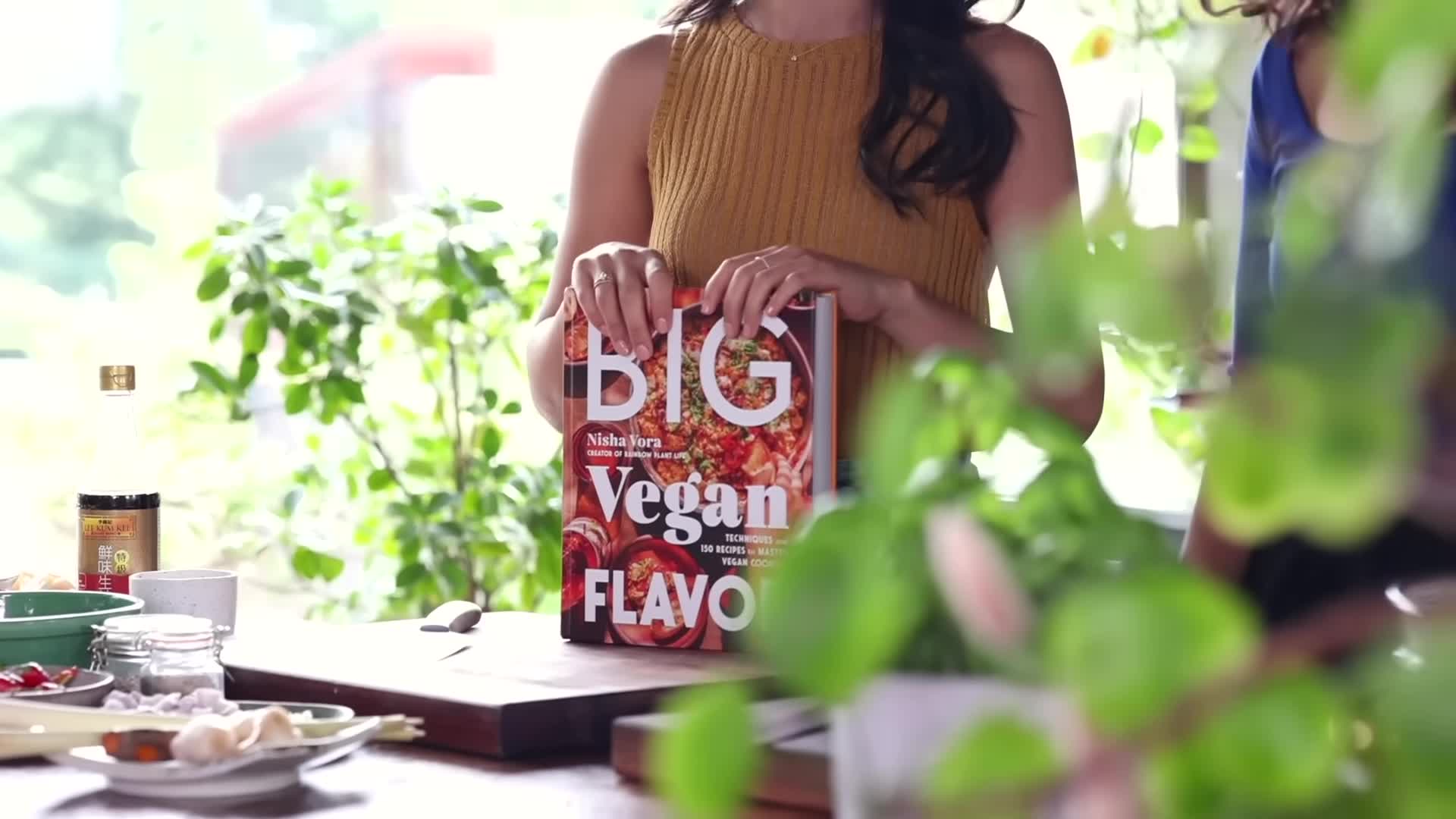
The recipe that we're making today is actually from Nisha's incredible massive, beautiful brand new cookbook.
It's perfect for anybody from like beginners to advanced vegans.
And I can just tell all of the like love that you have poured into this.
And this is now available on pre-order.
Yes, pre-order.
It will be in the market.
This is what my mom said.
She was like, it's going to be in the market.
Why are you laughing so much?
I'm like, which market?
Comes out September 3rd, and we'll also include a link to the printable recipe on my blog, so you can get it there as well.
If you're hungry for even more noodles because that's just how we jam there will be another noodle recipe of ours on Nisha's channel.
So feel free to check that out too.
But for now, let's get started.
So there are four components or four elements of this.
There's a laksa paste which is kind of like a curry paste, a broth, the soup which contains both of those plus a couple other ingredients.
And then fourth is the toppings that kind of like make it a whole package.
So I think we can start with the laksa paste.
My mouth is watering.
We've got some shallots and garlic that are just kind of roughly chopped.
Now we're gonna move on to one of my favorite ingredients, lemongrass.
You kind of just feel where it is really tough, but I would say cut off maybe this amount.
So you did that to see where does it bend, and that's where you cut?
Yeah.
And then you just start peeling the outer layers, which are quite papery and tough.
When do we get to the smashing?
One more layer for me.
Sorry.
So you want to release as much aroma from the lemongrass as you can.
To do that, we're just going to smash it down, which is really fun.
Oh, that's so satisfying.
That one's better.
I think I've destroyed it, though.
No, no, no, that's fine.
Is that OK?
Totally fine.
So I'm going to snap out this tough root.
So these are not edible.
They're too tough.
But you can smash down on them and infuse them into the soup for a little extra lemongrass.
Do I get both?
You get both.
I totally missed.
Sorry, again, here we go.
That's good.
Next up, look, we have galangal.
It is often used in Thai cooking.
I think some people think it's the same as ginger.
It looks similar, but the flavor and the aroma is actually quite different.
And would you say, though, that if you can't find this, you can use ginger instead?
It'll be a slightly different flavor, but still delicious.
So it is a little tough, but we're gonna try to slice it thinly.
This is so fun, I just get to tell someone what to do in the kitchen.
I'm your sous chef.
This is fresh turmeric.
Looks like a severed thumb.
If you don't have access to it, you can just use a little bit of ground turmeric.
Okay, chili peppers next.
This is a curry paste, so we need a little heat.
For me, that's gonna probably be four of these chilies.
But folks at home, if you're like, four is too many for me, just use one or two, it's up to you.
Next, we are adding in some roasted cashews and then Cilantro.
I just use the leaves and the tender stems.
Both delicious.
I'm gonna pick up the lime.
Resisting the lime in here.
The whole lime?
One teaspoon, so maybe like half to start.
Some Chinese light soy sauce.
If you don't have access to this, you could just use a regular supermarket soy sauce.
We have some cumin and coriander that we're going to toast in a dry frying pan.
And this is why I love Malaysian food so much.
It's just this hodgepodge melting pot of cultures.
We've got savory Chinese soy sauce.
We've got Thai, Southeast Asian type of aromatics.
We've got a little Indian spice in here.
So it's going to be super delicious.
Okay, so now we can blend this up?
Yes, depending on how good your food processor is, you might need to add some oil to make everything come together.
Wow, that smells incredible.
Wow.
Okay, what's next?
Component two, we're making the broth.
So it is actually quite simple.
There's only a couple ingredients.
First one is kombu.
Kombu is a type of seaweed.
It's very rich in umami.
I like to release a little more flavor by sniffing just in a couple different places.
And I'm assuming it's just like to increase the surface area so that the flavors can leach into the broth.
Yes, exactly.
Scientist's ideas.
So this is an optional ingredient.
This is another seaweed.
This is wakame.
Typically a laksa broth is made with, you know, fish products.
And so we're trying to add a little more umami, but in a plant-based way, also going to add some of that chinese light soy sauce.
And now we just need some water beautiful, and then we heat this up.
Yes, we're just going to gently simmer it for 10 minutes.
While that's simmering away, we are going to prep the veggies.
Yes, a couple ingredients to go inside the soup.
I have some beautiful oyster mushrooms here.
A traditional laksa soup has meat in it, and so i like to use oyster mushrooms to give it kind of that subtle meaty texture.
But i know some folks don't like mushrooms if you don't just use whatever vegetable you like.
All right, so now we're just gonna, I think, tear these into little strips.
Yes.
Last thing, we have some tofu puffs, which you're familiar with, right?
I love them, yeah.
These can be found at Asian grocery stores and they taste like nothing now.
But when you infuse them into the soup, into the broth, Soaks up all of the flavor.
That's the perfect sound for it.
I like to tear them in half if they're really large.
Then you get more tofu in each bite, but also the slurping.
Yeah, it just like soaks it up even more.
Yeah, it's even better.
I like to add fresh curry leaves to mine.
Again that slight Indian influence.
And, like I don't know, I'm Indian so I try to Indianify everything.
But if you don't have access to them, you can just omit the curry leaves.
You wanna do the honors?
I'm very clumsy.
Okay, I'll do it.
Oh, that already smells very umami-y.
It smells like the sea.
And then we just discard the seaweed.
And last thing, we're just gonna squeeze in a tablespoon of lime juice, brighten it up a bit.
Everything's prepped now, so we're gonna start by building the soup.
We're gonna fry the curry paste first.
Once the curry paste starts to dry out a bit, we'll go ahead and add in our broth, deglaze the pot, scrape up any of those brown bits and we'll add in our mushrooms the lemongrass stalks and just a tiny pinch of salt.
We'll let that rapidly simmer for 10 minutes.
We'll scoop out the lemongrass stalks and our final ingredients.
We've got some canned coconut milk, those tofu puffs and some fresh curry leaves.
So during this final simmer, we're gonna go ahead and cook the noodles.
These are fresh Chinese wheat noodles, but really any noodle you have access to will be fine.
It's up to you.
Beautiful.
Where are these pieces coming from?
It's because I smashed it too hard.
Was that too much?
It was too much.
Okay.
So I'm just tasting the broth to make sure it doesn't need any extra soy sauce or sugar.
If it's a little too acidic, I like to add a little brown sugar to just balance all the flavors.
It's time to eat.
We're gonna add some noodles to our bowls and then just scoop this delicious curry soup on top.
Now for the toppings, you can get creative here and add what you like.
I'm gonna go ahead and add some fried shallots for crunch, a little chili crisp, fresh lime juice and a little cilantro.
This smells incredible, Misha.
I'm gonna do a little slurp.
I'm just going for it.
You're going, okay.
Oh my God, wow.
You're so much faster than me.
Amazing.
Pip check.
Oh.
Yeah, that's the best laksa I've ever had, for sure.
Aw, thank you.
Thanks for having me here.
I'm having a moment.
I'll stop chewing so we can talk.
This is incredible.
And you guys are definitely going to want to try it out.
Nisha has been gracious enough to share the recipe from her cookbook.
So you can find the link to her cookbook and the full recipe breakdown over on her website.
The links for both are in the description box below.
And if you're hungry for even more another noodle dish.
We're going to share one of our recipes on Nisha's channel.
So be sure to check that out as well.
It's going to be so good.
Thanks for hanging with me today.
I really appreciate it.
Do you know our sign off?
Pick up limes.
Oh, what am I doing with my finger?
I was like, are we linking fingers?
We'll see you in the next video.
Was that too much?
It was too much.
Round two.
But maybe like you're only slightly mad.
Like you're just like a little ticked off.
Not like, sorry.
Yeah.
It was a bit too aggressive.
Sorry.
Okay, here we go.
Okay.
No.
If you need to get your anger out, Speak to a therapist.
I have a special guest.
Yay!
Don't be gangly, which is... I kind of actually like it if you... Hello.
I love it.
The weirder, the better.
Why did I do this with my left hand?
I should have done this with my right.
Like no strength with my left hand at all.
They have lost some water.
It's okay.
I gotta get the angle just right.
Oh my lord.
Next.
Sorry.
Oh my gosh, Nisha, this smells incredible.