Get the unmissable news stories of the day.
This is the Beijing Hour. Examining the events that impact and shape China and the rest of the world.
This is the Beijing Hour, one hour of news and information brought to you every weekday Now, here's your host, Shane Bigham, with you on this Monday, August 18th, 2025.
You're listening to The Beijing Hour, coming to you live from the Chinese capital.
On today's program, Ukraine's presidents discuss security guarantees with other European leaders. ahead of a meeting with the U.S. president in Washington.
Russian officials say Moscow also needs credible security assurances if there is to be peace in Ukraine.
After 12 days of competition, the World Games in Chengdu have come to an end.
In business, China's A-share market sets a new record for capitalization.
And we have the second episode of a six-part series, The Unyielding East, China's World War II Relics. telling stories about the nation and its people that stood their ground against fascism, and today we'll be following the traces of Chinese soldiers who sacrificed on the battlefield.
Now check in the day's top stories. Ukrainian President Volodymyr Zelensky has discussed security guarantees with European leaders ahead of a meeting with US President Donald Trump.
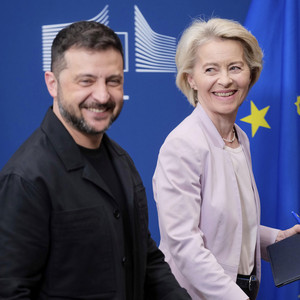
He said Europe can fund a strong army. European Commission President Ursula von der Leyen said there should be no limitations on support for Kiev. von der Leyen and other leaders, including British Prime Minister Keir Starmer and German Chancellor Friedrich Merz, will join Zelensky at the meeting in Washington.
Rahul Patak has more. Zilinski and his European allies really wanted to present a strong and united message coming out of Europe and the message that's primarily directed at Washington, that message being that Ukraine's borders, their current borders are sacrosanct and there can be no changing of those borders through the use of force.
Remember this time last week, Donald Trump was suggesting he was going to impose really strong sanctions against Russia if he didn't get a ceasefire agreement.
Now, Trump says he no longer has any plans to impose any economic pain on Russia, having spoken to Putin.
Now, in terms of the front line on the battlefield, this could mean the difference between the Ukrainians keeping the Russians at bay or Putin's forces capturing areas like Donetsk, which has been the epicenter of fighting in recent weeks.
And I think it's no coincidence that the EU Commission President von der Leyen said on Sunday that there should be no limitations on the military help that European countries could give Ukraine in the future.
So a very strong message coming out of Brussels.
And we will support you for as long as it takes for just and lasting peace.
And this peace must be achieved through strength.
Also on Monday, we had the extraordinary prospect of pretty much... every major European leader accompanying Zelensky on his trip to Washington to meet Donald Trump.
So one thing I don't expect is a repeat of those extraordinary scenes that we saw back in February when there was effectively a shouting match in the Oval Office between Zelensky, Donald Trump and his Vice President, J.D.
Vance. I think the feeling amongst European leaders is that Donald Trump will be less likely to bully Mr. Zelensky when he has all those European leaders standing beside him.
Clearly, they've concluded a united front in person is the best hope of swaying Mr Trump their way.
Zelensky and his allies are traveling to the United States after President Donald Trump met with Russian President Vladimir Putin on Friday.
The two leaders reached no deal, but agreed on many points in what Trump called productive talks.
European and NATO leaders say they'll present at United Front during talks in Washington.
Nick Harper explains what they'll be looking for during the meeting between Trump and Zelensky.
We're hearing that confirmed to come here to the White House on Monday will be the UK Prime Minister Keir Starmer, the German Chancellor Friedrich Merz.
France's President Emmanuel Macron, the Italian Prime Minister Giorgia Maloney.
Also, we will have here the NATO Secretary General Mark Rutte. and the president of the European Commission, Ursula von der Leyen, on top of, of course, President Zelensky himself.
And as Raoul mentioned, really, this all seems to be about trying to create that Eurocentric, united front.
European leaders feel that so far, with the talks on Friday in Alaska, they have been sidelined and essentially cut out of the equation. with Donald Trump meeting directly with Russia's.
Plenty of reaction, a lot of it coming from US Trump administration officials, including the Secretary of State, Marco Rubio.
Now, he has said that both Ukraine and Russia will need to make concessions in order to achieve any sort of agreement.
Also, Rubio not ruling out more sanctions against Russia, but he said if that happened, essentially it would be admitting defeat, it would be the end of any negotiations.
Russians are already facing very severe consequences.
There's not a single sanction that's been lifted.
And not one. I mean, they're facing all the same sanctions that have been in place today.
All the American support continues for Ukraine.
And we've heard from the special envoy, Steve Witkoff, saying that President Putin agreed that the US could offer robust security guarantees. to Ukraine, obviously not full NATO membership, but Article 5-like security guarantees, something that Wyckoff called a game changer.
It means that the United States is potentially prepared to be able to give Article 5 security guarantees, but not from NATO, directly from the United States and other European countries.
That is big. Witkoff also said that the expectation is that Monday will have really day-long meetings here at the White House.
Multiple breakout sessions, events taking place, not just a simple one and done Oval Office meeting.
It could be a very long day for those European That was Nick Harper in Washington.
Russia's envoy to international organizations in Vienna says Moscow agrees that future peace agreements on Ukraine must provide security guarantees to Kyiv, but Russia also needs credible security assurances.
Meanwhile, the Kremlin says President Vladimir Putin's briefed the leaders of Belarus, Kazakhstan and Uzbekistan on his meeting with U.S.
President Donald Trump. Belarus welcomes steps toward a peaceful resolution of the conflict with Ukraine.
Kazakhstan called the Alaska summit a move toward a long-term solution.
Uzbekistan praised the positive momentum in Russia-US dialogue and stressed the importance of resolving the conflict peacefully.
China says it supports all efforts that will bring a peaceful solution to the Ukraine conflict.
A foreign ministry spokesperson said China is pleased to see that Russia and the United States have maintained communication.
The spokesperson said China would like to see the two countries improve ties and make progress on a political settlement of the Ukraine crisis.
Coming up, a visit to the Jewel Garden in China's Shizhong region.
On the roof of the world, a quiet miracle has unfolded.
A season marks 60 years as an autonomous region, and China completes its 14 five-year plan.
CGTN journeys across the plateau to witness change.
From snow-capped peaks to modern railways, from ancient traditions to vibrant new schools, Xizang's story is one of resilience, harmony and hope.
Once isolated, now connected. Once impoverished, now thriving.
Shizong is a symbol of China's modernization and sustainable progress.
Join CGTN as we tell the story of a land transformed, where the future rises as high as the mountains that hold it.
Witness the Ascent, only on CGTN. All right, eight minutes past the hour.
Shenzhen's marking 60 years since its founding as an autonomous region.
Last year, regional GDP surged to 276.5 billion yuan That's 155 times the figure from 1965.
The region, also known as Tibet, has been making progress in economic and social development.
And today we have the story of Norbalinka, which means jewel garden in Tibetan.
The site west of Lhasa dates back to the 18th century and is on the UNESCO World Heritage List.
As Shizhong's largest and most culturally distinctive palace complex, it seamlessly blends natural beauty and rich cultural heritage.
Xu Yanwen looks at the ongoing efforts to preserve that treasured landmark.
Duan Yingyi is inspecting cracks in the beams of the Golden Padron.
Emergency repairs are needed to prevent a structural collapse.
Noblinka has more than 400 rooms. Most of them are wooden structures with over 200 years of history.
Luo protects them from rain and pest damage.
We inspect every ancient building, indoors and outdoors, We photograph and record the issues and then document the type and severity of the damage.
Then we compile reports to secure funding for conservation.
Noblinka builds his aunt's largest garden.
It has nearly 30,000 trees, including 137 centriole specimens and rare Himalayan plants.
However, the natural environment and Los Angeles urban development pose challenges to garden preservation.
Winter brings dryness, strong winds and temperature extremes, which lowers tree survival rates. urban construction continuously declined the groundwater levels.
This forces us to ensure adequate water for vegetation while improving soil quality.
The rainy season in summer increases risks to Asian structures.
Agila is a traditional Tibetan material used to help form roofs and floors.
De Dan Wang Mo is a cultural relic specialist who examines buildings and drainage to preserve exterior structures and interior artifacts.
We check floors for cracks if found. We treat them with oil to restore the waterproofing.
We still use traditional argilla techniques and manual ramming teams following the restore to original state principles.
This preserves heritage craftsmanship. Noblinka embodies Tibetan artistry in painting, sculpture, architecture, and carving.
Since 2002, the Chinese government has invested over 46 million U.S. dollars to maintain key sites like the Potala Palace and Norblinka.
The ancient structures are well preserved, and as a UNESCO World Heritage Site, Novolinka attracts global tourists. really beautiful.
The nature is gorgeous. All the trees, the flowers, everything is just amazing.
You can clearly see that religion is very much respected.
A lot of thought is put into every single part.
Beautiful, impressive history, beautiful buildings, beautiful architecture, friendly people, by the way.
So, interesting to be here. I love to travel and I love to see other places in the world.
This adds to having another perspective, another dimension.
The park is now providing a virtual tour guide.
Digitalized collections of stored artifacts and VR-guided tours also enhance visitor experience.
On the North Lincoln Mini program, a 720 degree VR experience allows you to admire the garden scenery without leaving home.
The gardens serve as a key venue for traditional Tibetan opera and folk performances during the annual Shoten Festival.
From historic summer palace to public cultural space, Noblinka has joined global visitors to discover the richness of Tibetan culture.
That was Xu Yanwen on preserving a historic and cultural landmark in Shizhong.
Chizung is often described as a vital ecological zone and important carbon sink.
Director Zhang Yongjian at the National Field Station in Nacu says the region's become greener during the 15 years he's been working there. and the wildlife population is increasing.
We asked them about how the region's efforts in environmental protection contribute to global climate governance and sustainability.
We can interpret this question from two aspects or two scales.
So global scale, So Xizhang has been like a carbon neutral and even carbon surplus in the past decade.
It means that Xizhang can sequester more carbon than the emission.
So not only for Shizong, so this one, they can decrease the concentration of carbon dioxide.
So Shizong is important for China. and also for the worldwide.
Second one, for a local or regional scale, season has become more grainy in the past decades.
So they can conserve water in the soil, so provide a more sustainable water source for downstream.
Second one, because the green are land, so they can protect the sand. from going to the air, so decrease the sand source for the lowland and other regions like inland and southern Asia.
That was Zhang Yongjian in Shizhong, about the region's role in improving the climate.
Leaders from more than 20 countries will gather in northern China at the end of the month to discuss the future of ties among the Shanghai Cooperation Organization.
Representatives from international organizations will also join the SEO Summit in Tianjin on August 31st and September 1st.
A young Iranian influencer is turning her passion for the Chinese language into a bridge between cultures.
Known by her Chinese name, Su Mengjie, she hopes to bring joy to her fans in China and Iran by sharing their history and culture.
As I'm interested in Chinese culture, I started to make videos to introduce Chinese culture to Iranians.
I uploaded these videos to Iranian apps and gained 70,000 followers after some time.
I became an internet celebrity in Iran. My first job was as a translator, but gradually I started to do business as well.
After the COVID-19 pandemic was downgraded, many tourists came to visit Iran.
So I started to work as a tour guide, which I really enjoyed, as it gave me the opportunity to introduce Iran and its history to Chinese friends.
Recently, I've been busy hosting tourist groups, and I'm glad to see that Chinese friends are interested in Iranian culture and history.
They've really enjoyed their time in Iran.
Cultural Messenger says she studied Chinese at a university in Tehran and believes learning the language can lead to a bright future.
China has completed a second full-scale rehearsal for the event marking the 80th anniversary of China's victory. in the War of Resistance Against Japanese Aggression and the World Anti-Fascist War.
The drill involved about 40,000 participants and expanded to include additional procedures such as commemorative rituals.
As preparations for the gathering on September 3rd continue, we take a look at a crucial assault that took place in eastern China in 1944.
Veterans and scholars tell us about the operation on the plains of central Jiangsu that centered on Chuzhou. hope for counter-offensive was ignited, morale was high, and the combat capability of anti-Japanese forces had significantly improved.
Yet disjointed fronts, blockaded routes, and the lack of a secure hinterland continue to severely restrict operations.
The slogan, this year destroy Hitler, next year defeat the Japanese, echoed across China.
On the central Jiangsu battlefield, an offensive breakthrough was urgently needed to shatter the deadlock and launch a strategic counterattack.
After careful deliberation, the Communist Party Committee of Central Jiangsu decided to initiate a major campaign After careful consideration, the new Fourth Army set its sights on Cheqiao Town, southeast of Huai'an.
Ceqiao seemed tightly controlled by the enemy. but it was actually a weak spot.
It was right between the two Japanese divisions.
Though deep in the enemy territory, Coordination between their defense sectors were poor, and there were many gaps.
If we took Churchill, it could tear a hole in their entire defense line. linking up the central Jiangsu-based areas.
Che Chiao was garrisoned by over 80 Japanese troops and more than 600 puppet soldiers, with 53 bunkers and defensive installations. a key enemy stronghold.
Su Yu, then commander of the new 4th Army's 1st Division, decided to personally lead a surprise strike deep into enemy territory.
He understood that victory required asynchronous assault on the stronghold and interception of enemy reinforcements.
We never moved without maps. I carried an army bag and followed Su Yu closely.
He knew the terrain well, often scouting personally.
The battle plan for Che Chiao was calculated step by step by him.
We were puzzled when Suyu led us on a seemingly roundabout route during reconnaissance.
Only after the battle did we realize he was personally choosing the route for attack. and the battlefield.
He even had roads built that looked like they were for farming but were actually for troop movement.
When the battle broke out, the outskirts of Chuchao erupted in artillery fire.
The enemy resisted fiercely, bayonet charges and closed combat became the main fight The enemy's spear nets were already at our bellies.
Our soldiers threw grenades and ammunition crates at the Japanese.
Some used rifle butts, others used fists.
They fought tooth and nail. Once the Japanese broke, they ran.
After three hours of fierce fighting, Che Chiao was completely taken.
Reinforcements were ambushed and crushed.
All Japanese and puppet troops were wiped out.
24 Japanese soldiers were captured alive, the highest number of Japanese prisoners taken in a single battle in China's war of resistance before 1945. for.
The victory at Churchill opened up a new phase in the war.
This triumph wouldn't have been possible without the support of the local people.
Without the people, there would have been no victory.
That's why the saying, the nation is the people and the people are the nation, is no empty slogan.
That was a report about the Battle of Cha Chao during World War II.
Descendants of POWs rescued by Chinese fishermen in 1942 have attended the European premiere of Dongji Rescue, a film recounting the ordeal. and they thank the Chinese people for their help.
The film tells the story of a Japanese vessel carrying 1,800 British prisoners of war that sank near Zhoushan off China's east coast.
Local fishermen risked their lives to save hundreds of them.
Jerry Borga, whose father and uncle survived, said he can tell the story today thanks to the fishermen's bravery.
I think it's a fantastic story that people need to know, especially in this world right now. when there are so many things going on there are so many troubled things going on in this world so now it's very important to get that story out there that there is inhumanity to man, but also there is love, care, and people give their lives.
I mean, those Chinese fisher people, They didn't need to go and save the people, the men, but they did.
Anthony Jones and Denise Wynne were also among the audience in London.
They said the film meticulously recreated what really happened, and the story should never be forgotten.
It's really fantastic. We're absolutely delighted that such a big film from China is getting the recognition over here in the UK that it deserves.
My father fortunately was rescued and he actually lived to be 101.
But before he died, he kept saying to me, Those fishermen were brave men.
They were heroes. They saved us at the risk of their own lives.
Dongqi Rescue came out in China on August the 8th.
It'll be on screens in North America starting from Friday.
Coming up, wrapping up the World Games in Chengdu after 12 days of competition.
United in Purpose during World War II. the Chinese military and people stood as one, fearlessly resisting Japanese fascism.
China's unwavering whole-nation effort forged the pivotal Eastern Front.
Through fierce battles, immense sacrifices, heroic endurance, and decisive support to the allies on the European and Pacific battlefields.
China has helped secure liberation the final victory and the lasting legacy for global peace and human progress resolve and resilience the main eastern battlefield of World War II, only on CGTN.
22 past the hour. The World Games has wrapped up 12 days of competition in Chengdu under the slogan, Boundless Sports, Countless Wonders.
Nearly 4,000 athletes from more than 110 countries and regions competed across 34 sports, 16 disciplines. and 256 events at the largest and most inclusive World Games ever.
Participants from a record 83 countries and regions reached the podium, the most in the history of the event. china topped the metal table with 36 gold 17 silver and 11 bronze medals followed by germany and ukraine The 13th edition of the World Games will take place in Germany in 2029.
International World Games Association President Jose Pereira shared his impressions and thoughts on the Games in southwestern China. very impressive venusis dragon boat and wushu And unfortunately, the day of the final is raining a lot.
But many spectators sit in the stands and follow the competition dragon ball.
To me, the quality of Dragon Ball, the level of the athletes is incredible because it's the first time in the games But all the ASEAN countries and the European countries are preparing very, very well and make a record in all the distance.
I feel very happy for this. We're sure it's a big stadium, always full to follow the athletes.
I think it's, to me, very, very important to to follow not only the traditional sport or the sport like beach handball.
The beach handball, all the stand is full. and very dynamic because normally the Chinese people is very quiet.
But sit in the stand, follow the competition, Very dynamic.
Consequently, this is good. It's changed totally, 100% changed.
I'm hearing all the opinion to many, many athletes, not only Spanish, the other countries.
The feeling is these games is the best in the history of the gold games.
This is all this to send to the population. you have big honor for the population in Chengdu organize this game because when the people, all the people at the return home, 150 countries or 30 national Olympic committees return home and say, oh, remember Chengdu because Chengdu,
It's very good. And second, atmosphere. The atmosphere around to the games or the spectator, all the smell, et cetera, is very, very good.
That was IWGA President Jose Pereira on the World Games in Chengdu.
Air Canada says it suspended plans to resume limited flying on Sunday evening after its flight attendants defied a government back-to-work order.
The flight attendants walked off the job on Saturday for the first time since 1985 after months of negotiations over a new contract.
Passengers are facing lengthy delays at Ottawa International Airport.
Among them is stranded traveller Jenny Phelps.
It's super stressful, of course, and very expensive having to stay three extra nights in a hotel than we were planning on.
Obviously, we know in the big scheme of things it's not the hugest problem in the world and we do support what the flight attendants are trying to achieve, but it's very stressful nonetheless.
Canada's largest airlines being unable to reach a tentative agreement with the Canadian Union of Public Employees.
The negotiations had focused on issues of pay and benefit improvements.
Air Canada said the union illegally directed its flight attendant members to defy a direction from the Canadian Industrial Relations Board to return to work. the union had invited Air Canada back to the table to negotiate a fair deal, calling the order to end the strike unconstitutional.
The airline now expects operations to resume on Monday evening.
Israel says its army will begin a new offensive to take over Gaza City, despite growing concerns from the international community.
Hamas has condemned the plan as a new wave of genocide and displacement.
Palestinians faced tense strikes and ground incursions as Israeli troops conducted operations on the outskirts of the city.
Residents are concerned about where to go next.
Kamel Abdel Kader is displaced from Beit Hanoun in northern Gaza.
They want to occupy Gaza? It's already occupied, isn't it?
Aren't we occupied? We are. Just leave the civilians in their homes and maybe impose military rule.
But displacement? What will displacement do?
Where shall we go? We have been displaced before and what happened?
We were displaced again and again. When will this war end?
Israel said it'll allow the United Nations and international organizations to deliver shelter to Gaza and move residents to a southern region.
Tens of thousands of Israelis have taken to the streets to urge the government to reach a ceasefire deal with Hamas and bring home the remaining hostages.
The protests began on Sunday in multiple cities.
People voiced opposition to Israeli Prime Minister Benjamin Netanyahu's plan to expand the conflict in Gaza.
The government plans to expand the war which will kill the hostages, which will lead to many innocent deaths in Gaza and we want to stop it before it's too late.
We want the world to hear that there are other opinions in Israel.
Not everyone is for the war. The majority which is silent is against the war. against the destruction of Gaza, and we hope for peace.
We don't think that there's any purpose to the war anymore.
And we need to end it for the sake of the Israelis and the sake of the Palestinians as well.
We are worried about our people and we are worried about the people of Gaza. to bring peace and calm to the area.
Demonstrators blocked highways and major routes between cities bringing traffic to a standstill.
Police used water cannons to disperse some gatherings and arrested at least 38 people.
Participants said they want to show the world that many in Israel oppose the conflict in Gaza.
Spain continues to battle major wildfires, especially in the northwestern Galicia region, where blazes have torn through parched forests for more than a week.
Local authorities have advised people to wear face masks and limit their time spent outdoors to avoid inhaling smoke and ash.
Spanish national rail operator has suspended the Madrid-Galicia high-speed train because of the fires.
Spanish Prime Minister Pedro Sanchez thanked fellow EU countries that have come to their aid.
Countries such as Slovakia, France, Italy, the Netherlands or Germany.
They are deploying personnel who are going to be under the orders of their Spanish counterparts. and they're also deploying capabilities and equipment so we can corral and extinguish the fires as soon as possible.
Two Dutch water bombers will join aircraft from France and Italy already helping Spanish authorities under a European cooperation agreement.
Temperatures surpassed 40 degrees Celsius in some areas in Spain over the weekend.
At 29 past the hour, Beijing's down to 24 degrees this evening.
Moderate rainfall and a high of 30 on Tuesday.
Ordos in Inner Mongolia will see heavy rain and a low of 18, followed by some moderate rainfall and 25 degrees.
Nanchang's down to 30, then sunny conditions and 37.
Nanning's down to 23, then torrential rainfall in 28 degrees.
Guangzhou will see heavy rains in 25 overnight, followed by more heavy rain and a high of 31 degrees Celsius.
Elsewhere in Asia, Islamabad's down to 23 degrees.
Moderate rainfall and 30 on Tuesday. Vientiane's at 24 overnight, then a light rain and 32.
It's time for a short break. So far this hour.
Ukraine's president has discussed security guarantees with other European leaders ahead of a meeting with the U.S. president in Washington.
Russian officials say Moscow also needs credible security assurances that there is to be peace in Ukraine.
After 12 days of competition, the World Games in Chengdu have come to an end.
Shane Begum with you. Stay with us here on The Beijing Hour.
Listen up. Can you hear the heartbeat of our world?
It's vibrant and pulsating with the essence of life itself.
From the stem of trees, to the gurgle of rivers, from the silent strength of mountains to the icy whispers of glaciers. even the solid ground beneath our feet.
Right there, in the midst of all, beats the heart of humanity.
What if those other heartbeats were to stop?
Would ours keep on ticking? Ever wondered what's actually going on in Africa through the perspective of an African?
How are things really going between China and Africa?
What's the narrative of this relationship?
Well, get a perspective with China Africa Talk.
Hear from African diplomats. entrepreneurs, academics, Chinese natives, and more.
Get on our wavelength every week to find out what's real with China-Africa Talk.
Find us on your favorite podcast. We'll see you there. examining the events that impact and shape china and the rest of the world this is the beijing hour one hour of news and information brought to you every weekday Now here's your host Shane Bigham with you on this Monday.
Still to come. In business, China's A-share market sets a new record for capitalization.
The second episode of our six-part series is coming up, The Unyielding East, China's World War II Relics.
We follow the traces of Chinese soldiers who sacrificed on the battlefield. to contact us you can email radio at cgtn.com or follow our x account at cgtn radio Now checking the day's headlines.
Chinese Foreign Minister Wang Yi begins a visit to India on Monday.
He is also the special representative on the China-India boundary question.
Wang is set to attend a special representative's talk.
China's foreign ministry said Beijing hopes to have in-depth discussions on topics including border control and cross-border exchanges.
A spokesperson also expressed Chana's willingness to jointly safeguard peace in the border region.
Wang will also hold talks with his Indian counterpart.
European Commission President Ursula von der Leyen's renewed Europe support for Ukraine.
She was speaking in Brussels along with Ukrainian President Volodymyr Zelensky ahead of their trip to Washington for talks with US President Donald Trump.
We welcome President Trump's willingness to contribute to Article 5-like security guarantees for Ukraine.
And the coalition of the willing, including the European Union, is ready to do its share.
We know that the work of defending Europe is first and foremost our responsibility.
And we've been working hard to speed up and scale up as we increase Europe's defence capability On Sunday, European and NATO leaders announced that they'll be joining Zelensky in Washington for crucial talks with the U.S. president.
The meeting is on the heels of the summit between Trump and Russian President Vladimir Putin in Alaska on Friday.
Zelensky said he is keen to hear more about what Putin and Trump discussed in Alaska.
Washington's expanded tariffs on steel and aluminum imports have taken effect.
The U.S. Commerce Department's added hundreds of derivative products to its list of goods subject to 50% tariffs.
Products comprising a mixture of materials will be taxed based on the steel and aluminum content and country of origin. striking flight attendants at Air Canada are defying a federal order to return to work.
They said the government order is unconstitutional and they offered to resume contract negotiations.
The employees walked off the job on Saturday. disrupting flights worldwide.
The airline suspended plans to resume limited flying on Sunday and is now expecting operations to return to normal on Monday evening.
Early results show that Bolivia's presidential election is headed for a first-ever runoff between centrist and right-wing candidates.
Senator Rodrigo Paz and former President Jorge Carroga have advanced to the October race.
Paz received 32.8% of the vote as counting past the 90% mark.
Kiroga secured 26.4%. The results delivered a major blow to the Andean nation's movement towards socialism party after almost 20 years of dominance.
South Korean President Lee Jae-mung has ordered his cabinet to prepare a partial implementation of existing agreements with North Korea.
He said relations with Pyongyang are crucial in protecting national interests and expanding the space to operate diplomatically amid rapidly changing external conditions.
The move follows Lee's announcement last week that Seoul intends to restore a 2018 agreement that has since fallen apart to suspend some military activities along the border.
Lee has been seeking to improve inter-Korean relations since taking office in June.
A flash flood that swept through a wild camping site in northern China has killed at least 10 people.
Two others are missing. The disaster happened in Inner Mongolia over the weekend.
Over 700 rescuers have joined the search for the missing.
In basketball, defending champion Australia edged China by one point to win the Asia Cup in Jeddah, Saudi Arabia.
It was Australia's third straight title at that tournament.
China had the chance to make a kill with three seconds left, but Hu Mingxuan's shot missed the target.
Despite the 90-89 defeat, China head coach Guo Shicheng said they worked well as a team.
It was China's first time to return to the championship stage since it won the Asia Cup 10 years ago.
You're listening to the Beijing Hour. Coming up in business, China's A-share market sets a new record for capitalization.
The Beijing Hour, your window on China and the rest of the world.
36 past the hour. In business now, stock markets on the Chinese mainland closed higher on Monday.
The Shanghai Composite was up nearly 9 tenths of a percent.
Exchange and component gained over 1.7%.
Telecommunications equipment and digital media shares led the gainers.
Timothy Pope has more. The Shanghai Composite Index closed at 3728 points, up about 0.9%.
I don't generally like to think back that far because it makes me feel old, but in August 2015, we'd just seen the composite index top of high almost 5,200 points and then come crashing back down.
The market's sitting at one of the lower points of that 2015 cycle.
But sentiment, crucially, is the polar opposite.
We've seen market capitalisation top 100 trillion yuan for the first time, and that's just an astonishing number.
We're in a solid bull run. The market's up about 23% from its low point in April.
The easing of trade tensions has played a big role in boosting the market to this level with another 90-day extension given out for more talks between China and the US.
This trade factor as the biggest gainers were Chinese rare earth stocks, and they have been more. sensitive than other sectors.
A sub-index tracking that sector was up 5.3%.
Elsewhere in China, the Hong Kong stock market ended lower with the Hang Seng down nearly 0.4%.
In the meantime, stocks in Japan ended higher.
The Nikkei gained almost 0.8%. The Chinese mainland's A-share markets hit a record high in market capitalization.
The total has exceeded 100 trillion yuan, nearly 14 trillion U.S. dollars, fueled by a recent bullish run.
The benchmark Shanghai Composite Index closed its Monday morning session at 3,740.50 points. the highest reading in a decade.
The Agricultural Bank of China has become the most valuable company in the A share market, followed by the Industrial and Commercial Bank of China.
Chinese labor authorities have introduced 17 new professions and recognized 42 new job titles.
New professions include coffee processing and cross-border e-commerce operations. newly added job titles feature roles such as barbecue chef and generative AI testing engineer.
Since 2004, the Ministry of Human Resources and Social Security has released eight batches of new professions to better align with the evolving talent needs of the economy.
According to the ministry, China's artificial intelligence industry faced a labor shortage of 5 million as of March.
And for more, Lily Liu spoke with Liu Jiuqin, a senior research fellow from Renmin University of China.
China's labor force and total population decline is a fact, but how is this talent dividend manifesting?
Can this growth of high-skilled professionals and also digital economy employment fully offset the gap that's left by that fading demographic dividend? the digitalized personnel, talented people can really offset the gap of the labor force.
Because as we know, the new quality productive force developed very well in China, especially in AI and high technology field.
We need a lot of different skills with high educated personnel. so in this way i think this at the moment i think the shortage will continue to have and also we need more time that to have more university or even the professional training course to train more skilled people to offset this a gap this gap can be easily can be difficult to be made of but still we need some time to provide more opportunities, especially we should try to have more business activities because the various business activities can create new job opportunities. and the new jobs of professionals and skills like the coffee processors and others.
So all these new jobs and the professionals come from the different diversified business activities also along with the improvement of the quality of life when the people have a high standard of life quality i think we'll have more skilled and professional people that to serve them All right, that's for sure.
And how would you assess the potential of China's talent and dividend in the country's economic transformation and upgrading process?
I think China has made its efforts to make all these possibilities to have two things.
One thing is that to make up new professionals in different areas because of from the university the new uh skilled of the the technology education in many universities they create a new deans and a new jobs creation and the second that we see the market is opening up wider than before that to invite to have more skilled people there.
So in this way, we should understand the fundamental question is that the dividend of the people, the skilled people are always decided by the economic development only when the economic development developed very well for instance the gdp and also the overall economic situation has been well improved.
The talented people and also talented dividend can be really reached to the standard of the market demand.
That was Senior Research Fellow Leo Jurchin from Renmin University of China, offering his insights on China's job market.
China's made efforts to boost development in areas inhabited by ethnic minorities throughout its 14th five-year plan.
The National Ethnic Affairs Commission says...
The country is exploring multiple ways, including funding support and industry guidance.
The Commission cited a joint initiative that supports private business to contribute to the economic development of frontier regions inhabited by ethnic minorities.
Other programs are also underway to boost local tourism and strengthen business.
Chinese carmaker Great Wall Motors has been seeking to enhance its presence in sales in Brazil and the broader Latin American region through localized production.
GWM's first Brazilian plant has just commenced production.
The facility is the company's third largest full-process vehicle production base overseas.
The plant in Sao Paulo covers 1.2 million square meters.
You're listening to The Beijing Hour. Coming up next, we have the second installment of our six-part series called The Unyielding East, China's World War II Relics.
Eighty years after the guns fell silent, echoes of China's fight against fascism still resonate.
What can a yellowed newspaper reveal about China's first end in World War II?
What does a blood-soaked vest tell us about the soldiers' final battle?
And what does an old record sing about the power of unity on the Eastern Front?
The Unyielding East, China's World War II relics, brings you the forgotten objects and the unforgettable stories of a nation that stood its ground. discovered China's role in the global fight against fascism and the people whose sacrifices helped secure final victory.
Listen to The Unyielding East, China's World War II relics, wherever you get your podcasts.
44 minutes past the hour. You're listening to The Beijing Hour, and now we continue our special series, The Unyielding East, China's World War II Relics.
Today we bring you stories of Chinese soldiers who lost their lives while guarding their homeland and meet a man dedicated to keeping their memory alive.
Do Hongyu has more. Hello and welcome to the Unyielding East, China's World War II relics. where silent war objects gave voice to the stories of China's fight against fascism.
Of all the collectors we met, Yang Guoqing is quite different.
He does not just collect wartime relics.
He connects with the men who once carried them, fought with them, and often never came home.
Maybe that's because he's the kind of collector who digs them out of the earth with his own hands and sits across from aging veterans, their children and grandchildren, and listens to stories that few others have heard.
About a two-hour drive northwest of central Beijing, winding through the mountains, we arrived at a quiet village.
By the roadside stands a small unassuming house.
A wooden sign hangs by the door reading National Memory.
This is a memorial hall personally curated by Yang Guoqing.
More than 80 years ago, the surrounding hills echoed with gunfire.
Here, Chinese troops faced off against Japanese invaders in what became known as the Battle of Nankou.
Inside, glass display cases lined the walls, filled with everything from gas masks and machetes to military camps left behind on the battlefield.
Maps and photographs cover the walls, tracing where each relic was found.
When asked a simple question, of all the artifacts, Which one has stayed with him the most?
Yang's answer took everyone by surprise.
Take a look in this case. See those two hands of garlic?
They were found on August 12th, 2008 at the Beijing battlefield.
They were sitting under a cup. At first I was puzzled.
Why would there be garlic on the battlefield?
It wasn't until 8 years later in 2016 that I finally understood I met the son of a veteran who had fought in the Battle of Nankou.
He was told that soldiers didn't have toothpaste or toothbrushes.
So instead, each soldier was given two hands of garlic for disinfection.
I realized then that these were garlic brought to the front lines by Chinese soldiers, but probably never eaten.
The soldier who carried them probably died before he could.
The battle in which he fell was one of the first and bloodiest clashes in northern China following Japan's full-scale invasion in 1937.
Nankou sits at a critical choke point between northern and northwestern China.
Whoever controlled it could open the way to deeper Chinese territory.
The Japanese understood its importance and in August of that year launched a major offensive to seize it.
China falls back fiercely. Around 60,000 Chinese troops held the Lan along the rugged terrain near the Great Wall, bracing for a brutal counterattack.
And brutal it was. The Battle of Nankou didn't just slow the enemy's advance.
It showcased China's unwavering determination to defend its homeland.
For Yang Guoqing, searching old battlefields began as a hobby, but the deeper he dug, the more that curiosity transformed into something greater, a sense At first, it was just fun. finding shell casing, climbing mountains, that kind of thing.
But then one day at Dongda Lin, another battlefield, My friend and I came across a large leg bone.
When I picked it up, I felt it. This was human. but we lost it somewhere along the way as it was tough to carry.
That moment really hit me. It made me realize This wasn't a game anymore.
War means death. So many people were killed.
From that day on, I started treating this work with far more care and respect.
Then his new wish was to find the complete remains of soldiers and to help lay their spirits to rest.
On August 30th, 2014, It was drizzling.
I was just outside a section of the Great Wall, maybe 10 meters away from it, when I found a military jacket button.
Nearby, I noticed the bones half buried in the soil.
I began to dig gently. As I went, more bones appeared.
But they weren't scattered. That was a full skeleton.
It took me more than two hours to uncover it all.
The body was lying on its back. with the head turned to one side.
Then I found a second skeleton on the first one's legs, but this one didn't have a head, The intact one was about 1.78 meters tall.
Considering Japanese soldiers back then were rarely taller than 1.6 meters, I believe this was a Chinese soldier.
I also found a bullet lodged in the abdomen of the headless skeleton.
A photo of that bullet hangs on the wall, pitted, rusted, and found resting in the mud beside the bones.
You can almost feel the pain frozen in time from the moment the metal tore through flesh.
He died without a coffin, so when I found him I gave him one.
He's still buried there by the Great Wall because he had guarded it.
The brutality at the Battle of Nankou remains etched in relics like the bones scattered across the battlefield.
The campaign dragged on for nearly 20 grueling days.
Chinese troops, outgunned and under-equipped, faced overwhelming odds.
About 6000 never returned home. Many families were left in the dark, never learning the fate of their loved ones.
But Yang Guoqing didn't stop at unearthing relics from the soil.
He sought to uncover the stories behind the objects.
He began speaking with villagers living near the old battlefields, gathering memories and first-hand accounts, anything that could breathe life into the past.
What he didn't expect was that his efforts would help fulfill the wish passed down through generations.
It was April 2010. While conducting field research, Yang met an elderly local named Li Lianke.
As they talked, Li recalled hearing machine gun fire as a child during the 1937 Battle of Nankou.
He even remembered seeing wounded soldiers carried down from the mountain.
One man, clearly dead, lay on a grain grinder. with a blanket draped over him.
Li had always been told that this man was an officer.
Driven by curiosity, Yang investigated and uncovered the truth.
The officer was Yu Entao, commander of the 2nd Battalion, 121st Regiment, 21st Division of the Chinese Army.
In 2011, Yang led volunteers to erect a memorial at the very spot Li had described.
Then, five years later, out of the blue, Young's phone rang.
It was a woman calling from Taiwan. She told me the man we'd built the monument for was her grandfather.
Her family had been searching for him for nearly 80 years.
They never knew where or how he died. In 2016, a memorial ceremony for Yuan Tao was held at his tombstone in Beijing.
His family traveled all the way from Taiwan to attend, including his daughter, Yixing Ai, who was 86 years old at the time.
She came in a wheelchair crossing the strait to reach the battlefield in Nankou.
In those mountains, she couldn't walk at all.
Someone had to push her everywhere. When she touched the tombstone, she let out a heartbreaking cry.
Everyone there was moved to tears. Yang's voice trembled as he recounted the story.
After a pause, he continued. The day after the ceremony, Yuan Tao's family returned to the site, bearing a bowl of dumplings.
Yu and Tao's mother used to say, I don't know where my son is.
The war is over and he never came back. Every Chinese New Year, they would set a place for him at the table and put dumplings in his bowl.
When she passed, she told Yu's wife to keep that tradition.
When the wife died, it passed to the daughter.
For nearly a decade since the memorial ceremony, Yang Guoqing has continued the ritual.
Every Spring Festival Eve, While others gather joyfully with their families, he drives alone to the memorial site.
There he clears the weeds wipes the tombstone clean, and carefully places a plate of warm dumplings, cakes, and fruits in front of it.
For me, that's a deep kind of comfort. It means all this work of collecting relics and field investigation haven't been in vain.
Some descendants still come to Nankou looking for their ancestors.
If I can help them, that's enough. Yuan Tao's story is just one of countless sacrifices made during China's 14-year war of resistance against Japanese aggression. from Japan's invasion in 1931 to its surrender in 1945. at least 35 million Chinese soldiers and civilians were killed or wounded.
Like Yu's family, many others spent decades waiting for loved ones who never returned. some leaving a place at the table, year after year.
Yet China's prolonged resistance tied down vast numbers of Japanese troops, making East Asia a crucial battlefield in the global fight against fascism.
This effort bought valuable times for the Allies and ultimately contributed to their victory.
China's sacrifice not only safeguarded its own sovereignty and dignity, but also helped reshape the world in the name of peace and justice.
That's the second episode of our special series, The Unyielding East, China's World War II Relics.
Join us tomorrow for a new episode, and you can also listen to the entire series on CGTN Radio Podcast Deep Dive.
At 57 past the hour. Checking the forecast before we go for the day.
In Beijing, it's down to 24 degrees this evening.
Moderate rainfall in 30 for Tuesday. Ordos in Inner Mongolia will see heavy rains overnight, a low of 18.
That's followed by moderate rainfall in 25.
Nanchang's down to 30, then sunny in 37.
Nanning is 23 overnight, followed by torrential rain and 28 degrees.
Guangzhou will see heavy rain this evening, a low of 25, then heavy rain and a high of 30.
Elsewhere in Asia, Islamabad's down to 23, followed by moderate rainfall and 30 degrees Celsius on Tuesday.
And that's it for this edition of the Beijing Hour.
Making news today, Ukraine's president has discussed security guarantees with other European leaders ahead of a meeting. with the US president in Washington.
After 12 days of competition, the World Games in Chengdu have come to an end.
On behalf of the staff, Shane Biggum in the Chinese capital, hoping you'll join us for the next edition of the Beijing Hour and open a window to the world together.
Find The Beijing Hour at precisely 6 p.m.
Beijing time. We meet you on podcast and on air every weekday.
The Beijing Hour, your window on China and the rest of the world.
He can't live without the Yellow River in his eyes.
The Yellow River is so noble and elegant.
Both my grandpa and dad made the living from the river.
Would you like to move away from the Yellow River?
I don't think I will. I love it so much.
The Yellow River, the second longest river in China, is regarded as a shaping force in the history, economy and culture of northern China.
Today, about 100 million people live within its water basin, making up nearly 9% of the country's population.
How is climate change felt at its headwaters?
And what are the locals doing to cope with it?
What are the descendants of the boatmen doing? what has kept some people from leaving their home village by the river and what has drawn others back.
Could the fading fishing community revive in a time of digital transformation?
From 2021 to 2024, our reporters visited the upper, middle and lower reaches of the Yellow River Talk to the herders, farmers, boatmen, fishermen and eco-activists who share a close bond with the river. and present their stories in pictures, podcasts and videos.
Or in our 12-part series, The Yellow River Mosaic.
Available only on CGTN Radio.