This BBC podcast is supported by ads outside the UK.
America is changing, and so is the world.
But what's happening in America isn't just a cause of global upheaval.
It's also a symptom of disruption that's happening everywhere.
I'm Asma Khalid in Washington, DC.
I'm Tristan Redman in London, and this is The Global Story.
Every weekday we'll bring you a story from this intersection, where the world and America meet.
Listen on bbc.com or wherever you get your podcasts.
This is the Global News Podcast from the BBC World Service.
I'm Alex Ritson, and at 16 hours GMT on Thursday 5th February, these are our main stories.
Peace talks between Ukraine, Russia and the US come to an end in Abu Dhabi, but with no sign of an agreement on territory.
Funding cuts endanger the UN Human Rights Office and we have a special report on the struggle for healthcare for mothers and their newborns in Gaza.
Also in this podcast, Britain's embattled Prime Minister defends himself for appointing a now disgraced party grandee.
The answers he gave were lies.
He portrayed Epstein as someone he barely knew.
Such deceit is incompatible with public service.
We start in Ukraine, where President Zelensky and his Polish counterpart, Donald Tusk, laid wreaths to commemorate Ukrainian soldiers who died in 2014 in an earlier conflict with Russia.
Meanwhile, the current fighting continues even though Russia and Ukraine have been engaged in peace talks backed by the United States in Abu Dhabi.
The discussions have just finished with hopes of a breakthrough slim.
President Trump's special envoy, Steve Witkoff, said discussions would continue...
He added that both sides had agreed to a prisoner of war swap, as I heard from our Eastern Europe correspondent, Sarah Rainsford, in Kiev.
This is a prisoner swap that we understood was coming and is now being confirmed.
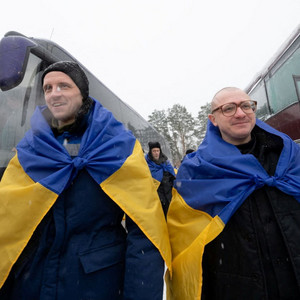
The US envoy, Steve Witkoff, as you mentioned, has said that a total of 314 prisoners will be exchanged pretty much half and half, as we understand, between Russia and Ukraine.
It's not entirely clear just yet whether those are all soldiers who are prisoners of war, if it possibly includes some civilian prisoners too, to be returned from Russian jails.
Certainly it's significant in the sense it's the first prisoner swap that's been arranged since last August the end of last August when I was here in Kiev and we spoke to some of the civilian prisoners who were released then and they described their really very, very difficult previous years in Russian jails in particular.
So that's a big deal for the families. of course, and it's a big deal for Ukraine, but it's part of a broader process of talks which at this point don't appear to be yielding any major breakthroughs, particularly, of course, on that massively sensitive issue of territory, land, disputed territory in the eastern Donbass where Russia is trying to get Ukraine to simply hand over territory that Russia has not managed to take through the fighting itself.
Yeah, it kind of feels like we've been here before.
What is holding both sides back?
We've definitely been here before, because this is the whole point of this war right now, which is that Russia is pushing with all the pressure it can possibly bring to bear, including multiple drone strikes and missile strikes on Ukraine, but also US diplomatic pressure on Ukraine to basically give in to Russia's big demand, and that is that they want that sort of 20 remaining of the Donbass which the Russians haven't taken on the battlefield.
They want that to be part of any peace deal.
And the Russian side is being particularly intransigent.
We've heard from the Kremlin saying that the fight, the battle, will continue until Ukraine makes what Dmitry Peskov, who's Vladimir Putin's spokesman, said was the right decisions.
But we've also heard from President Zelensky here in Ukraine, who said...
Russia is not winning on the battlefield.
And if it wants that land through military action, it will take Russia two years at the current rate to take that territory.
And it would cost, he said, 800,000 more dead soldiers.
So he's making the point that, you know, Russia's pressure is one thing in words but in reality, on the ground, although there is progress by Russia moving forward extremely, extremely slowly, it's costing hugely.
And President Zelensky is saying to Ukraine's Western allies give us more support, put more pressure on Russia and stop talking about concessions by Ukraine.
At the end of last year, the United Nations top human rights official warned his office was in what he described as survival mode.
Now Volker Turk has launched an appeal for hundreds of millions of dollars to address a combination of multiple human rights crises and funding cuts.
How serious is the funding crisis and is it at risk of collapse?
Our correspondent, Imogen Folks, joined us from Geneva, not today or tomorrow, but it is facing very serious cutbacks right.
I mean we see cutbacks right across the UN agencies, but UN Human Rights sometimes finds it more difficult to put its case because it's not jumping in where there's a famine, like the World Food Programme, or supporting children, like UNICEF, or offering shelter, like UN refugees.
It's a much quieter, but what UN Human Rights Chief Volker Turck tried to say today was very important work trying to uphold the rights of people who are disenfranchised or suffering major violations.
And they are the eyes and the ears on the ground, UN Human Rights monitors.
So very serious cutbacks.
The appeal today for $400 million is actually less than its appeal last year.
So it is taking into account the fact that there will be reduced funding, but it can't rely on that 400 million being handed over by member states.
And I think that's a big concern.
And no shortage of human rights crises around the world.
No, certainly not.
I mean, we have conflicts if you look at somewhere like Sudan or Gaza or Ukraine.
And you know in Ukraine from even before the conflict, UN Human Rights had monitors on the ground.
They are documenting violations.
We have seen before in cases like Syria or Myanmar that this documentation can lead to prosecutions and accountability.
It can be shared with international courts.
So I think if you're in one of those places, you will be dismayed that now these eyes and ears may not be on the ground anymore.
For example...
One which has been unfunded is the monitoring for the Democratic Republic of Congo, where sexual violence has reached terrible, terrible levels.
And women and girls who suffer that now don't really have anyone to turn to to say this happened to me.
Imogen, folks in Geneva.
The disappearance of the mother of one of America's best-known television news anchors is dominating the headlines in the US.
Savannah Guthrie, who co-hosts the morning programme Today on NBC News, made this tearful appeal on social media after police said they believed that Nancy Guthrie was kidnapped.
She's 84 years old.
Her health, her heart is fragile.
She lives in constant pain.
She is without any medicine.
She needs it to survive.
We too have heard the reports about a ransom letter in the media.
We need to know without a doubt that she is alive and that you have her.
We want to hear from you and we are ready to listen.
With more, here's our Washington correspondent, Helena Humphrey.
This was an emotional video posted to Instagram in which we see one of the most recognisable faces on American television, Savannah Guthrie, flanked by her siblings, and she appears bereft.
She delivers a message to any potential abductor of her mother, saying that they need to know that their mother is alive.
Now authorities say that they believe that Nancy Guthrie was kidnapped.
She went missing overnight from her home in Tucson Arizona, this past weekend and those authorities say that they are now working with the FBI to authenticate a potential ransom note in this case.
Now Savannah Guthrie, speaking about her mother, says that she has limited mobility, that she requires daily medication in order to survive.
And we've since heard from President Trump, who says that he has spoken to the NBC presenter and he has directed federal law enforcement to deploy all the necessary resources to bring Nancy Guthrie back home.
It's still dangerous to be a mother in Gaza.
That's the message from NGOs which have investigated maternal and neonatal deaths in the Strip.
They say that, despite the ceasefire, preventable deaths are still taking place as mothers struggle to obtain adequate health care and nutrition for themselves and their newborns.
Israel has increased the flow of aid into the Palestinian territory since October, but medics are still delivering malnourished babies in need of more care.
Shaima Khalil reports from Jerusalem.
Before they took their first breath, the cruelty of this war had already battered their fragile bodies.
Here in the Al-Sahaba Maternity Hospital in Gaza City, families who've endured Israeli bombardment, displacement and hunger look at their premature babies through the incubators, hoping they'll survive.
Dr Naim Ayyub says his hospital has had to compensate for a collapsed health system across northern Gaza.
The flow of aid into the strip has been scaled up in recent months following the ceasefire, but he sees a prevailing pattern.
Malnourished, traumatised mothers giving birth to underweight or premature babies.
Many babies do not survive.
We've seen numerous miscarriages and premature deliveries.
Those who make it are usually very frail, underdeveloped and underweight, often less than two kilos.
These women were surrounded by bombing and airstrikes.
And by the debris and toxic residue they leave behind.
Some babies are born with deformities as a result.
25-year-old Soha Khadr is a widowed mother of five.
Eight months pregnant, she's one of tens of thousands with little access to health care or proper nutrition.
Only recently was she able to see a doctor.
Just once.
She fled southern Gaza after being displaced in al-Mawassi camp and is now sheltering further north in Gaza City.
I would get very dizzy.
Sometimes I bled because of malnutrition.
I've been so frightened during this pregnancy because of the bombing and because we keep fleeing.
I look at my five little boys in these awful circumstances and at one point I wish this pregnancy would not continue.
Soha's having a baby girl, the one her late husband has been waiting for.
She'll come into this world, Soha says.
But her father is gone, shot while trying to get aid five months ago in Rafah.
Doctors say that many pregnant women walk for hours just to reach the occasional appointment.
Almost all have no access to regular health care.
Displacement has scarred their lives and that of their unborn babies.
Israel says it's meeting its obligations under the ceasefire, facilitating an increased flow of food and medical supplies into Gaza.
But aid agencies and the UN dispute this claim.
Right now it's dangerous to be a mother or an expectant mother in Gaza.
Asila Bouras is the director of the Occupied Palestinian Territory Department for the aid organization Physicians for Human Rights Israel.
For the past two years and up until now, the conditions of life did not change, even after the ceasefire.
When we're speaking about reproductive violence, we refer to actions that harm, control or deny a woman's reproductive autonomy and health.
The writing is on the wall, just like it has been for the past two years.
We're not seeing that there's something is changing.
Pregnant women are still malnourished and vulnerable.
The siege is still existing.
Aid is still not coming in at scale as it's supposed to be according to the Trump agreement.
For these babies, doctors warn, the damage has already been done.
They were denied the sustenance they so desperately needed even before they were born.
A deprivation likely to shape their lives for years to come.
Shaima Khalil.
Still to come in this podcast.
What we want to achieve is to provide an opportunity to be better fathers, to be better role models.
Introducing play sessions with their kids for dads in Scottish prisons.
America is changing, and so is the world.
But what's happening in America isn't just a cause of global upheaval.
It's also a symptom of disruption that's happening everywhere.
I'm Asma Khalid in Washington, D.C.
I'm Tristan Redman in London, and this is The Global Story.
Every weekday, we'll bring you a story from this intersection, where the world and America meet.
Listen on BBC.com or wherever you get your podcasts.
This is the Global News Podcast.
It hardly needs saying, but since President Trump came to power just over a year ago, he's dominated the news agenda.
He seems to be at the heart, if not the cause, of many dramatic world events over the last 12 months.
But there's another world leader with a very different style also looking to exert his influence.
That's China's Xi Jinping, although we hear little about him.
Over the last few days, though, Mr Xi has been very busy on the diplomatic front.
He had a long telephone call with the Russian President, Vladimir Putin, on Wednesday, before speaking to Mr Trump a few hours later.
To discuss what the callers talked about.
I spoke to our China correspondent, Stephen McDonnell, in Beijing.
When Xi Jinping and Vladimir Putin spoke to each other.
Vladimir Putin described Xi Jinping as a very good friend.
And remember, China has never criticised Russia's invasion of Ukraine and they're backing in Russia at a time when there are big sanctions on Russia because of this invasion.
Essentially, the Russian economy has been propped up by and large by China during this war and, And so you can see why both countries would want to talk up their relations.
Certainly they've become closer as a result of this war.
And there was something very interesting from the Kremlin readout of that meeting.
Apparently...
When Vladimir Putin and Xi Jinping expressed views to one another about the United States, they practically matched one another.
Now, when it came to a few hours later, Xi Jinping then picks up the phone again.
This time he's speaking to Donald Trump.
And according to Donald Trump, this went very well.
We often hear Donald Trump speaking about this great relationship he has with Xi Jinping.
And in a funny way You can see why the Chinese government would like his administration because the Trump administration thinks we've got our sphere of influence.
Everyone else can bug out of here, but we can do whatever we like when it comes to Latin America and South America.
Well, China might say that's OK as long as we can do anything we like in Asia.
It is unusual for him to call both men on the same day.
Should we be reading something into this?
Well, I mean, that was the thing that struck me.
You think, bang, call one, then call the other.
I've just come from the foreign ministry press briefing.
The spokesperson was asked about this and they're saying no no, it's just a coincidence of the scheduling.
I mean, I think many people would find that hard to believe, but possibly it is.
Stephen McDonnell in Beijing.
Keir Starmer has vowed that he will remain as British Prime Minister as he battles for his political future.
Elected less than two years ago, he's endured some damaging headlines, embarrassing climb-downs and plummeting poll ratings.
He's now become embroiled in one of the most damaging scandals of recent times the crimes of Jeffrey Epstein.
The American financier, a child sex offender, had many influential friends.
One of them was Peter Mandelson, appointed by the UK Prime Minister to be Britain's ambassador in the United States.
The latest batch of Epstein documents includes an email from 2009 with Peter Mandelson, then a government minister, asking him how they should celebrate his release from prison.
A few hours ago, Keir Starmer said that he was misled by Lord Mandelson.
The information now available makes clear that the answers he gave were lies.
He portrayed Epstein as someone he barely knew.
Such deceit is incompatible with public service.
The victims of Epstein have lived with trauma that most of us can barely comprehend.
I am sorry.
Sorry enough. for what was done to you.
Sorry that so many people with power failed you.
Sorry for having believed Mandelson's lies and appointed him.
I asked our political correspondent, Rob Watson, what else the Prime Minister had said in his defence.
He had two other defences.
One was what might be called the decency argument Alex, and that was.
He began by saying look, Important to remember that I went into politics late in life and I did it in order to try and change Britain for the better, not for personal gain.
A reference, of course, to Peter Mandelson, who was clearly keen on financial enrichment.
And then the second point that he made as part of his defence was to promise victims and the country more generally that look, that there will be justice.
There will be a criminal investigation into Peter Mandelson.
The rich and the powerful will not be protected.
He's been in trouble before, but just how bad is this for Keir Starmer, not just with his own party Labour, but with the country as well.
It's very bad.
I mean, that's it in short, Alex.
As you say, the polling suggests that he's the most unpopular leader and living memory MPs.
His own MPs are in despair.
But I think what's really hard to tell Alex is whether this is just another bruise on an already very battered and bruised politician or whether it's something more fatal.
There's constant talk in the UK of a leadership challenge.
Could this be the end of Starmer?
The short answer is it could be.
But I was thinking about this, Alex.
You know, there are only normally two ways in which politicians leave jobs early, right?
I mean, one is that they resign, and the second is that there's a rebellion.
Now, to judge from Sir Keir Starmer's performance today and up to now, through all the troubles he's had in his year or so in office, resignation doesn't seem something that he has in mind.
So then we move on to number two, rebellion.
And it's certainly the case that Labour MPs are in a very dark mood.
The party is in a very dark mood.
And some MPs have said maybe he should consider his future.
But there isn't a full-scale rebellion yet.
And you'll notice that last word, yet.
And I think really his long-term future depends on whether he can deliver what he promised to the British people a year or so ago, and that is to change the country for the better, proving very hard and, number two, removing drama and scandal from British politics.
Anyone remember that promise?
A jail in Scotland is allowing prisoners' children inside for play sessions with their dads.
It's part of a groundbreaking scheme to teach prisoners to be better fathers, in the hope that it might reduce re-offending.
Myra Anubi went to Barlinnie Prison in Glasgow to take a look.
A group of children are playing happily with their dads.
It could be a typical scene in any gym, but we are in a prison gym inside Scotland's biggest jail, and the men are serving sentences for crimes such as drugs and fraud.
OK, so what we're going to do is start with a wee warm-up.
We're going to get a game of tag.
They play a variety of games designed to get both dads and kids fit and to have fun together.
The dads are pretending to be surfboards.
So they're lying on these mats and the kids stand on them and they have to pretend that they're surfing.
It's all part of a scheme called Healthy Dads, Healthy Kids.
And the idea is based on a successful Australian programme to help with obesity.
But it's been adapted here for prisoners to learn parenting skills and be better dads.
This is one of the researchers behind it, Cindy Gray from the University of Glasgow.
What we want to achieve is to provide an opportunity for people in prison to maintain and strengthen parenting, the relationships that they have with their children, to be better fathers, to be better role models.
And the idea is then, that family relationships are strengthening, that the children have better relationships with their fathers.
Do you guys know the benefits of self-eating?
Just sort them out?
Yes.
The prisoners who have been selected all have school-aged children.
The course is once a week for eight days, and it starts with a classroom session on parenting skills, such as the dangers of screen time or the benefits of exercise.
Today, the main focus is on what their children eat.
Chris is serving a sentence for supplying drugs.
He rejects the idea that people who've committed crimes shouldn't be getting benefits like this.
Not everybody in prison is a bad person.
And also, it's not your kid's or your family's fault that you're in prison.
So it's no fair that I'm not there to play games.
I teach him how to tie his laces.
It's not his fault I'm in here.
He's not done anything wrong.
It's me.
The course is also trying to help the families of the prisoners.
One of the mothers who'd brought her daughter in today told me how much these sessions mean for them.
They get to run about like crazy and then we get to go and have dinner with them.
I get dead emotional actually because it's...
Well, just watching, I'm feeling emotional as well, so I can imagine what that's like for you.
It is, and it's so emotional.
See, when we went for a meal the first time, it's like the simple things you missed.
We can wait.
But listen, it's great.
I'm so glad we've got the opportunity to do this and I hope other families get to do it as well, because you can see how great it is.
We've got pizza.
We've got pizza.
All right.
At the end of the day, the families get a chance to eat dinner together and have a chat.
Sitting, having a normal family dinner, just talking, playing games, maybe ice pie.
So you don't really get the opportunity in other visits to actually sit and have food, but you can sit and have a bit of pizza and a bit of normality.
The course has so far run five times here at Balini Jail and it's early days for the research, but Cindy Gray believes it can have a long-term impact.
The men they know themselves for the first time, that their important role that they have in their children's lives and that they want to be with them.
And that desire to be a good dad translates to being a good person.
Through that, we think that's the mechanism through which re-offending will reduce.
After the dinner there are many hugs and tears, as the prisoners have to say goodbye to their families.
These dads will only have three more weeks on the course before a new group starts.
But it's hoped that the effects can be long-lasting.
Myra Anubi with that report.
And you can hear more about that project on this week's edition of People Fixing the World.
Japan is in the middle of a tourist boom.
In 2015 almost 20 million visitors went, but last year the figure was nearly 43 million, a record high.
A weak yen and the popularity of Japanese food and culture have been some of the driving factors.
You may think this boom and the money it brings would be a cause for celebration, but millions of Japanese citizens aren't happy.
So much so that a cherry blossom festival which attracts 200000 people has been cancelled after residents in a town complained of over-tourism.
I heard more from our global affairs reporter, Paul Moss.
Thing is with the cherry blossom season in Japan.
It's very brief.
It lasts two weeks.
But in fact in some places the cherry blossom only lasts on the trees themselves for two or three days.
So when there is a festival like this, it means that everyone is piling into a place at exactly the same time.
And yes, the town of Fuji Yoshida has a particularly popular cherry blossom festival.
It's very picturesque.
There's a view of Mount Fuji and I was just looking at a website which promotes the festival.
It says they have 650 trees, all with cherry blossom.
There are stage events and stalls.
Well, as you say, they've cancelled it because they've just had enough.
The town has a population of 50,000.
200,000 descended last time for the festival.
There were traffic jams, overcrowding.
The locals have had enough.
Yeah, Japan has had a record number of tourists over recent years but, as you've indicated, there have been complaints.
There have.
It's partly the sheer numbers that are there.
I mean, you know, Japan wasn't always a popular destination for tourists, mainly because it was so expensive.
I remember the first time I went there and you felt like you had to take out a bank loan just to go for supper.
Now, as you said, the yen has gone down.
It's cheaper.
But as well as the overcrowding, a lot of the complaints the Japanese make are about the tourists' behaviour.
This is an island nation with distinctive culture, distinctive etiquette.
And because it has a very low immigrant population.
Japanese people aren't used to seeing people doing things differently.
So they complain about things like foreigners walking across the road when the pedestrian light is red.
Japan has very complicated rules on waste disposal, and tourists don't often follow those.
And then, in fact, one enterprising tour company I was looking at has now given advice to visitors to Japan.
It says, don't throw your cigarette butts on the pavement.
Japanese people don't like it.
And also, Do not talk loudly on your mobile phone, particularly in cafes and restaurants.
I think there's a few of us outside Japan who might appreciate that advice being followed.
And the cigarette butt advice as well.
Travels, I think.
There's not just been over-tourism in Japan, though.
Other places kind of have the same problem.
Yeah, I mean it's partly the sheer numbers who can now afford to travel, particularly the new middle classes in the two world's most populous countries.
But also it's those influencers who suddenly mean that one cafe or one spot is the place everyone wants to go to and get that photograph they can post on social media.
That unfortunately has led to the problem being, as you say, worldwide.
Paul Moss.
And that's all from us for now.
If you want to get in touch, you can email us at globalpodcast at bbc.co.uk.
You can also find us on X at BBC World Service.
Use the hashtag Global News Pod.
And don't forget our sister podcast, The Global Story, which goes in depth and beyond the headlines on one big story, available wherever you get your podcasts.
This edition of the Global News Podcast was mixed by Joe McCartney and the producer was Richard Hamilton.
The editor is Karen Martin.
I'm Alex Ritson.
Until next time, goodbye.
But what's happening in America isn't just a cause of global upheaval.
It's also a symptom of disruption that's happening everywhere.
I'm Asma Khalid in Washington, D.C.
I'm Tristan Redman in London.
And this is The Global Story.
Every weekday, we'll bring you a story from this intersection, where the world and America meet.
Listen on BBC.com or wherever you get your podcasts.