Get the unmissable news stories of the day.
This is the Beijing Hour.
Examining the events that impact and shape China and the rest of the world.
This is the Beijing Hour.
One hour of news and information brought to you every weekday.
Now here's your host.
Shane Biggum with you on this Wednesday, January 28th, 2026.
You're listening to the Beijing Hour, coming to you live from the Chinese capital.
On today's program, the Chinese president's encouraging veterans in Zimbabwe to help foster China-Africa friendship.
The US president says another armada is on its way to the Middle East following the arrival of the Abraham Lincoln carrier group.
And China's warning against external interference in the Taiwan questions.
In business, RD spending by China's central state-owned enterprises reaches the trillion yuan milestone.
In sports, the head of the IOC has arrived in Italy ahead of the Winter Olympics.
In culture and entertainment.
A fashion show in Chongqing aims to bring ancient styles back into the mainstream.
Now check in the day's top stories.
Chinese President, Xi Jinping, is encouraging veterans of Zimbabwe's national liberation war to inspire more young people to contribute to China's friendship with Zimbabwe and Africa.
In his reply letter to Zimbabwean veterans, President Xi said he hopes the people will work together toward an all-weather China-Africa community with a shared future in the new era.
The veterans recently wrote to President Xi expressing their gratitude for China's support during Zimbabwe's liberation war.
With more on this.
Gao Junye spoke with Kenan Mugazaweta, who's among the veterans that wrote to President Xi.
So Mr. Mugazaweta, could you please tell me how are you feeling at the moment?
What messages in President Xi Jinping's letter resonated with you the most?
Yes, in our last meeting they read us a letter from President Ching where he extolled us and praised us for fighting for liberation in Zimbabwe.
And we are also very thankful for providing us with the necessary arms and equipment to fight the Rhodesian regime.
Okay, you mentioned how you've been fighting with the Rhodesian government.
Can you take us back to Zimbabwe's liberation journey?
What role did China play during that period?
During that period, China played many, many roles.
In the first place, China supplied us with the requisite arms like heavy machine guns, anti-aircraft machine guns, sub-machine guns.
And apart from that, China also provided us, gave us instructors at places like Mugagau in Tanzania, where there were Chinese instructors who instructed us in the use of small weapons, in the use of heavy machinery, in the art of guerrilla warfare.
And what about you yourself?
Can you just share some of your experiences from Zimbabwe's national liberation struggle?
What personal connections have you maintained with China over the years?
I first met the Chinese in 1976 in Tanzania, at Mukagawa in Tanzania.
First, they trained me in the use of the sub machine gun.
After that, they trained me in the use of the anti-aircraft machine gun.
After that, I got special training as an instructor.
I went to Mozambique and became an instructor.
Having been trained by the Chinese, I became an instructor in heavy machine guns and anti-aircraft machine guns in Mozambique, which subsequently we used to fight traditions.
What about Zimbabwe's development?
In your view, how has China and Zimbabwe been working together to push for national development?
As a liberation fighter and also as a Zimbabwean.
We are very pleased and very grateful to the Chinese government for the assistance they are giving us, especially during the times of our needs, especially in the United Nations, where we were sanctioned by the americans, sanctioned by the european unions, but china stood by us and defended us and also the bilateral relations between china and zimbabwe improved a lot and also china assisted us in construction for dams, construction for roads, construction of almost many of your infrastructure in zimbabwe.
That was canon mugazueta, a zimbabwean war veteran.
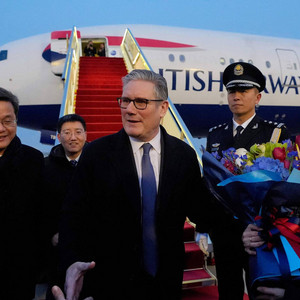
British Prime Minister Keir Starmer is in Beijing for his four-day official visit to China, the first visit to China by a British head of government in eight years.
Starmer is set to meet Chinese President Xi Jinping, Premier Li Cheng and top legislator Zhao Leji during his visit.
He'll also visit Shanghai.
The two countries are set to exchange views on bilateral relations and key global issues.
Starmer is also leading a high-level delegation of over 50 major British companies and institutions.
Xia Cheng has more on what to expect from the visit.
The delegation includes companies from the finance, pharmaceuticals manufacturing, culture and creative industries.
Both sides are preparing for the 2026 China-UK Entrepreneurs' Council meeting, for which more than 100 companies have registered to participate.
China's Ministry of Commerce plans to sign cooperation documents with their UK counterparts on trade and investment, with the goal of creating new growth drivers for bilateral economic ties.
China and the UK are important economic and trade partners.
In 2025, the trade in bilateral goods topped US100 billion, services trade exceeded US30 billion and two-way investment stock reached nearly US68 billion.
Since taking office, the UK Labour government has said it seeks a consistent, long-term and strategic relationship with China, with dialogue and cooperation at its core.
China has also expressed readiness to deepen political trust and practical cooperation.
Officials say that, amid a rise in global trade protectionism, both China and the UK remain committed to free trade and the multilateral trading system.
The two sides aim to leverage their complementary strengths and expand collaboration in green energy healthcare, creative industries and intelligent manufacturing.
China has also signaled its readiness to work with the UK to create a fair, transparent and rules-based business environment, pushing China-UK economic and trade ties to a new level.
That was Xie Cheng reporting.
And for more about the British Prime Minister's visit to China.
Do Hongyu spoke with Professor Cui Hongjian with the Academy of Regional and Global Governance at Beijing Foreign Studies University.
What is the significance of Prime Minister Keir Starmer's visit to China at this moment, especially as global trade protectionism intensifies and major economies reassess their economic ties?
The visit by Prime Minister Starmer to China.
I think undoubtedly one of the important purposes is trying to promote economic cooperation with China.
As we know, for the past decades even it looks like a little bit cooler situation on the political or diplomatic level, but undoubtedly there has been you know so big dynamic for coastal countries to continue economic cooperation.
If we just look at the bilateral trade and the total volume of the battle, trade between china and the uk has been over 100 100 billion us dollars.
So it shows a very big resilience of this economic cooperation.
For the British side to provide some more favorable conditions for economic development and to promote the living standard for average people has been a very, very clear political promise from the Labour Party to the British society.
So once the Steinmeier government tries to fulfill its promise to the British society, once Britain wants to get some more opportunity to help its economic development, China would be one of the most important and also most reliable choice.
And with over 50 major British companies joining the delegation, What concrete outcomes can we expect from the visit and which sectors could benefit the most?
Once the economic cooperation becomes a priority for this visit by Prime Minister, undoubtedly there will be some more efforts made from the British side to promote firstly, mutual trust, especially on some major corporations in some areas.
As we know, for both China and Britain people have a lot of cooperation in not only traditional trade and also some new areas, for example, green transformation, digital economy and also healthcare and some other, especially AI.
So I think now it's time to continue with our traditional cooperation and then to show some more ambition to open new area for cooperation.
Once british side received some very positive message from chinese, plan including china will open gradually its servers and banking sectors to the world, whilst china will try to promote its domestic consumption, i think there will be some more encouragement for more and more British companies and investors to look forward to some more opportunities in the Chinese market.
That was Cui Hongzhen with the Academy of Regional and Global Governance at Beijing Foreign Studies University.
Dr. Chris Evans is the headmaster of Reading School in the UK, which has a history of 900 years.
During an interview with Niu Honglin, he said his schools worked with others in China to boost people-to-people exchanges among students.
Evans also shared his experiences about his life in China and his impressions of the country and its people.
You are cooperating with a school in Guangzhou.
Can you tell us a bit more detail about the cooperation?
We were privileged in 2018 to build a relationship with a wonderful school in Suzhou.
And I had the great joy of visiting the Venice of the East and seeing the wonderful culture.
I came to love China for the first time in 2018, visiting a couple of times and finding some wonderful people.
Some of those relationships then have become friendships which over the last few years, have sustained conversation, often just a ni hao and a happy Chinese New Year and a little message backwards and forwards.
But as a consequence of some of those relationships, last year we began a new opportunity in Guangzhou, talking with a wonderful team.
They've already got a really flourishing school which has very deep values that are similar to ours.
In the West, people sometimes have the perception that the Chinese education system is focused only on results and that young people are pushed very hard towards high academic outcomes.
There's been some skepticism sometimes in britain about education models internationally, but we have found great joy in, you know, learning about each other's focuses and realizing we've got very similar values.
As a consequence, we've come to cooperative agreement to build a new high school which will have an international curriculum, and we think that young people in china can then benefit from all the best of the rigorous academic chinese curriculum whilst gaining qualifications that give them access to global education, so that school will be building on reading school's reputation, on our heritage, on our traditions, and also building buddies between academic experts in china and in the united kingdom to nurture expertise right in the heart of guangzhou regarding international qualifications.
So we're really looking forward to sending basketball and badminton teams over to China for exchanges and bringing students from China for language exchanges to Reading School.
We think young people need to stretch their wings, don't they?
They need to expand their own horizon beyond the little parochial, narrow view we have of our own communities and families.
And growing up must be about our eyes being open.
You have been visiting China and you've been to a lot of different places.
In your opinion?
What was the long lasting impression of China that you have, or some surprising element you got from probably your last trip here in china in 2018?
I sat on the bund in shanghai, on a bench um, with a gentleman who had no english and i had no mandarin, and he used his phone to translate, and we had a conversation for about two and a half hours at 4 30 in the morning, when i couldn't sleep because of jet lag and here in the middle of one of the world's biggest cities.
I had a really intimate and meaningful conversation with a stranger whose name I never learned, who never learned my name, but his world, his perspective, his faith, his family, his values, and shared similar conversation about the things that mattered most to me.
And it felt to me like the most remarkable privilege to drop into this person's world and to have this deep and meaningful conversation.
And it taught me that there is so much that makes us the same.
We often think about the things that make us different.
But actually, the things that bind us together are so profound.
Here we are as a species spread across the planet, with so many different things going on in so many different corners of our countries.
Yet the things that bind us together are remarkable, such that I can sit on a bench on the Bund in Shanghai and talk for two hours with someone I've never met before, via a translation app on his phone, about really deep things.
And I've gone away remembering that man, praying for him and thinking of his family and hoping that things are well for him.
Because I learned more about him in two hours than I've learned about some of my closest friends just because we talked openly.
So that remarkable capacity for human connection and the things that make us similar even you and I across the world via screens, the things that make us similar are so remarkable.
That's the thing that I think struck me in visiting China.
That was Dr Chris Evans, headmaster of Reading School, sharing his life and work experiences in China.
Coming up, the U.S. president says more American warships are heading toward the Middle East.
Post Plus, a selection of the best podcasts in China, covering history customs music, literature and in-depth dialogues.
Find your way to a wealth of Chinese culture and thinking, all on Post Plus.
Fifteen past the hour.
U.S.
President Donald Trump says another armada is on its way to the Middle East.
This comes as tensions with Iran rise.
The U.S.
Central Command has announced plans for multi-day military exercises in the region.
Washington's been deploying thousands of troops and major assets to the region in recent weeks, including the aircraft carrier Abraham Lincoln, which arrived with its strike group on Monday.
UN spokesperson Stefan Dujarric urged maximum restraint to avoid an escalation.
I think we are.
Secretary General is very concerned indeed about the reported military buildup in the Persian Gulf region.
Again, the Secretary-General calls for maximum restraints and encourages all actors to refrain from any actions that will further increase tension or ignite conflict in the – escalation in the wider region.
He remains convinced that all concerns regarding Iran are best addressed through dialogue, through diplomacy and negotiations.
And, in this regard, he welcomes all efforts aimed at regional de-escalation and calls on all actors to take concrete steps to defuse tensions and strengthen regional confidence.
Iranian President Mazhid Pazheshkin says he welcomes any process that would prevent conflict, provided it stays within international law.
He made the comment during a phone call with Saudi Prime Minister Mohammed bin Salman.
The Saudi leader assured Iran that Riyadh would not allow its airspace or territory to be used for military action against Tehran.
The United Arab Emirates has made a similar pledge.
Rising tensions between Iran and the US are drawing global attention, with recent protests in Tehran adding to concerns over regional stability.
Iranian officials say the country is prepared to defend itself, even as ordinary citizens carry on with daily life.
Saper Sarami has more from Tehran.
Public reaction to the possibility of renewed conflict has been mixed.
While some residents express concern, many prefer not to speak on camera.
We are not the slaves of the U.S.
Everyone is alert.
The IRGC, Basiji and the army.
We will respond decisively.
People should not be worried.
The U.S. can never beat us.
If they attack, we will defeat them.
Iranian authorities say order has been restored following the protests.
The UN Human Rights Council has adopted a resolution calling for an investigation.
A move Iran says reflects a politicized approach by some Western countries.
I also spoke with the reformist political expert who, while critical of Iran's economic challenges, firmly condemns foreign interference in the country's affairs.
During the 12-day war, they first waged war and then tried to bring people into the streets.
This time, however, they planned the protests first and then sought a US attack.
This means the US wanted to turn Iran into something like Syria and then push certain actors inside the country to call for American intervention.
Now that the situation is calm, they no longer know on what grounds they should attack.
Despite the tensions, daily life in Tehran goes on.
The streets remain busy and shops stay open, even as uncertainty over regional developments persists.
For many here, the hope is that tensions ease and stability prevails.
That was Saremi in Tehran.
The UN Children's Fund says restoring Gaza's shattered education system is life-saving, and getting children back into schools must be an immediate priority.
UNICEF spokesperson James Elder warns that the war in Gaza is destroying its future.
Before this war on children, Palestinians in Gaza had some of the highest literacy rates in the world.
Education was a source of pride, resilience and progress for generations.
Today, that legacy is very much under attack.
Schools, universities and libraries have been destroyed and years of progress have been erased.
This isn't just physical destruction.
It is an assault on the future itself.
We stress that 60 of school-aged children in the devastated enclave have no access to in-person learning and more than 90 of schools have been damaged or destroyed.
Elder said that UNICEF is scaling up its back-to-learning program in the Strip to reach 336000 children this year.
Coming up, China warns against external interference involving the Taiwan region.
As Europe and the US working to bring inflation down, China is facing an entirely different challenge.
This week on Chat Lounge, we unpack why low prices worry Beijing, how policymakers are aiming for a reasonable rebound and whether it can be achieved without creating new risks at home or abroad.
Tune in wherever you get your podcasts, and I'll see you at the end.
Radio.
21 minutes past the hour.
Chinese mainland spokespersons reiterated that relying on external forces to seek secessionism in Taiwan is a dead end.
Zheng Han is a State Council Taiwan Affairs Office spokesperson.
She made the remarks after the U.S.
Defense Department released its 2026 Defense Strategy Report, even though it does not mention Taiwan.
The Taiwan question is purely China's internal affair, and its resolution is a matter for the Chinese people alone, not subject to any external interference.
The path of Taiwan independence is a dead end.
The Democratic Progressive Party authorities in seeking to rely on external forces to achieve independence will inevitably end up being abandoned.
Public opinion in Taiwan is suggesting that it's the Chinese mainland, instead of the US, that holds decisive influence when it comes to the Taiwan question.
Campaigning is underway for the snap election in Japan next month.
It comes days after the dissolution of the lower house of the national diet.
Prime Minister Sanae Takeuchi announced the move last week, aiming to capitalize on her cabinet's high approval ratings.
Her decision came amid the government's increased military spending. and rising living costs.
Emeritus Professor Noriyuki Kawamura of the Nagoya University of Foreign Studies says the Takeuchi administration's deviated from its long-standing pacifist security policy and that trust in the ruling party has declined.
The Takahichi cabinet is seeking to advance Japan's military expansion policy, which means Japan is deviating from the defense policy of a peaceful nation upheld by all previous cabinets.
First, it is allowing the export of lethal weapons.
In addition, on the security policy front, it will keep expanding the defense budget.
This clearly departs from the fundamental security policy of exclusive defense based on Japan's pacifist constitution and is a major issue.
Liberal Democratic Party lawmakers were recently involved in highly non-transparent and even improper conduct regarding political funding.
Public trust in the LDP has declined, leading to a reduction in the number of the party's sitting lawmakers.
Ultimately, this boils down to the issue of public trust in politics.
The ongoing campaign period's only 16 days, the shortest in Japan's post-war history.
The White House is moving to ease tensions in Minneapolis after federal agents shot and killed two US citizens.
Border Czar Tom Homan has met with local leaders and taken over the city's immigration enforcement operations, replacing Border Patrol Chief Gregory Bovino.
This came as a Minnesota judge ordered the acting ICE director to appear in federal court on Friday.
Hendrix Ibrandi reports from Minneapolis.
It does seem to be somewhat of a shift from the Trump administration.
One indicator of that is that the head of the border patrol operations here in Minneapolis is out.
He's been swapped out now for the head, the person who's referred to as the border czar for the Trump administration, Tom Holman.
Holman has now come into Minneapolis to oversee the entire crackdown here.
And it's believed that he is going to show a little bit of a lighter touch than Bovino did.
Bovino, of course, referred to Alex Preddy as committing a massacre here on Saturday.
Video evidence clearly shows that was not the case.
That's not what he was doing at all before he was killed with 10 bullets to his body on the Saturday morning.
Tom Holman met with local officials here in Minneapolis.
Minneapolis Mayor Jacob Fry said this immigration enforcement surge must end.
He said it's had a negative impact on the community and on the Minneapolis Police Department.
President Trump spoke about this whole situation today.
He was meeting with supporters in Iowa.
He said this investigation will be a big one in his words.
He said he wants it to be an honorable and honest investigation.
Someone there asked him whether Freddie was a domestic terrorist or an assassin, as some people in the Trump administration alleged, literally right after Freddie's killing on Saturday.
Here's what Trump had to say.
Certainly shouldn't have been carrying a gun.
But all of hey look, bottom line everybody in this room We view that as a very unfortunate incident okay.
Everyone, unless you're a stupid person.
Very, very unfortunate incident.
I don't like that he had a gun.
I don't like that he had two fully loaded magazines.
That's a lot of bad stuff.
And despite that, I say that's a very unfortunate incident.
Now Trump has gotten a lot of blowback or the Trump administration's gotten a lot of blowback for insinuating that Pretty should not have been carrying a gun on Saturday.
Pretty, of course, had a license to conceal carry a gun.
He had a gun on him, of course.
A lot of gun rights supporters who normally would be supporting President Trump in his attitudes and his policies.
A lot of those gun rights supporters are very unhappy about some of the comments that the Trump administration officials have been making about the weapon issue here.
That was Hendrik Sybrandy reporting.
Joel Rubens, former U.S.
Deputy Assistant Secretary of State for House Affairs.
And during an interview with Sia Namdar, he said the White House move signals concern inside the Trump administration, but stops short of a real policy change.
The White House can read the polls just like anybody reading the newspaper can see it.
And this policy is tanking.
The American people hate it across the board.
And while I think the president is trying to soften the tone a little bit, I don't view this as serious or a real policy change.
If there are real policy change, we would see proposals.
We would see the firing of DHS Secretary Kristi Noem.
And we would see ICE taken out of the field and sent back out without masks, with clear rules of the road and with targets to arrest, rather than just going around and arresting anyone that they don't like.
So Not much of a change, a little calmer for the moment.
But Donald Trump's and, I think, the president of the White House, just trying to lick their wounds because they know how badly this policy is hurting them.
These tragic killings is that it's not just Democrats who have expressed outrage.
Republicans in Congress have as well.
This cuts across all party lines, what we're all witnessing here.
And that's why I think you see the poll numbers tanking because, for example, the gentleman who was killed over the weekend, Mr Pretty, he was legally carrying a weapon but was described as a terrorist who should not have a weapon.
And so for President Trump's base in the Republican Party.
Many of them, for years, have been advocating that someone should be allowed to legally carry a weapon, even to a protest.
So now they're all up in arms.
And we should not see people shot dead by American government agents, certainly not when they're disarmed and held to the ground and shot 10 times at point blank range.
And that's an image that won't get out of the minds of the American people.
And that symbolizes the catastrophe of this ICE policy.
That was Joel Rubin, a former U.S.
Deputy Assistant Secretary of State for House Affairs.
A plane crash in western India has killed several people, including the deputy chief minister of Maharashtra state.
Radhika Bajaj has more from Mumbai.
Wednesday morning brought the shocking news that Maharashtra's deputy chief minister, Ajit Pawar, died in a plane crash at around 845 am.
Pawar was en route to his political stronghold of Baramati, with early reports suggesting that the aircraft had crash-landed and burst into flames, killing all five people on board.
Visuals from the crash site show the wreckage completely gutted by fire.
Ajit Bawar was a towering figure in Maharashtra politics, a state known as the industrial and financial hub of India.
A seven-time member of the Legislative Assembly, he was widely recognized as a powerful administrative strategist and he held the post of Deputy Chief Minister six times under various alliances.
Now, news of his sudden passing has prompted an outpouring of condolences across political parties, including from Prime Minister Narendra Modi.
While his death will have significant implications for regional politics, attention is currently focused on the investigation that aims to determine the cause of this devastating accident.
That was Radhika Bajaj reporting.
We're at 29 past the hour.
Beijing overcast this evening.
It's down to minus 5.
Thursday is cloudy and plus 1.
Nanchang's down to 4 degrees and overcast in 5 elsewhere in Asia.
Islamabad's cloudy overnight, down to 5 degrees.
Thursday's overcast in 16.
Vientiane will be cloudy overnight and through tomorrow, below 16 and a high of 29.
Phnom Penh's cloudy tonight and tomorrow with a low of 21 and a high of 32.
In Africa, Nairobi is overcast and 29 degrees Celsius on Thursday.
It's time for a short break.
So far this hour, the Chinese president's encouraging veterans in Zimbabwe to help foster China-Africa friendship.
The US president says another armada is on its way to the Middle East following the arrival of the Abraham Lincoln Carrier Group and China's warning against external interference in the Taiwan question.
Shane Bigham with you.
Stay with us here on The Beijing Hour.
Shh, listen up.
Can you hear the heartbeat of our world?
It's vibrant and pulsating with the essence of life itself.
From the stem of trees to the gurgle of rivers.
From the silent strength of mountains To the icy whispers of glaciers.
Even the solid ground beneath our feet.
And right there, in the midst of all, beats the heart of humanity.
What if those other heartbeats were to stop?
Would ours keep on ticking?
Ever wondered what's actually going on in Africa through the perspective of an African?
How are things really going between China and Africa?
What's the narrative of this relationship?
Well, get a perspective with China Africa Talk.
Hear from African diplomats, entrepreneurs, academics, Chinese natives and more.
Get on our wavelength every week to find out what's real with China Africa Talk.
Find us on your favorite podcast.
We'll see you there.
Examining the events that impact and shape China and the rest of the world.
This is the Beijing Hour, one hour of news and information brought to you every weekday.
Now here's your host.
Shane Bigum with you on this Wednesday.
Still to come in business.
RD spending by China's central state-owned enterprises reaches the trillion yuan milestone.
In sports, the head of the IOC has arrived in Italy ahead of the Winter Olympics.
In culture and entertainment.
A fashion show in Chongqing aims to bring ancient styles back into the mainstream.
Contact us.
You can email radio at cgtn.com or follow our ex-account at cgtnradio.
But now checking the day's headlines, here's Dou Hongyu.
Thank you, Shane.
Chinese President, Xi Jinping, is encouraging veterans of Zimbabwe's National Liberation War to inspire more young people to contribute to China's friendship with Zimbabwe and Africa.
In his reply letter to Zimbabwean veterans, President Xi said he hopes the people will work together toward an all-weather China-Africa community with a shared future in the new era.
The veterans recently wrote to President Xi expressing their gratitude to China's support during Zimbabwe's liberation war.
China will host the first APEC senior officials meeting of 2026 in Guangzhou from February 1 to 10.
Foreign Ministry spokesperson Guo Jiakun said the meeting is the first official event of China's APEC host year and will focus on building an Asia-Pacific community, promoting shared prosperity and advancing cooperation in key priority areas.
More than 50 meetings and related activities are scheduled, with around 1,000 delegates expected.
Preparations for the event are currently progressing smoothly.
The spokesperson added that the meetings will help lay the groundwork for the APEC leaders' informal meeting in November.
The State Council Taiwan Affairs Office has announced that the think tank forum between the Communist Party of China and the Chinese Kuomintang Party will be in Beijing next week.
Spokesperson Zhang Han explained more details.
The theme of this forum is Prospects for Cross-Trade, Exchange and Cooperation.
Representatives and experts from the Communist Party of China and the Chinese Kuomintang, as well as from cross-strait sectors such as tourism industry technology, healthcare and environmental protection, will attend the forum.
They will engage in in-depth exchanges and discussions, jointly deliberating on the development of cross-strait relations and seeking benefits and well-being for compatriots on both sides of the strait.
A research center under the Taiwan Work Office of the CPC Central Committee is hosting the event on Tuesday, along with the Research Foundation of the Kuomintang Party.
The UN Security Council has voted to shut down its mission in Hodeidah, ending the UN's physical presence in the Yemeni port city.
Council members backed the move on Tuesday with 13 votes in favor, none against and two abstentions.
China abstained from the vote, voicing concerns over the decision to sunset the mission.
Chinese Permanent Representative Fu Cong stressed that UN engagement on the Hodeidah agreement should continue.
Although the UN mission to support the Hodeidah agreement will soon withdraw, its core tasks related to the Hodeidah agreement, such as monitoring the ceasefire and engagement with the parties to the conflict, will not come to an end.
The office of the special envoy of the Secretary General for Yemen will continue with the responsibilities.
Russia also rejected the premise that the UN mission had failed.
The United States strongly backed the decision to close the mission, arguing that ongoing restrictions imposed by the Houthis had rendered the agreement unworkable.
A brutal cold snap is gripping much of the eastern United States.
After a massive winter storm dumped heavy snow and ice.
Freezing temperatures hover Tuesday as far south as Tennessee, Arkansas and North Carolina and will plunge again overnight.
Associated Press reporter Jonathan Mattis said he heard the weight of the ice snapping trees in his neighborhood in Nashville Tennessee.
We just experienced the worst ice storm I've ever seen.
I was inside my house during this and we lost power pretty early in the morning.
While it was dark out still and I had my flashlight, I heard what sounded like cannons going off, and this was trees that were collapsing or cracking and breaking and falling.
And I also saw some flashes, which I was told afterwards was transformers that were breaking or exploding.
More than 100,000 residences in Nashville remain without power.
Across the country, officials have reported over 50 deaths from the extreme weather.
Over 170 million people are still under cold warnings.
Thank you very much.
That's Do Hongyu with headlines.
Coming up in business.
RD spending by China's centrally state-owned enterprises reaches the trillion yuan milestone.
The Beijing Hour, your window on China and the rest of the world.
37 past the hour.
Stock markets on the Chinese mainland finished mixed.
Shares in Shanghai and Shenzhen posted slight advances, with the gold and non-ferrous metals sectors leading the gainers.
The China Next Composite Index declined more than half a percentage point.
Hong Kong's Hang Seng Index surged around 2.6%.
In Tokyo.
Stocks ended mixed as export-oriented issues were sold off due to a stronger yen against the US dollar, while tech shares advanced following solid earnings from a major semiconductor equipment supplier.
The Nikkei stock average finished up nearly a tenth of a percent.
China's central state-owned enterprises invested over a trillion yuan in research and development in 2025.
That's over 140 billion U.S. dollars.
It's the fourth consecutive year above the trillion yuan mark.
In addition, they invested 25 trillion yuan in emerging sectors such as satellite communications and artificial intelligence, which made up nearly 42 of total investment.
This spending has spurred growth across industrial chains, supporting China's broader economic and social development.
According to official data, these SOEs play a crucial role, accounting for over 70 of revenue in sectors vital to national security, the economy and livelihoods.
Central SOEs also reported a combined profit of 25 trillion yuan, with total assets surpassing 95 trillion by the end of 2025.
Officials highlight that these enterprises continue to strengthen innovation, making significant progress toward technological self-reliance.
For more insights on China's efforts to reform its state-owned enterprises.
Vivian Nunes spoke with Professor Wang Yaojeng from Peking University.
In which specific areas or sectors did state-owned enterprises contribute most significantly to China's economic growth last year?
So two key words here, one is strategic and the other one is structural.
Strategic as in strategic emerging industries.
So the SOEs have been serving as the core engine for cultivating the new quality productive forces and directing massive investments into these new areas like new energy, advanced materials, artificial intelligence, commercial aerospace and also biotechnology, like you mentioned.
So in 2025, you also said that this 25 trillion yuan invested in these frontier sectors, which is a substantial portion of national investment in this field.
And this is not only accelerating the scale up of these industries but also de-risking early stage development, because the SOEs are able to maintain this large scale and long term capital commitment.
And second keyword structural, means industrial upgrade or a digital and intelligence transformation of traditional industries.
So the SOEs are entering this integration of AI plus and industrial internet platforms into foundational sectors like manufacturing, energy and in logistic.
And SOEs are playing an important role in establishing these industry benchmarks and facilitating the technology upgrading of the entire industrial chains and enhancing the overall economic productivity and resilience.
So, besides being the pioneers, the Chinese SOEs continue to ensure the stability of the macroeconomic foundation.
And you mentioned strategy there.
What are the key strategies for state-owned enterprises when it comes to enhancing their competitiveness, and are there specific areas where reform is most critically needed?
Well, the national goal of strengthening core functions and enhancing core competitiveness already points to the direction.
And it's not about competing on prices, but actually about playing a specific and strategic role in the economy, which is, Like I said, what the SOEs are already doing is upgrading the traditional industries and dominating strategic emerging sectors.
And these two strategies are actually interconnected.
First, the SOEs are optimizing capital allocation by consolidating resources into these critical fields.
That is important in national security and in economic lifelines public services and also future-oriented strategy industries, like we mentioned before.
And second, the SOEs are being pushed to become innovation leaders, particularly in tackling the critical bottleneck technologies such as semiconductors and industrial machinery, as they are able to maintain this consistent and massive RD investment.
And finally, a comprehensive AI and green initiative drives the digital intelligence transformation of their entire operations, especially in traditional industries.
And that was Wang Yaojing from Peking University.
China's state asset supervisor has called on state-owned enterprises to ramp up innovation and support the nation's goal of becoming a global technology leader.
This push comes as private companies have largely led the charge in driving new advancements in recent years.
The robotics sector illustrates this dynamic.
Data shows that global shipments of humanoid robots will surge by over 700 this year, exceeding 50000 units.
China plays a pivotal role in this growth by significantly lowering the cost of key components, making the technology more accessible worldwide.
China's output of industrial robots surged almost 30% in the first 10 months of last year.
By 2024, its manufacturers secured the world's second-largest market share, fueled by strong demand from nations including Vietnam, Thailand and Mexico.
For more about China's robotics industry.
Vivian Nunes spoke with Professor Guy Keke from the Beijing Institute of Technology.
China's robotics industry is more advanced than that in many other nations.
What are the competitive advantages that have led to that?
First of all, I think China has a complete industrial supply chain, which is crucial for supporting the industry.
So this facilitates collaboration across different production stages in the development cycle, reducing both cost and risk.
Moreover, we see that Chinese robotics companies are more proactive in innovating in production application scenarios, so this means more opportunities for product application and potential market growth.
In addition, the emphasis on talent cultivation is another important aspect contributing to the advantage.
The establishment of undergraduate programs such as embodied intelligence is of great significance for cultivating high-level talents in the field of robots.
And China's industrial robot exports are growing rapidly in Southeast Asia.
We just heard a moment ago
What are the key challenges though to entering European and American markets?
I guess several factors might be applied.
The first potential reason is that high-tech production usually have associated standard requirements.
European countries have different standards for robots, and the Chinese companies need to adapt their products to meet these standards.
This means more investment in technology in most cases, more building trust in products and adapting to the local really takes time.
Many European robot companies are also highly competitive.
Therefore, I think it might mean that Chinese companies need to offer the higher quality products to enter the European market.
That was Guy Keke from the Beijing Institute of Technology.
China's tax revenue surpassed 33 trillion yuan in 2025, meeting the government's annual target.
The State Taxation Administration said that tax relief measures for innovation and manufacturing led to over 28 trillion yuan in tax cuts, reductions and refunds.
From 2021 to 2025, taxes and fees totaled over 156 trillion yuan, making up 80% of fiscal revenue.
In addition, tax reductions and refunds during the period exceeded 10 trillion yuan.
In 2026, the authorities will deepen tax system reforms and optimize the tax structure.
They'll also encourage local governments to fully utilize their legal tax powers, aiming to expand local tax sources and increase financial autonomy.
China recorded over 700 million cross-border trips in 2025, marking a 14.2% increase.
Chinese mainland residents accounted for 335 million trips, rising by over 15%.
Residents from Hong Kong, Macau and Taiwan made up almost 280 million trips and that was up more than 10.
The number of foreign nationals reached over 82 million, a 26% increase.
Over 30 million foreign visitors entered China visa-free, making up 73 of all foreign arrivals, a 50 rise.
And throughout the year, China's immigration authorities worked to improve service efficiency, expanding visa-free entry to 48 countries and increasing mutual visa exemption agreements to 29.
China's experienced rapid growth in the number of unicorn companies in recent years.
The country boasts nearly 400 unicorns or start-ups valued at over 5 billion, ranking first in Asia and second globally.
Deputy Director Yan Lingling from the Center for Information Industry Development has called for increased support for the unicorns.
Artificial intelligence and commercial aerospace remain key hotspots for financing, with newly funded enterprises accounting for over 50 of annual investment.
These unicorns focus on core underlying technology research and development, with their patent numbers growing at an average annual rate of 30.
Experts also emphasize the further enhancement of regulatory governance in emerging industries to foster more internationally competitive sectors in China.
You're listening to The Beijing Hour.
Coming up in sports, the head of the IOC has arrived in Italy ahead of the Winter Olympics.
Sideline Story brings you all things sports related.
The hottest topics, latest events, juiciest stories, all with a very personal take.
Subscribe to Sideline Story podcast for heated sports discussions covering events that are happening in China and around the world.
47 past the hour, turning to sports now.
IOC President Christy Coventry is in Milan ahead of the Winter Olympic Games.
She shared her excitement about the competition that will officially open next week.
We're very excited to finally be here in Milano Cortina.
Boots on the ground, feeling very excited about that.
Can't wait to get started with everybody.
So looking forward to it and looking forward to seeing you over the next couple of days.
In the meantime, China Media Group is set up two outdoor broadcast studios in Italy that will serve as the hubs of its Olympic coverage.
One studio is in the city center and it uses the Milan Cathedral, better known as the Duomo, as its backdrop.
Positioned near one of the area's most recognizable landmarks, the site will enable on-location production and live broadcast delivery of games coverage.
The second studio is based at the Livigno competition venue and overlooks the ski slopes.
That area will host the freestyle skiing and snowboard events, with Chinese Olympic champions, including Su Yiming, Gu Ailing and Xu Mengtao, expected to compete.
The president of the Italian National Olympic Committee says the country will introduce several groundbreaking innovations at the Milano-Cortina Games.
Luciano Bonfilio says that Italy is ready to welcome the world's top winter sports athletes, along with visitors from around the world.
Italy is one of the most experienced countries in hosting major international sporting events.
We will host the Olympic Games for the fourth time following the Cortina Dampanzo 1956 Winter Olympics, Rome 1960 Summer Olympics and Turin 2006 Winter Olympics.
In 2026, Marking the 20th anniversary of the Touring Games, Italy will once again host the Winter Olympics, and this edition will feature Manning first.
The Games will be head-staged across multiple regions, so there will be main and second opening ceremony venues.
A dual cauldron design will be used and the telling flag will be carried into the stadium by two flag bearers from the two host cities.
In the meantime, the Olympic torch relays pass through the biathlon and cross-country skiing venues as preparations continue for the Winter Olympics.
The third Winter Games around the Altai Mountains is underway in northwest China.
The event in Xinjiang runs through Friday and features 16 medal events across three sports, including cross-country skiing, speed skating and ski mountaineering.
200 athletes and coaches from China, Kazakhstan, Russia, and Mongolia are taking part.
The Altai Mountains stretch more than 2,000 kilometers across those four countries.
In tennis from the Australian Open, world number one, Carlos Alcaraz, is charged into the semifinals for the first time in his career.
This came after a straight sets victory over local favourite Alex Di Manar.
The Spaniard shared his opinion about the opponent's performance in the match.
When he's playing against you know the best or the top player, he's trying to be more aggressive, which sometimes he's just out of his comfort zone that sometimes we see him miss, quite often in some easy balls, let's say.
So I noticed that and we know how to approach the match because, let's say, we are like one step forward.
The 22-year-old is aiming to become the sixth man of the Open era to complete the career Grand Slam.
Alcarazal next play world number three Alexander Zivarev, who edged American learner Tian in three hours and 11 minutes.
On the women's side, former Wimbledon champion Alina Rivikina made a statement in her bid to win her first Australian Open title.
She defeated second seed Iga Swantek in just over an hour and a half in the quarterfinals.
Swiatek has won six Grand Slam titles across the other three majors, but has never made it past the semifinals at the Australian Open.
Earlier, Coco Gauff's bid for a third Grand Slam title went up in smoke in the quarterfinals.
The third seeded American was smashed by Ukrainian Alina Svitolina, who dropped just three games to continue her pursuit of a first major title.
Next up for Svitolina is top seed Arina Sabalenka.
In the women's doubles, China's Zheng Shuai and Belgium's Elise Mertens came from behind to defeat Wu Fengxian of Chinese Taipei and Japan's Eri Hazumi, securing a place in the semifinals.
In football from the UEFA Champions League, defending champions Paris Saint-Germain will host Newcastle United in the last match of the league phase with an automatic spot in the round of 16 online.
PSG suffered their second defeat in the league phase in their 2-1 loss to Sporting CP on January 20th.
The Ligue 1 powerhouse has good news in the return of right-back Ashraf Hakimi, and the Moroccan could feature tonight.
PSG has won seven of its past ten home games in the Champions League.
A victory against Newcastle will bring automatic qualification for the last 16.
You're listening to the Beijing Hour, coming up in culture and entertainment.
The fashion show in Chongqing aims to bring ancient styles back into the mainstream.
From north to south, east to west, people in China are chasing their dreams and leaving their mark.
Want to know how they beat the odds and made a difference?
Footprints brings you the true life stories of their journeys.
53 past the hour now, turning to culture and entertainment.
A local fashion show in Chongqing has breathed new life into hanfu, a form of traditional Chinese attire.
The show integrates elaborate displays of intangible cultural heritage with immersive experiences.
Zhang Shuang reports.
A handful of contestants arrived, elegantly draped in traditional attire, as the sounds of guqin melodies intertwined with the swirling aroma of freshly brewed tea.
This intangible cultural heritage showcased not only featured runway displays by both creators and restorers, but also included demonstrations of traditional craftsmanship, talent performances and knowledge quizzes, vividly reviving traditional culture within the historic alleyways of this exotic metropolis in southwest China.
Today's outfit is inspired by the god of wealth, as we are approaching the Chinese New Year, so we hope to bring prosperity and good fortune to everyone.
On the day of the event, the main venue featured five intangible cultural heritage experience areas Thai Dying, Sand Art, Shadow Puppetry, Asian Fence and Tai Chi.
This time the focus is primarily on Hanfu, traditional Chinese clothing, but in the future we will also feature qipao.
Our goal is to project the essence of Chinese culture onto the global stage, showcasing its unique cultural aura to the world.
The transformation of the Chongqing Textile Institute commenced in 2023, evolved from the dilapidated Chongqing First Factory Hospital and incorporated over 20 intangible cultural heritage projects.
Since its opening in October 2025, the venue has welcomed some 80000 visitors, generating a revenue of 15 million yuan.
The development of the Chongqing Cotton Institute has revived our industrial legacy, enabling residents to reconnect with their nostalgic past.
This initiative has restored historic memories, offering a dedicated space for residents to reminisce about their bygone years.
Nowadays, the monthly alley fashion show has become a cultural emblem of Tuwan Street.
As the local community keeps a long-term perspective, this historic factory building is capitalizing on local resources to craft a new chapter in the promotion of the city's industrial and intangible cultural heritage, one where they can coexist and thrive.
That was Zhang Shuang reporting.
A new exhibition in Beijing is celebrating the profound mutual respect and shared artistic vision that united three giants of 20th century Chinese art.
The show, titled Between the Thousand Years, is currently at the Guardian Arts Center.
It focuses on Xu Beihong, Qi Baishu and Zheng Daqian, renowned reformers who revived the tradition of ink painting for the modern age.
While the three firmly believed in the enduring value of ink art, they each pioneered distinct methods, successfully blending Western techniques with ancient Chinese traditions.
This shared mission forged a strong bond between them.
The exhibition features works primarily from the collection of the Shubei Hong Memorial Museum, showcasing how each artist's innovation helped preserve and transform a centuries-old art form facing new challenges.
The pieces also provide a window into the social and cultural forces of their time that inspired their reforms.
Archaeologists in northwest China have unveiled a well-organized settlement from the Western Han Dynasty dating back over 2000 years.
The discovery sheds new light on life in the suburbs of Chong'an, one of China's ancient capitals.
The discovery was made at the Sanjio Relic Site in Shanxi Province.
According to the Provincial Archaeology Institute, the settlement operated from the mid-Western Han period through the Qin Dynasty.
A 57 pass.
Now checking the forecast before we go.
Beijing will be overcast in minus 5 on Wednesday evening.
Thursday is cloudy and plus 1.
Manchung is down to 4 degrees, then overcast in 5.
Elsewhere in Asia, Islamabad is cloudy overnight.
It's down to 5.
Thursday is overcast in 16.
Vientiane will be cloudy overnight and tomorrow.
A low of 16, a high of 29.
Phnom Penh is cloudy overnight and through tomorrow.
A low of 21, a high of 32.
In Africa, Nairobi is getting overcast conditions and 29 on Thursday.
Compatible sea light rainfall Wednesday night and through tomorrow, with a low of 19 and a high of 27 degrees Celsius.
That's it for this edition of the Beijing Hour.
Making news today.
The Chinese president is encouraging veterans in Zimbabwe to help foster China-Africa friendship.
The US president says another armada is on its way to the Middle East following the arrival of the Abraham Lincoln Carrier Group.
On behalf of the staff.
This is Shane Biggum in the Chinese capital, hoping you'll join us for the next edition of The Beijing Hour and open a window to the world together.
Find The Beijing Hour at precisely 6 p.m.
Beijing time.
We meet you on podcast and on air every weekday.
The Beijing Hour, your window on China and the rest of the world.
He can't live without the Yellow River in his eyes.
The Yellow River is so noble and elegant.
Both my grandpa and dad made a living from the river.
Would you like to move away from the Yellow River?
I don't think I will.
I love it so much.
The Yellow River, the second longest river in China, is regarded as a shaping force in the history, economy and culture of northern China.
Today, about 100 million people live within its water basin, making up nearly 9 of the country's population.
How is climate change felt at its headwaters? what are the locals doing to cope with it?
What are the descendants of the boatmen doing?
What has kept some people from leaving their home village by the river?
And what has drawn others back?
Could the fading fishing community revive in a time of digital transformation?
From 2021 to 2024.
Our reporters visited the upper, middle and lower reaches of the Yellow River, Talk to the herders farmers boatmen, fishermen and eco-activists who share a close bond with the river, and present their stories in pictures, podcasts and videos.
All in our 12-part series, The Yellow River Mosaic, available only on CGTN Radio.