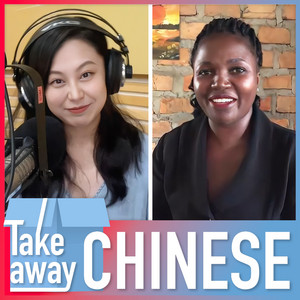
Takeaway Chinese, where you can take some Chinese away and experience progress day by day.
Takeaway Chinese, we will promise you a difference.
of experience here in China and she has a lot to share about the Chinese culture, about her Chinese story and about the culture of her own country.
Hello, hello to Razia!
Hi, welcome! Welcome to Takeaway Chinese!
Hi, Niu Niu! How are you?
I hope I've pronounced your name correctly.
Yes, Niu Niu is perfect.
You can call me Niu Niu for sure.
That is a good pronunciation and I hope I've pronounced your name correctly.
I know that you are Razia Anthiman and you also have a podcast. Tell us more about your podcast. So, my podcast is called Beijing Chronicles.
It's my latest creation of a podcast and we created that podcast after my visit to China last year, September and October.
And we went around China and we saw China in ways that I'd never seen before because I've never been to China and there's a lot that people say about China that you can only experience for yourself first hand to understand and so there's a lot of content a lot of things to talk about a lot of stories to tell the world a lot of experiences to share with Ugandans.
I ask this all the time because I find it a golden question ask someone who has never been here before so i'm going to ask this to you as well what was your first impression what is your first impression here in china you must have heard about it like i have heard of uganda i know that well uganda coffee is very popular here in china i know for uganda uh the altitude is relatively high yet you have a lot of different water areas so i'm very curious about the scene there.
But what was your impression about China?
What was the impression that you had before coming here?
And what was it like when you land in Beijing?
What did you think about when you're here?
So China for me was a country that I knew obviously is highly advanced and is moving at a really fast pace in terms of growth economically and technologically.
and I also knew that China is a country that banks so much on its history and its background and it has of course unique characteristics unique experiences in terms of its history and so you wouldn't compare China directly to other countries that are advancing or other huge economies in the world that are advancing at that same pace so when I came well I knew that This is an advanced country.
We landed at an airport in Beijing.
And my first experience was, wow, things are moving so swiftly.
The technology is really advanced.
And every aspect of process for that matter has been simplified with technology.
And there's a lot of things that I thought here in other countries would have to, you know, do it manually.
But in China, in Beijing, when I arrived, I felt like a lot of things had already been, the internet of things is really huge in China.
That's what I felt.
And there are very many small things that technology can handle that a human being did not have to.
So I felt the technology when I first landed in China at the airport and we could do everything.
I needed to exchange money, for example, and I didn't have to interact with an individual to buy dollars.
You know, at the Forbes Bureau, there was already a machine there that would do everything for me.
Yet, in several other airports around the world, you have to interact with a human being to be able to do that.
And I also felt like the the Chinese people are really, really friendly and very polite.
You know, the politeness of the Chinese people is really humbling.
And I felt that they are really friendly people as well.
And when we got outside the airport, heading to Peking University, where we stayed for two months, I felt like, OK, I thought China, being very advanced, had issues, as we had always read about, in terms of balancing advancement and environment conservation.
But I realize that a lot of a significant area of Beijing is actually green now.
And much as there's industrialization on the side, which of course Beijing and China cannot do away with right now, they're also striving to make sure that whatever advancement there is, is eco -friendly.
I really felt that.
I saw the greenery.
I saw the trees. I saw how, you know, the electric cars, EVs, which are trying to, you know, balance between the fumes and what goes into the air and what can be controlled in terms of advancement and the technologies that the Chinese people are using to build, for example, cars and to reduce emissions into the atmosphere.
Those are the things that really struck me at the landing point.
And of course, beyond that, the movement in China is really easy.
I did also experience riding bicycles, something that we don't do here.
And also everything is on your phone.
I felt like every Chinese, single Chinese needed a smartphone.
And I think every Chinese has a smartphone.
I believe so. Because how do you get around when you cannot pay for your bus, for example, for your commuter bus?
How do you get around when you cannot pay for your train service?
How do you get around?
How do you get around when you can't pay for a bike if you go to cycle around?
you know so I felt like every Chinese must have a smartphone and then also the level of security I think from the part of the world where I come from of course security is really a huge thing it's widespread in Beijing where it stayed and I never felt any kind of fear I never felt like someone would grab my phone through the window of the bus I never felt that so that also struck me As I arrived in China Yeah So yeah And there was a lot of things that we saw I think we'll have time to talk more about my experience there Yes, I love your answers and totally get you I've been here in Beijing for around
10 years And my feeling is similar Beijing is getting greener and greener And here in Beijing Actually here in the entirety of China We have the idea of building some pocket parks 口袋公园 in Chinese Literally pocket and the 口袋公园 refers to the little green land tucked in different commercial areas or in the center in the corner of a street or sometimes even in residential areas or in between two residential areas you can notice that sometimes there is this designing of having having some green land, having several trees, a little scene designed for people to appreciate the beautiful flowers, the vegetation here
in Beijing. So the idea that Beijing is getting greener and greener is real for me as well.
And I'm very impressed that you've also noticed that.
As for the cashless society, we call it 无限金社会, cashless society.
We don't really mean that there's no cash at all.
it's more like you don't need cash if you don't want to but for the elder generation you must know this for different countries when we develop our society we also need to balance and think about the elder generation so here in China here in Beijing we also want to make sure that for those who don't find it convenient or that easy to use a cell phone to pay for stuff you still can use use cash.
You can use card or anything.
So I really appreciate that.
But I heard that you've been here in Beijing.
You stayed in Beijing for two months.
Yeah, we were in Beijing for two months.
We took some, maybe a week out of Beijing.
We went to Inner Mongolia and we visited some really remarkable areas there.
But most of the time we spent in Beijing in Hadean districts.
I'm curious because again like I said I asked this to my foreign friends quite a lot and I've got some very interesting answers I ask what is the invention the technological application here in Beijing here in China that impressed you the most I want to inspire you with an answer that I got related to your previous response to my question that is one very interesting answer I got was vending machine.
自动贩售机, 自动 in Chinese means automatically, and 贩售 is to sell, and 机 is a machine, so a vending machine.
And the reason that one of my friends said they were really impressed about a vending machine was that you do not need anything to get the stuff you want from the vending machine.
You go, you select the things that you want, and it'll scan your face if you allow it and the money would be deducted from the e -wallet the online wallet or third -party payment platform and they find it really easy and convenient and especially that particular friend of mine was kind of like do not want to socialize with strangers too much and they find it quite reassuring they can stand there make the decision of what to buy by spending as much time as they want to, you know, because they're a little bit decidophobia as well.
And they find it really reassuring and easy.
And that was one answer I got.
So I'm asking you this as well.
What was that one invention or technological application that impressed you the most?
It's not a cliche, right, to say Alibaba?
Because we know Alibaba as an e -commerce giant around the world.
But I'd never experienced it in the way that the Chinese people experience it in China, you know, making the most out of an application.
So if you have Alibaba, the way that you can integrate with the other applications, for example, the banking system, your identification, your security, making payments, getting around, you know, even when it comes to your...
for example even social platforms and how you can incorporate the system into these other applications i think for me amazed me we know how advanced they are in terms of logistics we know that it's a huge it's a huge e -commerce marketplace but also for the ordinary person how they can take advantage of all its functions i think for me amazed me to just have this one one application that can sort all your errands on any given day in Beijing, anywhere in China, for me was amazing.
I think you're right.
And my feeling is that it's becoming a trend here in China in the technological advancement world, because a lot of the apps that we use, no matter originally if it's a third -party payment app, if it's a social media app, or if it's a video sharing app, I find these apps started or already starting to integrate a lot of different functions within the one app.
And they've created this thing called a Xiao Cheng Xu mini applications or mini program within the program.
So you open a app that you enjoy.
And when you maybe for instance, originally is a social media app, you talk to your friends with that app, take WeChat, for example, for example, you would usually communicate with each other using that app.
But later on, with the designing of Xiao Cheng Xu, of many apps, you can open the mini app within the main app and the mini app would allow you to do all these things that you have just described.
So totally not only Wechat and Alipay are doing that.
A lot of other popular apps here in China are also doing that.
I think they want to be the app that you go to no matter what is the function you're looking for.
It's a smart move, isn't it?
Yeah, it is. In fact, other than early pay, I think WeChat maybe is the epitome of integration when it comes to applications.
So everything is on WeChat.
You can pay with WeChat.
You can go to your bank on WeChat.
You can do your office work on WeChat.
you can get social with your friends on WeChat.
I think it really is the epitome of the integration that I'm talking about in terms of applications.
And that is really impressive for me.
And it made my life very easy, I must say.
We've spent some time talking about the virtual life here in China.
Let's talk a little bit about the reality, the real life in China, in terms of shopping, in terms of goods, in terms of delicious food.
What is your favorite Chinese dish?
I think I like what are they called I like dumplings I don't know if they're such a special delicacy there dumplings I love them I think that's my favorite my favorite I never got to eat them a lot though I found them quite expensive and in many of the restaurants where we ate they didn't have dumplings in the campus yeah but that that is my favorite I really love them but of course the noodles are really a go -to and the variety really gives you options you could eat this kind today the other kind the other day yeah but we also enjoyed you know food that we thought we wouldn't find in china many
people used to ask me oh what are you eating what are you eating in beijing are you eating snacks are you eating people think everything in China is not edible for us here from Uganda from Africa and I was telling them no there's a lot of stuff that you can eat there's a lot of stuff that is familiar it's just the recipe might be a little different but there's a lot of things that you can eat I also like the fact that the food in China I think is relatively I can say healthy that's what I can say yeah I found their their food really healthy, much as they have carbs, they have some oil sometimes,
I think relatively, the food there can be a good balance in terms of nutrition.
And when you're looking to eat healthy, they also have vegetables, I like them so much. I like vegetables.
And I found a lot of vegetables on the menus every time in China, anywhere.
And I think I like that about about the food in China but dumplings are my favorite dumplings are my favorite as well I'm from the northern side of the country and dumplings are very important for us we would have dumpling as our go -to food when it comes to different festivals you know the most important festival here in China is the spring festival and for us living in the northern part of the country we would definitely, we must have dumplings during that time.
So I love your answer.
And when it comes to the healthy or being very healthy, finding Chinese cuisine healthy, you can be more right.
Because to start with, Chinese cuisine is very balanced when it comes to nutrition.
Like you have observed, we have vegetable, we have carb, we have meat, a little bit of protein and everything.
It's a mixed template of one meal.
and these days for the younger generation here in china we focus a lot on living a healthier lifestyle we say young shown young shown is like cultivate your health so we want to put less salt in our cuisine when we have sugar we look at the calorie we take in we look at the sugar we take in sometimes we would use sweeteners instead of sugar you know to be healthier so there is definitely that trend but I have to tell you this you've only been in Beijing for two months it's too short for you to enjoy the entirety of the Chinese cuisines because China is so big it's so grand and we have a variety
of cuisines at least the most famous eight ones we say we have eight different cuisines Depending on or based on the region We have These are the 8 major cuisines And they're all different You can have the sweet and sour ones You can have the really spicy ones And even for spicy ones There are numbing spicy There are sour and spicy There are sweet and spicy So do come back to China And enjoy all these There are so much so much more that you haven't experienced just yet?
I think I've heard so many times the chicken mixed with pepper, it's really hot, very spicy.
Yes, yes. That is 公宝鸡丁康旁 chicken.
Is that what you're talking about?
Yeah, I think so. What's chili in Chinese?
辣, chili, 辣椒. 辣椒, yeah.
So it has a lot of 辣椒.
You're speaking Chinese.
I'm curious. Have you learned Chinese while you were here?
We did attend some Chinese classes, but to be honest, the schedules, I think, the timetable of the classes were really stretched.
So you will have a class today and then another class after 10 days.
So sometimes you need to constantly, you know, be learning, keep in touch. Because in these 10 days when we're not in the Chinese class, we're in other classes or traveling.
So it became a little bit difficult to learn so much in that kind of schedule.
But yeah, we did attend some classes and I think I got a few things.
I think you are definitely a beginner when it comes to Chinese learning.
And for the limited amount of Chinese learning experience, what do you think is the most difficult, most challenging?
most challenging I think is in the tonation the characters and then put them in the right to nation and like kind of my name in Chinese thank you I I was given the name based on the meaning of my name, so they tried to bring it closer, the meaning of my name.
But the most difficult thing with Chinese language, I think it's in the tonation and understanding the characters.
And it's beautiful, in a sense, and also very interesting to bring the character to the meaning at that point.
And the words might seem the same, but they're different.
And there's this, is it a phrase that I'm told is used even in kindergarten when you're teaching kids Chinese.
Ma, ma, ma, ma. There are five.
It says a horse, there's mam, there are five, but they're all, you know, if you didn't know Chinese, read them the same way.
but it's in the the characters the ease ma ma ma ma ma I know let me explain it's ma ma ma ma so that's the four tones that you would use in daily life and there's also the light tone so ma so ma ma ma ma ma these are the five tones and it's really significant because Because ma means mom, like you said.
Ma, it can be a different fabric or you can find the sound in, for instance, 麻烦, troublesome.
And 马 is horse. Yes, you remembered it correctly.
And 马, 马 can be calling someone, like cursing them a little bit or saying that you're not doing it right.
So it's that. And I know this.
I know there's a tongue twister in Chinese.
It's saying 妈妈骑马, 马慢.
so means the mommy is riding on a horse the horse rides really slowly the horse walks really slowly and is the mommy the mommy is saying oh bad horse bad horse so it's saying that the horse is not being a nice horse so this is the practice of the different tones way too hard for those who just started to learn Chinese.
Yeah, I need to practice it more.
That's it, I need to practice more of these.
Yes, you do. You should be a regular guest on Takeaway Chinese and we can learn Chinese or I can share some Chinese with you.
Yeah, maybe after a while, we could assess how much I've learned from talking Chinese, how much Chinese I've learned.
I think it's in the practice.
But also the other thing I realized about the Chinese language, when we're now moving around and trying to use the little Chinese that we had learned, was that maybe for the Chinese people who've never been outside China, they probably don't know about any other languages in terms of accent and pronunciation.
And so they wouldn't understand a wrong pronunciation.
pronunciation if i said uh chinese word the wrong way because of your exposure and your understanding of english it's easy for you to to identify and say i think she's trying to say this but many times we went to maybe shopping and you tried to explain something that you have the word but your tonation is not correct your pronunciation is not correct and they wouldn't get it to be very difficult.
You know, someone went and they were trying to buy kala, it's one of my easy words, coke.
But they failed. They said kola, kala, kola, kola.
They failed to get it.
I think she had to say, you know, like, shiga, this, this and that.
Is it shiga or niga?
Niga or shiga? Something like that you know trying to explain what exactly they wanted but with just the color that that word failed completely you know i think it's color yeah you're doing it well i know it's from the very beginning you're doing a good job yes i get it i think it's getting well in fact better and better these years because uh let's say 20 years ago or 30 years ago china China does not have that many foreign guests, which is why it's even harder for ordinary Chinese people to notice and to recognize the accent from our foreign friends.
So it's even harder.
But nowadays, with the help of, for instance, seeing more foreign friends coming to China and also the help of translation technology like the translation apps on Chinese phones, it's getting easier.
So I want to ask you this.
You said you do not know that many Chinese, that much Chinese when you travel in China, when you walk around.
So do you find it problematic?
Do you find it challenging to stay in China without learning or without mastering the language?
So I think when it comes to a language, the technology in China has really made things easy.
because in my experience even if I was going to buy something grocery store or the supermarket market I'll just use take out my WeChat app and I'll scan whatever Chinese is written there and it would reflect in the translated language of my choice English in this case and that became so easy for me I didn't have to ask around about products on any you know whether it was cosmetics or whether it was gadgets I'll just scan and I see what they're writing right away you know I know this because the reflection of exactly what's on WeChat is really amazing but also the translation apps I think are so many
in China we never had trouble with translation I must say if you have have a smartphone and you're connected to the internet, I think you shouldn't have trouble with Chinese because you can even use the audio kind of translations.
So for me, because of technology, that is not really a big deal because you have now technology that can help people get around just Chinese, English, French, Portuguese.
Yes, because I always say to my foreign friends, come to China, come to visit us.
But they are saying, well, I do not know the language, is the bilingual system in the country good enough?
Will I survive without knowing any Chinese?
And I am reassured today, thanks to your answer.
In that case, would you recommend your friends to come to China?
And if so, is there anything that you think is a must try if they're here?
It can be food. It can be things to buy.
It can also be experience to have or places to visit.
Do you have a recommendation list for your friends, especially those in Uganda?
Yeah, I do. I do have a recommendation.
Actually, it's a whole list. So depending on who I'm talking to, I was telling someone just the other day, last week, if you're into technology, She's a software developer and I was telling her, if you're into technology, China is the place to be.
The opportunities are just, you know, abundant for people in technology.
So you can be part of that.
There are many things you can try.
There are many things the Chinese are making.
I mean, there's a list of things, the EVs, the automation in terms of robots.
boards. There's a lot that I think someone who is into computers, who is into artificial intelligence can benefit from when they come to China.
So this is just one person who is so much into technology.
But in terms of someone who is looking to visit, many people don't visit China for social reasons.
It's what I think. If I wanted to go to a place, I would pick the places that have many people go to all the time.
And I was telling someone, you can actually go to China.
China has so many, you know, dozens of UNESCO heritage sites, things that you only see on TV, you can actually see them in China.
Because most people from Uganda think China is all about business.
It's all about buying products and bringing them back to Uganda and selling them, which is okay for those who are into business but i think there's many many many experiences in china that individuals depending on their interests can come and see so there's the visits you can go to the of course the most famous famous famous as we all know is the great wall of china but beyond that and maybe the pandas i love pandas so i tell people there's so much you can see in china so many people know that okay china is such a huge country with 1 .4 billion people but they don't understand or maybe haven't
imagined the vastness of china so i think there's a lot a lot a lot in china that many people who haven't been to china are not imagining yeah so beyond the products which is what we know china for mostly uh there's a lot to actually experience in China.
But the quick things that I would recommend for those who are into technology to come and learn and experience and see how the Chinese people have to be taught and the free thinking, the kind of competition, just to bring in foreign, maybe companies that are really good in terms of, say, a field, maybe EVs, the company that is making EVs. So if you have them as competition locally in China, how are you going to push, for example, BYD to improve on their models on their EVs. So yeah, I tell people to visit China.
Of course the food.
The food is, there are people who are really exploratory.
They would love to test so many things in terms of the cuisine.
But yeah, for me, I think it's the historical sites and technology.
Those two things are really things that I would recommend anytime for someone to visit and see and experience thank you thank you so much those were precious i love all those answers and from a outsider's point of view you've been here for around two months and those are experience and i think they are really valuable especially to those who have never been to china before so hopefully after listening to our special episode on takeaway chinese today you those of you who are listening who have always wanted to visit China would have been nudged a little bit in making your trip plan into something
real into really coming here and experience for yourself but the next best thing would be staying with Takeaway Chinese and learn about these cool stories that we are sharing on our program thank you so much for listening today it's me Niu Niu with our great guest, Razia Afman.
Thank you so much for joining the show.
Thank you again. Hope you had a good time as well.
Thank you so much, Niu Niu.
I have enjoyed my time talking with you about the Chinese.
Thank you. Thank you so much. And for our dear listeners, we will see you next time.
Bye -bye. Thank you.
you